7 Signs Your Property Has a Drainage Problem (And What to Do)
Water is patient. It doesn't announce itself with alarms or flashing lights — it simply follows gravity, pooling in low spots, seeping through cracks, and slowly undermining the most expensive investment most people will ever make. Recognizing drainage problem signs early is the single most cost-effective thing a homeowner can do to protect their property, yet the majority of drainage failures we analyze at Low Point Labs went undetected for months or even years before the damage became impossible to ignore.
The challenge is that many poor yard drainage symptoms are subtle. A patch of grass that stays green a little longer than the rest of the lawn. A musty smell in the basement that comes and goes. A hairline crack in the foundation that seems too small to worry about. Individually, these clues are easy to dismiss. Together, they tell a story — and it's a story every homeowner needs to learn how to read.
This guide walks you through the seven most reliable indicators that your property has a drainage problem, explains the science behind each one, and gives you a clear framework for deciding when a problem needs professional intervention versus a weekend fix.
Sign 1: Standing Water That Lingers More Than 24 Hours
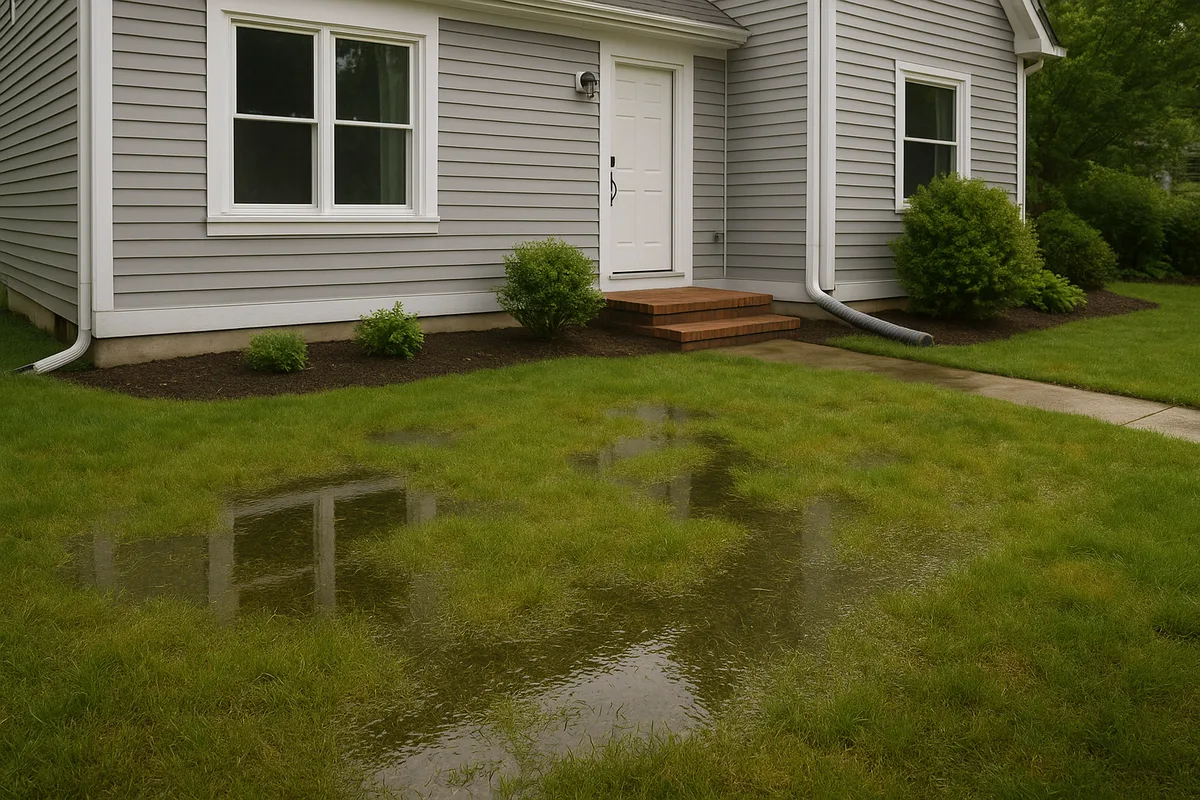
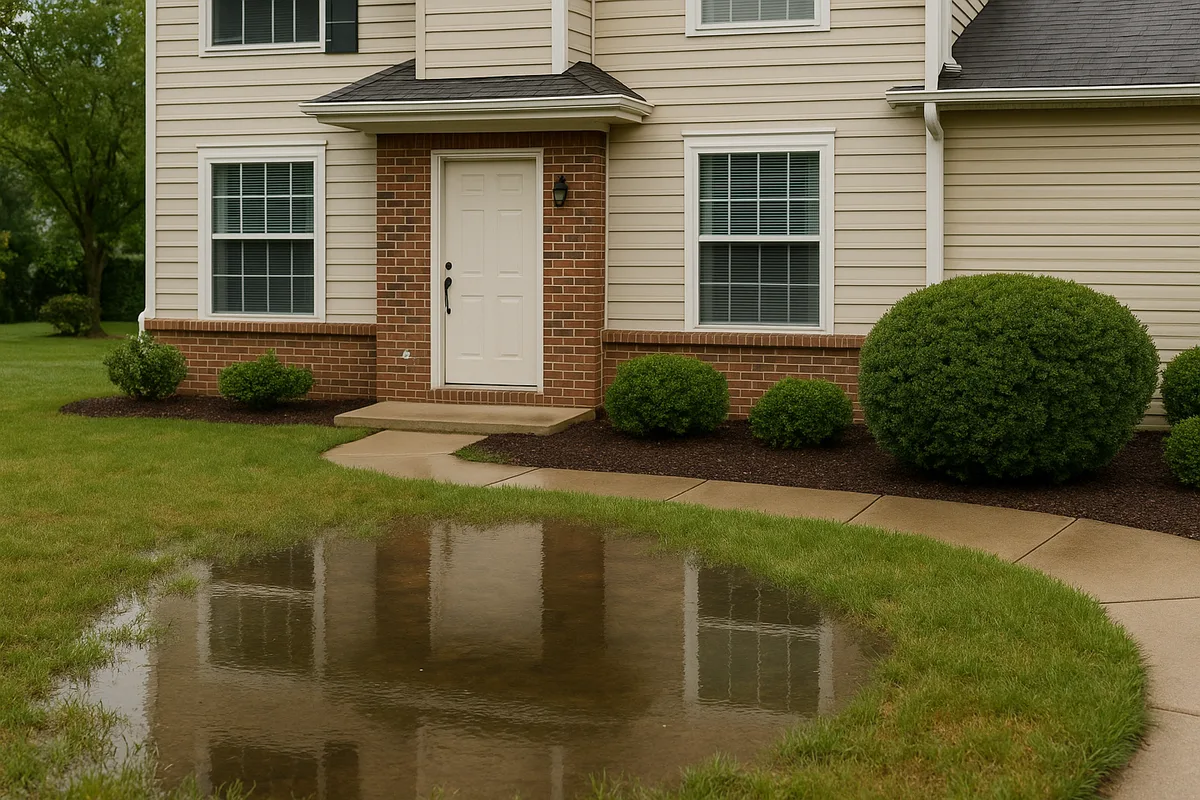
After a heavy rainstorm, it's normal for water to temporarily collect in certain areas of your yard. What's not normal is water that remains pooled 24 to 48 hours after the rain has stopped. Persistent standing water is one of the most visible and unambiguous drainage problem signs, and it indicates that the topography, soil composition, or drainage infrastructure on your property is failing to move water away at an acceptable rate.
The science here is straightforward. In a properly graded yard with reasonably permeable soil, surface water should either infiltrate into the ground or flow toward a designated drainage outlet within roughly 24 hours. The EPA's stormwater management guidelines recommend that residential sites be designed to handle at least the first inch of rainfall without creating prolonged ponding. When water lingers beyond that window, it means one of three things: the soil is too compacted or clay-heavy to absorb water at a sufficient rate, the grade is directing water into a depression with no outlet, or an existing drainage system — such as a French drain, catch basin, or swale — is clogged or undersized.
Where to Look
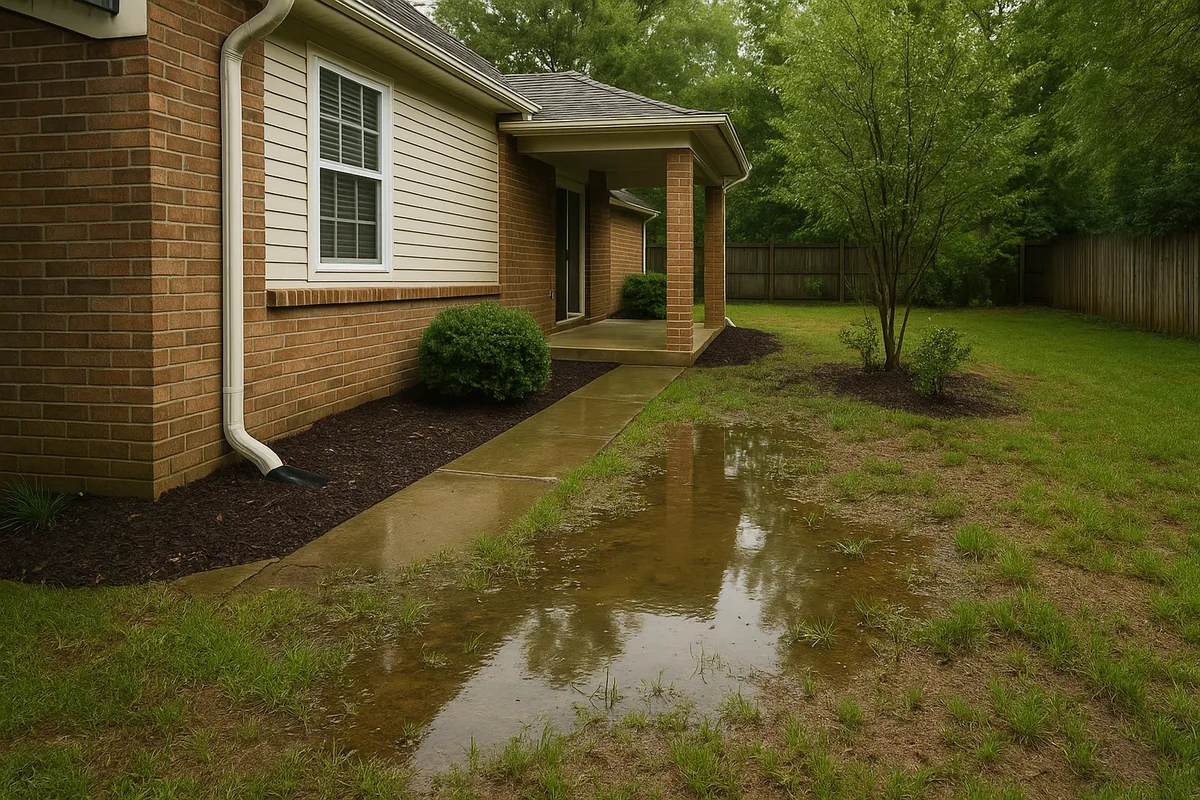
The most common locations for standing water include the areas directly adjacent to your foundation, low spots in the middle of the yard, the base of slopes, and anywhere downspout discharge concentrates flow. Pay special attention to areas near driveways and walkways, where compacted subgrade soils often prevent infiltration. If you notice water pooling against your foundation wall, treat it as an urgent issue — this is the single most damaging location for standing water on any residential property.
What to Measure
After your next significant rainfall (0.5 inches or more), walk your property and note where water collects. Mark those spots with small flags or stakes. Check again at 12 hours, 24 hours, and 48 hours. If water remains at the 48-hour mark, you have a drainage problem that warrants investigation. Document the approximate depth of ponding as well — even one to two inches of standing water, if persistent, can kill grass, attract mosquitoes, and accelerate soil erosion.
Sign 2: Water Stains, Efflorescence, or Dampness on Foundation Walls
Your foundation tells the truth about your drainage, even when your yard looks fine on the surface. Water stains — those horizontal tide marks on basement or crawl space walls — are evidence that water has been pressing against your foundation from the outside. Efflorescence, the white crystalline deposits that appear on concrete and masonry surfaces, is another telltale indicator. It forms when water migrates through the wall, dissolves mineral salts in the concrete, and then evaporates on the interior surface, leaving those salts behind.
These are among the most consequential property drainage issues because they signal hydrostatic pressure — the force exerted by water accumulating in the soil against your foundation. According to the American Society of Civil Engineers (ASCE), hydrostatic pressure is the leading cause of foundation wall failure in residential construction. A cubic foot of water weighs 62.4 pounds, and when saturated soil builds up against a foundation wall, the cumulative lateral pressure can exceed the wall's design capacity, leading to bowing, cracking, and ultimately structural compromise.
Interior vs. Exterior Clues
On the interior, look for damp spots that appear on basement walls after rain events, peeling paint or bubbling wallpaper at or below grade level, and any musty or earthy odors that intensify during wet weather. On the exterior, examine the foundation wall where it meets the soil line. If you see soil erosion channels, exposed footing, or areas where mulch or soil has been washed away from the wall, water is flowing toward your foundation rather than away from it.
The Grading Connection
The International Residential Code (IRC) specifies that the ground surface should slope away from foundation walls at a minimum gradient of 6 inches of fall over the first 10 feet (approximately a 5% slope). In our analysis of thousands of residential properties, we find that more than 60% of homes showing foundation moisture symptoms fail to meet this basic grading standard. Often, the original grading was adequate at the time of construction but has settled, eroded, or been altered by landscaping projects over the years.
Sign 3: Erosion Channels and Soil Displacement
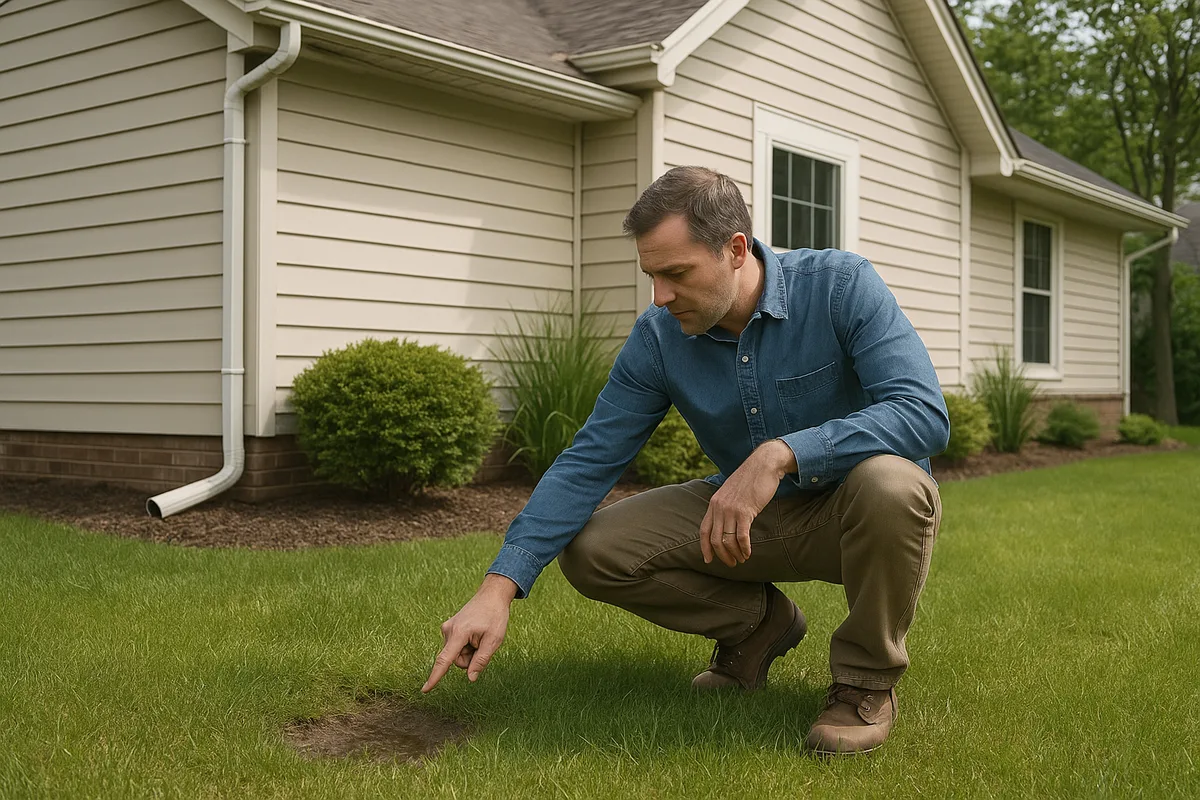
Erosion is water's signature. When you see miniature gullies carved into your yard, bare patches where topsoil has been stripped away, or sediment deposits on your driveway, sidewalk, or patio, you're looking at direct evidence that surface water is moving too fast, in too great a volume, or along unintended paths. These erosion patterns are reliable poor yard drainage symptoms that reveal exactly how water behaves on your property during storm events.
Sheet erosion — the uniform removal of a thin layer of soil across a broad area — is the most common and the hardest to detect. You may not notice it until your lawn starts thinning in certain areas or you realize that landscape beds have gradually lost several inches of soil. Rill erosion, which creates small but visible channels, is more obvious and indicates concentrated flow paths. Gully erosion, where channels exceed six inches in depth, represents a serious drainage failure that typically requires engineered intervention.
Reading the Evidence
Erosion channels function like a map of your property's drainage patterns. Follow them. Where do they start? Where do they end? The starting point tells you where water is concentrating — often at a downspout discharge, a hardscape edge, or the crest of a slope. The ending point tells you where water is depositing — often against a foundation, into a neighbor's yard, or into a low area that's already struggling with ponding. Understanding these flow paths is the foundation of any effective drainage solution.
Velocity and Volume
The two variables that drive erosion are water velocity and volume. Velocity increases with slope steepness and decreases with surface roughness (vegetation, mulch, gravel). Volume increases with impervious surface area — every square foot of roof, driveway, patio, and walkway that prevents rainfall from soaking into the ground adds to the volume of runoff that must be managed. A typical 2,000-square-foot roof generates approximately 1,250 gallons of runoff from a single inch of rainfall. If that volume is discharged from downspouts onto a bare slope without any velocity control, erosion is inevitable.
Sign 4: Cracks in Your Foundation, Walls, or Driveway
Not every crack is a drainage problem, but drainage problems almost always produce cracks. The mechanism is soil movement — specifically, the expansion and contraction of clay-rich soils as they absorb and release moisture. This cycle, known as shrink-swell behavior, exerts enormous force on foundations, slabs, and any rigid structure in contact with the ground. The U.S. Geological Survey (USGS) estimates that expansive soils cause more financial damage to structures in the United States each year than earthquakes, floods, hurricanes, and tornadoes combined.
When drainage is poor, the soil adjacent to your foundation goes through exaggerated wet-dry cycles. During wet periods, clay soils can expand by 10% or more in volume, pushing against the foundation. During dry periods, the same soil shrinks and pulls away, leaving gaps that fill with water during the next rain event, compounding the problem. Over time, this cyclical loading produces characteristic crack patterns: stair-step cracks along mortar joints in block or brick foundations, vertical cracks near corners, and horizontal cracks at mid-wall height (indicating lateral pressure from saturated soil).
Crack Interpretation Guide
Hairline cracks (less than 1/16 inch wide) in poured concrete foundations are common and often result from normal curing shrinkage. They become a drainage concern when they show signs of water infiltration — staining, mineral deposits, or active seepage. Cracks wider than 1/8 inch, cracks that are wider at one end than the other (indicating differential settlement), and any horizontal cracks in foundation walls should be evaluated by a structural professional. Diagonal cracks radiating from window and door corners in your home's interior walls can also indicate foundation movement driven by moisture-related soil instability.
The Driveway Test
Your driveway and garage slab can serve as an early warning system. Because these flatwork elements are typically thinner than your foundation and lack the structural reinforcement, they tend to crack and heave first. If you notice your driveway developing new cracks, lifting at joints, or settling unevenly, investigate the drainage conditions in that area. Often, a failed or disconnected downspout, a negative grade directing water under the slab, or a subsurface water path is the root cause.
Sign 5: Mosquitoes, Mold, and Unhealthy Vegetation Patterns
Some of the most telling drainage problem signs aren't structural at all — they're biological. Water that doesn't drain creates micro-ecosystems, and the organisms that thrive in those ecosystems are reliable indicators of chronic moisture conditions.
Mosquitoes are the most obvious biological indicator. Female mosquitoes require standing water to lay eggs, and they can complete their larval development cycle in as little as seven days in warm weather. If you're experiencing a persistent mosquito problem concentrated in specific areas of your yard, those areas almost certainly have standing water or saturated soil conditions. Beyond the nuisance factor, mosquitoes carry diseases including West Nile virus and Eastern Equine Encephalitis, making drainage problems a legitimate public health concern.
Mold and Mildew
Inside the home, chronic drainage problems create the elevated humidity conditions that mold requires to colonize. Mold needs three things: moisture, organic material (wood, drywall paper, carpet), and temperatures between 40°F and 100°F. A basement or crawl space with poor exterior drainage provides all three in abundance. If you're finding mold growth on basement walls, floor joists, or stored items — particularly if the growth recurs after cleaning — the solution isn't better ventilation or a dehumidifier alone. Those are symptom treatments. The cure is fixing the exterior drainage condition that's introducing the moisture in the first place.
Reading Your Lawn
Vegetation patterns are remarkably diagnostic. Look for these specific indicators:
- Unusually lush, dark green patches in an otherwise average lawn — these areas are receiving more water than surrounding turf and may indicate a subsurface water path, a broken irrigation line, or a topographic low spot that collects runoff.
- Moss growth in lawn areas that receive adequate sunlight — moss outcompetes grass in consistently wet, compacted soil conditions. Its presence in sunny areas is a strong indicator of poor drainage.
- Bare or thin patches on slopes — these typically indicate erosion is removing topsoil faster than grass can establish.
- Trees or shrubs showing stress or decline near the foundation — many common landscape species cannot tolerate the waterlogged root zone conditions created by poor drainage. Conversely, if you see volunteer willows, cattails, or sedges appearing in your yard, they're telling you the water table is high or surface drainage is failing.
Sign 6: Gutter Overflow and Downspout Discharge Problems
Your roof drainage system — gutters, downspouts, and their discharge points — is the first line of defense in your property's drainage infrastructure, and it's also the component most likely to fail. Overflowing gutters, disconnected downspouts, and poorly directed discharge are responsible for a disproportionate share of residential property drainage issues, yet they're among the easiest problems to identify and correct.
During a moderate to heavy rain, walk around your house (safely, with appropriate rain gear) and observe your gutter system in action. Gutters should carry water smoothly to downspouts without overflowing at any point. Downspouts should be securely connected and discharge water at least 4 to 6 feet away from the foundation — though 10 feet is preferable on flat lots. If you see water sheeting over gutter edges, spraying from joints, or pooling at the base of downspouts, you've identified a significant contributor to whatever drainage symptoms you're experiencing.
Common Gutter Failures
The most frequent gutter-related drainage failures include:
- Clogged gutters and downspouts — Leaves, granules from asphalt shingles, and debris accumulate over time, reducing capacity and causing overflow. A standard 5-inch K-style gutter can handle approximately 1.2 gallons per second when clean. Even a partial blockage can reduce that capacity by 50% or more.
- Insufficient gutter sizing — Homes with large roof areas, steep pitches, or complex rooflines may need 6-inch gutters or additional downspouts to handle peak flow rates. Many production-built homes are underserved by their original gutter systems.
- Improper gutter slope — Gutters should slope toward downspouts at approximately 1/16 inch per foot. Gutters that have sagged, pulled away from the fascia, or been installed level will hold standing water and overflow at low points.
- Downspout discharge at the foundation — This is the single most common and most damaging gutter-related drainage failure. A downspout that terminates at the base of the foundation wall concentrates the entire roof's runoff at the worst possible location. Extensions, splash blocks, or underground discharge lines are essential.
Underground Discharge Lines
Many homes have underground downspout discharge lines — buried pipes that carry roof runoff away from the foundation to a pop-up emitter, dry well, or storm drain connection. These systems are highly effective when functioning properly, but they're also prone to failure. Tree root intrusion, soil settlement causing pipe bellies (low spots where sediment accumulates), crushed pipes from vehicle traffic or construction activity, and simple clogging from debris that enters at the downspout connection are all common failure modes. If you have underground discharge lines, verify that their outlets are flowing during rain events. A downspout connected to a clogged underground line is actually worse than no underground line at all — it creates a pressurized system that can force water laterally through foundation walls.
Sign 7: Basement or Crawl Space Water Intrusion
This is the sign that no homeowner can ignore, and it's often the culmination of several other drainage failures working in concert. Water appearing inside your basement or crawl space — whether as active seepage through walls, water bubbling up through floor cracks, or simply chronically elevated humidity — represents a definitive drainage failure. By the time water reaches the interior of your home, the exterior drainage system has been overwhelmed.
Basement water intrusion manifests in several forms, each pointing to different failure mechanisms. Seepage through wall cracks indicates hydrostatic pressure from saturated soil. Water entering at the wall-floor joint (the cove joint) suggests that the footing drain — the perimeter drain tile installed during construction — is either clogged, collapsed, or was never installed. Water appearing on the floor away from walls may indicate a rising water table or subsurface water migrating under the footing.
Quantifying the Problem
The severity of basement water intrusion exists on a spectrum:
- Occasional dampness or humidity — The walls feel damp to the touch during or after rain events, and relative humidity in the space exceeds 60%. This represents early-stage drainage stress and is the ideal time to intervene.
- Intermittent seepage — Water visibly enters during heavy or prolonged rain events but dries between events. This indicates that the drainage system's capacity is being exceeded during peak events.
- Chronic seepage — Water enters during most rain events and the space rarely fully dries. This indicates a fundamental drainage failure that requires comprehensive remediation.
- Active flooding — Water accumulates to measurable depth during storm events. This represents complete drainage system failure and poses immediate risks to the structure, mechanical systems, and indoor air quality.
The True Cost of Inaction
Basement and crawl space water intrusion is expensive to ignore. Beyond the obvious costs of damaged belongings and flooring, chronic moisture in below-grade spaces leads to structural wood decay (floor joists, sill plates, subfloor), mechanical system corrosion (HVAC equipment, water heaters, electrical panels are often located in basements), mold colonization that can affect the entire home's air quality through the stack effect, and progressive foundation deterioration. The Insurance Institute for Business & Home Safety estimates that water damage claims average $11,000 to $15,000, and many policies exclude damage from gradual drainage failures — covering only sudden events like pipe bursts. Fixing the drainage problem before it produces interior water damage is almost always less expensive than remediation after the fact.
Diagnosing the Root Cause: A Systematic Approach
Identifying that you have a drainage problem is the first step. Understanding why you have a drainage problem is what separates an effective, lasting repair from a Band-Aid that fails within a few seasons. At Low Point Labs, we approach drainage diagnostics systematically, evaluating the property from the top down and the outside in.
The Hierarchy of Drainage
Residential drainage operates as a hierarchy, and problems at higher levels cascade into failures at lower levels:
- Roof drainage — Gutters, downspouts, and discharge management. This is the highest-volume, most concentrated source of water on most residential properties.
- Surface grading — The slope and contour of the ground surface within 10 to 20 feet of the foundation. This determines whether surface water flows away from or toward the structure.
- Subsurface drainage — French drains, curtain drains, footing drains, and other below-grade systems designed to intercept and redirect groundwater.
- Soil and infiltration — The ability of the native soil to absorb water at a rate that prevents surface ponding and excessive groundwater accumulation.
A problem at Level 1 (a clogged gutter) can produce symptoms that mimic a Level 3 failure (foundation seepage). If you install an expensive interior drain tile system to address basement water without first fixing the gutter that's dumping 1,250 gallons per storm event against your foundation, you've spent thousands of dollars treating a symptom while the cause continues unabated.
When to DIY vs. When to Call a Professional
Many drainage problems have straightforward solutions that a capable homeowner can implement:
- Gutter cleaning and downspout extensions — Low cost, high impact, and well within DIY capability.
- Regrading small areas — Adding topsoil to build up the grade near the foundation is manageable for areas under 100 square feet.
- Installing splash blocks or simple discharge diversions — Minimal skill and investment required.
Other problems require professional assessment and potentially engineered solutions:
- Persistent standing water that doesn't respond to surface regrading — may indicate subsurface water issues, impermeable soil layers, or complex topographic conditions.
- Foundation cracks showing active movement — requires structural evaluation before any drainage work.
- Grading problems affecting multiple properties — may involve easements, municipal stormwater systems, or regulatory considerations.
- Any situation where the source of water isn't obvious — subsurface water paths, seasonal water table fluctuations, and hidden spring activity all require specialized diagnostic tools and expertise.
Taking Action: From Diagnosis to Resolution
If you've recognized one or more of these seven drainage problem signs on your property, the worst thing you can do is nothing. Water damage is progressive — it accelerates over time as each storm event compounds the effects of the last. A small problem today becomes an expensive emergency next year.
Start with documentation. Photograph problem areas during and after rain events. Note the dates, approximate rainfall amounts (your local weather service or a simple rain gauge can provide this), and how long water takes to recede. This documentation is invaluable whether you're planning a DIY repair, hiring a contractor, or filing an insurance claim.
Next, prioritize. If you're seeing multiple signs, address them in order of severity and proximity to the foundation. Foundation-adjacent problems always take priority over mid-yard issues. Roof drainage problems should be addressed before surface grading problems, because fixing the highest-volume water source often reduces or eliminates downstream symptoms.
Finally, understand your property's topographic reality. Every lot has a drainage story written into its contours — where water enters, how it flows, and where it exits. Understanding that story is the key to solving drainage problems permanently rather than just relocating them. This is exactly what topographic drainage intelligence provides: a clear, data-driven picture of how water interacts with your specific property, revealing not just where problems exist but why they exist and how to resolve them at the source.
At Low Point Labs, we specialize in giving homeowners, contractors, and inspectors exactly this kind of clarity. Our drainage assessments use precise topographic analysis to identify low points, flow paths, and grading deficiencies — transforming vague concerns about "water problems" into specific, actionable insights. If you're seeing any of the signs described in this guide, explore our drainage assessment services to understand what your property's topography is really telling you.
See Drainage Intelligence in Practice
Talk with our team or request an invitation to the platform.
Frequently Asked Questions
Water that remains pooled in your yard for more than 24 to 48 hours after rainfall has stopped indicates a drainage problem. Brief ponding during active rain is normal, but persistent standing water suggests inadequate grading, poor soil permeability, or a failing drainage system that needs attention.
Yes, poor drainage is one of the leading causes of foundation damage in residential properties. Water accumulating against foundation walls creates hydrostatic pressure that can cause cracking, bowing, and structural failure. Additionally, the repeated wet-dry cycles in clay soils cause expansion and contraction that shifts foundations over time.
Downspouts should discharge water at least 4 to 6 feet away from the foundation, though 10 feet is recommended on flat lots. The discharge area should also be graded so water continues flowing away from the house rather than pooling or flowing back toward the foundation.
The International Residential Code requires a minimum slope of 6 inches of fall over the first 10 feet away from the foundation, which equals approximately a 5% grade. This ensures surface water flows away from the structure rather than ponding against it.
Most standard homeowners insurance policies do not cover damage resulting from gradual drainage failures, poor grading, or groundwater seepage. They typically cover sudden, accidental water events like burst pipes. This makes proactive drainage maintenance and repair especially important from a financial standpoint.
Yards that appear flat to the eye often contain subtle low spots — depressions of just one to two inches — that are invisible to casual observation but significant enough to trap water. Soil compaction from construction, foot traffic, or vehicles can also create impermeable layers that prevent infiltration even on seemingly level ground.
Related Articles
How to Diagnose Yard Drainage Problems on a Site Walk
What Causes Water to Pool in a Yard? 8 Common Drainage Issues Explained