How Much Slope Does a Yard Need for Proper Drainage?
Every year, thousands of homeowners discover water damage in their basements, crawl spaces, and foundations — damage that could have been prevented with proper yard slope for drainage. The grade of your yard is your property's first and most important line of defense against water intrusion, soil erosion, and structural damage. Yet most homeowners have never measured their yard's slope and have no idea whether it meets the grading slope requirements that building codes and drainage engineering standards demand.
The short answer is that most residential properties need a minimum slope of 2% (approximately a ¼-inch drop per foot) away from the foundation, but that number is just the beginning of the conversation. Different areas of your property have different drainage grading standards, and factors like soil type, rainfall intensity, impervious surfaces, and landscape features all influence how much slope you actually need. In this comprehensive guide, we'll break down the exact slope requirements for every part of your yard, teach you how to measure and evaluate your own grading, and explain what to do when your slope falls short.
Understanding Yard Slope: The Fundamentals of Drainage Grading
Yard slope — also called grade or gradient — refers to the angle of the ground surface relative to a horizontal plane. In residential drainage, slope is typically expressed in one of three ways: as a percentage, as a ratio (inches of drop per foot of horizontal distance), or as a fraction. Understanding these measurements is essential before you can evaluate whether your property meets grading slope requirements.
A 2% slope means the ground drops 2 feet for every 100 feet of horizontal distance, which translates to roughly ¼ inch per foot. A 5% slope equals about ⅝ inch per foot, and a 10% slope equals approximately 1¼ inches per foot. These may sound like tiny numbers, but they make an enormous difference in how effectively water moves across your property. Water is remarkably responsive to even slight changes in grade — a fraction of an inch can determine whether stormwater flows away from your foundation or pools against it.
The physics behind drainage slope are straightforward: gravity pulls water downhill. The steeper the slope, the faster water moves and the less time it has to infiltrate the soil surface. Conversely, flat or negatively graded areas allow water to pond, saturate the soil, and eventually find its way into your foundation, basement, or crawl space. The goal of proper yard grading isn't to create a steep hillside — it's to create a consistent, intentional gradient that directs water to designated collection points or away from structures entirely.
It's also important to understand the difference between positive drainage and negative drainage. Positive drainage means water flows away from a structure or toward an intended outlet. Negative drainage means water flows toward a structure or collects in an unintended area. Even a yard with adequate slope can have negative drainage if the slope is oriented in the wrong direction, which is why both the degree and the direction of slope matter equally.
Minimum Slope Requirements: What Building Codes and Standards Demand
The most widely referenced drainage grading standard in the United States comes from the International Residential Code (IRC), which is adopted in some form by the vast majority of U.S. municipalities. Section R401.3 of the IRC specifies that the ground surface around a building must slope away from the foundation at a minimum grade of 6 inches within the first 10 feet. This translates to a 5% slope — significantly steeper than many homeowners realize.
This 5% minimum applies specifically to the critical zone immediately adjacent to the foundation, sometimes called the "foundation drainage zone" or "grading envelope." The rationale is simple: the soil closest to your foundation is backfill soil that was disturbed during construction. This disturbed soil is more permeable than the surrounding native soil, creating a pathway for water to reach your foundation walls and footings. A steeper slope in this zone ensures that surface water is directed away quickly, before it can infiltrate the backfill.
Beyond the first 10 feet, the slope requirements become less prescriptive but no less important. General yard areas typically need a minimum of 1% to 2% slope to achieve positive drainage, though 2% is the practical minimum recommended by most drainage engineers and landscape architects. Slopes below 1% are considered essentially flat from a drainage perspective — construction tolerances and settling can easily eliminate such a subtle grade, turning a marginally sloped surface into a ponding area.
For specific yard features, the slope requirements vary:
- Lawns and turf areas: 2% minimum, 2% to 5% ideal
- Paved surfaces (patios, walkways): 1% to 2% minimum
- Driveways: 1% to 8%, depending on length and local codes
- Swales and drainage channels: 1% to 4%, depending on soil type and design flow
- Rain garden or bioretention areas: Side slopes of 3:1 (33%) maximum; bottom slopes of 0% to 1%
It's worth noting that local building codes may impose stricter requirements than the IRC. Some municipalities in high-rainfall areas or regions with expansive clay soils require steeper grades, wider grading envelopes, or additional drainage infrastructure. Always check with your local building department for the specific grading slope requirements that apply to your property.
How to Measure the Slope of Your Yard
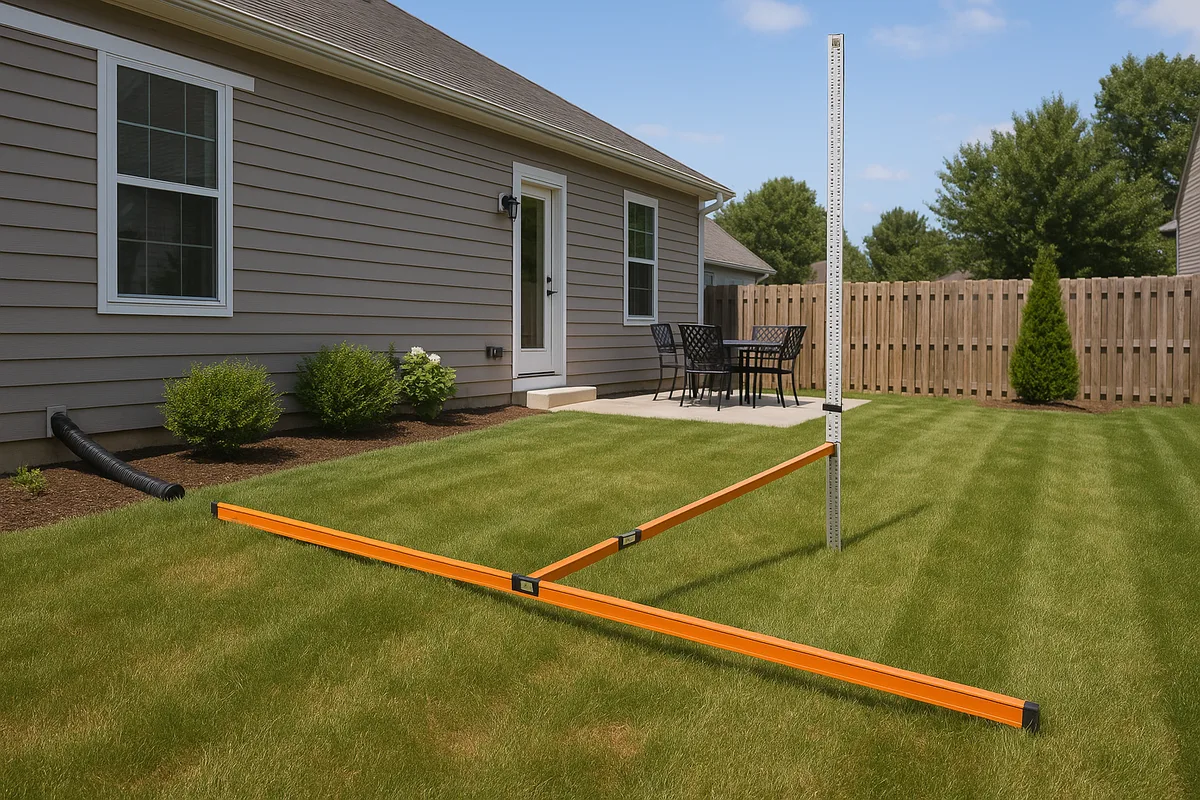
Measuring your yard's slope doesn't require expensive equipment or professional surveying skills, though professional measurement will always be more accurate. For a homeowner-level assessment, you need a few basic tools: a long straightedge or string line, a level (a 4-foot builder's level works well), a tape measure, and a few wooden stakes.
The String-and-Level Method
This is the most accessible method for homeowners. Drive a stake into the ground at the highest point you want to measure (typically right next to the foundation wall) and another stake at the lowest point (typically 10 feet away from the foundation). Tie a string tightly between the two stakes at ground level on the high stake. Use your level to make the string perfectly horizontal, then measure the distance from the string to the ground at the lower stake. This vertical distance is your total drop. Divide the drop (in inches) by the horizontal distance (in feet) to get your slope in inches per foot.
For example, if you measure a 5-inch drop over 10 feet, your slope is 0.5 inches per foot, or approximately 4.2%. If you measure only a 1-inch drop over 10 feet, your slope is 0.1 inches per foot, or about 0.8% — well below the IRC minimum of 5% in the foundation zone.
The Laser Level Method
A self-leveling laser level provides more accurate readings over longer distances. Set the laser on a tripod near the foundation, and use a grade rod or measuring stick at various points across the yard to determine the elevation difference. This method is particularly useful for assessing large yards or identifying subtle low spots that the string method might miss.
Professional Topographic Surveys
For the most accurate and comprehensive assessment, a professional topographic survey or a digital elevation analysis provides precise elevation data across your entire property. These surveys identify not just the overall slope but also micro-topographic features — small ridges, depressions, and swales — that significantly influence drainage patterns. At Low Point Labs, we use high-resolution topographic data to create detailed drainage maps that reveal exactly where water flows, where it collects, and where grading improvements are needed.
Regardless of which method you use, measure your slope in multiple locations around the foundation and across the yard. Drainage problems are often localized — one side of the house may have perfect grading while the opposite side has negative slope. A single measurement point can give you a dangerously incomplete picture of your property's drainage performance.
The Foundation Drainage Zone: Why the First 10 Feet Matter Most
If there's one area of your yard where slope is non-negotiable, it's the foundation drainage zone — the band of ground extending 10 feet out from your foundation walls in every direction. This zone is where the vast majority of residential water intrusion problems originate, and it's where proper yard slope for drainage has the greatest impact on your home's structural integrity and longevity.
During construction, the excavation for your foundation creates a trench that is later backfilled with soil. This backfill soil is never as dense or compacted as the undisturbed native soil surrounding it, no matter how carefully the builder compacts it during construction. Over time, backfill soil settles further, sometimes creating negative slope conditions that direct water straight toward the foundation. This settling is one of the most common causes of basement water problems in homes that were graded correctly at the time of construction.
The IRC's requirement of 6 inches of fall within 10 feet (a 5% slope) is designed to overcome the higher permeability of backfill soil and provide a meaningful safety margin against settling. Many drainage professionals recommend exceeding this minimum where possible, aiming for 8 to 12 inches of fall within 10 feet (6.7% to 10% slope). The steeper grade provides better long-term performance as the backfill continues to consolidate and settle.
There are situations where achieving the full 10-foot grading envelope isn't physically possible. Narrow side yards, adjacent structures, property line constraints, and existing hardscape can all limit how far you can extend the graded slope. The IRC acknowledges this reality and allows for a reduced grading distance if a "drainage system" is installed to manage water that can't be diverted by surface grading alone. These systems typically include subsurface drain tile, French drains, or channel drains that intercept water and convey it away from the foundation through pipes rather than surface flow.
Foundation plantings and landscaping beds adjacent to the house deserve special attention. Homeowners often build up mulch and garden soil against the foundation over years of landscaping, inadvertently creating dams that trap water against the walls. Flower beds should be graded with the same 5% minimum slope as the surrounding ground, and mulch depth should be limited to 2 to 3 inches to avoid creating water-retaining berms.
Beyond the Foundation: Yard Slope Requirements for Different Areas
While the foundation zone gets the most attention in building codes, every area of your property has drainage grading standards that contribute to the overall performance of your lot's stormwater management system. Understanding these requirements helps you identify problem areas and prioritize improvements.
Lawns and Open Turf Areas
Open lawn areas should maintain a minimum 2% slope toward a designated drainage outlet — a swale, storm drain inlet, street gutter, or natural drainage course. Slopes between 2% and 5% are ideal for turf areas because they provide reliable drainage without causing excessive erosion or making mowing difficult. Slopes above 10% become challenging to maintain as lawn and may require ground cover, terracing, or retaining walls to prevent erosion.
One common mistake is assuming that a large, flat lawn drains adequately because it "looks level." In reality, a truly level lawn will pond water after every significant rain event. The water may eventually infiltrate or evaporate, but the prolonged saturation damages turf roots, promotes fungal disease, and can contribute to mosquito breeding. Even gentle slopes of 2% to 3% dramatically improve turf health by allowing surface water to shed within minutes rather than hours.
Patios, Walkways, and Hardscape
Impervious surfaces like concrete patios, brick walkways, and stone pavers must be sloped to prevent ponding. The minimum recommended slope for hardscape is 1% (⅛ inch per foot), though 2% is preferred. Slopes below 1% on hardscape surfaces frequently result in standing water due to construction tolerances, settling, and surface irregularities.
Hardscape slope should always direct water away from the foundation and toward a permeable area where it can infiltrate or be collected. A common design error is sloping a patio toward the house to make it "feel level" from the perspective of someone sitting on it. This creates a direct water chute toward the foundation and should be corrected immediately if identified.
Driveways and Garage Approaches
Driveways present unique grading challenges because they must balance drainage requirements with vehicle safety and accessibility. The Americans with Disabilities Act (ADA) limits cross-slopes on accessible routes to 2%, and most building codes limit driveway longitudinal slopes to 12% to 15% for safety. Within these constraints, driveways should be crowned or cross-sloped at 1% to 2% to shed water to the sides, where it can be collected by edge drains or directed to adjacent permeable surfaces.
Garage approaches require particular care. If your driveway slopes toward the garage, a trench drain or area drain at the garage threshold is essential to intercept water before it enters the structure. The garage floor itself should slope toward the garage door at approximately 1% to 2% to direct any water that does enter back outside.
Swales and Drainage Channels
Swales are shallow, vegetated channels designed to collect and convey surface water across a property. They're one of the most effective and economical drainage features available, but they must be properly graded to function. The minimum longitudinal slope for a grass swale is typically 1%, with 2% to 4% being the optimal range. Slopes below 1% allow sediment to accumulate and water to pond within the swale, while slopes above 6% can cause erosion unless the swale is lined with erosion-resistant materials.
Swale cross-sections should have gentle side slopes — typically 3:1 (horizontal to vertical) or flatter — to facilitate mowing, prevent erosion, and ensure safety. A well-designed swale is barely noticeable in the landscape but moves enormous volumes of water during storm events.
Common Grading Problems and How to Identify Them
Even properties that were correctly graded during construction can develop drainage problems over time. Soil settlement, erosion, landscaping changes, additions, and neighboring property modifications can all alter your yard's drainage patterns. Recognizing the signs of grading problems early can save you thousands of dollars in water damage repairs.
Negative Grading (Slope Toward the Foundation)
The most critical grading problem is negative slope — ground that tilts toward the foundation rather than away from it. Signs include water stains on foundation walls, efflorescence (white mineral deposits) on basement walls, damp or musty odors in the basement or crawl space, and visible water pooling against the foundation during rain events. Negative grading can develop gradually as backfill soil settles, and it's particularly common on the sides of the house that receive less attention, such as narrow side yards or areas behind landscaping.
Low Spots and Ponding Areas
Low spots in the yard where water collects and stands for more than 24 hours after a rain event indicate inadequate slope or blocked drainage paths. These areas are easy to identify — they're the spots where the grass is always greener (or always dead), where moss grows, or where you see standing water after storms. Low spots can form due to soil compaction from foot traffic or equipment, settling of fill material, or erosion that removes soil from high points and deposits it in low areas.
Erosion Channels and Gullies
Paradoxically, too much slope can be as problematic as too little. When water moves too quickly across unprotected soil, it erodes channels and gullies that deepen with each storm. These erosion features concentrate flow, accelerate further erosion, and can undermine structures, sidewalks, and driveways. Signs include exposed roots, visible channels in the soil, sediment deposits at the bottom of slopes, and undermined edges along hardscape features.
Neighbor-to-Neighbor Drainage Conflicts
Changes to neighboring properties — new construction, regrading, additions, or landscaping modifications — can redirect water onto your property. This is one of the most common and contentious drainage issues homeowners face. Most states follow the "reasonable use" doctrine, which prohibits property owners from altering natural drainage patterns in ways that cause unreasonable harm to neighboring properties. If you suspect a neighbor's modifications are causing drainage problems on your lot, document the issue with photographs and consult your local building or code enforcement department.
Downspout Discharge Problems
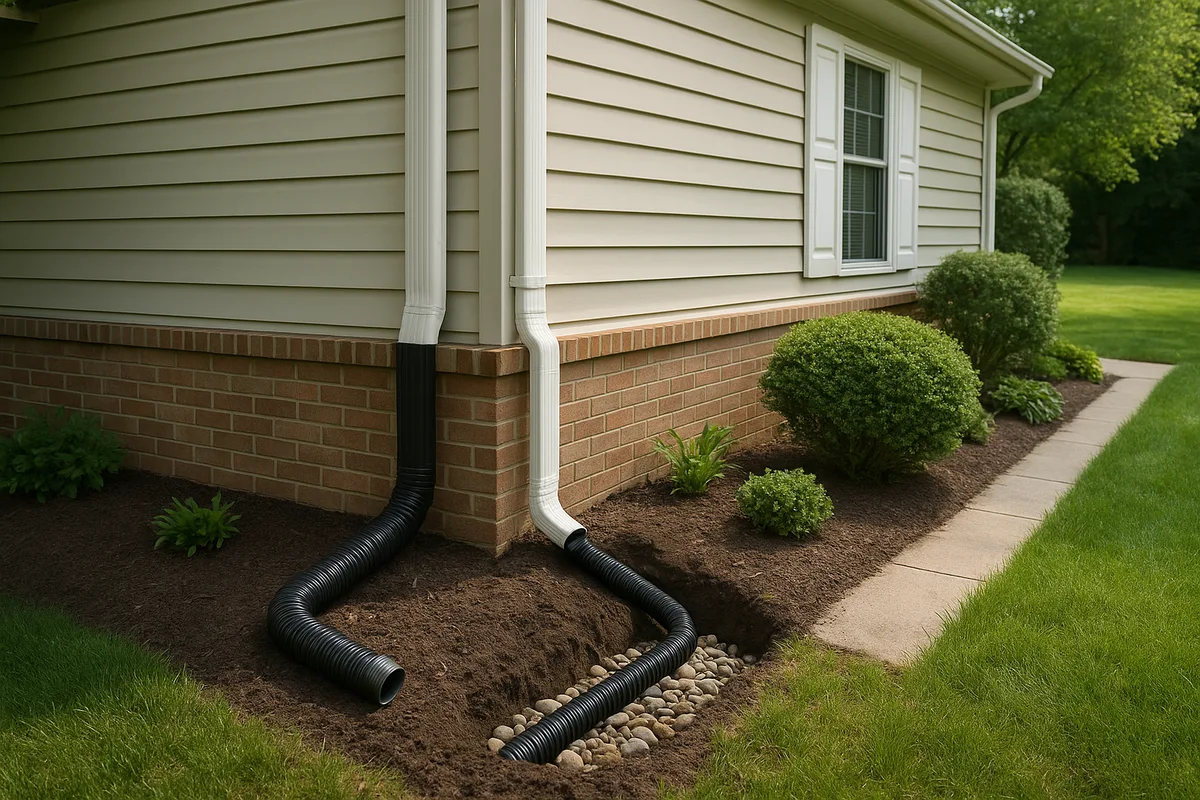
Roof downspouts that discharge directly at the foundation base are one of the most common contributors to foundation water problems, even on properties with adequate yard slope. Each downspout concentrates hundreds or thousands of gallons of water from a large roof area into a single point. If that water isn't directed away from the foundation via extensions, splash blocks, or underground piping, it overwhelms the local grading and saturates the soil adjacent to the foundation. Downspout extensions should discharge at least 4 to 6 feet from the foundation, and ideally 10 feet or more, onto a graded surface that continues to direct the water away.
How to Correct Inadequate Yard Slope for Drainage
When your yard's slope doesn't meet drainage grading standards, you have several correction options ranging from simple DIY projects to major regrading efforts. The right approach depends on the severity of the problem, the area affected, and your budget.
Regrading the Foundation Zone
For moderate negative grading around the foundation, adding soil to build up the grade is often the simplest and most cost-effective solution. Use clean fill dirt (not topsoil, which is too organic and retains too much water) to build the grade to the required 6 inches of fall within 10 feet. Compact the fill in layers of 4 to 6 inches to minimize future settling, and top with 2 to 4 inches of topsoil for planting. This is a project many homeowners can tackle themselves, though the volume of soil required is often more than expected — regrading even one side of a house can require several cubic yards of fill.
When adding soil to correct grading, be careful not to raise the grade above the level of your siding, stucco, or brick veneer. Most building codes require a minimum of 6 inches of clearance between the soil surface and the bottom of wood siding or framing to prevent moisture damage and termite access. If raising the grade would violate this clearance, you may need to consider alternative drainage solutions instead of or in addition to regrading.
Installing French Drains and Subsurface Drainage
When surface regrading alone can't solve the problem — due to space constraints, grade limitations, or the volume of water involved — subsurface drainage systems become necessary. A French drain is a trench filled with gravel and containing a perforated pipe that collects subsurface water and conveys it to a discharge point. French drains are typically installed at a minimum slope of 1% (⅛ inch per foot) and should discharge to daylight, a storm sewer (where permitted), or a dry well.
The U.S. Environmental Protection Agency (EPA) recognizes subsurface drainage as an important component of residential stormwater management, particularly when combined with green infrastructure practices like rain gardens and permeable pavements. A properly designed and installed French drain system can intercept groundwater before it reaches your foundation, even in areas where surface grading is inadequate.
Constructing Swales and Berms
For larger-scale drainage corrections, constructing swales (shallow drainage channels) and berms (raised ridges of soil) can redirect surface water across your entire property. Swales are particularly effective for intercepting sheet flow from uphill areas and directing it around structures to a safe discharge point. Berms can be used to block water from flowing toward the foundation or to redirect flow into a swale.
The key to effective swale and berm construction is proper grading. A swale must maintain consistent longitudinal slope (minimum 1%, ideally 2% to 4%) to prevent ponding, and its cross-section must be wide and shallow enough to convey the design flow without overtopping. A berm must be high enough and wide enough to block the anticipated flow without being overtopped or eroded. Both features should be vegetated immediately after construction to prevent erosion.
Retaining Walls and Terracing
On steeply sloped properties, terracing with retaining walls creates level or gently sloped areas that slow water flow and reduce erosion. Each terrace acts as a mini-drainage zone with its own grading requirements. The area behind a retaining wall must be graded to direct water to weep holes or a drainage system within the wall, not toward adjacent structures. Retaining walls over 4 feet in height typically require engineering design and building permits.
Dry Wells and Infiltration Systems
When there's no practical surface outlet for collected drainage water, dry wells and infiltration systems provide an underground discharge point. A dry well is a buried chamber (typically a perforated barrel, concrete vault, or proprietary plastic unit) surrounded by gravel that receives water from drain pipes or surface drains and allows it to slowly infiltrate into the surrounding soil. Dry wells work best in well-drained soils (sandy or gravelly) and are less effective in clay soils with low infiltration rates.
Dry well sizing depends on the volume of water to be managed and the infiltration rate of the surrounding soil. A common rule of thumb is to size the dry well to hold the runoff from a 1-inch rainfall event from the contributing drainage area, but local codes may specify different design storms.
The Long-Term Perspective: Maintaining Proper Yard Slope
Achieving proper yard slope for drainage isn't a one-time project — it's an ongoing maintenance responsibility. Soil settles, erodes, and shifts over time, and landscaping activities can inadvertently alter grading. A proactive approach to drainage maintenance protects your investment and prevents small problems from becoming expensive repairs.
Inspect your yard's grading at least once a year, ideally in early spring after the freeze-thaw cycle has had its maximum impact on soil settlement. Walk the perimeter of your foundation during a heavy rain and observe where water flows and where it pools. Check downspout extensions and splash blocks to ensure they're still in place and directing water away from the foundation. Look for new erosion channels, settling areas, or changes in drainage patterns.
Landscaping projects are a common cause of grading problems. Adding raised beds, berms, or retaining walls can block established drainage paths and redirect water in unintended directions. Before starting any landscaping project, consider how it will affect drainage patterns and plan accordingly. Even something as simple as adding a thick layer of mulch around the foundation can alter the grade enough to cause problems.
Tree roots can also affect drainage over time. As trees grow, their root systems can heave soil, crack drain pipes, and block underground drainage pathways. Large trees planted within 10 feet of the foundation are particularly problematic, as their roots can disrupt the foundation drainage zone and create channels for water to reach the foundation walls.
Soil compaction from foot traffic, vehicle parking, and construction equipment reduces infiltration rates and can turn previously well-drained areas into ponding zones. If you notice areas of your yard that seem to drain more slowly than they used to, soil compaction may be the culprit. Core aeration can help restore infiltration in turf areas, while more severely compacted areas may need to be excavated and regraded.
Ultimately, understanding your property's topography — its high points, low points, slopes, and drainage pathways — is the foundation of effective drainage management. Without this knowledge, you're making decisions about grading, landscaping, and drainage improvements in the dark. Low Point Labs specializes in providing homeowners with detailed, data-driven drainage intelligence that reveals exactly how water moves across their property. Our topographic drainage assessments identify problem areas, quantify slope deficiencies, and provide actionable recommendations for correction. If you're concerned about your yard's drainage performance, explore our drainage assessment services to get the clarity you need to protect your home.
See Drainage Intelligence in Practice
Talk with our team or request an invitation to the platform.
Frequently Asked Questions
The International Residential Code (IRC) requires a minimum slope of 6 inches of fall within the first 10 feet from the foundation, which equals a 5% grade. This translates to approximately ⅝ inch of drop per foot of horizontal distance. Many drainage professionals recommend exceeding this minimum where possible.
The simplest method is the string-and-level technique. Drive stakes at two points, stretch a level string between them, and measure the vertical distance from the string to the ground at the lower point. Divide the drop in inches by the horizontal distance in feet to get your slope in inches per foot. Multiply by 100 and divide by 12 to convert to a percentage.
Yes. Slopes above 10% in turf areas can cause erosion, make lawn maintenance difficult, and create safety hazards. Slopes above 33% (3:1 ratio) generally require erosion control measures such as ground cover, terracing, or retaining walls to prevent soil loss during storm events.
Visual assessment of slope is notoriously unreliable — the human eye cannot detect slopes below about 5%. Your yard may have hidden low spots, subtle reverse grades, or compacted soil areas that trap water. A topographic survey or professional drainage assessment can reveal micro-topographic features invisible to the naked eye.
Basic regrading around a foundation typically costs $1,000 to $3,000, depending on the area and volume of soil needed. Full yard regrading can range from $3,000 to $10,000 or more for larger properties. Adding drainage infrastructure like French drains or dry wells increases costs but may be necessary when regrading alone isn't sufficient.
Topsoil alone is not ideal for correcting drainage grades because its high organic content retains water. Use clean fill dirt or compactable fill to build up the grade, then add 2 to 4 inches of topsoil on top for planting. Always compact fill in layers to minimize future settling that could recreate the drainage problem.
Related Articles
French Drain vs. Dry Well vs. Sump Pump: Picking the Right Fix
Interior vs. Exterior French Drains: Which One Solves Your Problem?