How Clay Soil Affects Yard Drainage: Problems, Signs & Solutions
If your yard turns into a swamp every time it rains, there's a good chance you're dealing with clay soil drainage issues. Clay is one of the most widespread soil types across the United States, and while it has certain agricultural benefits, it creates enormous challenges for residential drainage. Water that should be percolating downward and flowing away from your home instead sits on the surface, saturates the root zone, and threatens your foundation.
Understanding how clay soil interacts with water is the first step toward reclaiming a functional, healthy yard. In this comprehensive guide, we'll break down exactly why clay soil causes drainage failure, how to identify whether your property sits on clay, and what proven strategies you can implement to solve clay soil water pooling and protect your home for the long term.
What Makes Clay Soil Different From Other Soil Types
Soil is classified by particle size, and clay occupies the smallest end of the spectrum. While sand particles measure 0.05 to 2.0 millimeters in diameter and silt particles range from 0.002 to 0.05 millimeters, clay particles are smaller than 0.002 millimeters. This microscopic size is what gives clay its distinctive properties — and its notorious reputation for causing drainage problems.
When clay particles pack together, they leave almost no pore space between them. In sandy soil, the relatively large gaps between particles allow water to flow through freely, often draining at rates of 1 to 6 inches per hour or more. Clay soil, by contrast, may drain at rates as low as 0.01 to 0.1 inches per hour. That means a single inch of rainfall that would pass through sandy soil in minutes could take an entire day — or longer — to percolate through clay.
Clay also has a unique electrochemical property: its particles carry a negative charge that attracts water molecules and dissolved minerals. This is why clay feels sticky when wet — it's literally holding onto water at the molecular level. When clay absorbs water, it swells, which further reduces the already minimal pore space and makes the soil even less permeable. When it dries out, it shrinks and cracks, creating a hard, almost concrete-like surface. This shrink-swell cycle is one of the most damaging characteristics of clay soil for residential properties.
The Role of Soil Texture in Drainage Capacity
Most residential lots don't sit on pure clay. Instead, they contain a mixture of sand, silt, and clay in varying proportions. Soil scientists use the USDA soil texture triangle to classify soil based on these proportions. A soil with 40% or more clay content is generally classified as "clay" or "heavy clay," but even soils with 25-35% clay content — classified as clay loam or silty clay loam — can exhibit significant drainage problems.
The critical threshold varies depending on other factors like organic matter content, soil structure, and compaction. A well-structured clay soil with good aggregation and organic matter can drain adequately for many purposes. But the clay soils found on most residential properties have been heavily disturbed during construction, stripped of topsoil, and compacted by heavy equipment — creating worst-case drainage conditions.
Hydrologic Soil Groups and What They Mean for Your Property
The Natural Resources Conservation Service (NRCS) classifies soils into four hydrologic soil groups based on their infiltration and runoff characteristics. Understanding where your soil falls on this scale is critical for diagnosing and solving drainage problems:
- Group A (Low Runoff Potential): Deep, well-drained sands and gravels. Infiltration rate greater than 0.30 inches per hour.
- Group B (Moderate Runoff Potential): Moderately deep, moderately well-drained soils with moderate texture. Infiltration rate of 0.15 to 0.30 inches per hour.
- Group C (Moderate-High Runoff Potential): Soils with a layer that impedes downward water movement, or moderately fine to fine texture. Infiltration rate of 0.05 to 0.15 inches per hour.
- Group D (High Runoff Potential): Clay soils with high shrink-swell potential, soils with a permanent high water table, or shallow soils over impervious material. Infiltration rate of 0.00 to 0.05 inches per hour.
Clay-dominant soils almost always fall into Group C or Group D. If your property sits on Group D soil, you can expect that 75-95% of rainfall will become surface runoff rather than infiltrating into the ground. You can look up your property's soil classification using the NRCS Web Soil Survey, which provides detailed soil maps and data for virtually every property in the United States.
How Clay Soil Causes Water Pooling in Your Yard
The mechanics of clay soil water pooling are straightforward but relentless. When rain falls on a clay-heavy yard, the water initially infiltrates the top fraction of an inch of soil. But as the clay particles absorb moisture and swell, they create an increasingly impermeable barrier. Additional rainfall has nowhere to go but across the surface.
This is why you'll often notice that the first few minutes of a rainstorm seem manageable, but prolonged rain quickly overwhelms your yard. The soil reaches its saturation point rapidly, and from that point forward, nearly 100% of incoming water becomes surface runoff. If your yard's grading doesn't provide a clear path for that runoff to flow away from the property, it collects in every low point, depression, and poorly graded area.
The Compaction Problem
Compaction dramatically worsens clay's natural drainage limitations. During home construction, heavy equipment — excavators, dump trucks, concrete trucks, and graders — repeatedly drives across the lot, compressing the soil and eliminating what little pore space existed. Studies have shown that construction traffic can increase soil bulk density by 10-25%, reducing infiltration rates by 70-99% compared to undisturbed soil.
The problem doesn't end after construction. Foot traffic, lawn mowers, and even the natural settling process continue to compact clay soil over time. Many homeowners don't realize that the "soil" in their yard is actually a thin veneer of topsoil (often just 2-4 inches) placed over heavily compacted clay subsoil during the final grading phase of construction. That topsoil layer provides some initial drainage capacity, but once water penetrates through it and hits the compacted clay below, it stops cold.
Perched Water Tables in Clay
One of the most misunderstood phenomena in residential drainage is the perched water table. In a poor draining soil yard, water doesn't just pool on the surface — it can also become trapped within the soil profile. When a layer of permeable topsoil sits above a layer of impermeable clay, water fills the topsoil layer and has nowhere to drain. This creates a saturated zone called a perched water table that can persist for days or weeks after a rain event.
A perched water table is particularly problematic because it's invisible from the surface. Your yard may appear to have dried out, but the soil remains waterlogged just inches below the surface. This saturated condition kills grass roots, promotes fungal diseases, and — most critically — can exert hydrostatic pressure against your foundation walls and basement floor.
Signs Your Yard Has Clay Soil Drainage Issues
Identifying clay soil drainage issues early can save you thousands of dollars in foundation repairs, landscaping replacement, and remediation costs. Here are the telltale signs that clay soil is compromising your property's drainage:
Surface Indicators
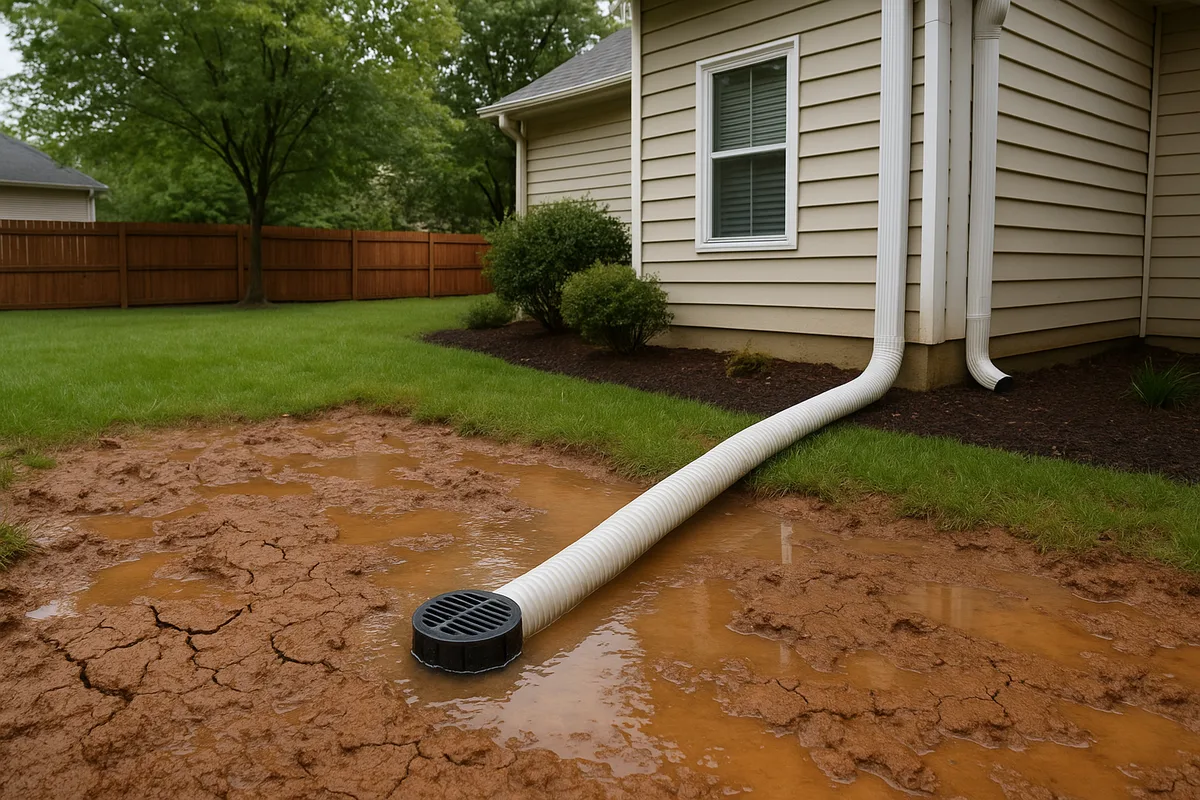
Standing water after rain is the most obvious sign. If puddles persist for more than 24 hours after rainfall ends, your soil is not draining adequately. Pay particular attention to areas within 10 feet of your foundation, as these represent the highest-risk zones for water intrusion.
Surface crusting occurs when clay particles at the soil surface disperse and reform into a hard, sealed layer as they dry. This crust prevents even the limited infiltration that clay soil would otherwise allow. You can identify crusting by looking for a smooth, almost glazed appearance on bare soil areas after they dry.
Erosion channels and rills form when surface runoff concentrates and flows across your yard with enough velocity to carve small channels. In clay soils, these channels often form in predictable patterns because the water follows the path of least resistance across the impermeable surface.
Moss and algae growth in lawn areas indicates persistently wet conditions. While moss can grow in shaded areas regardless of soil type, widespread moss growth in sunny areas is a strong indicator of saturated soil.
Subsurface Indicators
Sticky, plastic soil when wet is a direct indicator of high clay content. Grab a handful of moist soil and try to roll it into a ribbon between your thumb and forefinger. If you can form a ribbon longer than 2 inches that holds together without cracking, your soil has significant clay content. A ribbon longer than 3 inches indicates heavy clay (40%+ clay content).
Cracking soil when dry is the flip side of clay's shrink-swell behavior. Deep cracks — sometimes extending 2-3 feet into the ground — form as clay loses moisture and contracts. These cracks can damage shallow utility lines, tear apart root systems, and create pathways for rapid water infiltration during the next rain event, which can lead to sudden, uneven swelling.
Soil color can also be revealing. Gray or blue-gray soil indicates prolonged saturation and anaerobic (oxygen-depleted) conditions. Well-drained soil is typically brown, reddish-brown, or yellowish-brown. If you dig a hole and encounter gray, mottled, or gleyed soil within 18 inches of the surface, your yard has a serious drainage limitation.
Structural Indicators
Foundation cracks — particularly horizontal cracks in basement walls or stair-step cracks in block foundations — can indicate hydrostatic pressure from saturated clay soil pressing against the foundation. The shrink-swell cycle of clay can also cause differential settlement, where one part of the foundation moves more than another, creating diagonal cracks.
Sticking doors and windows that change with the seasons often indicate foundation movement caused by clay soil's moisture cycling. During wet periods, the clay swells and pushes the foundation upward; during dry periods, it shrinks and allows the foundation to settle. This cyclical movement can be remarkably destructive over time.
Basement dampness or water intrusion in homes built on clay soil is extremely common. Even without visible cracks, water can migrate through the concrete itself under hydrostatic pressure, appearing as damp spots, efflorescence (white mineral deposits), or active seepage.
The Impact of Clay Soil on Foundation and Property Value
The financial consequences of unaddressed clay soil drainage issues are substantial. Foundation repairs related to clay soil movement and water damage average $5,000 to $15,000 for moderate cases, with severe cases exceeding $30,000 or more. But the costs extend far beyond the foundation itself.
Landscaping in a poor draining soil yard requires constant replacement. Grass thins and dies in waterlogged areas, trees and shrubs develop root rot, and flower beds become breeding grounds for mosquitoes. Homeowners with clay soil drainage problems often spend 2-3 times more on landscaping maintenance compared to those with well-drained properties.
Property value is directly affected as well. Home inspectors are trained to identify drainage deficiencies, and visible signs of water pooling, foundation movement, or basement moisture can reduce a home's appraised value by 10-15%. In competitive real estate markets, buyers increasingly request drainage assessments as part of their due diligence, and properties with documented drainage problems can sit on the market significantly longer.
The Hidden Cost of Soil Moisture Cycling
Clay soil doesn't just cause problems when it's wet — the drying cycle is equally destructive. During extended dry periods, clay soil can shrink away from foundations, leaving a gap that fills with debris and loose soil. When the next heavy rain arrives, water rushes into this gap and applies concentrated hydrostatic pressure directly against the foundation wall. This wet-dry cycling is considered one of the most damaging soil conditions for residential structures.
In regions with pronounced wet and dry seasons — much of the southern, central, and western United States — this cycling occurs predictably every year. Over a 20-30 year period, the cumulative damage can be severe. Proactive drainage management is not optional in these conditions; it's essential structural maintenance.
Proven Solutions for Clay Soil Drainage Problems
Addressing clay soil water pooling requires a multi-layered approach. No single solution is sufficient for most properties — effective drainage management in clay soil combines surface grading, subsurface drainage, soil improvement, and strategic landscaping.
Surface Grading and Slope Correction
The foundation of any drainage solution — regardless of soil type — is proper surface grading. The International Residential Code (IRC) requires a minimum slope of 6 inches of fall within the first 10 feet away from the foundation (approximately a 5% grade). On clay soil, this minimum is often insufficient, and many drainage professionals recommend 8-12 inches of fall over 10 feet where achievable.
Grading corrections involve adding or redistributing soil to create consistent slopes that direct water away from the foundation and toward designated drainage outlets. On clay soil properties, grading should incorporate a cap of higher-quality topsoil (6-8 inches minimum) over the clay subgrade. This topsoil layer provides some initial infiltration capacity and supports healthier turf, which in turn improves surface drainage through root channels and organic matter development.
Swales — shallow, vegetated channels — are highly effective on clay soil properties because they work with the surface runoff rather than fighting it. A properly designed swale intercepts sheet flow, concentrates it into a manageable channel, and directs it to a safe discharge point. Swales should have a minimum longitudinal slope of 1-2% and be lined with dense turf or erosion-resistant vegetation.
French Drains and Subsurface Drainage Systems
French drains are the workhorse of subsurface drainage in clay soil. A French drain consists of a perforated pipe laid in a gravel-filled trench, wrapped in filter fabric to prevent clay particles from clogging the system. The pipe collects water that infiltrates into the trench and carries it by gravity to a discharge point.
In clay soil, French drain design requires special attention to several factors:
- Trench depth: Minimum 18-24 inches, with 24-36 inches preferred for intercepting subsurface water.
- Gravel specification: Clean, washed #57 stone (¾ to 1 inch) provides optimal drainage. Avoid limestone in areas with high clay content, as it can calcium-cement over time.
- Pipe diameter: 4-inch perforated corrugated or rigid PVC pipe is standard for residential applications. Rigid PVC (SDR-35 or Schedule 40) is preferred in clay soils because it resists crushing under soil pressure.
- Filter fabric: Non-woven geotextile fabric rated for fine-grained soils. The fabric wraps the entire gravel column to prevent clay migration into the drain.
- Slope: Minimum 1% slope (1/8 inch per foot) along the pipe run, with 2% preferred.
The critical mistake many contractors make in clay soil is installing French drains too shallow or without adequate filter fabric. Clay particles are so fine that they can migrate through low-quality filter fabric and gradually clog the gravel and pipe, rendering the system useless within 5-10 years. Investing in high-quality materials and proper installation is essential for long-term performance.
Soil Amendment and Improvement
While you can't change the fundamental nature of your soil, you can significantly improve the drainage characteristics of the top 6-12 inches through amendment. The most effective amendments for clay soil include:
Coarse organic matter — composted bark, aged wood chips, or quality compost — improves soil structure by promoting aggregation. Clay particles bind to organic matter and form larger clumps (aggregates) with pore spaces between them. Incorporating 3-4 inches of organic matter into the top 8-10 inches of soil can improve infiltration rates by 50-200%. However, organic matter decomposes over time and must be replenished periodically.
Gypsum (calcium sulfate) is often recommended for clay soil improvement, but its effectiveness is widely misunderstood. Gypsum works by causing clay particles to flocculate (clump together), which can improve drainage in sodic soils — soils with high sodium content. However, most residential clay soils are not sodic, and gypsum provides minimal benefit. Before investing in gypsum, have your soil tested for sodium adsorption ratio (SAR). If your SAR is below 6, gypsum is unlikely to help.
Sand addition is another commonly recommended but frequently misapplied amendment. Adding sand to clay soil in incorrect proportions can actually make drainage worse by creating a concrete-like mixture. To meaningfully improve drainage, you would need to add enough sand to achieve at least 60-70% sand content in the amended zone — which typically means incorporating 4-6 inches of coarse sand into the top 8 inches of soil. This is expensive and labor-intensive but can be effective in targeted areas like garden beds or chronically wet lawn sections.
Biochar is an emerging amendment that shows promise for clay soil improvement. This charcoal-like material created from organic waste has an extremely porous structure that can improve soil drainage, water-holding capacity, and microbial activity simultaneously. Research suggests that biochar amendments of 5-10% by volume can improve clay soil infiltration rates by 30-50%.
Strategic Landscaping for Clay Soil Properties
Plant selection plays a surprisingly important role in managing drainage on clay soil. Deep-rooted plants create channels (macropores) through the clay that allow water to infiltrate more effectively. Over time, a well-established root network can dramatically improve the drainage characteristics of the upper soil profile.
Native grasses and prairie plants are particularly effective because they develop root systems that extend 3-6 feet deep or more, penetrating through clay layers that surface-rooted turf grasses cannot reach. Switchgrass, big bluestem, and Indian grass are excellent choices for rain gardens and bioswales on clay soil properties.
Rain gardens — shallow, planted depressions designed to capture and infiltrate stormwater — can be adapted for clay soil by incorporating an amended soil mix and an underdrain. A typical clay-soil rain garden uses a 50/50 blend of sand and compost to a depth of 18-24 inches, with a perforated pipe underdrain at the bottom that connects to the storm drainage system. This design allows the rain garden to capture and filter stormwater even though the native clay soil won't accept infiltration at adequate rates.
Trees can be both allies and adversaries on clay soil. Large trees with aggressive root systems (willows, silver maples, poplars) can help dry out saturated clay through transpiration — a mature tree can transpire 50-100 gallons of water per day. However, these same trees can cause significant soil shrinkage during dry periods, leading to foundation settlement. The general guideline is to plant large trees at a distance from the foundation equal to at least the tree's expected mature height.
Drainage System Design Considerations for Clay Soil Properties
Designing an effective drainage system for a poor draining soil yard requires understanding the full hydrologic picture of your property. This means accounting for not just rainfall, but also the topography, contributing drainage area, soil conditions, and available discharge points.
Calculating Runoff Volume
On clay soil (Hydrologic Soil Group D), you should plan for 75-95% of rainfall to become runoff. For a 5,000-square-foot lot receiving 1 inch of rainfall, this translates to approximately 2,300-2,900 gallons of runoff that must be managed. During a significant storm event (2-3 inches of rain), that number jumps to 7,000-8,700 gallons.
These volumes are critical for sizing drainage infrastructure. Undersized pipes, insufficient swale capacity, or inadequate dry well volume will result in system failure during the storms that matter most. Professional drainage design uses local rainfall intensity data — available through resources like NOAA Atlas 14 — to size systems for specific design storms, typically the 10-year or 25-year recurrence interval event.
Discharge Point Planning
Every drainage system needs a place to send the water it collects. On clay soil properties, the options are often limited because the soil won't accept infiltration-based solutions like dry wells or infiltration trenches without significant modification. Common discharge options include:
- Municipal storm sewer connections (where permitted by local code)
- Daylight outlets to lower-elevation areas, ditches, or natural drainage ways
- Oversized dry wells with gravel reservoirs that provide temporary storage and slow release
- Detention/retention areas on the property designed to hold water temporarily and release it slowly
Local regulations vary significantly regarding stormwater discharge. Many municipalities require that post-development runoff rates not exceed pre-development rates, and some require stormwater management plans for any grading or drainage work that disturbs more than a certain area threshold. Always check local requirements before installing drainage systems.
Combining Multiple Approaches
The most effective drainage strategies for clay soil properties layer multiple solutions together. A comprehensive approach might include:
- Re-grading the immediate foundation perimeter to achieve proper slope
- Installing a perimeter French drain at the foundation footing level
- Creating surface swales to intercept and redirect overland flow
- Building a rain garden in a natural low point to capture and treat runoff
- Amending soil in high-use lawn areas to improve surface infiltration
- Extending downspouts to discharge at least 6-10 feet from the foundation, connected to buried solid pipe where possible
Each of these components addresses a different aspect of the drainage challenge, and together they create a resilient system that can handle a wide range of storm events.
Maintenance and Long-Term Management of Drainage in Clay Soil
Drainage systems in clay soil require more maintenance than those in sandy or loamy soils. The fine clay particles are relentless in their ability to migrate into and clog drainage infrastructure. A proactive maintenance schedule is essential for long-term performance.
Annual Inspection Checklist
Every spring and fall, inspect your drainage system for the following:
- Surface grading: Check that slopes away from the foundation are maintained. Clay soil settlement and erosion can gradually flatten slopes over time. Re-grade as needed to maintain minimum 5% slope for the first 10 feet.
- French drain outlets: Verify that discharge points are clear and flowing freely. Sediment, vegetation, and animal nesting can block outlets.
- Downspout connections: Ensure all downspouts are securely connected to extensions or buried pipes. A single disconnected downspout can dump hundreds of gallons of water directly against the foundation during a storm.
- Swale condition: Check that swales are free of sediment buildup and that vegetation is healthy. Thin or bare areas in swales are vulnerable to erosion.
- Sump pump operation: If you have a sump pump, test it by pouring water into the pit and verifying that it activates and discharges properly.
Addressing Seasonal Challenges
Clay soil properties face distinct challenges in different seasons. In spring, snowmelt combined with spring rains can create prolonged saturation conditions. The freeze-thaw cycle can also damage drainage infrastructure — water that enters cracks in pipes or gravel beds can freeze and expand, causing displacement and breakage.
In summer, extended dry periods cause clay to shrink and crack. While this temporarily improves surface drainage (water flows into the cracks), it creates problems when the rain returns. The cracks allow water to penetrate deep into the soil profile, where it can exert lateral pressure on foundation walls. Maintaining consistent soil moisture around your foundation — through careful irrigation during dry spells — can minimize the shrink-swell cycle and protect your foundation.
Fall brings leaf litter that can clog drainage inlets, gutter outlets, and French drain surfaces. A thorough cleaning before winter is essential. Winter freeze conditions can block discharge outlets and render French drains temporarily inoperative, making proper surface grading even more critical as the primary drainage mechanism during cold months.
When to Call a Professional
While many drainage improvements are within the capability of a motivated homeowner, certain situations warrant professional assessment and design:
- Recurring basement water intrusion despite basic drainage improvements
- Foundation cracks that are growing or accompanied by structural movement
- Properties with multiple contributing drainage areas or complex topography
- Lots where the natural drainage path crosses neighboring properties (potential legal and easement issues)
- Any project requiring connection to municipal storm sewers or work within drainage easements
A professional drainage assessment provides the topographic data, soil analysis, and engineering design needed to solve complex problems. At Low Point Labs, we specialize in topographic drainage intelligence — using detailed elevation data and hydrologic analysis to identify exactly where water flows on your property, where it collects, and how to redirect it effectively. If you're struggling with clay soil drainage issues on your property, our assessment services can provide the clarity and actionable data you need to implement lasting solutions. Explore our drainage assessment tools and take the first step toward a drier, healthier property.
See Drainage Intelligence in Practice
Talk with our team or request an invitation to the platform.
Frequently Asked Questions
Perform a simple ribbon test: grab a handful of moist soil and squeeze it between your thumb and forefinger, pushing it into a flat ribbon. If the ribbon extends more than 2 inches without breaking, your soil has significant clay content. You can also check your property's soil type for free using the NRCS Web Soil Survey at websoilsurvey.nrcs.usda.gov.
Yes. While you can't change the native clay, you can improve drainage through surface grading corrections, French drain installation, soil amendment of the top 8-12 inches with organic matter, and strategic landscaping with deep-rooted plants. Most effective solutions work with the clay rather than trying to replace it entirely.
Clay soil drains at approximately 0.01 to 0.1 inches per hour, meaning a single inch of water can take 10 to 100 hours to percolate through. By comparison, sandy soil drains at 1 to 6 inches per hour. This extremely slow drainage rate is why standing water can persist for days on clay soil properties.
Adding sand to clay soil can actually make drainage worse if done incorrectly, creating a concrete-like mixture. To meaningfully improve drainage, you would need to achieve at least 60-70% sand content in the amended zone, which requires incorporating 4-6 inches of coarse sand into the top 8 inches of soil. This is expensive but effective in targeted areas.
Yes. Clay soil is one of the leading causes of residential foundation damage. Its shrink-swell behavior causes cyclical movement that cracks foundations over time, and its impermeability traps water against foundation walls, creating hydrostatic pressure. Foundation repairs related to clay soil problems average $5,000 to $15,000 for moderate cases.
Drainage systems in clay soil should be inspected at least twice per year — in spring and fall. Check French drain outlets for sediment blockage, verify surface grading slopes are maintained, test sump pumps, and clear debris from drainage inlets. Clay's fine particles can clog systems faster than other soil types, making regular maintenance essential.
Related Articles
How to Diagnose Yard Drainage Problems on a Site Walk
How to Spot Undersized Drainage Systems Before They Fail