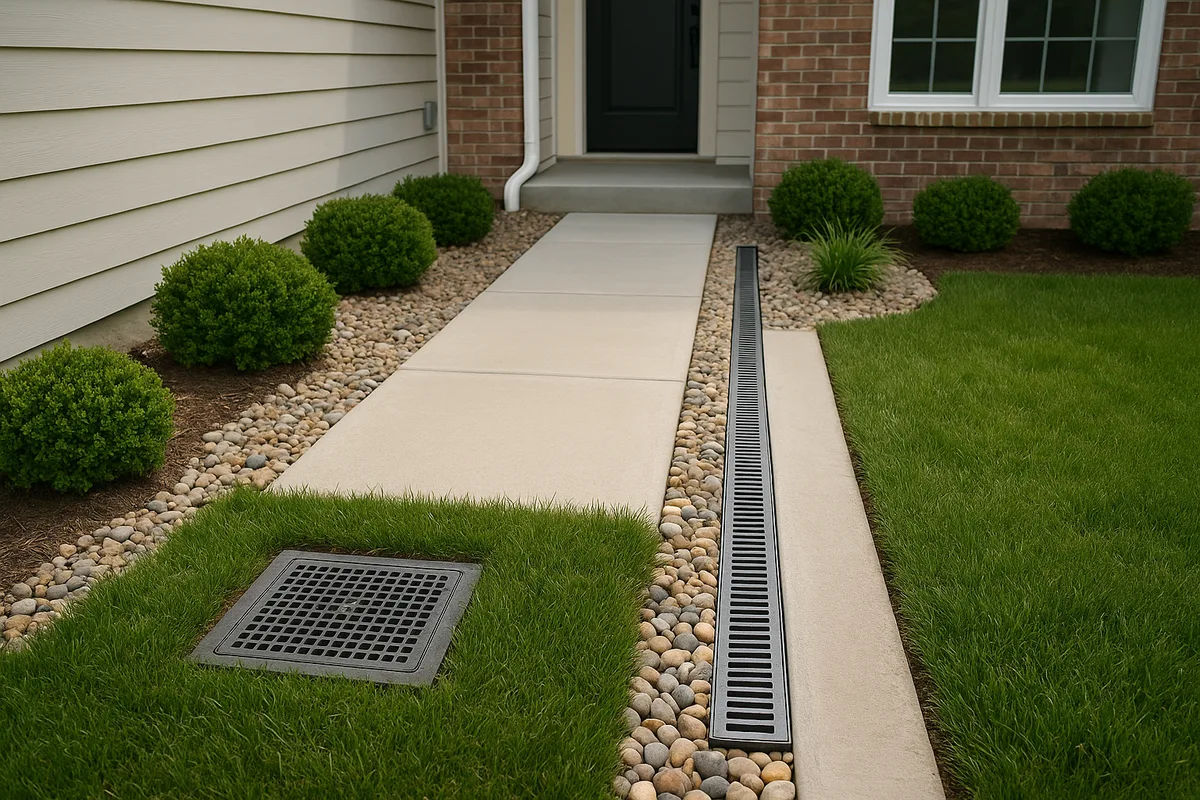
Understanding Slope and Grade Around Your Home: A Complete Guide
The ground surrounding your home isn't just a canvas for landscaping — it's a carefully engineered surface designed to move water away from your most valuable investment. Understanding slope and grade around your home is essential for every homeowner, whether you're buying a new property, troubleshooting a wet basement, or planning a landscaping renovation. When the slope away from house foundations is inadequate or compromised, the consequences can range from minor nuisances like soggy lawns to catastrophic structural damage costing tens of thousands of dollars.
At Low Point Labs, we analyze topographic drainage patterns for residential properties every day, and we consistently find that grading issues are among the most common — and most overlooked — contributors to water intrusion problems. The good news is that property grading basics are straightforward to understand, and many grading deficiencies can be corrected before they cause serious harm. This guide will walk you through everything you need to know about residential slope and grade, from the science behind water movement to the specific yard slope requirements that protect your foundation.
What Slope and Grade Actually Mean in Residential Construction
In everyday language, people use "slope" and "grade" interchangeably, but in construction and civil engineering, they carry specific — and slightly different — meanings. Grade refers to the elevation of the ground surface at any given point relative to a reference point, such as your foundation or a benchmark elevation. When contractors talk about "grading" a property, they mean reshaping the earth's surface to achieve specific elevations across the lot. Slope, on the other hand, describes the rate of change in elevation over a horizontal distance — essentially, how steep the ground is and in which direction it tilts.
For homeowners, the critical concept is positive drainage: the ground should slope away from your house in all directions so that surface water — whether from rain, snowmelt, or irrigation — flows naturally toward the edges of your property, into swales, storm drains, or other collection points. When grade is "positive," water moves away from the foundation. When it's "negative" or "flat," water pools against the foundation walls, saturates the backfill soil, and eventually finds its way into your basement, crawl space, or slab.
The relationship between slope and grade is mathematical but intuitive. If the ground drops 6 inches over a horizontal distance of 10 feet as you move away from your foundation, you have a slope of 5% — or roughly a half-inch of fall per foot. This rate of fall is what determines whether water moves briskly away from your home or lingers where it can cause damage. Understanding this relationship is the foundation (no pun intended) of all property grading basics.
How Slope Is Expressed
Slope can be expressed in several ways, and you'll encounter different conventions depending on who you're talking to. Percentage is the most common in residential grading: a 2% slope means the ground drops 2 feet for every 100 feet of horizontal distance, or 0.24 inches per foot. Ratio is another common expression — a 4:1 slope means the ground drops 1 foot vertically for every 4 feet of horizontal distance (equivalent to a 25% slope). You may also see slope expressed in degrees, though this is less common in residential work. For most homeowners, thinking in terms of inches of drop per foot of horizontal distance is the most practical approach.
Yard Slope Requirements: What the Codes and Standards Say
Yard slope requirements aren't arbitrary recommendations — they're codified standards backed by decades of building science research and field experience. The International Residential Code (IRC), which forms the basis for most local building codes in the United States, addresses grading in Section R401.3. The requirement is clear: the ground surface must slope away from foundation walls at a minimum fall of 6 inches within the first 10 feet. This translates to a minimum slope of 5%, or approximately 0.6 inches per foot.
When the lot size, adjacent structures, or other physical constraints make it impractical to achieve a full 6 inches of fall in 10 feet, the IRC allows for alternative solutions. These typically include the installation of swales, drains, or other approved methods to divert water away from the foundation. However, the intent of the code is unambiguous: water must not be allowed to accumulate against foundation walls.
It's important to note that the IRC requirement of 6 inches in 10 feet is a minimum. Many drainage professionals, including our team at Low Point Labs, recommend achieving greater slope where site conditions permit. A slope of 1 inch per foot (approximately 8.3%) within the first several feet of the foundation provides a more robust safety margin, particularly in regions with heavy rainfall, clay soils, or high water tables. Some local jurisdictions have adopted more stringent requirements than the IRC minimum, so always check your local building code for specific yard slope requirements in your area.
Beyond the Foundation Zone
While the first 10 feet from the foundation gets the most attention, the overall lot grading matters too. Beyond the initial slope zone, the yard should continue to direct water toward appropriate discharge points — typically the street, a storm sewer inlet, a drainage easement, or a natural watercourse. The U.S. Environmental Protection Agency (EPA) emphasizes that effective surface water management begins with proper lot grading, which reduces the need for more complex and expensive stormwater infrastructure. Even a modest positive slope of 1-2% across the remainder of the yard is generally sufficient to keep water moving and prevent ponding.
How to Measure Slope and Grade Around Your Property
You don't need a surveyor's license to assess the basic grading conditions around your home. With a few simple tools and a systematic approach, you can identify potential problem areas and determine whether your property meets minimum yard slope requirements.
The String Level Method
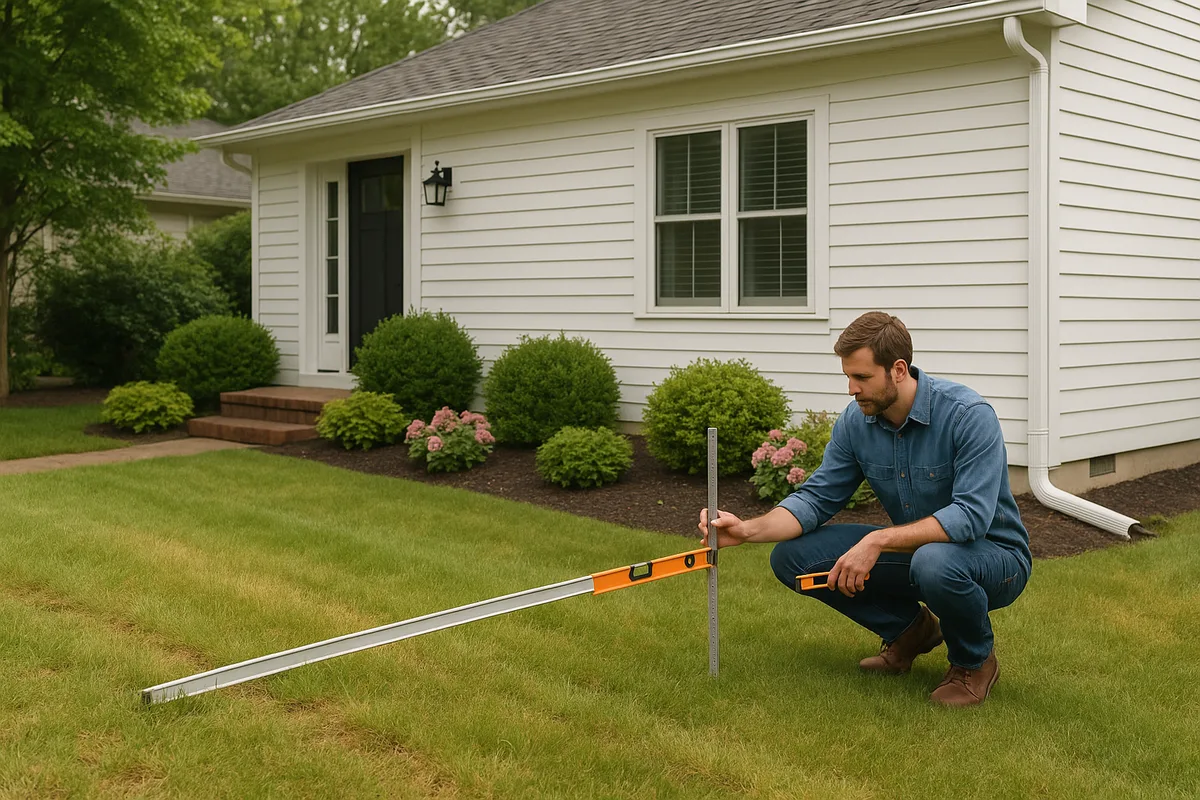
The simplest and most accessible method uses a wooden stake, a length of string, a line level (a small bubble level that hooks onto a string), and a tape measure. Drive the stake into the ground 10 feet from your foundation wall. Tie the string to the foundation at ground level and stretch it to the stake, keeping it taut. Attach the line level to the midpoint of the string and adjust the string at the stake until the bubble reads level. Now measure the distance from the string down to the ground at the stake. This measurement is your total fall over 10 feet. If it's 6 inches or more, you meet the IRC minimum. If it's less — or if the ground is actually higher at the stake than at the foundation — you have a grading deficiency.
Repeat this process at multiple points around your home. Grading problems are often localized — you might have excellent slope on three sides and a significant negative grade on the fourth, perhaps where a patio was installed, a garden bed was built up, or soil has settled over the years.
Using a Laser Level or Builder's Level
For more precise measurements, especially over longer distances, a rotary laser level or a traditional builder's level (transit) provides accuracy to within fractions of an inch. Set the instrument at a known elevation point, then take rod readings at regular intervals across your property. By comparing readings, you can create a simple elevation map that reveals the overall drainage pattern of your lot. This is essentially a simplified version of what professional surveyors and drainage analysts do, and it's remarkably effective for identifying low points, reverse slopes, and areas of ponding.
Reading the Signs Without Measuring
Sometimes the evidence of poor grading is visible without any measurement tools at all. Look for these telltale indicators:
- Staining or discoloration on foundation walls, especially a horizontal "tide line" of mineral deposits
- Soil erosion channels running toward the foundation rather than away from it
- Mulch or soil displacement that has migrated against the foundation
- Standing water near the foundation after moderate rain events (not just extreme storms)
- Lush, unusually green grass in areas immediately adjacent to the foundation, suggesting persistent moisture
- Efflorescence (white crystalline deposits) on basement or crawl space walls
- Musty odors in below-grade spaces
- Cracks in foundation walls, particularly horizontal cracks that may indicate hydrostatic pressure
These signs don't replace measurement, but they help you prioritize where to focus your assessment and can indicate that the slope away from house walls has been compromised.
Common Causes of Grading Failure
Even homes that were properly graded during construction can develop drainage problems over time. Understanding the common causes of grading failure helps you anticipate and prevent issues before they escalate.
Backfill Settlement
During construction, a trench is excavated around the foundation for forming, pouring, waterproofing, and installing drainage tile. After the foundation is complete, this trench is backfilled — ideally with compactable material placed in lifts and mechanically compacted. In practice, however, backfill is often loosely placed and inadequately compacted. Over the following months and years, this loose soil consolidates under its own weight, rainfall, and freeze-thaw cycles, creating a depression — sometimes called a "settlement trough" — right where you need positive slope the most. This is one of the most common grading failures we see in homes less than 10 years old.
Landscaping Changes
Homeowners and landscapers frequently alter the grade around a home without realizing the drainage implications. Adding raised garden beds against the foundation, installing patios or walkways without proper slope, building up mulch beds year after year, and regrading for aesthetic purposes can all compromise the original drainage design. Even something as simple as repeatedly adding 2-3 inches of mulch annually can, over a decade, create a situation where the grade has effectively been raised against the foundation while remaining the same farther out — reducing or reversing the slope.
Soil Erosion
On properties with steeper slopes or exposed soil, erosion from rain and runoff can gradually reshape the grade. Soil washes away from high points and accumulates in low points, potentially redirecting water flow toward the foundation. Downspout discharge that isn't properly extended away from the home is a particularly common erosion culprit — the concentrated flow from a roof can carve channels in the soil and deposit material in patterns that create negative grade.
Tree Root Activity and Organic Decomposition
Large trees near the foundation can affect grading in multiple ways. Root growth can heave soil in some areas while creating voids in others. When trees are removed, the decomposition of the root system creates subsurface voids that eventually collapse, causing surface settlement. Additionally, the organic matter from decades of leaf fall and decomposition can alter soil composition near the foundation, changing its drainage characteristics.
Structural and Geological Factors
In some cases, grading failure is caused by factors beyond the surface. Subsurface water movement, expansive clay soils that swell and shrink with moisture cycles, frost heave, and even subtle geological settlement can alter surface grades over time. These issues often require professional assessment to identify and address.
The Consequences of Inadequate Slope Away From House Foundations
The slope away from house foundations isn't just a building code checkbox — it's a critical defense system. When this slope is inadequate, the consequences can be severe, progressive, and expensive to remediate.
Water Intrusion
The most immediate consequence of negative or flat grade is water intrusion into below-grade spaces. Water follows the path of least resistance, and when it pools against a foundation wall, it exerts hydrostatic pressure — the force of water pushing against a surface. Even well-waterproofed foundations can be overwhelmed by sustained hydrostatic pressure. Water finds its way through cracks, cold joints (the seam where the footing meets the wall), pipe penetrations, and even through the concrete itself via capillary action. The result is a wet basement or crawl space, which leads to secondary problems including mold growth, damage to stored belongings, and degradation of mechanical systems.
Foundation Damage
Saturated soil against a foundation wall creates multiple structural risks. Hydrostatic pressure can cause horizontal cracking and inward bowing of foundation walls, particularly in block (CMU) construction. In cold climates, water-saturated soil freezes and expands, exerting enormous lateral pressure on foundation walls — a process called frost thrust. Over time, this cyclical loading can cause significant structural displacement. Additionally, persistent moisture accelerates the deterioration of concrete and morite, reducing the foundation's structural capacity and lifespan.
Soil Instability
When water consistently saturates the soil around and beneath a foundation, the soil's bearing capacity — its ability to support the weight of the structure — can be reduced. This is particularly problematic with clay soils, which lose strength when saturated and can undergo significant volume changes. The result can be differential settlement, where one part of the foundation sinks more than another, causing cracks in walls, misaligned doors and windows, and in severe cases, structural failure.
Landscape and Hardscape Damage
Poor grading doesn't just threaten the house itself. Standing water kills grass and ornamental plants, promotes mosquito breeding, creates ice hazards in winter, and accelerates the deterioration of patios, walkways, and driveways. Freeze-thaw damage to hardscapes is dramatically accelerated when water is allowed to pool and saturate the base materials.
Financial Impact
The financial consequences of grading failure are significant. According to the American Society of Home Inspectors (ASHI), water intrusion is the most common defect found in residential inspections, and improper grading is a leading cause. Foundation repairs can range from $5,000 for minor crack injection to $50,000 or more for major structural stabilization. Mold remediation typically costs $1,500 to $10,000, and in severe cases, much more. By contrast, corrective grading — addressing the root cause — often costs a fraction of these amounts when caught early.
How to Correct Grading Problems: Practical Solutions
The approach to correcting grading problems depends on the severity of the deficiency, the site constraints, and the budget available. Here are the most common and effective solutions, ranging from simple to complex.
Adding and Reshaping Soil
The most straightforward grading correction involves adding clean fill soil against the foundation and reshaping it to achieve the required slope. The ideal material is a clay-loam blend — soil with enough clay content to shed water rather than absorb it, but enough sand and silt to be workable and stable. Avoid using pure topsoil or organic-rich soil against the foundation, as these materials retain moisture and decompose over time, causing settlement.
When adding soil, maintain a minimum of 6 to 8 inches of clearance between the soil surface and any wood framing, siding, or stucco. Burying siding or framing members invites termite infestation and wood rot. This clearance requirement sometimes limits how much soil you can add, particularly on homes with low-profile foundations.
Compact the new soil in lifts (layers) of 4-6 inches, using a hand tamper or plate compactor. Loose, uncompacted fill will settle over time, potentially recreating the very problem you're trying to solve. After achieving the desired grade, cover the soil with sod, seed, or a thin layer of mulch (no more than 2-3 inches) to prevent erosion.
Extending Downspouts
Roof runoff is one of the largest concentrated water sources on a residential property. A typical 1,500-square-foot roof generates approximately 935 gallons of water from just 1 inch of rainfall. If that water is discharged at the foundation through short downspouts, even perfect grading may be overwhelmed. Extend all downspouts a minimum of 6 feet from the foundation — 10 feet is better. Use rigid or corrugated drain pipe rather than splash blocks, which tend to be displaced and are less effective at directing water. Ensure the discharge point is at a lower elevation than the entry point and that the water has a clear path to flow away from the home.
Installing Swales and Berms
A swale is a shallow, vegetated channel designed to collect and redirect surface water. A berm is a raised ridge of soil that blocks water from flowing in an undesired direction. Used together, swales and berms are powerful tools for managing surface drainage on properties where simple regrading isn't sufficient. A typical residential swale should have a minimum longitudinal slope of 1-2% (to keep water moving through it) and side slopes no steeper than 3:1 (to allow mowing and prevent erosion).
French Drains and Curtain Drains
When surface grading alone can't solve the problem — for example, when a neighboring property drains toward your home or when subsurface water is a factor — subsurface drainage systems may be necessary. A French drain (also called a curtain drain or perimeter drain) consists of a perforated pipe installed in a gravel-filled trench, designed to intercept and redirect groundwater. These systems are typically installed along the uphill side of the problem area, at a depth sufficient to intercept the water before it reaches the foundation. Proper design requires understanding the soil type, water table depth, and flow patterns — this is where professional drainage analysis becomes particularly valuable.
Regrading With Hardscape Integration
When patios, walkways, or driveways are contributing to grading problems, the solution may involve removing and reinstalling these elements with proper slope. Hardscapes adjacent to the foundation should slope away at a minimum of 1/4 inch per foot (approximately 2%). This is a less aggressive slope than what's required for soil because hardscapes are impervious and shed water more efficiently. However, the water must be directed to a permeable area or collection point — simply moving the water from the patio surface to the patio edge accomplishes nothing if the surrounding grade directs it back toward the house.
Professional Grading Assessment: When and Why You Need One
While DIY assessment and correction are appropriate for minor grading issues, there are situations where professional analysis is essential. Property grading basics are straightforward in concept, but the interactions between topography, soil type, subsurface conditions, neighboring properties, and existing infrastructure can create complex drainage puzzles that require expert interpretation.
During Home Purchase
A standard home inspection typically includes a visual assessment of grading, but it rarely involves actual measurement or topographic analysis. If the inspection reveals signs of water intrusion, or if the property has complex topography, requesting a dedicated drainage assessment before closing can save you from inheriting expensive problems. Understanding the slope away from house foundations — and whether it meets yard slope requirements — should be a non-negotiable part of your due diligence.
After Water Intrusion Events
If you've experienced water in your basement or crawl space, understanding the cause is critical before investing in solutions. Too many homeowners spend thousands on interior waterproofing systems (sump pumps, interior drain tile, vapor barriers) without addressing the exterior grading that's causing the problem. Interior systems manage water that's already reached the foundation — they don't prevent it from getting there. A professional grading assessment can determine whether the problem is surface-related (and correctable through grading), subsurface-related (requiring drainage systems), or both.
Before Major Landscaping or Construction Projects
Any project that alters the ground surface around your home — a new patio, retaining wall, pool, addition, or significant landscaping renovation — has the potential to affect drainage patterns. A pre-project drainage assessment establishes baseline conditions and identifies constraints that should be incorporated into the project design. It's far less expensive to design drainage into a project from the beginning than to retrofit it after problems appear.
Topographic Drainage Intelligence
At Low Point Labs, we go beyond simple slope measurement. Our topographic drainage intelligence analyzes the complete water flow picture for your property — identifying low points, flow paths, accumulation zones, and the relationship between your lot and neighboring properties. This comprehensive approach reveals problems and opportunities that simple spot-checks miss, giving you the information you need to make confident decisions about your property's drainage.
Maintaining Proper Grade Over Time
Achieving proper grade is not a one-time event — it's an ongoing responsibility. The forces that degrade grading — settlement, erosion, landscaping changes, biological activity — are continuous, and periodic assessment is necessary to ensure that your drainage remains effective.
Annual Inspection Routine
Walk the perimeter of your home at least once a year — ideally in spring, after freeze-thaw cycles have had their maximum impact. Look for settlement along the foundation, erosion channels, areas where mulch or soil has built up against the siding, and any changes in how water behaves during rain events. Pay particular attention to areas around downspout discharge points, which are subject to the most concentrated water flow and erosion.
Mulch Management
Mulch is one of the most common contributors to gradual grade degradation. As organic mulch decomposes, it compresses and new layers are added on top, gradually raising the grade against the foundation. Limit mulch depth to 2-3 inches, and periodically remove and replace old mulch rather than simply adding more on top. Keep mulch pulled back at least 6 inches from the foundation wall, and never allow it to contact wood siding or framing.
Gutter and Downspout Maintenance
Clogged gutters cause uncontrolled water discharge directly against the foundation, bypassing even well-designed grading. Clean gutters at least twice a year — more often if you have overhanging trees — and verify that downspouts remain connected, properly extended, and discharging at appropriate locations. Check splash blocks and discharge pipes after major storms, as they can be displaced by water flow or lawn maintenance equipment.
Documentation and Monitoring
Keep records of your grading measurements and observations over time. Photograph problem areas and note the dates and conditions. This documentation is invaluable for tracking trends, demonstrating issues to contractors or inspectors, and establishing a maintenance history for future buyers. If you notice a consistent pattern of settlement or erosion in a particular area, it may indicate an underlying issue — such as a leaking underground pipe or a subsurface drainage path — that requires investigation.
Responding to Changes
Anytime you notice a change in how water behaves on your property — a new puddle, a wet spot that wasn't there before, water appearing in a previously dry basement area — investigate promptly. Drainage problems are progressive: small issues become big issues, and big issues become expensive issues. Early intervention is almost always less costly and less disruptive than delayed response.
Taking Control of Your Property's Drainage
Understanding slope and grade around your home empowers you to protect your property proactively rather than reactively. The principles are straightforward: maintain a minimum slope away from house foundations of 6 inches in 10 feet, manage roof runoff effectively, monitor conditions regularly, and address deficiencies before they cause damage. These property grading basics, consistently applied, prevent the vast majority of surface-water-related foundation problems.
But knowing the principles and accurately assessing your specific property are two different things. Every lot has unique topography, soil conditions, and drainage dynamics that influence how water moves across and through the ground. That's where expert analysis makes the difference between guessing and knowing.
Low Point Labs specializes in topographic drainage intelligence — detailed analysis of how water interacts with your property's unique terrain. Whether you're investigating an existing problem, evaluating a potential purchase, or planning a project, our assessments give you the clarity and confidence to make informed decisions about your property's drainage. Explore our drainage assessment services to understand exactly where your water goes — and whether it's going where it should.
See Drainage Intelligence in Practice
Talk with our team or request an invitation to the platform.
Frequently Asked Questions
The International Residential Code (IRC) requires a minimum fall of 6 inches within the first 10 feet from the foundation wall, which equals approximately a 5% slope or 0.6 inches per foot. Many drainage professionals recommend exceeding this minimum where site conditions allow.
Common signs of improper grading include water pooling near the foundation after rain, staining or mineral deposits on foundation walls, musty odors in the basement or crawl space, soil erosion running toward the house, and cracks in foundation walls. You can measure the slope using a string level stretched 10 feet from the foundation.
Use a clay-loam blend that sheds water rather than absorbing it. Avoid pure topsoil or organic-rich soil, as these retain moisture and decompose over time, causing settlement. Compact the soil in 4-6 inch lifts and maintain at least 6-8 inches of clearance between the soil surface and any wood siding or framing.
Downspouts should discharge water a minimum of 6 feet from the foundation, though 10 feet is preferred. Use rigid or corrugated drain pipe rather than splash blocks, and ensure the discharge point is at a lower elevation than the foundation so water flows away from the home.
Yes. Raised garden beds against the foundation, accumulated mulch layers, improperly sloped patios or walkways, and regrading for aesthetic purposes can all compromise drainage. Even adding 2-3 inches of mulch annually can gradually reverse the slope over a decade.
Inspect the grading at least once a year, ideally in spring after freeze-thaw cycles. Also check after major storms, significant landscaping changes, or any time you notice new signs of water intrusion. Early detection of grading problems prevents costly foundation repairs.
Related Articles
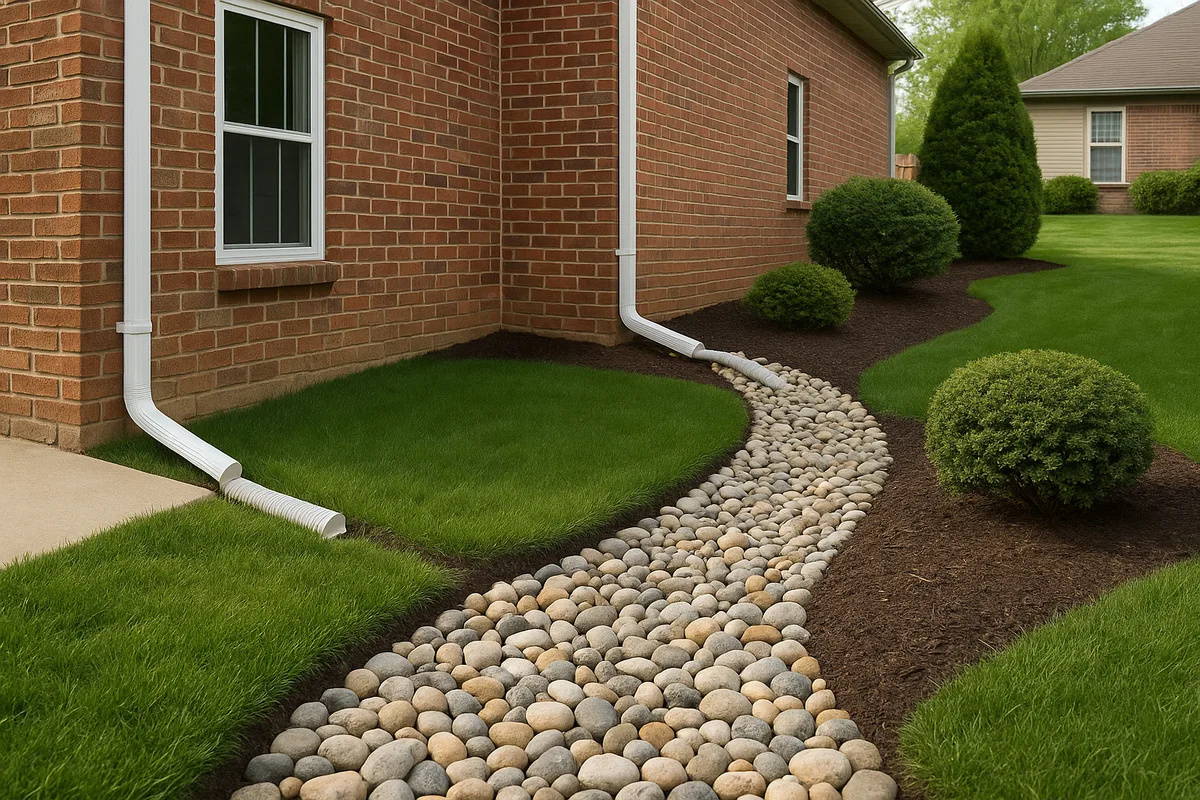
How Water Actually Flows Across Your Property: A Complete Guide
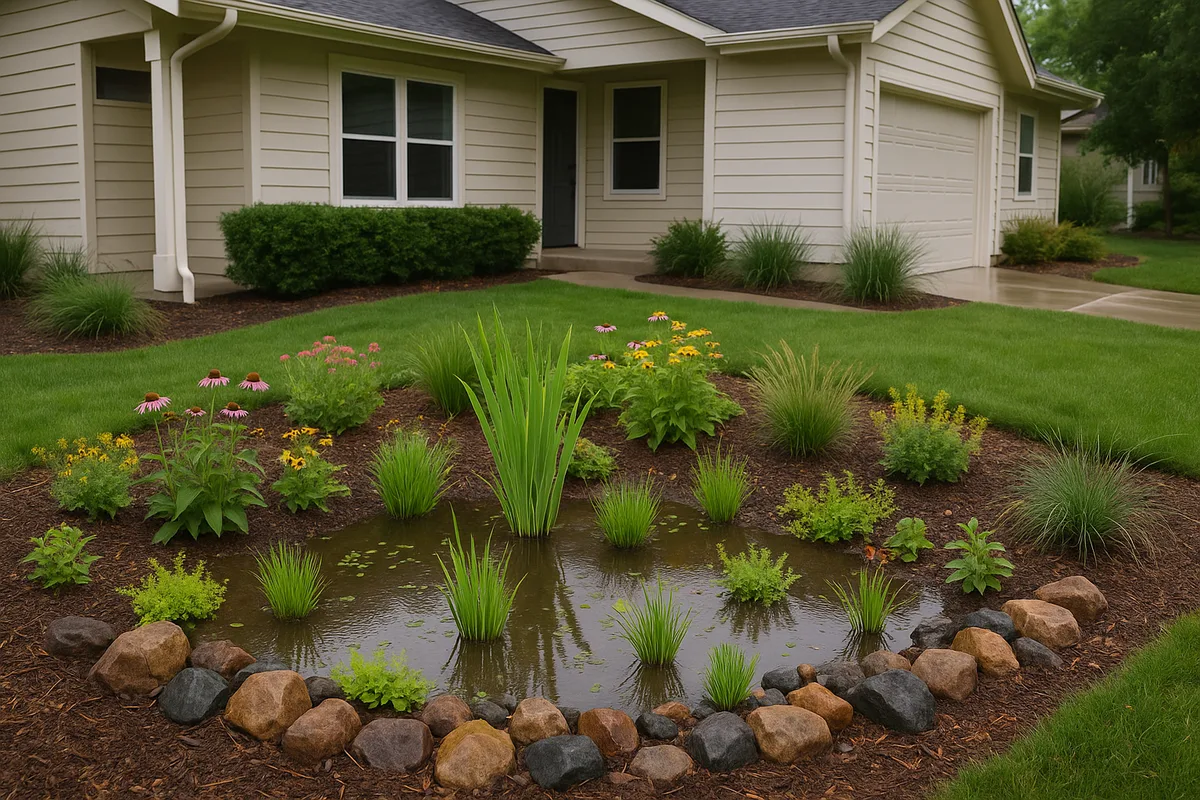
Rain Gardens: Do They Actually Solve Drainage Problems?