Why Some Homes Always Have Water Problems: The Root Causes
Every neighborhood has one — the house where the sump pump runs constantly, where the basement smells like mildew no matter the season, where the yard turns into a swamp after every rainstorm. Sometimes it's several houses on the same street. The owners try French drains, regrading, gutter extensions, and landscaping overhauls, yet the water keeps coming back. If you've ever wondered why some homes have chronic drainage problems while the house next door stays perfectly dry, the answer is rarely simple — and it's almost never about a single broken component.
The truth is that persistent yard flooding causes are layered. They involve the interaction of topography, soil composition, groundwater behavior, impervious surface coverage, and decades of land-use decisions that may predate the home itself. A drainage failure at any home is usually the visible symptom of multiple converging factors, many of which are invisible to the naked eye and overlooked during standard home inspections. Understanding these root causes is the first step toward actually solving the problem instead of just treating symptoms.
This article breaks down the real reasons some properties are perpetually wet, explains why common fixes often fail, and outlines what it takes to achieve a lasting solution.
The Topographic Trap: When Your Lot Sits at the Bottom
Topography is the single most powerful determinant of where water goes, and it's the one factor homeowners have the least ability to change. Water obeys gravity with absolute consistency. If your home sits at a topographic low point — even a subtle one — every raindrop that falls on the surrounding landscape is being directed toward your property by the shape of the earth itself.
What makes this especially insidious is that many low points are not obvious to the human eye. A property can appear flat or even slightly elevated relative to the street while still sitting in a broad, shallow depression that collects runoff from acres of surrounding terrain. These micro-watersheds are invisible without elevation data, but they're the reason some homes experience chronic drainage problems that no amount of gutter work or French drains can resolve. You can't French-drain your way out of being the collection point for an entire hillside.
Development patterns make this worse. In many subdivisions built from the 1950s through the 1990s, grading plans prioritized road drainage and lot yield over individual lot hydrology. Builders would cut and fill to create level building pads, often creating artificial low points in the process. The home looked fine on closing day, but the long-term drainage pattern was baked into the landscape. Decades later, the homeowner is left wondering why their yard floods while the neighbors' don't — the answer is literally in the ground beneath them.
To truly understand whether topography is working against you, you need high-resolution elevation data. The USGS 3D Elevation Program (3DEP) provides LiDAR-derived elevation models that can reveal drainage patterns invisible at ground level. This kind of data shows not just where your lot sits, but where water is coming from — which is often the more important question.
Soil That Won't Drain: The Hidden Layer Beneath Your Yard
Even if your lot has decent topography, the soil beneath the surface can create chronic water problems that persist for the life of the home. Soil is not uniform — it exists in layers (called horizons), and those layers can have dramatically different drainage characteristics. A property might have 12 inches of loamy topsoil that drains beautifully, sitting on top of a dense clay hardpan that's essentially waterproof.
This is one of the most common persistent yard flooding causes that homeowners and even contractors misdiagnose. The surface looks like it should drain. The soil test from the top 6 inches says it's sandy loam. But 18 inches down, there's a layer of compacted clay or glacial till that acts as an underground bathtub. Water percolates through the topsoil, hits the impermeable layer, and has nowhere to go. It saturates the root zone, rises to the surface, and creates the standing water that drives homeowners to frustration.
Hydrologic Soil Groups and What They Mean for Your Property
The Natural Resources Conservation Service (NRCS) classifies soils into four Hydrologic Soil Groups (HSGs) based on their infiltration and runoff characteristics:
- Group A: Sandy, well-drained soils with high infiltration rates. These rarely cause drainage problems.
- Group B: Moderately well-drained soils, typically silt loams. Generally manageable with proper grading.
- Group C: Soils with slow infiltration rates, often containing a clay layer. These are where problems start.
- Group D: Clay-heavy soils with very slow infiltration and high runoff potential. Properties on Group D soils are significantly more likely to experience chronic drainage failures.
Many regions of the United States — the Gulf Coast, the Midwest, the Piedmont, and large swaths of the Pacific Northwest — are dominated by Group C and D soils. If your home was built on these soils without adequate drainage infrastructure, water problems aren't a possibility; they're a near-certainty.
You can look up the soil composition of any property in the United States using the NRCS Web Soil Survey. This free tool provides detailed soil maps, drainage classifications, and depth-to-water-table estimates that are invaluable for understanding why a property behaves the way it does.
Compaction: The Man-Made Drainage Killer
Even soils that should drain well can become functionally impermeable through compaction. During construction, heavy equipment — excavators, dump trucks, concrete trucks — drives repeatedly over the lot, compressing the soil structure and eliminating the pore spaces that allow water to infiltrate. The topsoil that gets spread over the finished lot is typically only 2–4 inches deep, sitting on a compacted subsurface that may as well be concrete.
This compaction layer doesn't heal itself. Without deep mechanical aeration or amendment, it persists for decades. It's one of the most common reasons newer homes experience drainage failures that older homes on the same street don't — the older homes were built with lighter equipment on less-disturbed soil.
Grading That Works Against You
Proper grading is the first line of defense against water intrusion, and it's the element that fails most often over time. The International Residential Code (IRC) specifies a minimum slope of 6 inches of fall over the first 10 feet away from the foundation — roughly a 5% grade. This standard exists because it's the minimum needed to reliably move surface water away from the structure before it can infiltrate the backfill zone around the foundation.
The problem is that grading is not permanent. It changes. Slowly, relentlessly, and in ways that homeowners rarely notice until the damage is done.
How Grading Degrades Over Time
Several forces conspire to flatten or reverse the positive drainage grade around a home:
- Backfill settlement: The soil placed against the foundation during construction is inherently less dense than the undisturbed soil around it. Over 3–10 years, this backfill compacts and settles, often creating a negative grade (sloping toward the foundation) where a positive grade once existed.
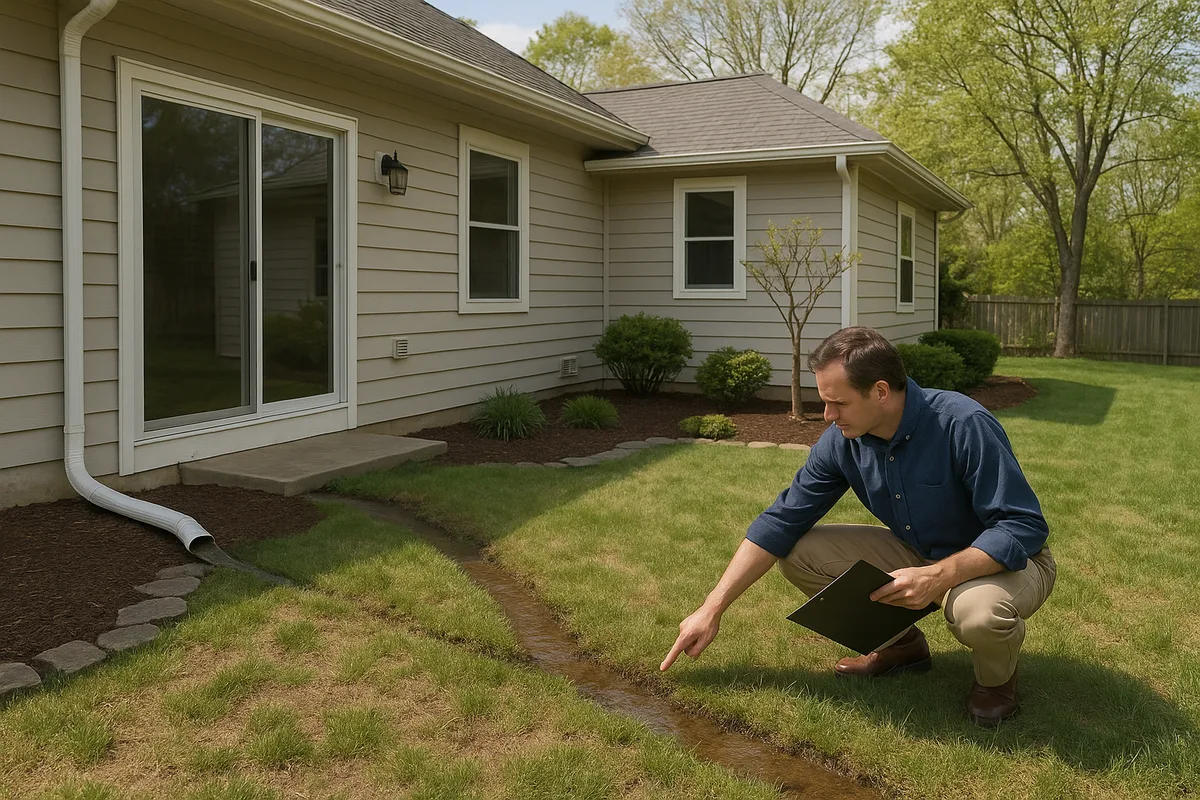
- Erosion: Surface runoff, especially from roof downspouts, erodes soil along the foundation perimeter. Without regular maintenance, channels form that direct water toward rather than away from the structure.
- Landscaping changes: Raised garden beds, mulch buildup, tree root growth, and patio installations can all alter the grade profile around a home. A 4-inch mulch ring that builds up over several years can effectively dam water against the foundation.
- Neighbor modifications: When adjacent properties are regraded, paved, or built up, the runoff patterns change for everyone downstream. Your grading may have been perfect when the house was built, but your neighbor's new patio is now sending an additional 500 square feet of runoff onto your lot.
This is why drainage failure homes are often homes that worked fine for years before problems appeared. The original grading was adequate, but time, nature, and neighborhood changes eroded that margin of safety until the system failed.
The Swale That Disappeared
Many subdivision grading plans rely on shallow swales — gentle, grass-lined channels between lots — to convey stormwater from backyards to storm drains or detention areas. These swales are critical infrastructure, but they're rarely maintained because most homeowners don't even know they exist. Over time, they fill with sediment, get buried under fences or sheds, or are graded flat during landscaping projects. When the swale disappears, the water that used to flow through it has to go somewhere — and that somewhere is usually the lowest lot in the chain.
The Groundwater Factor: Water Rising From Below
Not all water problems come from above. In many cases, the most persistent and hardest-to-solve drainage issues originate from below the surface, driven by a high or seasonally fluctuating water table.
The water table is the level below which the soil is fully saturated. In some regions, this level is 50 feet down and irrelevant to residential construction. In others — coastal plains, river valleys, glacial outwash areas, and regions with shallow bedrock — the water table may be just 2–4 feet below the surface. During wet seasons, it can rise to within inches of the ground surface or even above it.
Homes built in areas with a high water table face a fundamentally different drainage challenge than homes dealing with surface runoff. You can't grade your way out of a rising water table. French drains help only if they have somewhere to discharge to. Sump pumps can manage the symptom, but they're fighting a battle against hydrostatic pressure from an essentially infinite water source.
Signs of Water Table Problems vs. Surface Drainage Problems
Distinguishing between surface water and groundwater issues is critical because the solutions are completely different:
| Indicator | Surface Water Problem | Groundwater Problem |
|---|---|---|
| Timing | Occurs during/immediately after rain | Can occur during dry periods |
| Location | Concentrated near downspouts, low spots | Uniform across basement floor or yard |
| Basement water entry | Through walls, window wells, cove joint | Through floor cracks, floor-wall joint |
| Sump pump behavior | Runs during storms, stops after | Runs continuously, even in dry weather |
| Yard saturation | Puddles in specific areas | Entire yard feels spongy |
Many homes with chronic drainage problems are actually dealing with both simultaneously — surface water that can't infiltrate because the soil is already saturated from below. This double-whammy is common in river floodplains and low-lying coastal areas, and it's one of the reasons these properties seem impossible to dry out.
Impervious Surface Creep: Death by a Thousand Square Feet
One of the most underappreciated causes of chronic residential water problems is the gradual increase in impervious surface coverage — both on the property itself and in the surrounding watershed. Every square foot of roof, driveway, patio, sidewalk, and compacted soil is a square foot that can no longer absorb rainfall. Instead, that water becomes runoff, and it has to go somewhere.
Consider the math. A 2,000-square-foot roof generates approximately 1,250 gallons of runoff from a single inch of rainfall. Add a 600-square-foot driveway (375 gallons), a 200-square-foot patio (125 gallons), and 400 square feet of sidewalks and paths (250 gallons), and a single inch of rain on one residential property produces roughly 2,000 gallons of runoff that must be managed.
Now multiply that across an entire neighborhood. A typical subdivision with 30 homes on quarter-acre lots may have 40–60% impervious coverage when you include streets, driveways, and roofs. Before development, that same land might have had less than 5% impervious coverage. The volume and velocity of stormwater runoff in a developed neighborhood can be 5–10 times what the natural landscape produced. All of that additional water flows downhill, and the properties at the bottom of the drainage chain bear the cumulative burden.
The Neighborhood Development Effect
This is why some homes develop water problems years or even decades after construction. The house was fine when it was built in a neighborhood with large lots and mature trees. Then the lot next door was subdivided. A neighbor added a large addition and paved their backyard for parking. The city widened the street. Each change was small, but the cumulative effect was a dramatic increase in the volume of runoff reaching the low-lying properties.
This phenomenon — sometimes called "impervious surface creep" — is one of the most common drivers of chronic drainage problems on properties that previously had no issues. The property itself hasn't changed, but the watershed around it has been fundamentally altered.
Infrastructure Failures You Can't See
Beneath many residential neighborhoods lies a network of storm drainage infrastructure — pipes, catch basins, culverts, and outfalls — that was designed and installed decades ago. Like all infrastructure, it deteriorates over time, and when it fails, the consequences show up as water problems on individual properties.
Common Infrastructure Failures
- Collapsed or crushed pipes: Clay tile and corrugated metal storm pipes installed before the 1980s are particularly prone to collapse. When a pipe in the system fails, water backs up and surfaces at the lowest available point — often someone's yard or basement.
- Root intrusion: Tree roots seek out the moisture in storm drains and can completely block pipes over time. A single mature tree can render a 12-inch storm pipe functionally useless.
- Sediment accumulation: Storm drains that aren't regularly maintained accumulate sediment, reducing their capacity. A pipe designed to handle a 10-year storm event may only be able to handle a 2-year event after decades of sediment buildup.
- Undersized infrastructure: Many storm drainage systems were designed using rainfall data and development assumptions from the 1960s or 1970s. Increased impervious coverage and changing precipitation patterns mean these systems are now undersized for current conditions.
- Disconnected or abandoned systems: During road work, utility installations, or adjacent construction, storm drain connections can be accidentally severed or intentionally abandoned without adequate replacement.
The frustrating reality for homeowners is that much of this infrastructure is on public right-of-way or neighboring properties, making it invisible and inaccessible. A homeowner can spend thousands on drainage improvements for their own lot, only to discover that the real problem is a collapsed municipal storm pipe 200 feet down the street.
On-Site System Failures
Properties with their own drainage infrastructure — French drains, curtain drains, foundation drains, sump systems, and dry wells — face similar deterioration challenges. French drains are particularly notorious for failing over time. The geotextile fabric that wraps the gravel and pipe is designed to filter fine soil particles, but over 10–20 years, those particles accumulate and clog the fabric, reducing flow to a trickle. The drain still exists in the ground, but it's no longer functional.
This is one of the most common reasons homeowners report that "we already installed a French drain and it didn't work." In many cases, the drain worked fine initially but has since clogged. In other cases, the drain was installed without adequate understanding of where the water was coming from or where it needed to go, so it was solving the wrong problem from day one.
Climate Patterns and Changing Rainfall Intensity
The conversation about why some homes always have water problems would be incomplete without addressing the changing nature of rainfall itself. Across much of the United States, total annual precipitation hasn't changed dramatically, but the pattern of that precipitation has shifted significantly. More rain is falling in fewer, more intense events.
This matters enormously for residential drainage. A drainage system designed to handle 0.5 inches of rain per hour may be completely overwhelmed by a storm that delivers 2 inches in 30 minutes — even if the total daily rainfall is the same. The peak intensity, not the total volume, is what causes flooding.
NOAA's Atlas 14 precipitation frequency estimates show that in many parts of the country, what was once considered a 100-year rainfall event is now occurring every 25–50 years. Infrastructure and grading designed to handle historical rainfall patterns are increasingly inadequate for current conditions. This disproportionately affects properties that were already marginal — homes that could barely handle the old rainfall patterns are now overwhelmed by the new ones.
The Seasonal Saturation Cycle
In many regions, chronic drainage problems are worst in late winter and early spring — not because storms are necessarily larger, but because the soil is already saturated from months of winter precipitation, snowmelt, or a high seasonal water table. A 0.5-inch rain event in August might produce zero runoff because the soil can absorb it all. The same 0.5-inch event in March, on already-saturated soil, produces nearly 100% runoff. Properties that seem fine for nine months of the year suddenly become swamps during the wet season.
This seasonal pattern is a hallmark of drainage failure homes and often leads to misdiagnosis. Homeowners and contractors visit the property during dry conditions, see no obvious problems, and conclude the drainage is adequate. The problems only manifest under saturated conditions — which are precisely the conditions that matter most.
Why Common Fixes Fail: Treating Symptoms Instead of Causes
The residential drainage industry has a pattern of applying standardized solutions without first understanding the specific causes of a property's water problems. This leads to a cycle of failed fixes that costs homeowners thousands of dollars and years of frustration.
The Typical Fix-and-Fail Cycle
Here's how it usually goes:
- Homeowner notices water in basement or standing water in yard. They call a waterproofing company or landscaper.
- Contractor proposes a solution — usually whatever solution they specialize in. Waterproofing companies recommend interior drain tile and sump pumps. Landscapers recommend regrading and French drains. Gutter companies recommend gutter guards and downspout extensions.
- The solution is installed and may work for a while, especially if conditions are dry.
- The problem returns during the next significant wet period because the underlying cause was never identified or addressed.
- The homeowner calls a different contractor, who proposes a different solution, and the cycle repeats.
This cycle persists because most contractors are solution-focused rather than diagnostic-focused. They're trained to install specific products, not to analyze watershed hydrology, soil stratigraphy, or topographic drainage patterns. It's the equivalent of a doctor prescribing medication without running any tests.
What a Proper Diagnostic Approach Looks Like
Solving chronic drainage problems requires a diagnostic process that identifies all contributing factors before any solution is proposed:
- Topographic analysis: Where does the property sit in the local drainage pattern? What is the contributing watershed area? Where are the natural flow paths?
- Soil investigation: What are the soil types and layers? Where is the water table? What are the infiltration rates at various depths?
- Grading assessment: Does the current grade move water away from the foundation? Are swales and drainage paths intact and functional?
- Infrastructure evaluation: Are existing drainage systems (French drains, storm pipes, sump systems) functional? Are municipal systems in the area adequate?
- Impervious surface analysis: What percentage of the property and surrounding area is impervious? How has this changed over time?
- Hydrologic modeling: Given all of the above, how much water reaches the property during various storm events, and where does it go?
Only after this diagnostic work is complete can appropriate solutions be designed with confidence. In many cases, the analysis reveals that the problem requires a combination of approaches — not just one fix, but a system of interventions that address multiple contributing factors simultaneously.
Breaking the Cycle: A Systems Approach to Chronic Drainage Problems
Homes with persistent water problems need more than a single intervention. They need a drainage strategy — a coordinated system of solutions designed around the specific conditions of the property and its position in the landscape.
The Hierarchy of Drainage Solutions
Effective drainage management follows a hierarchy, and each level should be addressed before moving to the next:
- Intercept water before it reaches the property. If runoff from upslope properties is contributing to the problem, interceptor drains, berms, or swales at the property boundary can redirect it before it becomes your problem.
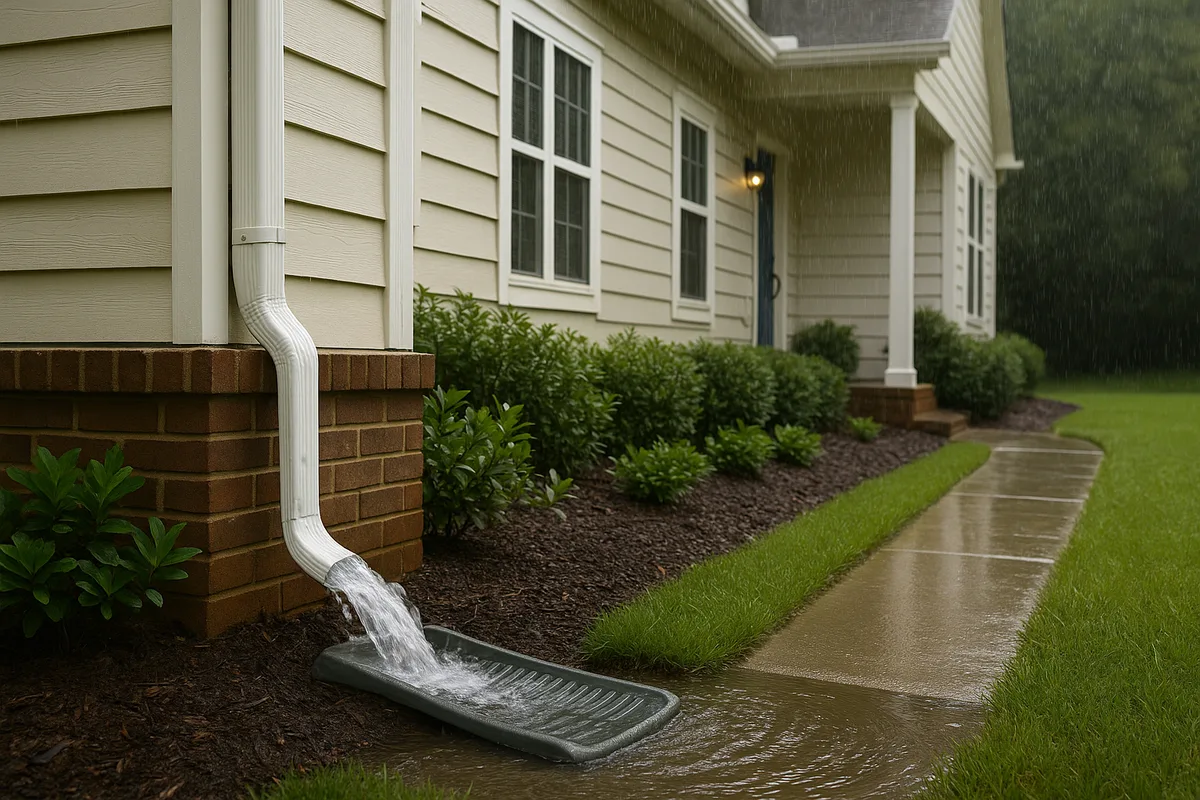
- Move surface water away from the structure. Proper grading, functional gutters and downspouts, and adequate discharge points are the foundation of any drainage system. These should be optimized before investing in subsurface solutions.
- Manage subsurface water. Foundation drains, curtain drains, and sump systems address water that infiltrates the soil. These are essential on properties with high water tables or clay soils but should complement — not replace — surface drainage.
- Provide adequate discharge. Every drainage system needs somewhere to send the water. This might be a storm drain, a daylight outlet, a rain garden, or a dry well — but it must have sufficient capacity and must not create problems for downstream properties.
- Build in redundancy. Properties with chronic problems should have backup systems. A sump pump needs a battery backup. A French drain needs a cleanout for maintenance access. A swale needs an overflow path for extreme events.
When the Problem Is Bigger Than Your Property
Some drainage problems genuinely cannot be solved at the individual property level. If your home sits at the bottom of a watershed that generates more runoff than your lot can manage, no amount of on-site drainage work will fully solve the problem. In these cases, solutions may require:
- Coordination with neighbors to address shared drainage paths and swales
- Engagement with municipal authorities to repair or upgrade public storm drainage infrastructure
- Community-level stormwater management such as detention basins, bioswales, or permeable pavement in shared areas
- Easement negotiations to establish legal drainage paths across adjacent properties
These situations are complex and often contentious, but they're sometimes the only path to a real solution. Understanding the full scope of the problem — through proper topographic and hydrologic analysis — is essential for making the case and designing effective interventions.
Moving From Frustration to Understanding
If your home has chronic drainage problems, the most important thing you can do is stop guessing and start diagnosing. Every failed fix represents not just wasted money, but wasted time during which water continues to damage your foundation, degrade your landscaping, and diminish your property value.
The properties that always seem to have water problems aren't cursed — they're misunderstood. The water is following rules. It's responding to topography, soil, groundwater, impervious surfaces, and infrastructure conditions that can be measured, mapped, and analyzed. Once you understand why the water behaves the way it does on your property, you can design solutions that actually work.
At Low Point Labs, we specialize in exactly this kind of diagnostic intelligence. Our topographic drainage assessments use high-resolution elevation data, soil analysis, and hydrologic modeling to reveal the complete picture of why water moves the way it does on your property. We identify the root causes — not just the symptoms — so that any investment you make in drainage improvements is targeted, effective, and lasting. If you're tired of the fix-and-fail cycle, explore our drainage assessment services and find out what's really going on beneath the surface.
See Drainage Intelligence in Practice
Talk with our team or request an invitation to the platform.
Frequently Asked Questions
Your property likely sits at a lower elevation or topographic collection point, even if the difference isn't visible to the eye. Subtle grade changes of just a few inches can direct runoff from surrounding properties onto yours. High-resolution elevation data can reveal these hidden drainage patterns.
A French drain can help, but only if the water problem is caused by shallow subsurface water that the drain can intercept and redirect. If the issue is a high water table, poor topographic position, or upstream runoff volume that exceeds the drain's capacity, a French drain alone won't solve the problem. Proper diagnosis is essential before installation.
Drainage conditions change over time. Common causes include backfill settlement around the foundation, increased impervious surfaces in the neighborhood, clogged or collapsed drainage infrastructure, and changes in precipitation intensity. A property that drained adequately at construction can develop chronic problems as these factors accumulate.
Surface runoff problems occur during and immediately after rainstorms and tend to affect specific low spots. High water table problems can occur even during dry weather, cause uniform saturation across the yard, and often result in sump pumps running continuously. Many properties experience both simultaneously.
Soil type is one of the most significant factors in residential drainage. Clay-heavy soils (Hydrologic Soil Groups C and D) have very slow infiltration rates and generate much more runoff than sandy soils. You can look up your property's soil type for free using the NRCS Web Soil Survey.
Yes. If your property sits at the bottom of a large drainage area, the volume of water reaching your lot may exceed what any on-site system can handle. In these cases, solutions may require coordination with neighbors, municipal infrastructure improvements, or community-level stormwater management.
Related Articles
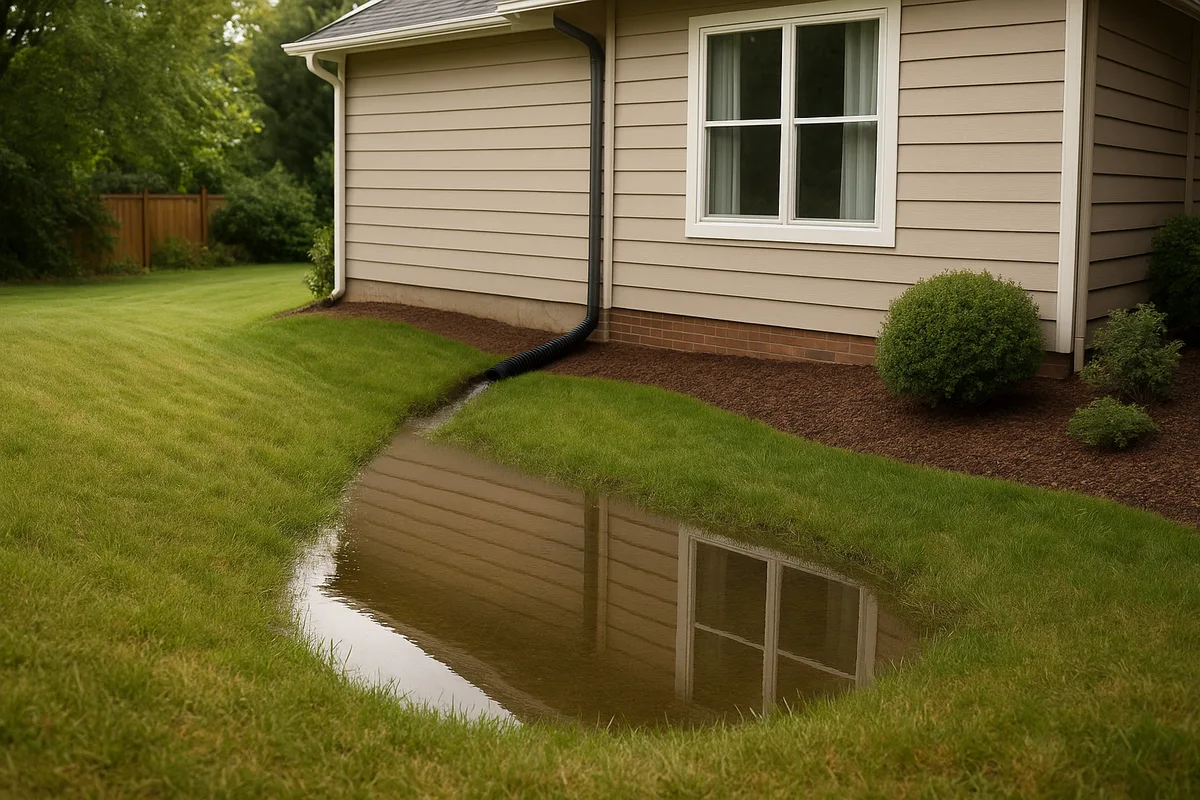
How Terrain Determines Where Water Will Pool on Your Property
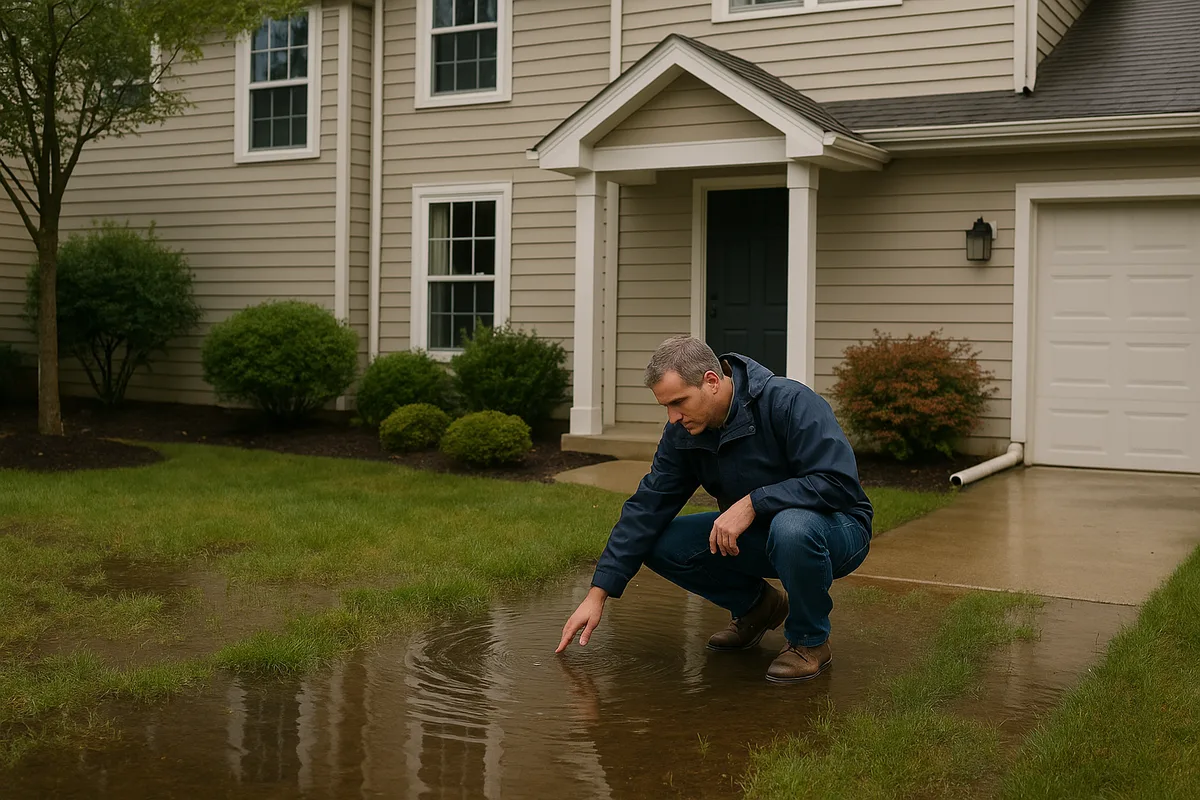
How to Evaluate a Property After a Storm Event: A Complete Guide