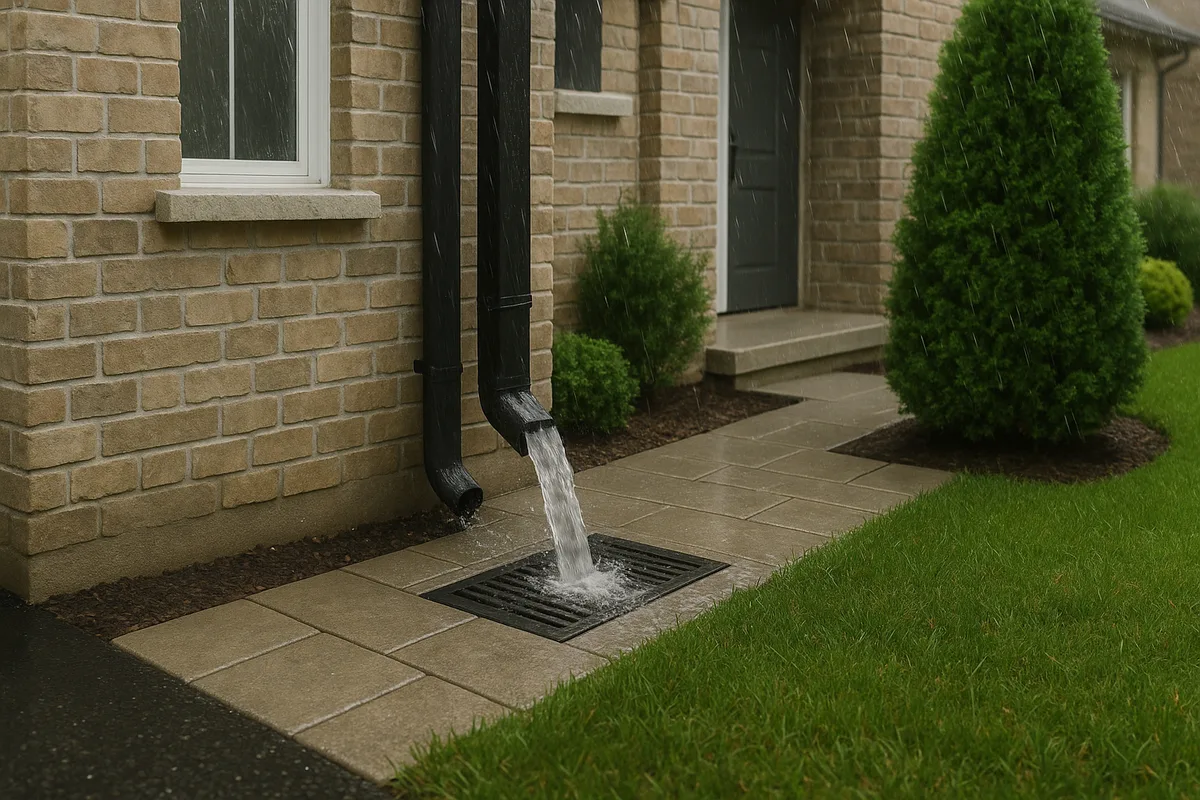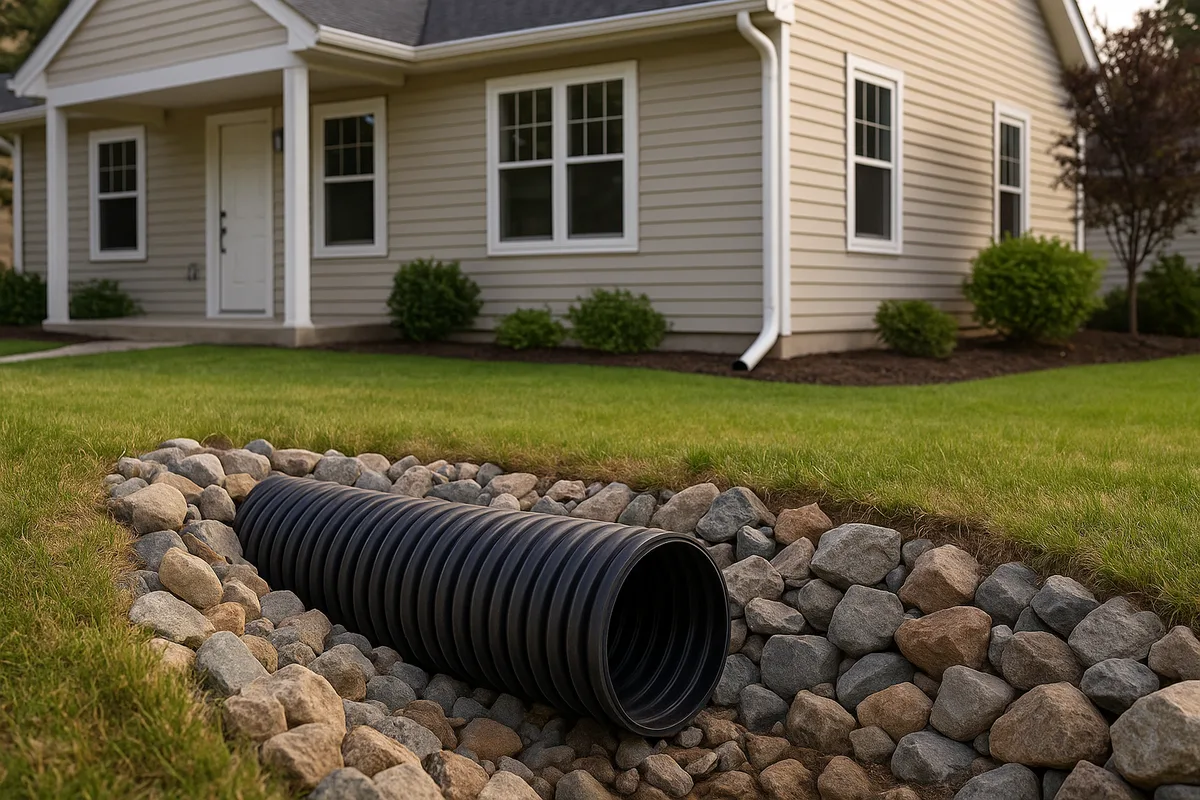
Right-Sizing Pipes and Culverts for Real-World Drainage Conditions
Getting pipe sizing right is one of the most consequential decisions in any residential drainage project. Install a pipe that's too small, and you'll face backups, erosion, and property damage during heavy storms. Go too large, and you waste money on materials, excavation, and potentially create low-velocity conditions that encourage sediment buildup. The sweet spot — right-sizing — requires more than plugging numbers into a formula. It demands an understanding of real-world conditions: your soil, your slope, your watershed, and the storms your region actually produces.
At Low Point Labs, we've analyzed thousands of residential properties and consistently find that drainage failures trace back to one root cause more than any other: pipes and culverts that were sized using assumptions rather than site-specific data. This guide walks you through the principles, calculations, and practical considerations that separate a drainage system that works on paper from one that works in the ground, in the rain, decade after decade.
Why Pipe Sizing Matters More Than Most Homeowners Realize
Drainage infrastructure is buried and invisible, which makes it easy to undervalue. But an undersized pipe doesn't just underperform — it actively creates problems. When a pipe can't handle the flow directed to it, water backs up at the inlet, overtops the surrounding grade, and finds alternative paths. Those alternative paths often lead to foundations, crawl spaces, retaining walls, and neighboring properties. What started as a simple capacity shortfall becomes a structural and legal problem.
Oversizing carries its own risks. A pipe that's dramatically larger than needed will carry water at very low velocities. When flow velocity drops below approximately 2 feet per second (fps), sediment that enters the pipe settles out instead of being carried through. Over time, this sediment accumulation reduces the effective diameter of the pipe, ironically creating the same capacity problem you were trying to avoid. You also pay more — not just for the pipe itself, but for the wider trench, additional bedding material, and heavier equipment required to handle larger-diameter pipe.
The goal of proper drainage pipe sizing is to match the pipe's hydraulic capacity to the peak flow it will need to convey during the design storm event, while maintaining a velocity that keeps the pipe self-cleaning. This balance is where engineering meets site reality.
Understanding Hydraulic Capacity: What a Pipe Can Actually Carry
Every pipe has a theoretical maximum flow rate determined by its diameter, slope, roughness, and whether it flows full or partially full. This is its hydraulic capacity — the ceiling on how much water the pipe can move. Understanding how each variable affects capacity is essential for making informed sizing decisions.
Diameter: The Dominant Variable
Diameter has the single largest impact on capacity. The relationship isn't linear — it's exponential. Doubling the diameter of a pipe increases its flow capacity by roughly 5.6 times, not two times. This means that the difference between a 6-inch and an 8-inch pipe is far more significant than the 2-inch measurement gap suggests. An 8-inch pipe carries approximately 2.1 times the flow of a 6-inch pipe at the same slope and roughness. Moving from 12 inches to 15 inches nearly doubles capacity again.
This exponential relationship is why even small errors in estimating peak flow can lead to dramatically wrong pipe sizes. If you underestimate flow by 30%, you might select a 12-inch pipe when you actually need a 15-inch — and that 12-inch pipe will be overwhelmed during exactly the storms that matter most.
Slope: The Engine of Flow
Slope provides the gravitational energy that drives water through a pipe. Steeper slopes produce higher velocities and greater capacity. A 12-inch corrugated HDPE pipe at 1% slope carries roughly 1.8 cubic feet per second (cfs) flowing full. Increase the slope to 2%, and capacity jumps to about 2.5 cfs. At 4%, it reaches approximately 3.6 cfs.
But slope is often the variable you have the least control over. Residential sites have existing grades, and the pipe must connect a specific inlet elevation to a specific outlet elevation. The available slope is dictated by these fixed points and the horizontal distance between them. When available slope is limited — a common scenario on flat lots — you'll need a larger diameter to compensate.
Roughness: The Hidden Resistance
The interior surface of a pipe creates friction that resists flow. Rougher surfaces slow water down and reduce capacity. This friction is quantified by Manning's roughness coefficient (n), a dimensionless number where higher values mean more friction.
Common Manning's n values for residential drainage pipes:
- Smooth-wall PVC or HDPE: n = 0.009–0.012
- Corrugated HDPE (interior smooth): n = 0.012–0.015
- Corrugated metal pipe (CMP): n = 0.022–0.027
- Corrugated HDPE (corrugated interior): n = 0.018–0.025
- Concrete pipe: n = 0.012–0.015
- Cast iron: n = 0.012–0.014
The difference between a smooth-wall pipe (n = 0.010) and a corrugated metal pipe (n = 0.024) is enormous in practice. At the same diameter and slope, the smooth pipe carries roughly 2.4 times more water. This is why material selection is inseparable from pipe sizing — choosing a rougher material without adjusting the diameter is a recipe for undersizing.
The Manning Equation: Your Core Sizing Tool
The Manning equation is the workhorse of open-channel and gravity-pipe hydraulics. For pipes flowing full (or designed to flow full), it calculates velocity and, by extension, flow capacity:
V = (1.49 / n) × R^(2/3) × S^(1/2)
Where:
- V = velocity (feet per second)
- n = Manning's roughness coefficient
- R = hydraulic radius (cross-sectional area of flow divided by wetted perimeter; for a full circular pipe, R = D/4)
- S = slope of the pipe (feet per foot, or percent expressed as a decimal)
Once you have velocity, flow rate (Q) is simply:
Q = V × A
Where A is the cross-sectional area of the pipe.
Working Through a Real Example
Let's size a pipe for a residential lot that needs to convey 2.3 cfs of peak runoff. The available slope is 1.5% (0.015 ft/ft), and we're using smooth-interior corrugated HDPE (n = 0.012).
For a 12-inch (1.0 ft) diameter pipe:
- A = π × (1.0)² / 4 = 0.785 ft²
- R = 1.0 / 4 = 0.25 ft
- V = (1.49 / 0.012) × (0.25)^(2/3) × (0.015)^(1/2)
- V = 124.17 × 0.397 × 0.1225
- V ≈ 6.04 fps
- Q = 6.04 × 0.785 ≈ 4.74 cfs
A 12-inch pipe at this slope and roughness handles 4.74 cfs — well above our 2.3 cfs requirement. Let's check a 10-inch (0.833 ft) pipe:
- A = π × (0.833)² / 4 = 0.545 ft²
- R = 0.833 / 4 = 0.208 ft
- V = 124.17 × (0.208)^(2/3) × 0.1225
- V = 124.17 × 0.351 × 0.1225
- V ≈ 5.34 fps
- Q = 5.34 × 0.545 ≈ 2.91 cfs
A 10-inch pipe carries 2.91 cfs — still above our 2.3 cfs target with a reasonable margin. Now check an 8-inch (0.667 ft) pipe:
- A = 0.349 ft²
- R = 0.167 ft
- V = 124.17 × (0.167)^(2/3) × 0.1225 ≈ 4.62 fps
- Q = 4.62 × 0.349 ≈ 1.61 cfs
The 8-inch pipe falls short at 1.61 cfs. So for this scenario, a 10-inch pipe is the right size — it handles the design flow with roughly 26% surplus capacity, and velocity stays well above the 2 fps self-cleaning minimum.
This is the fundamental process of culvert sizing and pipe sizing: calculate your design flow, then iterate through pipe sizes until you find the one that matches.
Calculating Design Flow: The Rational Method
Before you can size a pipe, you need to know how much water it must carry. For residential and small-site applications, the Rational Method is the standard approach:
Q = C × I × A
Where:
- Q = peak runoff (cfs)
- C = runoff coefficient (dimensionless, 0 to 1)
- I = rainfall intensity (inches per hour) for the design storm and time of concentration
- A = drainage area (acres)
Selecting the Runoff Coefficient
The runoff coefficient represents the fraction of rainfall that becomes surface runoff rather than infiltrating into the soil. It varies by surface type:
- Rooftops: C = 0.85–0.95
- Concrete/asphalt driveways: C = 0.85–0.95
- Gravel surfaces: C = 0.35–0.70
- Lawns on sandy soil (flat, <2% slope): C = 0.05–0.10
- Lawns on clay soil (steep, >7% slope): C = 0.25–0.35
- Wooded areas: C = 0.10–0.20
For a drainage area with mixed surfaces, calculate a weighted average. A typical suburban lot might have 30% impervious surface (C = 0.90) and 70% lawn on loam soil (C = 0.20), yielding a composite C of approximately 0.41.
Determining Rainfall Intensity
Rainfall intensity depends on two things: the return period (design storm frequency) and the time of concentration (how long it takes water to travel from the farthest point in the drainage area to the pipe inlet).
Most residential drainage systems are designed for the 10-year storm — meaning the intensity of rainfall expected to be equaled or exceeded once every 10 years on average. Some jurisdictions require 25-year or even 100-year design storms for culverts that cross roads or affect multiple properties.
Rainfall intensity data for your specific location is available through NOAA Atlas 14, which provides precipitation frequency estimates for any point in the United States. Enter your coordinates, select the return period and duration matching your time of concentration, and you'll get the intensity value for your design storm.
Why Real-World Flow Estimates Differ from Textbook Ones
The Rational Method works well for small drainage areas (under about 200 acres), but its accuracy depends entirely on the quality of your inputs. Here's where real-world conditions diverge from assumptions:
Drainage area boundaries aren't always obvious. On flat terrain, it's difficult to determine exactly where water flows without detailed topographic data. A slight ridge that diverts runoff from a neighbor's yard onto yours can increase your drainage area — and design flow — by 50% or more.
Runoff coefficients change over time. A new development upslope, a patio addition, or even soil compaction from construction traffic can increase the C value for areas draining to your pipe.
Rainfall patterns are shifting. NOAA Atlas 14 is based on historical data, and many regions are experiencing more intense short-duration rainfall events than historical records predict. Designing to the 10-year storm using yesterday's data may leave you undersized for tomorrow's weather.
Antecedent moisture matters. The Rational Method doesn't account for how wet the soil already is when the design storm hits. Saturated soils produce dramatically more runoff than dry soils, effectively pushing the C value higher.
Culvert Design: Special Considerations Beyond Pipe Sizing
Culvert design involves additional factors that don't apply to simple yard drain pipes. Culverts carry water under roads, driveways, or embankments, and their failure has more severe consequences — including road washouts, embankment collapse, and upstream flooding.
Inlet and Outlet Control
Culvert hydraulics operate under one of two conditions: inlet control or outlet control. Understanding which condition governs your culvert determines how you size it.
Inlet control occurs when the culvert barrel can carry more water than the inlet can accept. The capacity bottleneck is at the entrance. Headwater depth (the ponding depth upstream of the culvert) is the primary factor determining flow. Inlet control is common with steep culverts and smooth-barrel pipes where the pipe itself has abundant capacity.
Outlet control occurs when the culvert barrel's friction and length limit capacity more than the inlet geometry does. Headwater depth depends on the barrel length, roughness, slope, and tailwater conditions (water level at the outlet). Outlet control is common with long culverts, rough-walled pipes, and flat slopes.
For residential driveway culverts, inlet control is more common, and headwater depth is your primary design constraint. Most homeowners and local codes want headwater depth limited to 1.0 to 1.5 times the culvert diameter — meaning a 15-inch culvert should have no more than about 15 to 22.5 inches of water ponding at its inlet during the design storm.
Culvert Shape and Material
Round pipes are the most common and cost-effective culvert shape, but they're not always the best choice. When cover depth is limited (the vertical distance between the top of the culvert and the road surface), pipe-arch or elliptical shapes provide equivalent hydraulic capacity with less height. A 15-inch round pipe and a 14×23-inch pipe-arch carry similar flows, but the arch shape needs 1 inch less of vertical space.
Material selection for culverts must account for structural loads (traffic weight), corrosion resistance, and expected service life:
- Corrugated HDPE: Lightweight, corrosion-resistant, 50–75+ year service life. Best for residential driveways with limited traffic.
- Reinforced concrete pipe (RCP): Extremely durable, 75–100+ year service life. Ideal for municipal roads and heavy-load applications.
- Corrugated metal pipe (CMP): Moderate cost, but susceptible to corrosion in acidic or saline environments. 25–50 year service life depending on gauge and coatings.
- Aluminized steel: Better corrosion resistance than standard CMP, suitable for moderate-pH environments.
End Treatments and Erosion Protection
A properly sized culvert can still fail if its inlet and outlet aren't properly treated. Headwalls, wingwalls, and flared end sections serve three functions: they improve hydraulic efficiency (reducing headwater depth by 10–25% compared to a projecting pipe), they prevent embankment erosion around the pipe ends, and they protect the pipe from damage.
At the outlet, energy dissipation is critical. Water exiting a culvert at high velocity will scour the downstream channel if not controlled. Riprap aprons are the most common residential solution — a pad of graded stone extending at least 4 pipe diameters downstream, with a depth of at least 1.5 times the D50 stone size. For a 15-inch culvert with an outlet velocity of 6 fps, a riprap apron using 4–6 inch stone, extending 5 feet downstream and 3 feet wide, is a reasonable starting point.
Common Pipe Sizing Mistakes in Residential Projects
After analyzing drainage systems across diverse residential properties, we've identified the most frequent sizing errors. Avoiding these mistakes is often more valuable than mastering the calculations, because even perfect math can't overcome flawed assumptions.
Mistake 1: Ignoring Upstream Development
The most common cause of undersized residential pipes is failing to account for the full contributing drainage area. Your pipe doesn't just handle rain that falls on your property — it handles all the runoff that flows onto your property from uphill. A 0.5-acre lot might have a 3-acre contributing watershed if it sits at the bottom of a slope. Sizing the pipe for 0.5 acres of runoff guarantees failure.
Accurate drainage area delineation requires topographic data. Eyeballing slopes and guessing at watershed boundaries introduces errors that cascade through every subsequent calculation. This is precisely the type of analysis where high-resolution elevation data transforms outcomes.
Mistake 2: Using the Wrong Roughness Coefficient
Many DIY drainage projects and even some contractor installations use Manning's n values from generic tables without verifying which value applies to their specific pipe product. A single manufacturer may offer corrugated HDPE pipe with both corrugated and smooth interiors — and the capacity difference between n = 0.012 and n = 0.024 is a factor of two. Using the wrong n value effectively halves or doubles your calculated capacity.
Always use the Manning's n value specified by the pipe manufacturer for the specific product you're installing. If the manufacturer doesn't provide one, use the higher (rougher) end of the published range for that pipe type.
Mistake 3: Designing for Average Conditions Instead of Peak Conditions
Drainage pipes don't need to handle average rainfall — they need to handle the peak intensity of the design storm. A region that receives 40 inches of rain per year might experience peak 10-year intensities of 5 inches per hour for a 10-minute duration. Designing for average conditions produces a pipe that works perfectly 95% of the time and catastrophically fails during the storms that cause damage.
Mistake 4: Neglecting Debris and Maintenance
Theoretical capacity assumes a clean, unobstructed pipe. In practice, pipes accumulate sediment, leaves, root intrusions, and other debris that reduce effective diameter. A conservative approach adds a 20–25% capacity buffer to account for real-world obstruction. Some engineers apply a clogging factor that reduces the effective diameter by 10–15% for the design life of the pipe.
For culverts in wooded areas or locations with significant leaf litter, this factor should be even higher unless the owner commits to regular inspection and cleaning.
Mistake 5: Insufficient Slope
Minimum pipe slope recommendations exist for a reason. At slopes below about 0.5% for small-diameter pipes (4–8 inches), flow velocity drops below the 2 fps self-cleaning threshold. Sediment settles, biological growth accelerates, and effective capacity degrades rapidly. For residential applications, a minimum slope of 1% is a practical target. If site conditions force you below 1%, increase the pipe diameter to maintain velocity, or consider alternative conveyance strategies.
Pipe Sizing for Special Conditions
Textbook sizing assumes uniform conditions along the pipe's length. Real sites are rarely that cooperative. Several common scenarios require adjustments to the standard approach.
Shallow Groundwater and Saturated Soils
When the water table is near the pipe invert, the pipe may need to handle both surface runoff and groundwater infiltration. Perforated pipes used in French drain applications are intentionally designed to collect groundwater, but even solid-wall pipes can experience infiltration at joints, especially in older systems. For sites with high water tables, consider sizing the pipe to handle both the calculated surface runoff and an estimated groundwater contribution.
Soil data from the NRCS Web Soil Survey can help identify areas with seasonal high water tables, poorly drained soils, and hydrologic soil groups that influence both runoff coefficients and groundwater behavior.
Multiple Inlets and Branching Systems
Residential drainage systems often have multiple catch basins or area drains feeding into a single trunk line. The trunk line must be sized for the combined peak flow from all contributing inlets — but that combined peak isn't simply the sum of individual peaks if the drainage sub-areas have different times of concentration.
For small residential systems where all sub-areas are within a few hundred feet of each other, summing the individual peak flows is a reasonable and conservative approach. For larger or more spread-out systems, a routing analysis may be warranted to determine the actual combined peak.
When pipes join, the downstream pipe must be at least as large as the largest upstream pipe. It's hydraulically incorrect to reduce pipe size in the downstream direction, even if the slope increases. This principle is sometimes violated in residential installations, creating bottleneck points that cause backups.
Tailwater Conditions
If your pipe outlets into a ditch, stream, or pond that already has standing water, that tailwater reduces the pipe's capacity. A pipe that can carry 3 cfs with a free outlet might only carry 2 cfs when the outlet is submerged. Tailwater effects are particularly important for culverts and for pipes that outlet near flood-prone areas.
Design should account for the tailwater elevation expected during the design storm — which is often higher than normal water levels, since the same storm that fills your pipe is also raising water levels in the receiving channel.
Cold Climate Considerations
In regions with freeze-thaw cycles, pipe sizing must account for ice formation that reduces effective diameter. Frost heave can also alter pipe slope, reducing capacity or creating low spots where water ponds and freezes. Deeper burial (below the frost line) mitigates frost heave, but increases installation cost. For culverts in cold climates, many engineers add an additional 10–15% to the calculated pipe diameter as a frost allowance.
From Calculation to Installation: Bridging the Gap
Even a perfectly sized pipe will underperform if installation doesn't match the design assumptions. Several installation practices directly affect whether the pipe achieves its calculated capacity.
Bedding and Backfill
Pipe bedding — the material the pipe rests on — must provide uniform support along the pipe's length. Rocks, roots, or voids beneath the pipe create point loads that can deform flexible pipe (HDPE, PVC) and crack rigid pipe (concrete). A minimum 4-inch bedding of compacted granular material (clean crushed stone or coarse sand) is standard practice for most residential installations.
Backfill material and compaction are equally important. Poorly compacted backfill settles over time, creating surface depressions that concentrate water directly above the pipe — exactly where you don't want it. Backfill should be placed in 6–8 inch lifts, each compacted to 90–95% of standard Proctor density.
Maintaining Design Slope
The pipe must maintain its design slope consistently from inlet to outlet. A sag (belly) in the middle of a run creates a low point where sediment accumulates and water ponds. Even a 1-inch sag in a 50-foot run can reduce effective capacity and create maintenance problems. Use a laser level or string line during installation to verify grade at every joint.
Joint Integrity
Pipe joints that separate or misalign create turbulence, reduce capacity, and allow soil infiltration that gradually clogs the pipe. Follow manufacturer specifications for joint assembly, and use couplings rated for the expected loads and soil conditions. For corrugated HDPE pipe, snap-together joints are adequate for most residential gravity applications, but soil-tight or water-tight joints may be required in areas with high groundwater or fine-grained soils.
Inlet Protection
The pipe inlet is the most vulnerable point in the system. A grate, screen, or catch basin with a sump should protect the inlet from debris that would clog the pipe. The grate or screen must be sized so that it doesn't become the capacity bottleneck — a common mistake. A grate with 50% open area needs roughly twice the cross-sectional area of the pipe to avoid restricting flow. For a 12-inch pipe, that means a grate opening of at least 1.5 square feet.
Making Smarter Sizing Decisions with Better Data
The accuracy of any pipe sizing calculation is only as good as the data behind it. Drainage area, slope, soil type, rainfall intensity — each input carries uncertainty, and those uncertainties compound. A 20% error in drainage area combined with a 15% error in runoff coefficient produces a flow estimate that could be off by 38% or more. That's the difference between a pipe that works and one that floods your yard.
This is where modern topographic intelligence changes the equation. High-resolution elevation data reveals the actual drainage boundaries, flow paths, and slopes on your property — not the ones you assume or estimate from a walk-around inspection. It identifies low points where water collects, subtle ridges that redirect flow, and upstream areas that contribute runoff to your system.
At Low Point Labs, we specialize in exactly this type of analysis. Our drainage assessments use detailed topographic data to map your property's true drainage patterns, identify contributing areas, and provide the site-specific inputs that make pipe sizing calculations accurate. Whether you're planning a new drainage installation, troubleshooting an existing system, or evaluating a property before purchase, understanding your site's topographic reality is the foundation of every good drainage decision.
Stop guessing at pipe sizes and start sizing with confidence. Explore Low Point Labs' drainage assessment services to get the topographic intelligence your project needs.
See Drainage Intelligence in Practice
Talk with our team or request an invitation to the platform.
Frequently Asked Questions
The correct pipe size depends on the volume of water it must carry, which is determined by your drainage area, soil type, slope, and local rainfall intensity. Most residential yard drains use 4-inch to 8-inch pipes, but properties with large contributing areas or steep slopes may require 10-inch to 15-inch pipes. A site-specific calculation using the Rational Method and Manning equation is the only reliable way to determine the right size.
Use the Manning equation: V = (1.49/n) × R^(2/3) × S^(1/2), where n is the pipe's roughness coefficient, R is the hydraulic radius (diameter divided by 4 for a full pipe), and S is the slope. Multiply the resulting velocity by the pipe's cross-sectional area to get the flow rate in cubic feet per second.
A minimum slope of 0.5% is generally required to maintain self-cleaning velocity (at least 2 feet per second) in most pipe materials. However, a 1% slope is recommended for residential installations to provide a margin of safety against sediment buildup and minor installation imperfections.
An undersized culvert causes water to pond upstream (creating excessive headwater), which can overtop the road or embankment, erode the surrounding soil, flood upstream properties, and potentially wash out the entire crossing. Undersized culverts also experience higher outlet velocities that cause downstream scour and erosion.
Smooth-interior pipe carries roughly twice the water as corrugated-interior pipe of the same diameter and slope because it creates less friction. For most residential drainage applications, smooth-interior corrugated HDPE offers the best balance of capacity, durability, and cost. If you use corrugated-interior pipe, you'll need to increase the diameter to achieve equivalent capacity.
Most residential drainage pipes are designed for the 10-year storm, meaning the rainfall intensity expected to occur on average once every 10 years. Culverts crossing roads or affecting multiple properties are often designed for the 25-year or 50-year storm. Check your local jurisdiction's stormwater ordinance for specific requirements, as these vary widely.
Related Articles
How to Calculate a Catchment Area Without Spending Hours on Google Earth

How to Spot Undersized Drainage Systems Before They Fail