Designing a Swale vs French Drain: How to Choose the Right System
When water pools in your yard after every rainstorm, the question isn't whether you need a drainage solution — it's which one. The swale vs French drain debate is one of the most common decisions homeowners and contractors face when designing a system to move water away from structures and prevent erosion. Both are proven, time-tested approaches, but they solve fundamentally different problems in fundamentally different ways.
Choosing the wrong one doesn't just waste money — it can make your drainage problem worse. A French drain installed where a swale is needed may overwhelm the pipe's capacity. A swale cut into terrain that demands subsurface interception may leave saturated soil right where you don't want it. Understanding the engineering principles behind each system, and how they interact with your specific property's topography, soil, and hydrology, is the foundation of effective drainage system design.
This guide breaks down everything you need to know to make the right choice: how each system works, when one outperforms the other, how to size and design them properly, and the real-world cost and maintenance implications that most articles gloss over.
How Swales and French Drains Actually Work
Before comparing the two systems, it's essential to understand the mechanics of each. Despite being lumped together in casual conversation, swales and French drains operate on entirely different principles — one manages water on the surface, the other intercepts it below grade.
Swales: Engineered Surface Channels
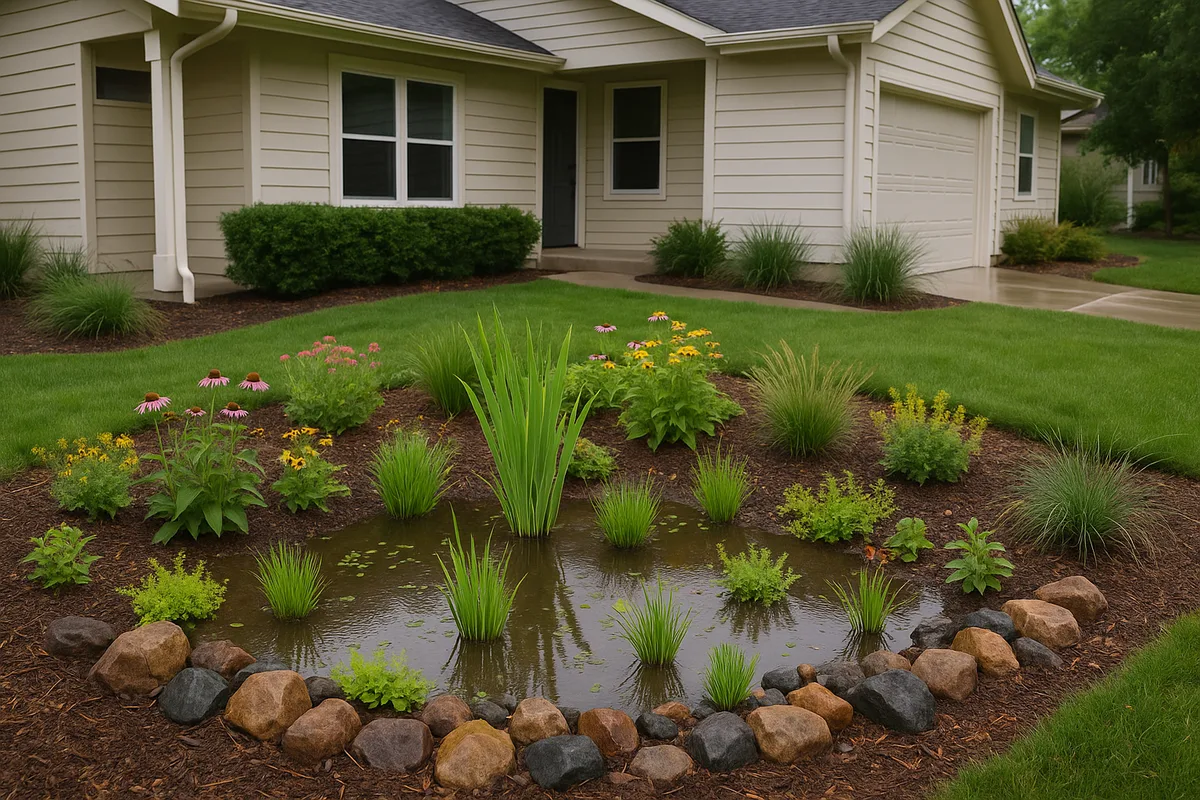
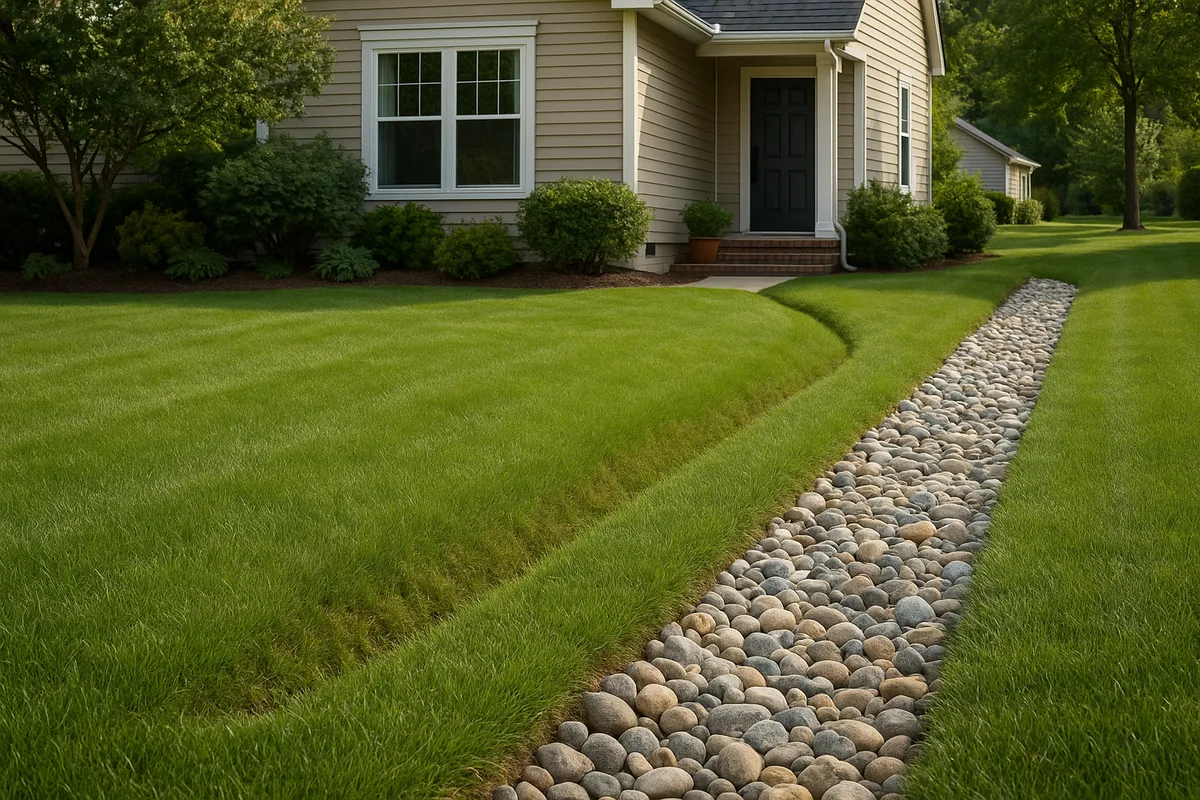
A swale is a shallow, vegetated or lined channel designed to collect and convey surface runoff along a controlled path. Think of it as a deliberately shaped depression in the landscape — wider and shallower than a ditch, with gently sloped sides that allow water to flow without causing erosion.
Swales work by gravity. Water enters the channel from the surrounding grade, flows along the swale's longitudinal slope, and is directed to a designated outlet — a rain garden, dry well, storm drain, or natural drainage course. The vegetated surface slows the water, promotes infiltration into the soil, and filters sediment and pollutants. A properly designed swale has a cross-sectional shape (typically parabolic or trapezoidal), a calculated longitudinal grade (usually between 1% and 5%), and side slopes gentle enough to mow — typically 3:1 or flatter.
Swales are surface-level systems. They handle sheet flow and concentrated runoff that you can see. They're integral to landscape grading and are often the most natural-looking drainage solution available.
French Drains: Subsurface Interception Systems
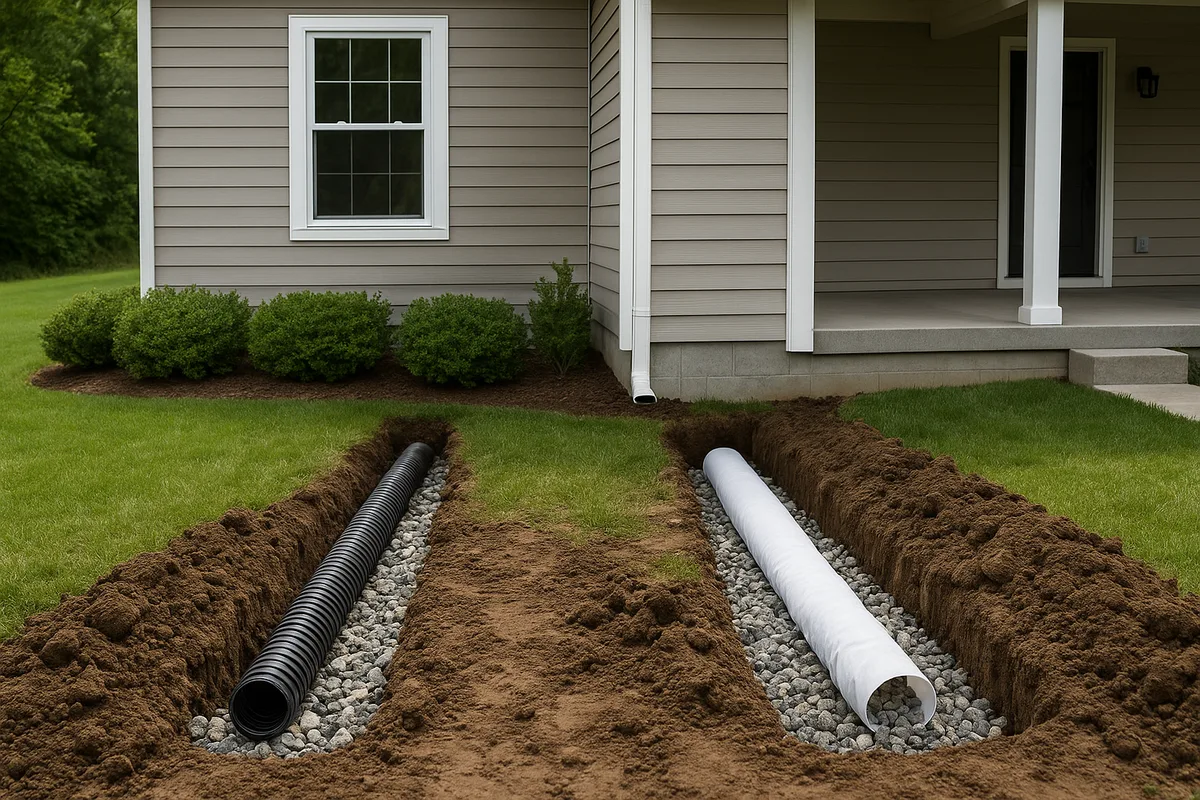
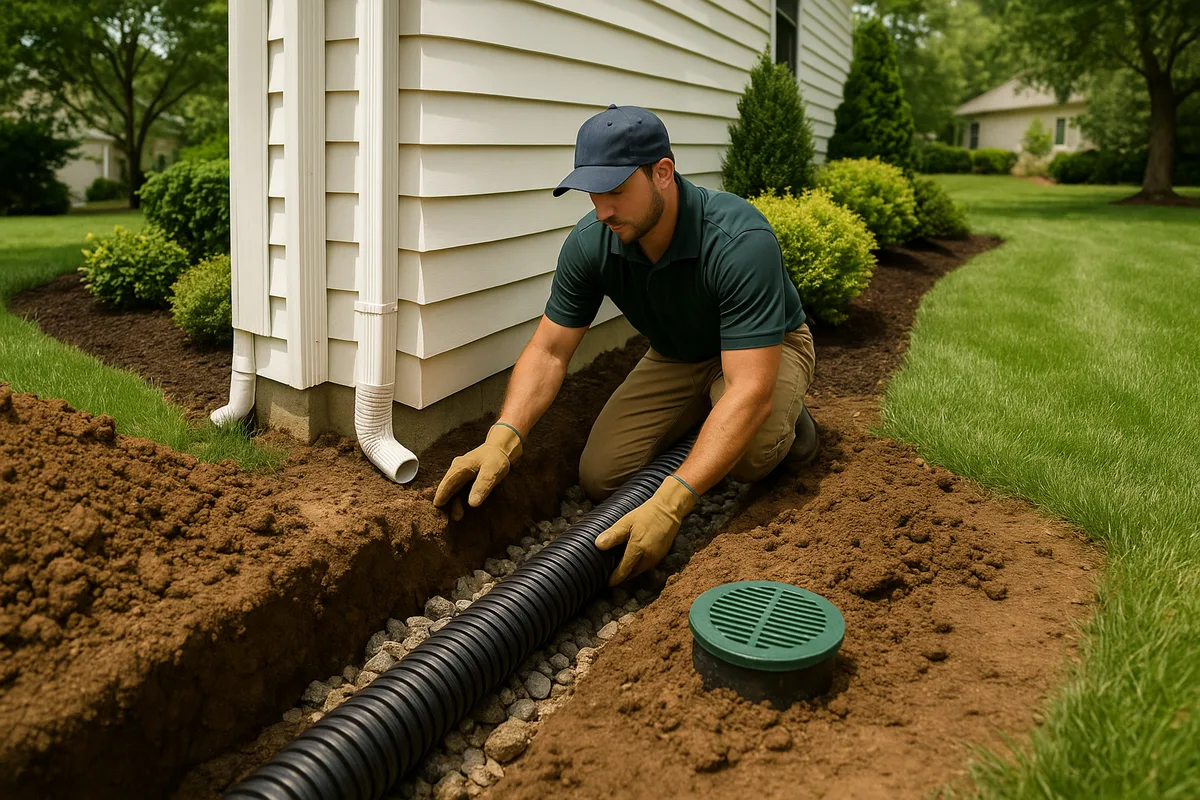
A French drain is a trench filled with gravel and a perforated pipe, designed to intercept and redirect groundwater or subsurface water that has already infiltrated the soil. The trench is typically 12 to 24 inches wide and 18 to 36 inches deep, lined with filter fabric to prevent soil migration into the gravel, and pitched at a minimum slope of 1% toward an outlet.
The mechanism is straightforward: water in saturated soil moves laterally through the ground under hydrostatic pressure. When it encounters the gravel-filled trench, it enters the void spaces in the aggregate, drops into the perforated pipe at the bottom, and is carried away by gravity to a daylight outlet or collection point. The filter fabric keeps fine soil particles from clogging the system over time.
French drains are subsurface systems. They deal with water you can't see — the saturated zone, rising water tables, and lateral seepage through soil. They're the go-to solution when the problem isn't water running across the surface but water moving through the ground toward your foundation.
When to Choose a Swale Over a French Drain
Swales are the better choice in a surprisingly wide range of residential scenarios. If your primary problem is surface water — runoff from a roof, driveway, patio, or uphill slope — a swale is often the most effective, economical, and environmentally sound solution.
Managing Surface Runoff and Sheet Flow
If you can see the water moving across your yard during a rain event, you're dealing with surface runoff. This is a swale's specialty. Swales intercept sheet flow before it concentrates into erosive channels, redirect it along a controlled path, and either convey it off-site or encourage it to soak into the ground.
A common application is the "berm and swale" system along a property boundary where an uphill neighbor's lot drains onto yours. The berm (a raised ridge of compacted soil) blocks the flow, and the swale running along its base captures and redirects it. This combination can handle significant volumes of surface water without any pipe, gravel, or underground infrastructure.
Swales are also ideal for managing runoff from impervious surfaces. A swale positioned at the downhill edge of a driveway or along the perimeter of a patio can capture hundreds of gallons per storm event and direct it to a safe discharge point. When vegetated with deep-rooted grasses or native plants, these swales also provide meaningful water quality benefits by filtering sediment and absorbing nutrients.
Properties with Adequate Slope and Space
Swales need two things that French drains don't: surface space and consistent grade. Because they're open channels, they occupy a footprint in your yard — typically 3 to 6 feet wide for residential applications. And because they rely on gravity to move water along their length, they need a continuous downhill slope from inlet to outlet.
If your property has the room and the grade, a swale is almost always cheaper to install and easier to maintain than a French drain. There's no pipe to clog, no gravel to replace, and no filter fabric to deteriorate. A well-designed, well-vegetated swale can last indefinitely with nothing more than periodic mowing.
Swales also integrate beautifully into landscape design. A gently curving swale planted with ornamental grasses, river rock, or native wildflowers becomes a landscape feature rather than an eyesore. Many homeowners don't even realize they're looking at a drainage system.
Stormwater Infiltration Goals
In many jurisdictions, stormwater regulations now require or incentivize on-site infiltration — keeping rainwater on your property rather than piping it to the storm sewer. Swales are one of the most effective tools for this purpose. By slowing runoff and spreading it over a vegetated surface, swales give water time to soak into the soil. This recharges groundwater, reduces downstream flooding, and can help you comply with local stormwater ordinances.
The EPA recognizes vegetated swales as a stormwater best management practice (BMP) for both water quality and quantity control. In residential settings, a well-designed infiltration swale can reduce runoff volume from a typical storm by 40% to 80%, depending on soil type and swale dimensions.
When a French Drain Is the Right Answer
French drains solve a different category of problem. If your issue is subsurface water — a high water table, lateral seepage from an uphill source, or hydrostatic pressure against your foundation — no amount of surface grading or swale construction will fix it. You need to intercept the water underground.
High Water Tables and Saturated Soils
Some properties sit on land where the water table is seasonally or permanently close to the surface. In these conditions, your yard may stay soggy for days or weeks after rain, not because of poor surface drainage, but because the soil is saturated from below. Basements may show dampness or seepage even when the surface grade is perfect.
A French drain installed at the appropriate depth can intercept this subsurface water before it reaches your foundation or saturates your lawn. The key is placing the drain at or slightly below the elevation of the water table's seasonal high point, and ensuring the pipe has a continuous fall to a daylight outlet or sump.
To determine whether a high water table is your issue, you can consult the NRCS Web Soil Survey, which provides detailed information about soil types, drainage classifications, and seasonal high water table depths for any location in the United States. This data is invaluable for drainage system design — it tells you what's happening underground before you start digging.
Foundation Perimeter Drainage
French drains are the standard solution for foundation drainage — the system that keeps water from pressing against your basement or crawlspace walls. A perimeter French drain (sometimes called a footing drain) is installed at the base of the foundation, below the slab or crawlspace floor level, and collects water that would otherwise build up hydrostatic pressure against the foundation wall.
This is non-negotiable territory for a French drain. A swale at the surface can redirect runoff away from the house, but it cannot intercept water that's already in the soil and moving laterally toward the foundation. In most cases, the optimal approach is both: proper surface grading and swales to manage runoff, plus a perimeter French drain to handle subsurface water.
Intercepting Lateral Seepage on Slopes
If your home sits at the base of a slope, you may experience lateral seepage — water that infiltrates the soil uphill and moves through the ground toward your property. This water may never appear on the surface until it emerges as a seep or spring at the base of the slope, often right where your house is.
A curtain drain (a type of French drain installed perpendicular to the direction of water flow) is the classic solution. Installed across the slope between the water source and your home, it intercepts the subsurface flow and redirects it around the structure. The trench should extend to a depth that reaches the impermeable layer (clay, rock, or hardpan) that the water is flowing over, ensuring complete interception.
Design Parameters: Sizing Each System Correctly
Both swales and French drains fail when they're undersized. A swale that overtops during a moderate storm or a French drain that can't keep up with the volume of subsurface water is worse than useless — it creates a false sense of security while the real damage continues underground.
Sizing a Swale
Swale design starts with hydrology: how much water will the swale need to handle? For residential properties, this typically means calculating the peak runoff from the contributing drainage area during a design storm — usually the 10-year, 24-hour event for residential applications, though local codes may specify different standards.
The basic formula involves the Rational Method: Q = CiA, where Q is peak flow in cubic feet per second, C is the runoff coefficient (a measure of how much rainfall becomes runoff based on surface type), i is rainfall intensity for the design storm, and A is the drainage area in acres. Rainfall intensity data for your location can be found through NOAA Atlas 14.
Once you know the peak flow, you size the swale's cross-section using Manning's equation, which relates flow rate to channel shape, slope, and roughness. For a residential grass-lined swale, typical design parameters include:
- Bottom width: 2 to 6 feet
- Side slopes: 3:1 or flatter (for mowability and safety)
- Longitudinal slope: 1% to 5% (steeper slopes may require erosion protection)
- Flow depth: 6 to 12 inches maximum during the design storm
- Freeboard: 3 to 6 inches above the design flow depth
- Manning's roughness coefficient (n): 0.03 to 0.05 for mowed grass
For most residential lots, a swale with a 3-foot bottom width, 3:1 side slopes, and a 2% longitudinal grade can handle the runoff from 10,000 to 20,000 square feet of contributing area, depending on soil type and surface cover.
Sizing a French Drain
French drain design is less about peak flow and more about sustained volume. Subsurface water doesn't arrive in a dramatic peak the way surface runoff does — it moves slowly through the soil and arrives over hours or days. The drain needs to handle this sustained flow without backing up.
Key design parameters include:
- Trench width: 12 to 24 inches (wider trenches provide more storage and interception area)
- Trench depth: 18 to 36 inches for yard drainage; deeper for foundation applications (typically to the bottom of the footing)
- Pipe diameter: 4 inches is standard for residential applications; 6 inches for larger systems
- Pipe material: Perforated corrugated HDPE or rigid PVC (rigid PVC is more durable and less prone to crushing)
- Aggregate: Clean, washed ¾-inch to 1½-inch crushed stone (round river rock is acceptable but provides slightly less void space)
- Filter fabric: Non-woven geotextile, wrapped around the aggregate — not the pipe
- Minimum slope: 1% (1 inch of fall per 8 feet of run); 2% is preferred
A critical design consideration is the outlet. Every French drain must have a positive outlet — a point where the pipe daylights at a lower elevation and water can freely discharge. French drains that terminate in a dead end or rely on soil absorption at the end of the pipe will eventually fail. If gravity outlet isn't possible due to topography, a sump pit with a pump may be necessary.
Soil Type: The Variable That Changes Everything
No discussion of swale vs French drain selection is complete without addressing soil. Soil type affects how water moves through your property, how quickly it infiltrates, and which drainage approach will actually work.
Sandy and Loamy Soils
Sandy soils and sandy loams have high infiltration rates — typically 1 to 8 inches per hour. Water moves through them quickly, which is generally good for drainage but creates specific design implications.
Swales work exceptionally well in sandy soils because water infiltrates rapidly through the swale bottom, reducing the volume that needs to be conveyed. An infiltration swale in sandy soil can often handle the entire design storm without any water reaching the outlet. This makes swales a particularly cost-effective choice on sandy sites.
French drains in sandy soils require careful attention to filter fabric. Sand particles are small enough to migrate through poorly selected geotextile, eventually filling the void spaces in the gravel and clogging the system. Use a non-woven geotextile with an apparent opening size (AOS) appropriate for your soil's particle size distribution — typically an AOS of 40 to 70 for sandy soils.
Clay and Silty Clay Soils
Clay soils are where drainage gets difficult. Infiltration rates of 0.01 to 0.1 inches per hour mean water sits on the surface and moves through the ground extremely slowly. Clay soils swell when wet, creating an almost impermeable barrier, and shrink when dry, creating cracks that can channel water unpredictably.
Swales in clay soil function primarily as conveyance channels rather than infiltration features. The water won't soak in — it needs to be carried to an outlet. This means the swale must be sized for the full design storm volume with minimal infiltration credit. On the positive side, clay-lined swales resist erosion well because the soil particles bind tightly together.
French drains in clay soil face a paradox: the soil that creates the drainage problem also limits the drain's effectiveness. Water in clay moves so slowly that a French drain may only intercept water from a narrow zone immediately adjacent to the trench — sometimes just 1 to 3 feet on either side. This means you may need multiple parallel drains, or a more comprehensive approach that combines French drains with surface grading and swales.
In heavy clay, consider using a French drain with an impermeable liner on the uphill side of the trench. This forces water that reaches the trench to enter the gravel and pipe rather than passing through. It's a technique borrowed from landfill engineering that works remarkably well in residential applications.
Identifying Your Soil Type
If you don't know your soil type, start with the NRCS Web Soil Survey. Enter your address, delineate your property boundary, and pull up the soil map and data tables. Pay particular attention to the hydrologic soil group classification:
- Group A: High infiltration, low runoff (sands, loamy sands)
- Group B: Moderate infiltration, moderate runoff (silt loams, loams)
- Group C: Low infiltration, moderate-to-high runoff (sandy clay loams)
- Group D: Very low infiltration, high runoff (clays, silty clays, soils with high water tables)
This classification directly influences your drainage system design. Group A and B soils are generally good candidates for infiltration swales. Group C and D soils often require French drains, or swales designed purely for conveyance with armored outlets.
Cost Comparison: Installation and Long-Term Ownership
Cost is often the deciding factor for homeowners, and the difference between swales and French drains is significant — both in upfront installation and in long-term maintenance.
Installation Costs
A residential swale typically costs $2 to $8 per linear foot for a simple graded and seeded channel, or $10 to $25 per linear foot for a more elaborate design with rock check dams, native plantings, or decorative stone. A 100-foot swale might run $200 to $2,500 depending on complexity.
A French drain runs $20 to $50 per linear foot for a standard installation with 4-inch perforated pipe, washed gravel, and filter fabric. A 100-foot French drain typically costs $2,000 to $5,000. Foundation perimeter drains are more expensive — $40 to $80 per linear foot — because they require deeper excavation, often in tight spaces next to the house, and may involve waterproofing membrane installation.
These are contractor-installed prices. DIY installation can cut costs by 40% to 60%, but both systems require a solid understanding of grade, slope, and hydrology to function correctly. A poorly graded swale ponds water instead of conveying it. A French drain with insufficient slope or a missing outlet becomes an underground reservoir.
Maintenance and Lifespan
Swales are low-maintenance by nature. Mow the grass, remove debris, and inspect the channel after major storms for erosion or sediment buildup. A well-constructed swale on stable soil can last decades — essentially the life of the landscape — with minimal intervention. Total annual maintenance cost: effectively zero beyond normal lawn care.
French drains require more attention and have a finite lifespan. Even with proper filter fabric, fine soil particles gradually migrate into the gravel over time, reducing void space and flow capacity. Tree roots can infiltrate perforated pipe. Pipe connections can separate due to soil settlement.
A well-installed French drain with quality materials typically lasts 15 to 25 years before performance degrades noticeably. Replacement means excavating the entire trench, removing the old material, and reinstalling — essentially the full original cost. Some homeowners extend the life of their French drains by installing cleanout ports every 50 to 100 feet, allowing periodic flushing with a garden hose or pressure washer.
Total Cost of Ownership
Over a 20-year period, a 100-foot swale might cost $500 to $2,500 total (installation plus negligible maintenance). The same length of French drain might cost $4,000 to $10,000 (installation, periodic maintenance, and one potential replacement). This 3:1 to 5:1 cost ratio is why experienced drainage professionals always consider whether a swale can solve the problem before recommending a French drain.
But cost alone shouldn't drive the decision. A swale can't solve a subsurface water problem, no matter how cheap it is. And a French drain that prevents $50,000 in foundation damage is the best investment a homeowner can make, regardless of its price tag.
Combining Both Systems for Complete Drainage
The best drainage system design often isn't an either/or choice — it's a layered approach that uses both swales and French drains, each handling the type of water it's best suited for.
The Layered Drainage Strategy
Consider a home at the base of a gentle slope with clay soil. During rain events, surface water runs down the slope toward the house. Between storms, subsurface water seeps through a sandy layer above the clay hardpan and emerges as dampness in the basement.
The complete solution involves three layers:
- Surface grading: Ensure the ground within 10 feet of the foundation slopes away at a minimum of 5% (6 inches of fall over 10 feet), per standard building code recommendations.
- Swale: Install a swale across the slope, 15 to 30 feet uphill from the house, to intercept and redirect surface runoff before it reaches the foundation zone.
- French drain: Install a curtain drain between the swale and the house, at a depth that reaches the clay hardpan, to intercept subsurface seepage.
This layered approach addresses both surface and subsurface water, providing redundancy and dramatically reducing the load on any single component. The swale handles the high-volume, short-duration surface flows. The French drain handles the low-volume, long-duration subsurface flows. Together, they keep the foundation dry in all conditions.
Downspout Integration
Roof downspouts deserve special mention because they're often the single largest source of concentrated water on a residential property. A 2,000-square-foot roof generates about 1,250 gallons of runoff per inch of rainfall. That water hits the ground at four to six concentrated points around the house.
The worst thing you can do is connect downspouts directly to a French drain. The volume and velocity of roof runoff will overwhelm a French drain's capacity and flush sediment into the pipe, accelerating clogging. Instead, extend downspouts via solid (non-perforated) pipe at least 10 feet from the foundation, then discharge into a swale, dry well, or rain garden.
If the downspout extension must cross the path of a French drain, use a solid pipe section through the French drain zone to prevent the roof water from entering the subsurface system. Keep the two systems separate — each handling its designated water source.
Outlet Design and Erosion Control
Every drainage system needs a well-designed outlet, and this is where many residential installations fail. Water concentrated at an outlet point has significant erosive energy. Without proper protection, the outlet will erode, undermine the pipe or channel, and create a new problem downstream.
For swale outlets, use a riprap apron — a pad of 4- to 8-inch stone, 3 to 6 feet wide and 4 to 8 feet long — at the discharge point. This dissipates the water's energy and prevents scour. For French drain daylight outlets, use a solid end cap with a pop-up emitter or a headwall with a flap gate to prevent animals from entering the pipe.
Always verify that your outlet discharges to an appropriate location. Directing concentrated flow onto a neighbor's property, onto a public sidewalk, or into a waterway without authorization can create legal liability and may violate local stormwater regulations.
Making the Final Decision: A Diagnostic Framework
After understanding both systems, the decision comes down to diagnosing your specific water problem. Here's a systematic framework that drainage professionals use to determine the right approach.
Step 1: Identify the Water Source
Go outside during a moderate rain event and observe. Where is the water coming from? Is it running across the surface from uphill, off a roof, or off a paved surface? Or is your yard soggy even when it hasn't rained recently, suggesting subsurface water?
- Surface water you can see flowing: Swale is the primary solution.
- Subsurface water (soggy soil, basement seepage, springs): French drain is the primary solution.
- Both: You need both systems, layered appropriately.
Step 2: Assess Your Topography
Drainage system design is inseparable from topography. You need to understand the elevation changes across your property — where the high points are, where the low points are, and where water naturally wants to go.
For a basic assessment, you can use a simple line level and stakes to measure grade changes. For a more comprehensive picture, topographic data from the USGS 3D Elevation Program (3DEP) provides high-resolution elevation models that reveal drainage patterns invisible to the naked eye. At Low Point Labs, we use this type of data to create detailed drainage intelligence maps that show exactly how water moves across a property.
Key topographic factors in the swale vs French drain decision:
- Consistent surface slope available: Favors a swale (needs continuous grade to outlet).
- Flat terrain with no gravity outlet: May require a French drain to a sump pump, or a swale designed as an infiltration basin.
- Steep slopes (greater than 10%): Swales need check dams or rock lining to prevent erosion; French drains may be more practical.
- Low-lying areas with no outlet: Consider a dry well or infiltration system rather than either a swale or French drain.
Step 3: Evaluate Soil and Groundwater Conditions
Pull your soil data from the NRCS Web Soil Survey. Look at the hydrologic soil group, the seasonal high water table depth, and the permeability rating. Dig a test hole 2 to 3 feet deep and observe:
- Does water seep into the hole from the sides? Subsurface water is present — French drain territory.
- Does the hole stay dry but the surface stays wet? Surface drainage problem — swale territory.
- What color is the soil at depth? Gray or mottled soil indicates prolonged saturation and a high water table.
Step 4: Consider Practical Constraints
Finally, consider the practical realities of your property:
- Available space: Swales need 3 to 6 feet of width. If your yard is too narrow, a French drain's 12- to 24-inch trench may be the only option.
- Existing landscaping: A swale requires regrading the surface, which may disturb established gardens, trees, or hardscaping. A French drain can sometimes be threaded between obstacles with less surface disruption.
- Utilities: Both systems require calling 811 before digging. Underground utilities may limit where you can install either system.
- Local regulations: Some municipalities regulate swale construction, particularly if it alters natural drainage patterns. French drains that discharge to the storm sewer may require a connection permit.
- Budget: If cost is the primary constraint and a swale can solve the problem, it's almost always the more economical choice.
Putting It All Together: Your Property Deserves a Data-Driven Approach
The swale vs French drain decision shouldn't be based on guesswork, a contractor's preference, or what your neighbor installed. It should be based on data — topographic data that reveals how water moves across your property, soil data that tells you what's happening underground, and hydrologic analysis that quantifies the volume of water you're dealing with.
Effective drainage system design starts with understanding your property's unique drainage signature: where water collects, where it flows, and where it causes problems. Only with this information can you confidently choose the right system — or combination of systems — and design it to handle the water volumes your property actually generates.
At Low Point Labs, we specialize in exactly this kind of topographic drainage intelligence. Our assessments use high-resolution elevation data, soil analysis, and hydrologic modeling to give homeowners, contractors, and inspectors a clear picture of a property's drainage dynamics. Whether you're deciding between a swale and a French drain, planning a new construction project, or troubleshooting a persistent water problem, our data-driven approach takes the guesswork out of drainage design.
Explore our drainage assessment services to see how topographic intelligence can help you make the right drainage decision for your property — the first time.
See Drainage Intelligence in Practice
Talk with our team or request an invitation to the platform.
Frequently Asked Questions
A swale is a shallow, open channel on the surface that collects and redirects surface runoff using gravity. A French drain is a buried trench filled with gravel and perforated pipe that intercepts and redirects subsurface water. Swales handle water you can see; French drains handle water moving underground.
A swale can redirect surface runoff away from your foundation, but it cannot intercept subsurface water or relieve hydrostatic pressure against basement walls. If your foundation problem involves groundwater seepage, you need a French drain. Many properties benefit from both systems working together.
A well-installed French drain typically lasts 15 to 25 years before sediment buildup reduces its performance and replacement is needed. A properly constructed and vegetated swale can last indefinitely with basic maintenance like mowing and occasional sediment removal.
A French drain needs a minimum longitudinal slope of 1% (1 inch of fall per 8 feet of run), with 2% preferred. A swale typically requires 1% to 5% slope. Both systems rely on gravity, so a continuous downhill grade to an outlet is essential for proper function.
Yes, soil type is a critical factor. Sandy soils with high infiltration rates work well with infiltration swales. Clay soils with low permeability often require French drains to intercept slow-moving subsurface water. You can check your soil type using the NRCS Web Soil Survey.
It's generally not recommended. The high volume and velocity of roof runoff can overwhelm a French drain and accelerate clogging with sediment. Instead, extend downspouts with solid pipe at least 10 feet from the foundation and discharge into a swale, dry well, or rain garden.
Related Articles
Curtain Drains vs. Footing Drains: What's the Difference?
How to Turn a Basic Yard Maintenance Customer into a High-Ticket Drainage Client