FEMA Flood Zone Remapping in Sacramento: Impact on Property Values
What FEMA Flood Zone Remapping Means for Sacramento Homeowners
FEMA flood zone remapping in Sacramento is not a hypothetical scenario — it is an ongoing process that has already reshaped how thousands of properties in the region are classified, insured, and valued. The Federal Emergency Management Agency periodically updates its Flood Insurance Rate Maps (FIRMs) to reflect new data on hydrology, topography, and infrastructure improvements such as levee certifications and channel modifications. For Sacramento — a metropolitan area uniquely situated at the confluence of the Sacramento and American Rivers and protected by one of the most extensive urban levee systems in the United States — these remapping efforts carry outsized consequences.
When FEMA redraws flood zone boundaries, properties can shift from high-risk Special Flood Hazard Areas (SFHAs) into moderate- or low-risk zones, or vice versa. Each designation directly impacts flood insurance requirements, mortgage lending conditions, and ultimately, what buyers are willing to pay. Whether you are a homeowner watching your insurance premiums climb, a real estate investor evaluating acquisition targets, or a contractor advising clients on drainage improvements, understanding the mechanics and implications of FEMA flood zone remapping in Sacramento is essential.
This article provides a comprehensive, expert-level guide to the remapping process, the tools available to challenge or leverage your flood zone designation, and the concrete steps you can take to protect — or even enhance — your property's value.
How FEMA Flood Zone Designations Work
The Anatomy of a Flood Insurance Rate Map
FEMA's Flood Insurance Rate Maps divide communities into zones based on modeled flood risk. The most consequential distinction is between Special Flood Hazard Areas (SFHAs) and non-SFHAs:
- Zone A and AE (SFHA): Areas with a 1% or greater annual chance of flooding — commonly called the "100-year floodplain." Properties in these zones with federally backed mortgages are required to carry flood insurance.
- Zone X (Shaded): Areas with a 0.2% annual chance of flooding (the "500-year floodplain"). Insurance is recommended but not mandated.
- Zone X (Unshaded): Areas of minimal flood hazard. No federal insurance requirement.
- Zone AO: Areas subject to shallow flooding, often from sheet flow on sloped terrain.
In Sacramento County, the interplay between levee accreditation status and zone designation has been a dominant theme. When levees meet FEMA's accreditation standards — demonstrating they can withstand the 1%-annual-chance flood with adequate freeboard — the areas behind them may be reclassified out of high-risk zones. When levees fail to meet those standards, entire neighborhoods can be swept into SFHA designations virtually overnight.
Why Sacramento Is Uniquely Affected
Sacramento sits in a broad, low-elevation floodplain. The city's founding in the mid-19th century was marked by catastrophic floods, and the region's modern flood control infrastructure — including Folsom Dam, the Sacramento Weir, the Yolo Bypass, and hundreds of miles of levees — represents billions of dollars in federal, state, and local investment. Despite these protections, FEMA's mapping process evaluates flood risk based on strict engineering criteria. If a levee's documentation, maintenance records, or structural analysis falls short of FEMA standards, the agency treats the levee as if it does not exist for mapping purposes.
This means that even neighborhoods with substantial physical flood protection can find themselves mapped into high-risk zones. The Natomas Basin is perhaps the most prominent example: for years, approximately 80,000 residents lived under SFHA designations despite the presence of surrounding levees, because those levees had not been formally accredited. The resulting insurance mandates, lending restrictions, and development moratoria had profound effects on property values and community growth.
The Sacramento Remapping Timeline: Where We Stand in 2026
Recent Map Revisions and Levee Accreditation Progress
Sacramento's flood zone landscape has shifted dramatically over the past decade. The Sacramento Area Flood Control Agency (SAFCA) and the U.S. Army Corps of Engineers have invested heavily in levee improvements along the American River, the Sacramento River, and the Natomas Basin perimeter. As these improvements have been completed and documented, FEMA has issued Letters of Map Revision (LOMRs) that reclassify protected areas from Zone AE to Zone X.
For Natomas specifically, the completion of levee improvements and the subsequent FEMA accreditation process has been a multi-phase effort. As of early 2026, significant portions of the basin have been or are in the process of being remapped out of the SFHA. This has triggered a measurable rebound in property values and renewed development interest.
However, remapping is not uniform across the county. Some areas along the lower Sacramento River, in the Pocket-Greenhaven neighborhood, and in unincorporated areas of Sacramento County remain in or near SFHA designations. Ongoing levee evaluation projects mean that additional map changes — both favorable and unfavorable — are likely in the coming years.
How to Check Your Current Flood Zone Status
Every Sacramento homeowner should know their property's current FEMA flood zone designation. FEMA's National Flood Map Service Center provides free access to the latest effective FIRMs. You can search by address to see your zone designation, the effective date of the map panel, and any pending Letters of Map Change.
Keep in mind that FEMA maps are periodically updated, and there can be a lag between when physical improvements are completed and when the map officially changes. If your property is in a zone that does not reflect recent levee work or grading changes, you may have grounds to pursue a Letter of Map Amendment (LOMA) or Letter of Map Revision (LOMR) — processes we will cover in detail below.
LOMAs and LOMRs: Challenging Your Flood Zone Designation
What Is a LOMA?
A Letter of Map Amendment (LOMA) is FEMA's official determination that a specific property or structure is not located within the SFHA as shown on the current FIRM. A Sacramento LOMA flood zone change is typically based on natural ground elevation data — if your property's lowest adjacent grade or lowest floor elevation is at or above the Base Flood Elevation (BFE), you may qualify for a LOMA even if the broader area is mapped as high risk.
LOMAs are property-specific. They do not change the FIRM itself; rather, they provide an official exemption for your parcel. This is a critical distinction: a LOMA removes the mandatory flood insurance requirement for federally backed mortgages on your property, which can save thousands of dollars annually and make your home significantly more attractive to buyers.
To apply for a LOMA, you will need:
- An Elevation Certificate: Prepared by a licensed surveyor or engineer, this document establishes your property's elevation relative to the BFE.
- FEMA MT-EZ or MT-1 Application: The appropriate form depends on whether the request involves a single structure/lot or a more complex situation.
- Supporting documentation: This may include a property survey, site plan, and any relevant topographic data.
FEMA does not charge a fee for LOMA applications, and processing typically takes 60–90 days.
What Is a LOMR?
A Letter of Map Revision (LOMR) is a more substantial change. A LOMR Sacramento County request formally revises the FIRM to reflect physical changes — such as levee construction, channel improvements, fill placement, or floodplain reconfiguration — that alter the boundaries or elevations of the SFHA. Unlike a LOMA, a LOMR changes the map itself and can affect multiple properties or entire neighborhoods.
LOMRs are typically initiated by local governments or agencies (such as SAFCA) after completing infrastructure projects. However, private developers or property owners can also submit LOMR requests when they have undertaken qualifying work. The application process is more complex and expensive than a LOMA, often requiring detailed hydrologic and hydraulic (H&H) analyses prepared by a licensed professional engineer.
For Sacramento homeowners, the practical takeaway is this: if your neighborhood has benefited from recent levee improvements or other flood control work, there may already be a LOMR in progress that will change your flood zone designation. Contact your local floodplain administrator — typically within the Sacramento County Department of Water Resources or the City of Sacramento Department of Utilities — to inquire about pending map changes.
FEMA's Map Change Process: What to Expect
FEMA's process for adopting map changes involves several stages that homeowners should understand. You can review the full scope of FEMA's map change products, including LOMAs, LOMRs, and Conditional Letters of Map Revision (CLOMRs), through FEMA's Map Changes & LOMAs resource page. Key stages include:
- Preliminary Map Issuance: FEMA releases draft updated maps for community and public review. This is your opportunity to comment and raise objections.
- Appeal and Comment Period: Typically 90 days. Property owners who believe the preliminary maps are inaccurate can submit scientific or technical data to support an appeal.
- Letter of Final Determination (LFD): FEMA issues the LFD, establishing the date the new maps will become effective — usually six months after the LFD.
- Effective Date: The new FIRMs take effect, and flood insurance requirements change accordingly.
During the preliminary and appeal stages, homeowners have a genuine opportunity to influence the outcome. If you have elevation data, drainage analyses, or other evidence that your property should not be in the SFHA, engaging during this window is far more efficient than seeking a LOMA after the maps are finalized.
How Flood Zone Changes Directly Impact Sacramento Property Values
The Insurance Cost Equation
The most immediate financial impact of a Sacramento flood zone change on property value is the cost of flood insurance. Under the National Flood Insurance Program (NFIP), policies for properties in SFHAs have historically ranged from $1,500 to $5,000 or more per year, depending on the structure's elevation, construction type, and coverage amount. With FEMA's Risk Rating 2.0 methodology — which prices policies based on individualized risk factors rather than simple zone designations — premiums can vary even more widely.
When a property is remapped out of an SFHA, the mandatory insurance requirement disappears for borrowers with federally backed mortgages. Even if a homeowner chooses to retain a Preferred Risk Policy (which is available at significantly lower rates for properties in non-SFHA zones), the annual savings can be substantial — often $1,000 to $3,000 or more. Over a 30-year mortgage, this translates to $30,000 to $90,000 in cumulative savings, a figure that is directly capitalized into property values.
Research consistently shows that SFHA designation depresses home values by 2% to 7% relative to comparable properties outside the flood zone, with the effect being more pronounced in markets where flood risk is salient — as it certainly is in Sacramento.
Buyer Perception and Market Dynamics
Beyond the hard dollars of insurance premiums, Sacramento flood insurance real estate dynamics are shaped by buyer psychology. Properties in high-risk flood zones carry stigma. Buyers worry about future flooding, the hassle of insurance claims, and the possibility that premiums will increase further under Risk Rating 2.0. Listing agents in Sacramento report that SFHA designation is one of the first questions informed buyers ask, and properties with that designation often sit on the market longer and sell at lower prices.
Conversely, when a neighborhood is remapped out of the SFHA, the effect on market sentiment can be dramatic. The Natomas experience is instructive: as levee improvements progressed and FEMA map changes were anticipated, home prices in the basin began to recover even before the official remapping took effect. Buyers priced in the expected removal of insurance mandates and the signal that the area's flood risk had been materially reduced.
For sellers, this creates a strategic consideration. If a LOMR is pending for your area, timing your sale to coincide with — or just after — the effective date of the new maps can maximize your sale price. If you are buying in an area where remapping is expected, purchasing before the map change may allow you to acquire a property at a discount that will appreciate once the designation changes.
Lending and Appraisal Implications
Flood zone designation also affects the lending process. Properties in SFHAs require flood insurance as a condition of obtaining a federally backed mortgage (FHA, VA, conventional loans sold to Fannie Mae or Freddie Mac). This adds a layer of complexity and cost to the transaction. Some lenders are more cautious about underwriting properties in flood zones, and appraisers may adjust comparable sales to account for flood risk.
When a property is removed from the SFHA — whether through a LOMA, LOMR, or full map revision — the lending process becomes smoother. No flood insurance escrow is required, appraisals are not penalized for flood zone status, and the pool of willing buyers expands.
Drainage, Grading, and Your Role in Managing Flood Risk
Why Site-Level Drainage Matters Even Outside the Flood Zone
FEMA flood zone designations address regional flood risk — the likelihood that river flooding, levee overtopping, or major storm events will inundate an area. But they do not address localized drainage problems that can cause water damage, foundation issues, and property value loss regardless of your zone designation.
In Sacramento's flat terrain, poor lot grading, inadequate surface drainage, and high water tables are common problems. A property that is technically outside the SFHA can still experience chronic standing water, saturated soils, and basement or crawl space moisture if the site's topography does not direct water away from the structure.
This is where topographic drainage intelligence — the core of what Low Point Labs provides — becomes essential. Understanding the micro-topography of your lot, identifying low points where water collects, and verifying that grading meets the minimum standard of 2% slope (approximately ¼ inch per foot) away from the foundation for the first 6 to 10 feet are critical steps that every Sacramento homeowner should take.
How Drainage Improvements Can Support a LOMA Application
If your property is in an SFHA and you are considering a LOMA application, site-level drainage and grading improvements can play a supporting role. While a LOMA is primarily based on natural ground elevation relative to the BFE, ensuring that your property's grading directs water away from the structure — and that your elevation certificate reflects the true lowest adjacent grade — can make the difference between approval and denial.
Specific actions that can support your case include:
- Regrading the lot to raise the lowest adjacent grade above the BFE. This may involve importing fill material, which must comply with local floodplain management ordinances.
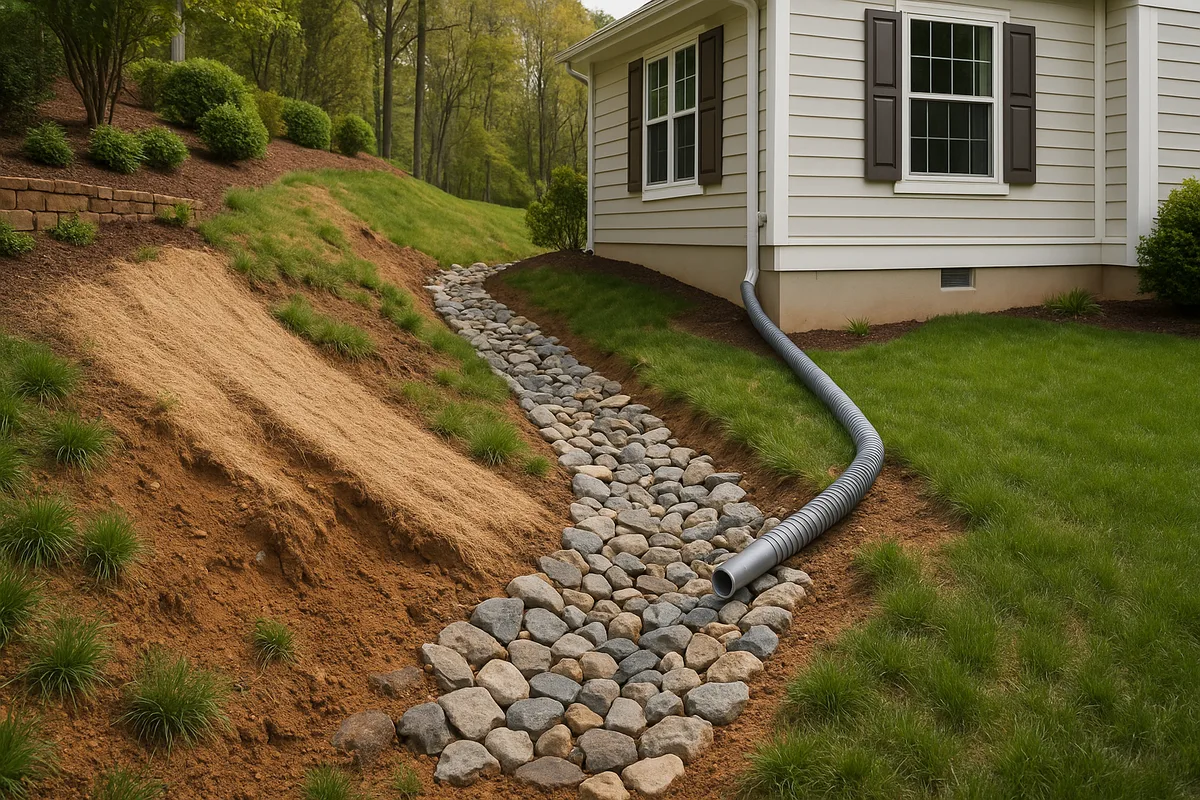
- Installing proper surface drainage — swales, French drains, or catch basins — to prevent ponding near the foundation.
- Documenting all improvements with as-built surveys and updated elevation certificates.
It is important to note that placing fill in the floodplain may require permits and may trigger a CLOMR (Conditional Letter of Map Revision) or LOMR rather than a simple LOMA. Always consult with your local floodplain administrator and a licensed engineer before undertaking work in the SFHA.
The Connection Between Soil Type and Flood Risk
Sacramento County's soils play a significant role in localized flood risk. Much of the region sits on alluvial soils deposited by the Sacramento and American Rivers — silty clays and clay loams that drain poorly and can become saturated quickly during winter storms. The USDA's Natural Resources Conservation Service classifies many Sacramento soils in Hydrologic Soil Group C or D, meaning they have slow to very slow infiltration rates.
For homeowners, this means that even modest rainfall events can produce surface ponding and waterlogged yards if drainage infrastructure is inadequate. Understanding your soil type — which you can research through the NRCS Web Soil Survey — is a foundational step in designing effective drainage solutions.
Properties with Group D soils, for example, may benefit from subsurface drainage systems (French drains, perforated pipe networks) that intercept water before it reaches the foundation. Properties with sandier soils (Group A or B) may drain naturally but could be more susceptible to erosion during high-flow events.
Risk Rating 2.0: The New Insurance Pricing Reality
How Risk Rating 2.0 Changes the Equation
FEMA's Risk Rating 2.0 methodology, which began phasing in for new policies in October 2021 and applied to all renewing policies by April 2023, fundamentally changed how flood insurance is priced. Under the old system, premiums were largely determined by zone designation and the structure's elevation relative to the BFE. Under Risk Rating 2.0, FEMA considers a broader set of risk factors:
- Distance to the nearest water source (river, creek, coast)
- Type of flooding (river overflow, storm surge, coastal erosion, heavy rainfall)
- Property-specific elevation (not just relative to BFE, but absolute elevation and local topography)
- Cost to rebuild the structure
- Historical flood claims on the property
For Sacramento homeowners, Risk Rating 2.0 means that your flood insurance premium is increasingly individualized. Two neighboring properties in the same flood zone may pay very different rates based on their specific characteristics. This makes site-level drainage and elevation data more important than ever — not just for LOMA applications, but for understanding and potentially reducing your insurance costs.
What This Means for Sacramento Property Values Going Forward
Risk Rating 2.0 adds nuance to the relationship between flood zone designation and property value. Under the old system, being in or out of the SFHA was a binary switch that determined whether you needed insurance. Under Risk Rating 2.0, even properties outside the SFHA may face meaningful premiums if FEMA's model identifies elevated risk factors — and properties inside the SFHA may pay less than expected if their individual characteristics are favorable.
For the Sacramento real estate market, this creates both opportunities and challenges. Savvy buyers and their agents will increasingly look beyond the simple zone designation to understand a property's individualized flood risk and insurance cost. Sellers who can demonstrate low flood risk — through elevation certificates, drainage assessments, and documentation of site improvements — will have a competitive advantage.
Practical Steps for Sacramento Homeowners
If You Are Currently in a High-Risk Flood Zone
- Verify your designation. Check your property's current flood zone at FEMA's National Flood Map Service Center. Confirm the effective date of the map panel — if it is several years old, a revision may be in progress.
- Obtain an Elevation Certificate. Hire a licensed surveyor to prepare an Elevation Certificate (FEMA Form 086-0-33). This document is the foundation for any LOMA application and can also help your insurance agent determine the most accurate premium under Risk Rating 2.0.
- Investigate pending map changes. Contact the Sacramento County Department of Water Resources or the City of Sacramento Department of Utilities to ask whether a LOMR or map revision is in progress for your area.
- Evaluate LOMA eligibility. If your property's lowest adjacent grade or lowest floor elevation is at or above the BFE, you may qualify for a LOMA. The application is free and can remove the mandatory insurance requirement.
- Assess your site drainage. Even if you remain in the SFHA, improving your property's drainage and grading can reduce actual flood risk, potentially lower your Risk Rating 2.0 premium, and protect your investment.
If You Are Being Remapped Into a High-Risk Zone
- Engage during the comment period. If FEMA has issued preliminary maps that place your property in the SFHA, you have a 90-day window to submit technical data challenging the designation. An elevation certificate and a professional drainage analysis can support your case.
- Understand grandfathering options. If you currently have a flood insurance policy and your zone changes, you may be eligible for grandfathered rates under certain conditions. Consult with your insurance agent.
- Plan for insurance costs. Budget for flood insurance premiums and factor them into your household expenses. Under Risk Rating 2.0, premiums are capped at 18% annual increases for existing policyholders, so costs may phase in gradually.
- Consider drainage improvements. Proactive grading and drainage work can reduce your actual flood risk and may support a future LOMA application if your elevation is close to the BFE.
If You Are Being Remapped Out of a High-Risk Zone
- Do not cancel flood insurance immediately. Even though mandatory insurance requirements are removed, consider maintaining a Preferred Risk Policy. These policies are significantly cheaper and provide valuable protection — remember, more than 25% of all flood claims come from properties outside SFHAs.
- Leverage the change in your property listing. If you are selling, highlight the zone change in your marketing materials. Buyers will recognize the value of reduced insurance costs and lower perceived risk.
- Get a drainage assessment anyway. Removal from the SFHA means FEMA's regional flood models show reduced risk from major river flooding. It does not mean your property is immune to localized drainage problems. A professional topographic drainage assessment can identify and address site-specific vulnerabilities.
Real Estate Transactions: Disclosure, Due Diligence, and Strategy
Seller Disclosure Obligations in California
California law requires sellers to disclose known material facts about a property, including its flood zone designation. The Natural Hazard Disclosure Statement (NHD), which is a standard part of California residential real estate transactions, will identify whether the property is in an SFHA, a dam inundation zone, or other hazard areas.
If your property has been the subject of a LOMA or LOMR, you should provide copies of the relevant FEMA determination letters to the buyer. Similarly, if you are aware of pending map changes that could affect the property's flood zone designation, disclosing this information is both a legal obligation and a practical strategy — buyers who discover undisclosed flood risk after closing are likely to pursue legal remedies.
Buyer Due Diligence
Buyers in the Sacramento market should go beyond the NHD report. Specific steps include:
- Reviewing the FIRM directly to understand the property's zone designation and the effective date of the map.
- Requesting an Elevation Certificate from the seller or ordering one independently.
- Checking for pending LOMRs or map revisions that could change the property's designation after closing.
- Obtaining a flood insurance quote before finalizing the purchase, so you understand the true cost of ownership.
- Commissioning a topographic drainage assessment to identify site-level water management issues that FEMA maps do not capture.
Investment Strategy: Buying Ahead of Remapping
For real estate investors, FEMA flood zone remapping in Sacramento creates arbitrage opportunities. Properties in areas where LOMR applications are pending or levee improvements are underway may be undervalued relative to their post-remapping potential. The key is understanding the timeline and probability of the map change.
Factors to evaluate include:
- Status of levee improvement projects: Are they funded, under construction, or complete? Have they been submitted to FEMA for accreditation?
- FEMA review timeline: Has a CLOMR been issued? Has the LOMR application been submitted? What is the estimated date for the new maps?
- Community engagement: Is the local government actively pursuing map changes, or is the process stalled?
Investors who can accurately assess these factors — and who are comfortable holding properties through the remapping timeline — can acquire assets at flood-zone-discounted prices and realize appreciation when the designation changes.
Protecting Your Property Value With Proactive Drainage Intelligence
FEMA flood zone remapping in Sacramento is a macro-level process driven by regional hydrology, levee infrastructure, and federal policy. But property value is ultimately determined at the individual lot level. Two properties on the same street, in the same flood zone, can have dramatically different drainage characteristics — and dramatically different vulnerability to water damage.
This is why topographic drainage intelligence is so valuable. By understanding the precise elevation contours of your lot, identifying where water flows during storm events, mapping low points where ponding occurs, and evaluating the adequacy of your grading and drainage infrastructure, you gain actionable insight that goes far beyond what a FEMA map can tell you.
At Low Point Labs, we specialize in providing this level of detail. Our drainage assessments use high-resolution topographic data to map water flow paths, identify areas of concern, and recommend targeted improvements. Whether you are preparing a LOMA application, evaluating a property for purchase, or simply want to understand and mitigate your flood risk, our analysis gives you the data-driven foundation you need.
Sacramento's flood risk landscape is evolving. FEMA maps are changing. Insurance pricing is becoming more individualized. In this environment, the homeowners and investors who thrive are those who understand their property's drainage at the deepest level. Explore Low Point Labs' drainage assessment services today and take control of your property's flood risk story.
See Drainage Intelligence in Practice
Talk with our team or request an invitation to the platform.
Frequently Asked Questions
Check your current flood zone designation at FEMA's National Flood Map Service Center (msc.fema.gov) by entering your address. You can also contact the Sacramento County Department of Water Resources or the City of Sacramento Department of Utilities to ask about pending Letters of Map Revision (LOMRs) or preliminary map updates for your area.
Research shows that SFHA (high-risk flood zone) designation typically depresses home values by 2% to 7% compared to similar properties outside flood zones. The impact comes from mandatory flood insurance costs, which can range from $1,500 to $5,000+ annually, as well as reduced buyer demand and more restrictive lending conditions.
A LOMA (Letter of Map Amendment) is a property-specific determination that your individual parcel or structure is not in the flood zone, based on its natural elevation. A LOMR (Letter of Map Revision) formally changes the FEMA flood map itself, usually because of physical changes like levee improvements or channel modifications, and can affect multiple properties or entire neighborhoods.
Yes, homeowners can apply for a LOMA directly with FEMA at no cost. You will need an Elevation Certificate prepared by a licensed surveyor showing that your property's lowest adjacent grade or lowest floor is at or above the Base Flood Elevation. The application typically takes 60–90 days to process.
It is strongly recommended. More than 25% of all flood insurance claims come from properties outside high-risk flood zones. Preferred Risk Policies are available at significantly reduced rates for properties in low- to moderate-risk zones and provide valuable financial protection against localized flooding and drainage events.
Risk Rating 2.0 prices flood insurance based on individualized risk factors — including distance to water, property elevation, flood type, and rebuild cost — rather than just flood zone designation. This means two Sacramento homes in the same zone may pay very different premiums. Properties with favorable elevation and good drainage may see lower costs, while others may see increases capped at 18% per year.
Related Articles
Sacramento County Stormwater Requirements: What Property Owners Must Know
Soggy Lawn That Never Dries: 9 Common Causes and How to Fix Them