The Paradox of Water in the Golden State
California is a state defined by its relationship with water — or, more precisely, by the tension between too little and too much. In a place where annual rainfall averages just 22 inches statewide, it might seem counterintuitive that drainage is one of the most consequential property concerns homeowners face. But that statistic obscures a reality that every Californian who has lived through a wet winter understands viscerally: when rain comes to California, it comes with force, it comes fast, and it arrives on landscapes that are often spectacularly unprepared to absorb it.
Consider what happened across Southern California in early 2025, when a series of atmospheric rivers dumped months' worth of rainfall in days on hillsides freshly denuded by wildfire. Debris flows obliterated homes. Neighborhoods that had never experienced standing water found their crawl spaces flooded. Insurance claims surged. And the fundamental lesson repeated itself: in California, drainage isn't a background concern — it's a frontline defense.
What makes California's drainage landscape uniquely complex is the convergence of factors found nowhere else in the country. You have Mediterranean climate patterns that concentrate nearly all annual precipitation into a four-to-five-month window. You have some of the most aggressively expansive clay soils on the continent. You have wildfire cycles that strip vegetation and create hydrophobic soil layers. You have seismic activity that shifts grades and fractures foundations. You have one of the most aggressive regulatory environments for stormwater management in the nation. And you have 14 million single-family homes spread across terrain that ranges from sea-level delta lands to steep coastal bluffs to desert valleys.
This guide addresses all of it — region by region, soil type by soil type, regulation by regulation — with the practical specificity that California property owners need to protect their investments.
California's Drainage Geology: Why Your Soil Matters More Than Your Roof
Understanding drainage in California starts underground. The state's geological diversity is staggering, and soil behavior during rainfall is the single most important variable in residential drainage performance.
Adobe Clay and Expansive Soils
The dominant drainage villain across much of California is expansive clay soil — often referred to locally as "adobe clay." This soil type is prevalent throughout the Central Valley, the Bay Area's East Bay hills, the Inland Empire, and large portions of the Los Angeles Basin. According to the USDA Web Soil Survey, many California soils have a plasticity index exceeding 30, placing them among the most expansive in the nation.
Expansive clay creates a vicious drainage cycle. During California's dry season (typically May through October), these soils shrink dramatically, creating deep cracks that can extend several feet below the surface. When the rainy season arrives, water initially pours through these cracks, saturating soil at depth. As the clay absorbs moisture, it swells — sometimes by 10% or more in volume — exerting lateral pressure on foundations, buckling slabs, and closing the very cracks that allowed initial infiltration. The surface then becomes nearly impermeable, and subsequent rainfall has nowhere to go but across the surface or against your foundation.
This cycle is why California leads the nation in foundation damage claims related to expansive soil. It's also why drainage solutions that work perfectly in sandy soils — simple French drains, for example — often underperform in clay-dominant areas unless designed with proper aggregate beds and filter fabric.
Sandy and Loamy Soils
Coastal areas from San Diego through Santa Barbara, portions of the Sacramento Valley floor, and scattered alluvial fans throughout the state feature sandy loam soils with dramatically different drainage characteristics. These soils drain quickly — sometimes too quickly, allowing contaminants to reach groundwater. The challenge in sandy soils isn't usually surface ponding; it's erosion, subsurface channeling, and the undermining of foundations by water that moves laterally through permeable layers.
In communities built on old alluvial fans — common throughout the Inland Empire and San Gabriel Valley — the soil profile can change dramatically within a few vertical feet, with sandy surface layers sitting atop clay hardpan. This creates perched water tables during wet periods, where water saturates the sandy layer but can't penetrate the clay below, leading to unexpected seepage into basements and lower-level living spaces.
Decomposed Granite and Rocky Soils
Foothill communities from the Sierra Nevada foothills through the Transverse Ranges often sit on decomposed granite (DG) or rocky soils with minimal organic content. These soils have moderate permeability but poor water-holding capacity, meaning they shed water quickly during intense rainfall. The drainage challenge here is velocity — water moves fast across and through these soils, creating erosion channels, undermining retaining walls, and concentrating flow at low points. The USGS has documented how these soil types contribute to rapid runoff in California's foothill communities, particularly after wildfire removes stabilizing vegetation.
Peat and Organic Soils of the Delta
The Sacramento–San Joaquin Delta region presents a drainage scenario unlike anything else in California — or, arguably, in the United States. Thousands of homes sit on islands of peat soil that have subsided, in some cases, 15 to 25 feet below sea level since the land was first drained for agriculture in the late 1800s. These homes exist behind levees, and their drainage systems must actively pump water upward and out. Foundation behavior on peat is unpredictable, and the ongoing subsidence means that a home's drainage grade can change measurably within a few years.
Climate Patterns and Their Drainage Implications
California's Mediterranean climate — dry summers and wet winters — creates drainage dynamics fundamentally different from states with year-round precipitation.
The Atmospheric River Factor
The state's most significant rainfall events are driven by atmospheric rivers (ARs), corridors of moisture that originate over the Pacific Ocean. The National Oceanic and Atmospheric Administration categorizes atmospheric rivers on a 1-to-5 scale, and California routinely experiences AR3 through AR5 events that can deliver 5 to 15 inches of rain in 48 to 72 hours. These events are intensifying with climate change — a trend that multiple climate models project will continue through mid-century.
For residential drainage, the atmospheric river pattern means that systems must be designed for peak capacity, not average conditions. A property that handles a half-inch-per-hour rainfall rate may be completely overwhelmed by a two-inch-per-hour event that arrives during an AR4. This is why California drainage design increasingly uses the 100-year storm standard (roughly 2 to 4 inches per hour depending on region) rather than the 10-year standard that was common in older construction.
Regional Rainfall Variation
The statewide average of 22 inches of rain per year is nearly meaningless for individual property owners because of extreme regional variation:
- North Coast (Eureka, Crescent City): 40-80 inches annually, with some locations exceeding 100 inches. Drainage here resembles the Pacific Northwest — persistent saturation, high water tables, and the need for continuous drainage capacity.
- San Francisco Bay Area: 15-25 inches in lowland areas, 30-50 inches in the coastal hills. The microclimates of the Bay Area mean that two homes five miles apart can receive dramatically different rainfall.
- Central Valley (Sacramento, Fresno, Bakersfield): 10-20 inches, concentrated heavily in December through March. The flat terrain and clay soils mean that even modest rainfall creates ponding.
- Los Angeles Basin: 12-18 inches in coastal areas, 20-30 inches in foothill communities. The steep terrain transitions create rapid runoff concentration.
- San Diego County: 10-15 inches at the coast, declining to under 5 inches in the eastern desert. But when rain arrives, it often comes in intense bursts.
- Sierra Nevada Foothills: 25-50 inches, with increasing snow-to-rain ratios at elevation due to warming temperatures, meaning more liquid water hitting the ground faster.
The Wildfire-Drainage Nexus
No discussion of California drainage is complete without addressing wildfire. The state's fire seasons have grown longer and more intense, and the drainage implications of wildfire are severe and long-lasting.
When vegetation burns, the intense heat can create a hydrophobic (water-repellent) layer in the soil, typically 1 to 3 inches below the surface. This layer can persist for two to five years, depending on soil type and fire intensity. During that period, burned hillsides shed water at rates 5 to 40 times higher than pre-fire conditions. For homes downslope of burn scars — a common situation throughout the wildland-urban interface from San Diego to Shasta County — this means dramatically increased flood and debris flow risk.
The National Weather Service issues specific debris flow warnings for recently burned areas, and post-fire drainage assessment has become a critical component of property evaluation in fire-prone communities. If your property is within a mile of a burn scar less than five years old, your drainage requirements have fundamentally changed, regardless of what your system handled before the fire.
California's Regulatory Landscape: What Property Owners Must Know
California has one of the most complex stormwater regulatory frameworks in the nation, and it directly affects residential property owners in ways that vary by jurisdiction.
The State Water Resources Control Board and MS4 Permits
California's stormwater regulations flow from the federal Clean Water Act, administered at the state level by the State Water Resources Control Board (SWRCB) and nine Regional Water Quality Control Boards. The state's Municipal Separate Storm Sewer System (MS4) permits impose stormwater management requirements on cities and counties, which in turn pass those requirements down to property owners through local ordinances.
The practical effect: in most California jurisdictions, any construction or grading project that disturbs 500 square feet or more of soil requires a grading permit and may trigger stormwater management requirements. Some jurisdictions — notably Los Angeles County, San Diego, and much of the Bay Area — have even lower thresholds. The Environmental Protection Agency provides the federal framework, but California's implementation is significantly more stringent than most states.
Low Impact Development (LID) Requirements
Since 2012, most California municipalities have adopted Low Impact Development ordinances that require new construction and significant remodels to manage stormwater on-site. The standard requirement is to retain or infiltrate the 85th percentile storm event — roughly 0.75 to 1.5 inches of rainfall depending on location.
For homeowners, this means that if you're adding an addition, building a new garage, or significantly modifying your hardscape, you may be required to install bioretention areas, permeable pavement, rain gardens, or other low impact development features. These requirements apply even in drought-prone areas, because the regulatory goal is water quality — preventing polluted runoff from reaching waterways — not just flood prevention.
Grading and Drainage Permits
Virtually every California jurisdiction requires that finished grades direct water away from structures and toward approved discharge points. The California Building Code (CBC) Section 1804.4 requires a minimum 5% grade (6 inches of fall in 10 feet) away from foundations for the first 10 feet, or, where lot lines or physical barriers prevent this, an approved alternative drainage system.
Grading permits are typically required for:
- Filling or excavating more than 50 cubic yards of earth
- Changing the drainage pattern on a property
- Any grading on slopes steeper than 3:1
- Work within setbacks of slopes, creeks, or drainage easements
Permit requirements vary significantly by jurisdiction. Los Angeles, for example, requires a geology and soils report for grading on any hillside lot. San Francisco has specific requirements for managing groundwater encountered during excavation. Sacramento County has detailed standards for drainage within its floodplains.
Flood Zone Regulations and Disclosure
California has approximately 1.2 million properties in FEMA-designated Special Flood Hazard Areas (SFHAs), but the actual number of flood-vulnerable properties is much higher. FEMA flood maps are updated periodically, and California has been undergoing significant map revisions in recent years, particularly in the Central Valley and coastal areas.
California's Natural Hazard Disclosure (NHD) law requires sellers to disclose whether a property is in a FEMA flood zone, a dam inundation zone, or a state-designated flood hazard area. However, these disclosures only capture properties in mapped hazard areas. Properties with localized drainage problems — the ones most likely to cause day-to-day damage — are not captured by NHD reports.
For properties in flood zones, the National Flood Insurance Program (NFIP) through FloodSmart.gov provides flood insurance options. California's participation in the Community Rating System (CRS) means that some communities offer discounted flood insurance premiums based on their floodplain management practices.
Proposition 218 and Stormwater Fees
A unique California consideration: Proposition 218, passed in 1996, has made it legally complex for municipalities to fund stormwater infrastructure through fees. Several California cities have had their stormwater fees challenged in court. The practical result is that many California communities are underfunded in stormwater infrastructure, meaning that the public storm drain system your property connects to may be undersized, poorly maintained, or both. This places additional burden on individual property owners to manage water on their own lots.
Diagnosing Drainage Problems on Your California Property
Before spending money on solutions, you need an accurate diagnosis. California's seasonal climate actually makes drainage assessment somewhat easier than in states with year-round rain — you can observe your property during the dry season for evidence of past water problems, and during the wet season for active issues.
Visual Inspection Checklist
Walk your property and look for these indicators:
Foundation and Structure:
- Stair-step cracks in stucco or brick, particularly at corners (common sign of expansive soil movement)
- Efflorescence (white mineral deposits) on foundation walls or garage slabs — indicates water migration through concrete
- Gaps between the foundation and the soil surface (indicates soil shrinkage during dry season)
- Sticking doors or windows that worsen seasonally (suggests foundation movement from soil moisture changes)
- Cracks in interior drywall that open and close with seasons
Yard and Hardscape:
- Standing water more than 24 hours after rain ends
- Erosion channels or gullies, even small ones
- Soil pulling away from foundation during summer months
- Uneven settling of patios, walkways, or driveways
- Moss or algae growth on hardscape (indicates persistent moisture)
- Mulch or soil displacement patterns showing water flow paths
Subsurface Indicators:
- Musty odors in crawl spaces or garages
- Moisture or condensation on interior walls at or below grade
- Elevated moisture readings on lower drywall (use a pin moisture meter — available at any hardware store for under $40)
- Sump pump running frequently during rain events (if equipped)
The Hose Test
During California's dry season, you can simulate rainfall to test your drainage system:
- Place a garden hose at the highest point of your property and let it run at moderate flow for 30 minutes
- Observe where water travels, where it pools, and how quickly it moves
- Check that water flows away from the foundation on all sides
- Verify that downspout discharge points move water at least 6 feet from the foundation
- Confirm that water reaches the street, a drainage swale, or a designed infiltration area — not your neighbor's property
Soil Assessment
You can perform a basic soil drainage test yourself:
- Dig a hole 12 inches deep and 12 inches in diameter
- Fill it with water and let it drain completely (this saturates the surrounding soil)
- Fill it again and time how long it takes to drain
- Less than 1 hour: Well-draining soil (sandy/loamy) — surface drainage is your primary concern
- 1-4 hours: Moderate drainage — standard drainage solutions will work
- 4-12 hours: Slow drainage — you likely have significant clay content and need engineered solutions
- More than 12 hours: Very poor drainage — professional assessment recommended; you're dealing with heavy clay or a hardpan layer
For a detailed understanding of your specific soil type, the USDA Natural Resources Conservation Service maintains soil surveys for every county in California that identify soil series, drainage class, permeability rates, and shrink-swell potential.
Grade Assessment
Proper grading is the single most important drainage element, and you can assess it with a simple 4-foot level and a tape measure:
- Place the level against your foundation wall, extending outward
- Level it horizontally and measure the gap between the far end of the level and the ground
- You need a minimum of 1 inch of drop per foot (roughly 2.5% grade) for the first 4 feet — the CBC requires 6 inches in 10 feet (5%), but more is better
- Walk the entire perimeter of your home and check every face
- Pay special attention to the uphill side of your home if you're on a slope — this is where grading failures most commonly cause problems
Common California Drainage Solutions: What Works and What Doesn't
Drainage solutions must be matched to California's specific conditions. Here's what works in each scenario, with realistic cost expectations for 2026.
Surface Grading and Swales
Best for: Properties with adequate space and grade, clay or loam soils
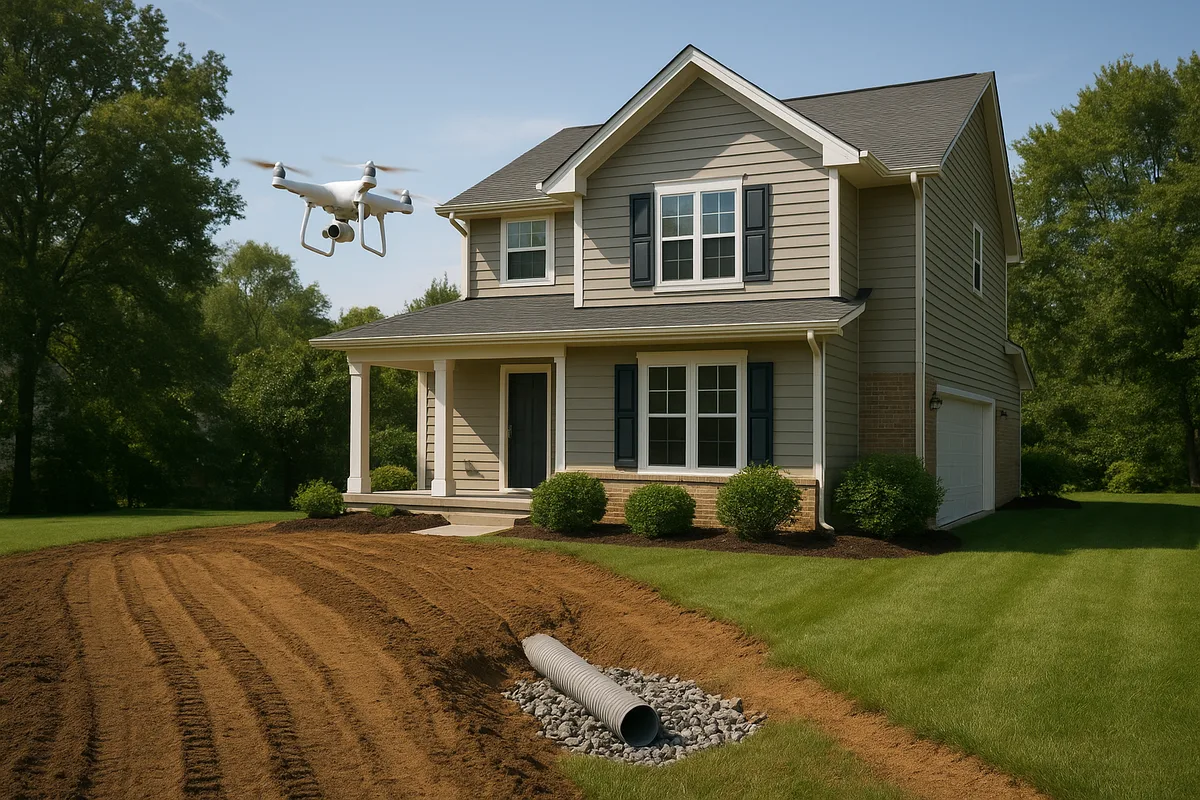
How it works: Reshaping the ground surface to direct water away from structures and toward approved discharge points. Swales are shallow, vegetated channels that slow and direct surface flow.
California-specific considerations:
- In expansive clay areas, grading must account for seasonal soil volume changes — a grade that works in summer may reverse in winter as clay swells
- Swales in clay soil should be lined with amended soil or gravel to prevent them from sealing shut
- Vegetated swales meet LID requirements in most jurisdictions
- Requires minimal permitting for minor regrading (typically under 50 cubic yards)
Cost range: $1,500-$5,000 for typical residential lot regrading; $800-$2,500 for a simple swale
French Drains
Best for: Intercepting subsurface water, redirecting water from uphill sources, perimeter foundation drainage
How it works: A trench filled with gravel surrounding a perforated pipe that collects and redirects groundwater. The NDS drainage products line offers residential-grade French drain components widely available in California.
California-specific considerations:
- In heavy clay soils, French drains must be surrounded by a substantial gravel bed (minimum 6 inches on all sides of the pipe) and wrapped in filter fabric to prevent clay migration into the aggregate
- Pipe diameter matters more in clay areas — use minimum 4-inch perforated pipe, 6-inch in areas with heavy flow
- French drains in clay soils have a finite lifespan (typically 10-20 years) before clay infiltration reduces effectiveness — plan for eventual maintenance or replacement
- In sandy soils, French drains work exceptionally well but may need to discharge to a controlled point to prevent erosion at the outlet
- French drains that discharge to the street or storm drain system may require a connection permit
Cost range: $25-$50 per linear foot installed; a typical 100-foot perimeter system runs $2,500-$5,000
Area Drains and Catch Basins
Best for: Collecting standing water from low spots, patio areas, and driveway depressions
How it works: Grated inlets connected to solid (non-perforated) pipe that carries collected water to a discharge point.
California-specific considerations:
- Essential in flat Central Valley properties where grading alone can't create sufficient slope
- Must be sized for peak flow — a single 6-inch area drain may be insufficient for a large patio area during an atmospheric river event
- Debris screens are critical in areas near trees, especially during fall leaf drop
- In fire-prone areas, debris from burned vegetation can overwhelm standard grates — consider oversized or redundant drains
Cost range: $500-$1,500 per drain installed with connecting pipe
Channel Drains (Trench Drains)
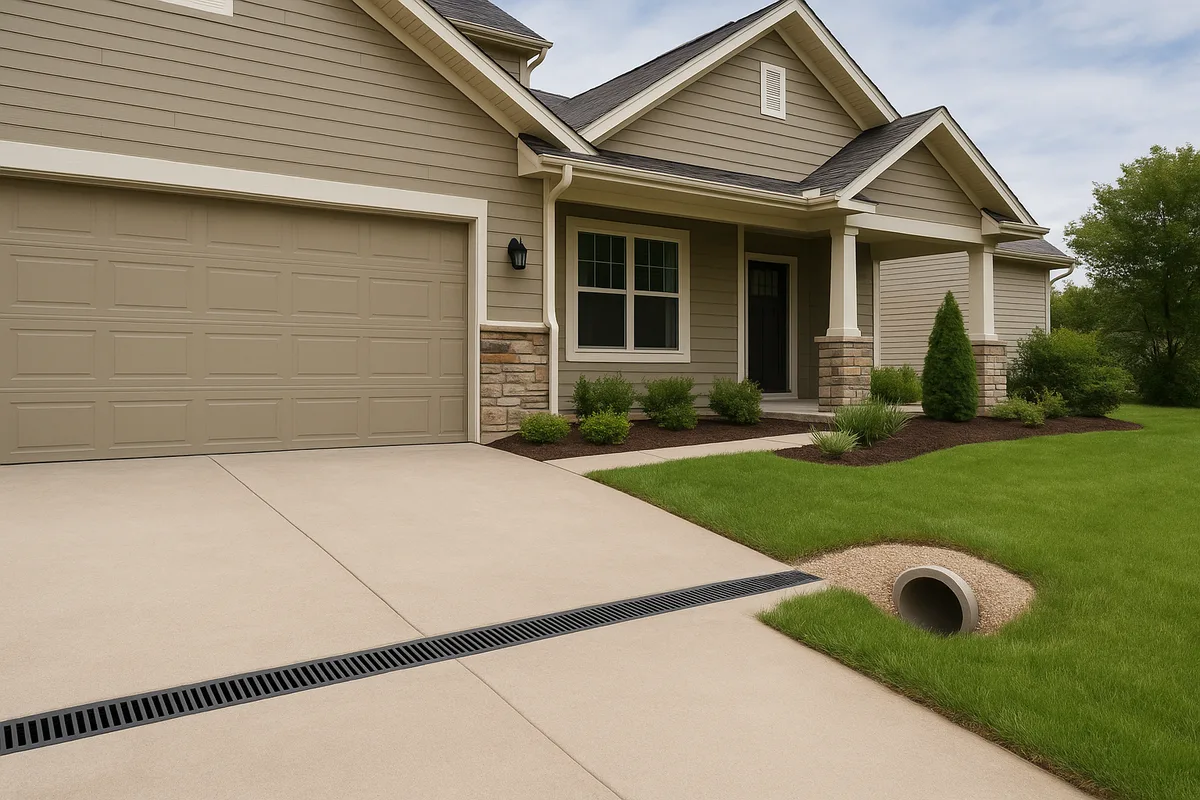
Best for: Driveways, garage entries, patio edges, and anywhere a linear collection point is needed
How it works: A narrow, linear drain with a grate that intercepts sheet flow across hardscape surfaces.
California-specific considerations:
- Nearly mandatory for sloped driveways that direct water toward garages — extremely common in hillside communities throughout the state
- ADA compliance requirements apply to grate spacing in any area accessible to the public
- Polymer concrete channels outperform standard concrete in seismic zones due to flexibility
Cost range: $50-$100 per linear foot installed
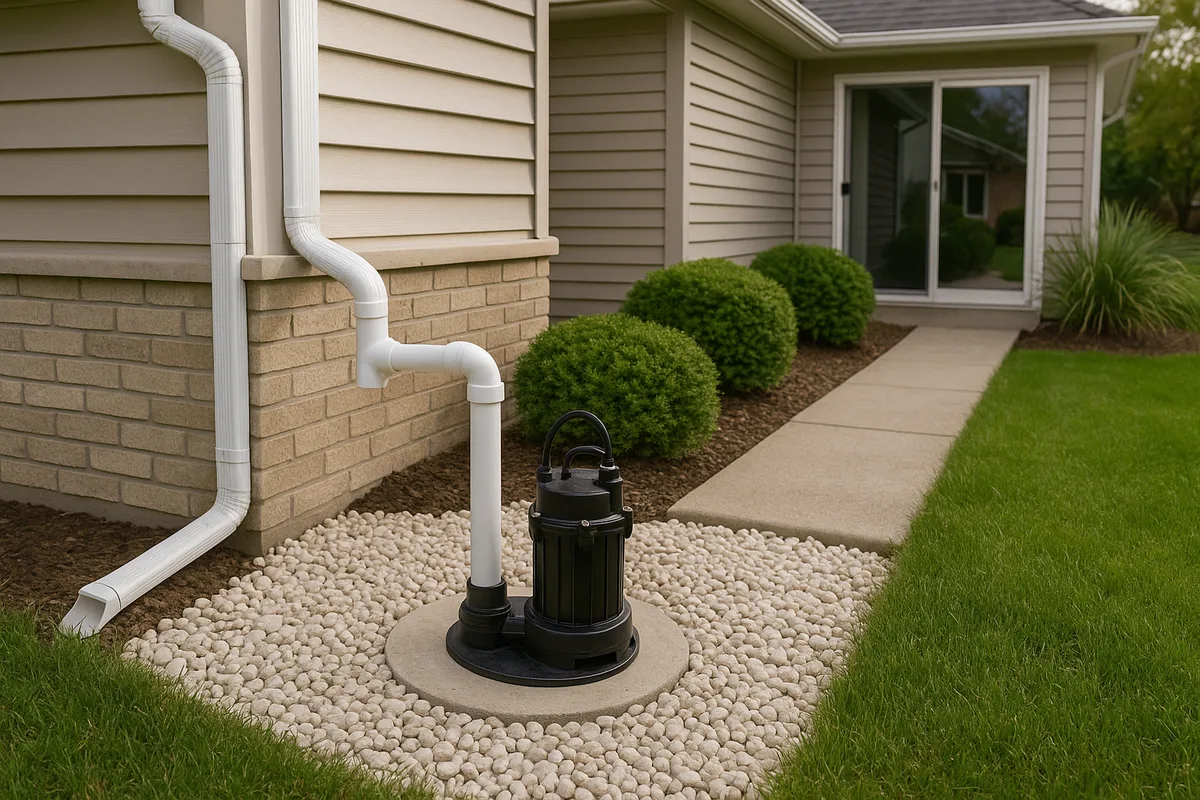
Sump Pumps and Ejector Systems
Best for: Below-grade living spaces, properties with high water tables, delta region homes
California-specific considerations:
- Less common in California than in Midwest or East Coast states, but essential for certain situations: below-grade basements in Bay Area homes, delta region properties, and homes with subterranean garages
- Battery backup is critical — California's power shutoffs during high-wind events (PSPS events) can coincide with storm periods
- Solar-powered backup systems are increasingly popular and may qualify for local rebates
- Discharge must comply with local stormwater ordinances — pumping to the street or storm drain may require a permit
Cost range: $1,200-$3,500 installed with backup system
Retaining Walls and Drainage Behind Them
Best for: Hillside properties, slope stabilization, managing uphill water sources
California-specific considerations:
- Any retaining wall over 4 feet in height requires a building permit and engineered plans in California
- Drainage behind retaining walls is not optional — it's a structural requirement. Hydrostatic pressure from trapped water is the leading cause of retaining wall failure in California
- Walls must include a drainage aggregate backfill, perforated collection pipe at the base, and weep holes at regular intervals
- In seismic zones (all of California), retaining walls must meet additional structural requirements
- Walls on expansive soil require deepened footings — typically 24-36 inches minimum
Cost range: $40-$80 per square face foot for engineered block walls with proper drainage; $80-$150+ for concrete or stone
Rain Gardens and Bioretention
Best for: Meeting LID requirements, managing roof runoff, properties with moderate drainage issues
How it works: Shallow, planted depressions designed to capture and infiltrate stormwater. The American Society of Landscape Architects has published extensive guidance on bioretention design for residential applications.
California-specific considerations:
- Must be planted with drought-tolerant species that can also handle periodic inundation — California native plants like deer grass (Muhlenbergia rigens), California fuchsia, and sedge species are ideal
- In clay soils, rain gardens require an amended soil mix (typically 60% sand, 20% compost, 20% native soil) and may need an underdrain
- Many California water agencies offer rebates for rain garden installation as part of their water conservation programs
- Rain gardens satisfy LID requirements in most jurisdictions, potentially simplifying permit processes for remodel projects
- Sizing: plan for 5-10% of the impervious area draining to the garden
Cost range: $1,500-$4,000 for a typical residential rain garden
Permeable Hardscape
Best for: Driveways, patios, walkways where reducing runoff volume is the goal
California-specific considerations:
- Permeable pavers, pervious concrete, and permeable asphalt all have California-specific installation standards
- Performance in clay soils requires a substantial aggregate base (12-18 inches minimum) to provide storage volume, since infiltration into native clay will be slow
- Maintenance is critical — permeable surfaces must be vacuumed or pressure-washed annually to prevent clogging
- Satisfies LID requirements and may reduce stormwater fees in jurisdictions that charge based on impervious area
- Not recommended for steep slopes (greater than 5%) without additional engineering
Cost range: $12-$25 per square foot for permeable pavers; $8-$15 for pervious concrete
Regional Drainage Profiles
Los Angeles Basin and Inland Empire
The LA Basin presents a textbook case of drainage complexity. Steep mountain fronts (the San Gabriel and Santa Monica Mountains) transition abruptly to a flat coastal plain, creating a system where water concentrates rapidly. The region's famous concrete-lined flood control channels — managed by the LA County Flood Control District — were engineered to move water to the ocean as fast as possible, but they create challenges at the neighborhood level.
Key issues:
- Hillside lots throughout the Hollywood Hills, Palos Verdes, and San Gabriel foothills face slope drainage, debris flow risk, and retaining wall challenges
- Valley floor properties in the San Fernando and San Gabriel Valleys contend with clay soils, flat grades, and aging storm drain infrastructure
- Post-fire drainage is a recurring concern — the Eaton and Palisades fires of early 2025 created burn scars that will affect drainage patterns for years. Properties downslope of these burn areas face elevated debris flow risk through at least 2028
- Expansive soil damage is pervasive — the Rincon and Altamonte soil series that underlie much of the basin are among the most expansive in the state
LA County's LID ordinance is among the strictest in the state, requiring on-site retention of the 85th percentile, 24-hour storm event for any project creating or replacing 500 square feet or more of impervious surface.
San Francisco Bay Area
The Bay Area's drainage challenges are shaped by its dramatic topography, varied microclimates, and aging infrastructure.
Key issues:
- East Bay hills (Oakland, Berkeley, Hayward) sit on Moraga Formation clay soils that are extremely expansive. Landslide risk is elevated during wet winters, and many hillside homes have inadequate subdrainage
- Peninsula communities (Daly City through Palo Alto) face a mix of sandy soils near the coast and clay soils inland. Sea level rise is increasingly affecting drainage in low-lying areas near the Bay
- South Bay (San Jose, Santa Clara) sits on the Santa Clara Valley floor, where a history of groundwater overdraft caused significant subsidence. Some areas are 10-15 feet lower than they were a century ago, complicating drainage to the Bay
- North Bay (Marin, Sonoma) experiences the highest rainfall in the region and faces recurring flooding along the Russian River and Napa River corridors
- San Francisco proper has a combined sewer system (stormwater and sewage in the same pipes), which means that heavy rainfall can overwhelm the system and cause backups into homes — particularly in low-lying neighborhoods like the Mission, SOMA, and the Sunset
The Army Corps of Engineers has been involved in multiple flood risk management studies in the Bay Area, particularly around the San Francisquito Creek watershed and the Coyote Creek corridor in San Jose, where a 2017 levee failure displaced 14,000 residents.
Central Valley (Sacramento and San Joaquin Valleys)
The Central Valley is California's flattest and, in many ways, most drainage-challenged region.
Key issues:
- Extreme flatness — grades of less than 0.1% are common, meaning water has almost no gravitational incentive to move. Positive drainage requires engineered systems, not just grading
- Sacramento's flood risk is among the highest of any major American city. The city sits at the confluence of the Sacramento and American Rivers, protected by an extensive levee system. Properties behind levees may not be mapped in FEMA flood zones but face catastrophic risk if levees fail. The Federal Emergency Management Agency has been remapping Sacramento-area flood zones, and many properties that were previously Zone X (minimal risk) have been reclassified to Zone AE (high risk), triggering flood insurance requirements
- Hardpan layers — much of the Central Valley has a cemented hardpan layer (often called "caliche" or "duripan") 2 to 6 feet below the surface that prevents vertical drainage. Water perches on this layer, creating saturated conditions even in areas with sandy surface soils
- Agricultural drainage legacy — many residential subdivisions were built on former agricultural land with existing tile drain systems. These systems may still function (directing water to agricultural drainage ditches that may no longer exist) or may have been damaged during construction
San Diego County
San Diego's semi-arid climate means that drainage systems spend most of the year dormant, which creates its own problems.
Key issues:
- Decomposed granite soils in the inland and foothill areas drain quickly but erode easily, creating sedimentation problems
- Coastal bluff erosion is a significant concern in communities like Del Mar, Encinitas, and Solana Beach, where drainage mismanagement on blufftop properties accelerates cliff retreat
- Tijuana River watershed — properties in the South Bay area (Imperial Beach, Chula Vista) face unique challenges from transboundary flows and water quality issues
- Canyon drainage — San Diego's distinctive canyon topography means many homes sit at the rim of canyons that serve as natural drainage corridors. Improper discharge into canyons can trigger erosion and is strictly regulated
San Diego's MS4 permit is notably stringent, and the city's stormwater standards manual requires hydromodification management for most new development — meaning that post-development runoff rates and durations must match pre-development conditions.
Sierra Nevada Foothills
The foothill communities from Placer County through Mariposa County face a distinctive set of drainage challenges.
Key issues:
- Steep terrain with thin soils over granite bedrock creates rapid runoff and erosion
- Wildfire risk is extreme, and post-fire drainage impacts can persist for years
- Septic system interaction — many foothill communities are not served by municipal sewer, and drainage system design must account for septic leach field locations and function
- Seasonal creek flooding — many properties are adjacent to seasonal creeks that can go from dry to raging within hours during storm events
Seasonal Considerations for California Drainage
Pre-Season Preparation (September-October)
This is the most important maintenance window for California drainage systems:
- Clean all gutters and downspouts — California's dry season deposits dust, leaves, and debris that will block flow at the first rain
- Flush French drains and subsurface pipes with a garden hose to verify flow
- Clear area drain grates and catch basin screens
- Inspect and clean channel drains
- Check sump pump operation and battery backup charge
- Verify that grading still directs water away from foundations (soil settlement and landscaping changes can alter grades over time)
- Trim vegetation away from foundation walls to allow airflow and visibility
- In fire-prone areas, this coincides with defensible space maintenance — coordinate both efforts
The Federal Emergency Management Agency's preparedness site offers comprehensive checklists for flood preparedness that complement these drainage-specific steps.
Rainy Season Monitoring (November-March)
- Walk your property during the first significant rain of the season and observe water flow patterns — this is your best diagnostic opportunity
- Check for standing water within 24 hours of rain ending
- Monitor foundation walls and crawl spaces for moisture intrusion after each significant storm
- Keep area drain grates clear of leaf debris throughout the season
- After any storm delivering more than 2 inches in 24 hours, inspect for erosion, soil displacement, and any new cracks in hardscape or foundation
Dry Season Maintenance (April-August)
- Repair any erosion damage identified during the rainy season
- Regrade areas where settling has occurred
- This is the optimal time for drainage system installation — dry soil is easier to excavate, and contractors are more available
- Maintain consistent irrigation near foundations to prevent excessive clay shrinkage — the goal is stable soil moisture, not saturation. Many California foundation engineers recommend maintaining soil moisture within 3 feet of the foundation during dry months
- Inspect retaining wall weep holes to ensure they're not blocked by soil, roots, or insects
Cost Considerations and ROI
Drainage improvements in California are among the highest-ROI investments a property owner can make, particularly in areas with expansive soils where foundation damage from poor drainage can cost $20,000-$100,000+ to repair.
Typical Cost Ranges (2026, California)
| Solution | Cost Range | Lifespan |
|---|---|---|
| Gutter/downspout extension | $200-$800 | 10-20 years |
| Surface regrading | $1,500-$5,000 | 5-15 years (needs periodic maintenance) |
| French drain (per linear foot) | $25-$50 | 10-20 years |
| Area drain system | $500-$1,500 per drain | 20-30 years |
| Channel drain (per linear foot) | $50-$100 | 20-30 years |
| Sump pump system | $1,200-$3,500 | 7-12 years (pump replacement) |
| Rain garden | $1,500-$4,000 | 15-25 years |
| Retaining wall with drainage | $5,000-$25,000+ | 30-50+ years |
| Full perimeter drainage system | $8,000-$20,000 | 15-25 years |
| Permeable paver driveway | $15,000-$35,000 | 25-40 years |
California labor costs are among the highest in the nation, which significantly impacts drainage project budgets. The San Francisco Bay Area and coastal Southern California markets typically run 20-40% above these ranges. Central Valley and inland communities may be 10-20% below.
Financing and Assistance
Several financial resources exist for California property owners facing drainage challenges:
- FEMA Hazard Mitigation Grants may be available after declared disasters for drainage improvements that reduce future risk
- SBA Disaster Loans through the Small Business Administration are available to homeowners (not just businesses) after federally declared disasters, with loans up to $500,000 for real property repairs including drainage
- Local water agency rebates — many California water agencies offer rebates for rain gardens, permeable pavement, rain barrels, and other green infrastructure installations
- PACE financing (Property Assessed Clean Energy) programs in some California jurisdictions include stormwater management improvements as eligible projects
When to Get Professional Help
Not every drainage issue requires a professional, but California's complex soil conditions, regulatory requirements, and potential for serious structural damage mean that professional assessment is warranted in several situations:
You Need a Professional When:
- Foundation cracks are present — especially diagonal or stair-step cracks, or cracks wider than 1/4 inch. These may indicate soil movement driven by drainage issues, and the solution requires understanding the cause before treating the symptom
- Your property is on a slope — hillside drainage is complex, and mistakes can create liability for damage to downslope properties. California law holds uphill property owners responsible for changes in natural drainage patterns that cause damage to neighbors
- You're in a post-fire area — drainage assessment after wildfire requires understanding of hydrophobic soil layers, debris flow risk, and changed runoff coefficients. This is specialized work
- You're buying or selling a home — a pre-purchase drainage assessment can identify issues that standard home inspections miss. Drainage problems are the most commonly overlooked deficiency in California real estate transactions
- Your project triggers permit requirements — working without required permits in California can result in stop-work orders, fines, and complications when you sell the property
- You have a retaining wall over 3 feet — even though permits kick in at 4 feet, walls over 3 feet that fail can cause significant damage and liability
Types of Professionals
- Licensed Civil Engineers (PE): Required for engineered drainage plans, retaining wall design, and grading plans in most jurisdictions. Look for engineers with geotechnical or water resources specialization
- Geotechnical Engineers: Specialize in soil behavior and are essential for hillside properties, expansive soil situations, and foundation drainage design
- Licensed Landscape Architects: Can design integrated drainage and landscape solutions, including rain gardens and bioswales. The American Society of Landscape Architects maintains a directory of licensed practitioners
- Licensed Contractors (C-12 or C-36): C-12 (Earthwork and Paving) and C-36 (Plumbing) are the most relevant California contractor license classifications for drainage work. Always verify licenses through the California Contractors State License Board
- Drainage Specialists: Some companies specialize exclusively in residential drainage. Look for companies with specific California experience and references in your soil type
Professional drainage design follows standards published by organizations like the American Society of Civil Engineers and the Water Environment Federation, ensuring that systems are engineered to handle California's unique storm intensity patterns.
Real Estate Implications
Drainage condition has a measurable impact on California real estate transactions, and the stakes are rising.
Disclosure Requirements
California's Transfer Disclosure Statement (TDS) requires sellers to disclose known material defects, which includes drainage problems. The Supplemental Property Questionnaire (SPQ) specifically asks about flooding, drainage, grading, and soil issues. Failure to disclose known drainage problems can result in post-sale litigation — and California courts have consistently held sellers liable for undisclosed drainage defects.
The Natural Hazard Disclosure (NHD) report covers flood zones, dam inundation zones, and other mapped hazards, but it does not address property-specific drainage conditions. This gap is where many buyers get caught — they see a clean NHD report and assume drainage isn't a concern.
Impact on Property Value
Properties with documented drainage problems typically sell for 5-15% below comparable properties, depending on severity. Conversely, properties with well-designed, documented drainage systems can command premiums, particularly in areas known for drainage challenges.
For real estate professionals, understanding drainage is increasingly a differentiator. The ability to identify drainage red flags during property showings — and to recommend appropriate assessments — protects clients and builds trust.
Insurance Considerations
Standard California homeowner's insurance policies do not cover flood damage or damage from surface water intrusion. Flood insurance through the National Flood Insurance Program covers flooding from external sources but typically does not cover damage from poor drainage or grading on the property itself.
This coverage gap means that drainage-related damage — the most common type of water damage to California homes — is often uninsured. This makes prevention through proper drainage design and maintenance not just advisable but financially essential.
Green Infrastructure and California's Water Future
California is at the forefront of integrating stormwater management with water supply, and this trend is reshaping residential drainage.
The state's increasing embrace of stormwater capture as a water supply source means that drainage systems are evolving from "get water off the property" to "capture, clean, and infiltrate water on the property." This philosophical shift is embedded in current regulations and will only intensify.
For property owners, this means:
- Rain barrels and cisterns are legal and encouraged throughout California (they were legalized statewide in 2012). A typical residential rain barrel captures 50-100 gallons per downspout, and larger cistern systems can capture thousands of gallons for landscape irrigation
- Stormwater infiltration is increasingly viewed as groundwater recharge — particularly important in overdrafted basins throughout the Central Valley and Southern California
- Green infrastructure solutions (rain gardens, bioswales, permeable pavement) often qualify for rebates and satisfy regulatory requirements simultaneously
- Organizations like American Rivers advocate for green infrastructure approaches that serve both drainage and ecological functions — an approach gaining traction in California policy
The Cooperative Extension System through UC Cooperative Extension provides California-specific guidance on rain gardens, drought-tolerant bioswales, and other green infrastructure approaches adapted to local climate and soil conditions.
Getting a Drainage Intelligence Report™
The complexity of California's drainage landscape — the soil variability, the regulatory patchwork, the wildfire interactions, the seismic considerations — means that generic drainage advice only goes so far. Every California property has a unique combination of soil type, topography, climate exposure, regulatory jurisdiction, and infrastructure condition that determines its drainage risk profile.
A Low Point Labs Drainage Intelligence Report™ provides property-specific analysis that accounts for all of these variables. Using advanced topographic data, soil mapping, historical precipitation records, and regulatory databases, our reports identify drainage vulnerabilities, quantify risk, and recommend specific solutions calibrated to your property's unique conditions.
Whether you're a homeowner concerned about foundation cracks that appear every winter, a buyer evaluating a hillside property in the East Bay, a real estate agent who wants to provide clients with actionable intelligence, or a contractor scoping a drainage project — a Drainage Intelligence Report™ gives you the data-driven foundation for confident decisions.
California's water challenges aren't going away. Atmospheric rivers are intensifying. Wildfire seasons are lengthening. Regulations are tightening. The properties that weather these trends successfully will be the ones with drainage systems designed for California's actual conditions — not generic solutions borrowed from other climates.
Get your property's Drainage Intelligence Report™ today and know exactly where you stand.
Explore our US Drainage Guide for a national perspective on residential drainage.
Frequently Asked Questions
The Low Point Labs Drainage Intelligence™ platform is accessible via invitation-led onboarding.