The City Built Between Two Rivers — And the Drainage Consequences That Follow
Sacramento sits at the confluence of the Sacramento and American Rivers, a geographic fact that has shaped nearly every aspect of how the city handles water. What makes Sacramento's drainage story genuinely unusual among American cities is this: much of the urban core sits below the flood stage of the rivers that border it. The city exists behind an elaborate system of levees, weirs, and bypass channels — one of the most complex flood management systems in the United States — and yet the drainage challenges that affect most Sacramento homeowners on a daily basis have almost nothing to do with river flooding. They have everything to do with what happens when 22 inches of annual rain meets adobe clay soil on flat terrain with minimal natural gradient.
That combination — clay, flatness, and concentrated winter rainfall — creates a drainage environment that is deceptively challenging. Sacramento doesn't look like a place with serious water problems. There are no dramatic hillsides funneling runoff, no coastal storm surges, no hurricane seasons. Instead, Sacramento's drainage issues are quieter and more insidious: saturated yards that stay soggy for weeks, foundation damage from expansive clay soils that swell and shrink with the seasons, aging stormwater infrastructure in older neighborhoods that simply cannot keep pace with modern impervious surface coverage, and a regulatory environment that has grown significantly more complex in recent years.
If you own property in Sacramento — whether it's a 1940s bungalow in Land Park, a mid-century ranch in Arden-Arcade, or a newer build in Natomas or Elk Grove — understanding your drainage is not optional. It's one of the most consequential factors affecting your home's structural health, your insurance costs, and your property value.
Sacramento's Drainage Landscape: Soil, Topography, and Climate
The Adobe Clay Problem
Sacramento's single most defining drainage characteristic is its soil. The Sacramento Valley floor is dominated by what locals and soil scientists alike call adobe clay — heavy, dense, fine-grained clay soils that are among the most poorly draining soils you'll encounter in any major American city. According to USDA soil survey data, much of the Sacramento metro area is classified within the San Joaquin, Galt, and Cosumnes soil series, all of which feature clay or clay loam textures with very low permeability rates.
What does this mean in practical terms? When rain falls on Sacramento clay, it doesn't percolate downward the way it would in sandy or loamy soils. Instead, it pools on the surface or saturates the top few inches of soil, creating a perched water table effect. A yard that looks perfectly dry in August can become a standing-water problem within hours of the first significant November rain — not because the drainage system failed, but because the soil itself is essentially impermeable.
The challenge is compounded by the expansive nature of Sacramento's clay. These soils swell when wet and shrink when dry, a cycle that creates enormous stress on foundations, hardscape, and underground drainage infrastructure. The USDA Natural Resources Conservation Service classifies many Sacramento soils as having "high shrink-swell potential," meaning they can expand by 4-8% in volume when saturated. Over a 2,000-square-foot foundation footprint, that translates to enormous lateral and vertical pressure. Cracks in slab foundations, sticking doors, and uneven floors throughout Sacramento are overwhelmingly attributable to this soil behavior rather than structural deficiency.
Sandy Loam Pockets and Transitional Soils
Not all of Sacramento sits on heavy clay. Properties closer to the American River — particularly in neighborhoods like Fair Oaks, Carmichael, and portions of East Sacramento along the river bluffs — sit on sandier, more permeable alluvial soils deposited by the river over millennia. These areas tend to drain significantly better, but they come with their own challenges: erosion susceptibility during heavy flows, higher vulnerability to subsurface water migration toward foundations, and in some cases, proximity to the river's flood zone.
The transition zones between clay and sandy soils can be particularly problematic. In neighborhoods like Arden-Arcade and parts of North Sacramento, you'll find properties where one side of the lot sits on reasonably permeable loam while the other side hits a clay lens just a few feet down. Water flows freely through the sandy layer and then hits the clay barrier, creating underground pooling that can emerge as seepage in basements, crawl spaces, or along foundation walls. Understanding your specific soil profile — not just the general soil type for your neighborhood — is critical for designing effective drainage solutions.
The Flatness Factor
Sacramento is remarkably flat. The city's elevation ranges from roughly 0 to 75 feet above sea level across the entire metro area, with most residential neighborhoods sitting between 15 and 40 feet. This matters enormously for drainage because gravity is the primary force that moves surface water, and when there's minimal slope, water has no particular reason to go anywhere.
In well-graded subdivisions, builders create artificial slope — typically a minimum of 2% grade away from foundations — to direct water toward street gutters, storm drains, or designated drainage swales. But Sacramento's flatness means that even small grading errors compound quickly. A property that settles unevenly by just an inch or two over a decade can reverse the intended drainage direction, sending water toward the foundation instead of away from it. This is one of the most common drainage failures we see in Sacramento properties built before modern grading standards were strictly enforced.
The US Geological Survey topographic data for the Sacramento Valley illustrates just how little elevation change exists across the metro area. From Natomas to Elk Grove — a distance of roughly 20 miles — the total elevation change is less than 50 feet. In practical terms, this means Sacramento's stormwater system relies almost entirely on engineered infrastructure rather than natural topographic drainage.
Sacramento's Mediterranean Climate and Rainfall Patterns
Sacramento's climate creates a uniquely challenging drainage cycle. The city receives virtually all of its 22 inches of annual rainfall between October and April, with the driest months (June through September) receiving essentially zero precipitation. This feast-or-famine pattern means that Sacramento's clay soils spend five to six months drying out, shrinking, and cracking, then spend five to six months absorbing water, swelling, and becoming saturated.
The National Oceanic and Atmospheric Administration climate data for Sacramento shows that January alone averages nearly 4 inches of rainfall — roughly 18% of the annual total concentrated in a single month. When atmospheric river events occur, Sacramento can receive 2-4 inches in a 24-hour period, overwhelming both natural soil absorption and engineered drainage systems.
What makes this pattern especially damaging is the transition period. When the first rains arrive in October or November, they fall on soil that has been baking and cracking for months. The initial rain rushes through the surface cracks rather than spreading evenly, creating localized saturation pockets deep in the soil profile. As the wet season progresses and the cracks swell shut, subsequent rainfall has nowhere to go and begins pooling on the surface. By January and February, Sacramento's clay soils are typically at or near full saturation, and every additional storm creates surface drainage problems.
The National Weather Service Sacramento forecast office regularly issues flood advisories not because of river flooding but because of urban and small stream flooding — the direct result of saturated soils and overwhelmed storm drain infrastructure in residential neighborhoods.
Neighborhood-by-Neighborhood Drainage Challenges
Natomas
Natomas represents Sacramento's most dramatic drainage story. The North and South Natomas areas sit in a natural floodplain between the Sacramento and American Rivers, protected by a ring of levees. Much of the development here occurred from the 1990s through the 2010s, and while newer homes were built to modern grading standards, the fundamental challenge remains: Natomas is a basin. Water that enters the basin — whether from rainfall, irrigation, or storm events — must be pumped out. The Natomas Basin relies on pump stations operated by Reclamation District 1000 to remove stormwater, and when those systems are stressed during major storms, localized flooding can occur.
Properties in Natomas also sit on some of the heaviest clay soils in the metro area, deposited by centuries of river flooding before the levees were built. Foundation issues related to expansive soil are extremely common here, and many homeowners discover that their lot grading has shifted within just a few years of construction due to soil settlement.
Land Park and Curtis Park
These established neighborhoods south of downtown feature some of Sacramento's oldest housing stock, with many homes built in the 1920s through 1940s. Drainage infrastructure here is aging — some storm drain lines are 80+ years old and have reduced capacity due to root intrusion, joint separation, and sediment accumulation. The tree canopy that makes these neighborhoods so desirable also contributes to drainage challenges: mature tree roots can disrupt underground drainage lines and alter surface grading over time.
Many Land Park homes have raised foundations with crawl spaces, and standing water in crawl spaces during the wet season is one of the most common complaints. The combination of aging infrastructure, mature landscaping that has altered original grading, and clay soils makes these neighborhoods particularly prone to chronic drainage issues.
Pocket-Greenhaven
The Pocket area, surrounded on three sides by the Sacramento River, faces unique drainage pressures. While levees protect the neighborhood from river flooding, the low-lying topography means that stormwater drainage relies heavily on pump stations. During extended wet periods, groundwater levels can rise to within a few feet of the surface, creating hydrostatic pressure against foundations and making subsurface drainage solutions less effective than they would be in areas with deeper water tables.
Arden-Arcade
This unincorporated area (Sacramento County jurisdiction rather than City of Sacramento) features highly variable soil conditions and a mix of housing ages from the 1950s through the 1990s. The Arcade Creek and its tributaries create natural drainage corridors, but many properties that were developed near these waterways experience seasonal flooding when creek levels rise. The soil transitions from sandy loam near the American River bluffs to heavy clay as you move south, creating the transitional soil challenges described earlier.
East Sacramento and Midtown
These grid-pattern neighborhoods feature older infrastructure and a high percentage of impervious surface coverage. Narrow lots, concrete driveways, and limited yard space mean that individual properties generate significant runoff with minimal on-site absorption capacity. The storm drain system in these areas was designed for a much lower density of impervious surfaces than currently exists, and localized street flooding during heavy rains is common, particularly in low spots along the grid.
Elk Grove and South Sacramento
The rapidly developed areas south of Sacramento feature newer infrastructure but sit on particularly heavy Galt-series clay soils. Many subdivisions built in the 2000s and 2010s include detention basins and engineered drainage systems, but individual lot drainage still depends on proper grading maintenance. The flat terrain in Elk Grove means that even minor grading changes — from landscape modifications, patio additions, or natural soil settlement — can create ponding problems.
The Regulatory and Legal Framework
City of Sacramento Stormwater Quality Program
Sacramento operates under a Municipal Separate Storm Sewer System (MS4) permit issued by the Central Valley Regional Water Quality Control Board. This permit, which implements federal Clean Water Act requirements enforced by the Environmental Protection Agency, imposes specific obligations on both the city and individual property owners regarding stormwater quality and quantity.
For homeowners, the most relevant regulatory requirements include:
- Grading permits: Any grading work that disturbs more than 50 cubic yards of soil or alters drainage patterns on a property typically requires a grading permit from the City of Sacramento Department of Utilities. This includes many drainage improvement projects.
- Stormwater quality requirements: Projects that create or replace more than 2,500 square feet of impervious surface must incorporate stormwater quality measures — typically bioretention areas, permeable pavement, or other low-impact development features.
- Prohibition on cross-connections: It is illegal to connect sump pumps, foundation drains, or downspout extensions to the sanitary sewer system. All such water must be directed to the storm drain system, to landscape areas, or to approved on-site retention.
- Illicit discharge prohibition: Discharging anything other than stormwater to the storm drain system — including pool water, wash water, or sediment-laden runoff from construction — is prohibited.
Sacramento County Drainage Requirements
For properties in unincorporated Sacramento County (including Arden-Arcade, Carmichael, Fair Oaks, and portions of Orangevale and Citrus Heights), the Sacramento County Department of Water Resources administers stormwater regulations. County requirements are broadly similar to city requirements but administered separately. The county's Stormwater Quality Design Manual specifies hydromodification management requirements — meaning that new development and significant redevelopment must ensure that post-project stormwater runoff rates and durations do not exceed pre-project conditions.
Flood Zone Designations and Insurance
Sacramento has one of the most complex flood zone maps of any American city. FEMA flood maps for Sacramento County designate significant portions of the metro area as Special Flood Hazard Areas (SFHAs), including much of Natomas, portions of the Pocket, areas along the American River Parkway, and properties near various creeks and waterways.
If your property is in a designated SFHA and you have a federally backed mortgage, you are required to carry flood insurance. The National Flood Insurance Program provides coverage, though premiums have increased substantially under FEMA's Risk Rating 2.0 methodology, which prices policies based on individual property risk rather than broad zone designations.
Critically, many Sacramento homeowners whose properties are not in designated flood zones still experience water damage from poor site drainage, and standard homeowner's insurance policies typically do not cover this type of damage. The distinction between "flooding" (water entering from outside the property, covered by flood insurance) and "water damage from drainage failure" (often excluded or limited under standard policies) is one that catches many Sacramento homeowners off guard.
Real Estate Disclosure Requirements
California's Transfer Disclosure Statement (TDS) requires sellers to disclose known material facts about a property, including drainage problems, flooding history, and grading issues. The Natural Hazard Disclosure (NHD) report, required for all California real estate transactions, identifies whether a property is in a FEMA flood zone, a dam inundation zone, or other hazard areas. The Department of Housing and Urban Development also requires flood zone disclosure for federally related mortgage transactions.
However, disclosure requirements only cover known conditions. Many drainage problems are not immediately apparent — they may only manifest during heavy rain events, or they may be developing gradually as grading shifts over time. This is one of the primary reasons that pre-purchase drainage assessments have become increasingly common in Sacramento real estate transactions.
Diagnosing Drainage Problems on Your Sacramento Property
Before spending money on solutions, you need to understand what's actually happening with water on your property. Here's a systematic approach to drainage assessment that accounts for Sacramento's specific conditions.
Visual Inspection During Dry Season (May-September)
Even during Sacramento's bone-dry summers, you can identify drainage vulnerabilities:
- Check foundation grading: Walk the perimeter of your home with a 4-foot level. The soil surface should slope away from the foundation at a minimum of 2% (approximately 1/4 inch per foot). In Sacramento's clay soils, settlement often reverses original grading within 5-10 years of construction.
- Look for soil cracks: Sacramento's clay soils develop visible cracks during the dry season. While some cracking is normal, cracks wider than 1/2 inch or cracks that extend more than a foot deep indicate highly expansive soil that will create significant drainage stress when the rains return.
- Inspect hardscape for heaving or settlement: Sidewalks, driveways, and patios that have shifted, cracked, or developed uneven surfaces are indicators of expansive soil movement. Note the direction of tilt — this tells you which direction water will flow when it rains.
- Check gutters and downspouts: Ensure all downspouts discharge at least 4-6 feet from the foundation. In Sacramento's clay soils, the standard recommendation of "away from the foundation" isn't sufficient — you need to ensure the discharge point connects to a drainage system or flows to a location where it won't pool.
- Examine crawl space: If your home has a raised foundation, inspect the crawl space for signs of past moisture — water stains on piers, efflorescence (white mineral deposits) on concrete, mold or mildew, or standing water residue.
Active Observation During Wet Season (November-March)
The wet season is when Sacramento's drainage problems reveal themselves:
- Observe during and immediately after rain: Go outside during a significant rain event (1/2 inch or more) and watch how water moves across your property. Where does it pool? Where does it flow? Does it flow toward or away from your foundation? Does water sheet across your driveway or walkways?
- Check for ponding: After rain stops, note any areas where water remains standing for more than 24 hours. In Sacramento's clay soils, some surface moisture lasting 12-24 hours is normal. Standing water persisting beyond 48 hours indicates a drainage deficiency.
- Monitor the street and gutter: Is water backing up in the street gutter in front of your property? Is the storm drain inlet clogged with leaves or debris? In older Sacramento neighborhoods, homeowners are often surprised to learn that the storm drain inlet nearest their property is undersized for current conditions.
- Check for neighbor contributions: Sacramento's flat terrain means that water from adjacent properties often flows onto yours. Note whether your drainage problems are caused by on-site conditions or by runoff from neighboring properties. This distinction matters for both solution design and potential legal responsibility.
Soil Testing
For any significant drainage project in Sacramento, a basic soil assessment is invaluable. You can perform a simple percolation test yourself:
- Dig a hole 12 inches deep and 12 inches in diameter
- Fill it with water and let it drain completely (this pre-saturates the soil)
- Fill it again and measure the water level
- Check the water level after 1 hour
In well-draining soil, the water level should drop 1-2 inches per hour. In Sacramento's typical clay soils, you'll often see less than 1/4 inch per hour — sometimes essentially zero. This tells you that any drainage solution relying on soil absorption (rain gardens, dry wells, infiltration trenches) will need to be significantly oversized or supplemented with positive drainage to an outlet.
For professional-grade soil analysis, the USDA Web Soil Survey provides detailed soil maps for every parcel in Sacramento County, including drainage class, permeability rates, shrink-swell potential, and depth to water table. This free resource should be your starting point before hiring any contractor.
Foundation Assessment
Because Sacramento's expansive clay soils create direct linkage between drainage and structural integrity, any drainage assessment should include a basic foundation evaluation:
- Measure doors and windows: Doors or windows that stick seasonally (tight in winter, loose in summer) indicate foundation movement driven by soil moisture changes.
- Check for cracks: Diagonal cracks at window and door corners, stair-step cracks in brick veneer, or horizontal cracks in foundation walls all suggest soil-related foundation stress.
- Look for floor slope: Place a marble or ball on hard floors in various rooms. Consistent rolling in one direction indicates differential settlement.
If you identify foundation concerns, address drainage first. In many Sacramento cases, stabilizing the moisture environment around the foundation — by correcting grading, managing downspout discharge, and installing perimeter drainage — resolves or halts foundation movement without the need for expensive structural repair.
Drainage Solutions for Sacramento Properties
Grading and Surface Drainage Corrections
The single most cost-effective drainage improvement for most Sacramento properties is correcting surface grading. This involves reshaping the soil surface around the foundation to ensure positive slope away from the structure and toward designated drainage points.
In Sacramento's clay soils, grading corrections require specific techniques:
- Import appropriate fill material: Don't simply push existing clay soil around. Import a clay-amended topsoil or compactable fill that provides positive drainage while remaining compatible with the existing clay. Using sandy fill on top of clay creates a "bathtub" effect where water infiltrates the sand layer and pools on the clay interface.
- Compact in lifts: Clay soil must be compacted in 4-6 inch lifts at the proper moisture content. Under-compacted fill will settle, reversing your grading corrections within a year or two.
- Maintain grade over time: Sacramento's expansive soils will shift your grading. Plan to re-evaluate and touch up grading every 3-5 years.
Typical cost for grading correction around a Sacramento home: $1,500-$4,500 depending on the extent of work needed and accessibility.
French Drains and Subsurface Drainage
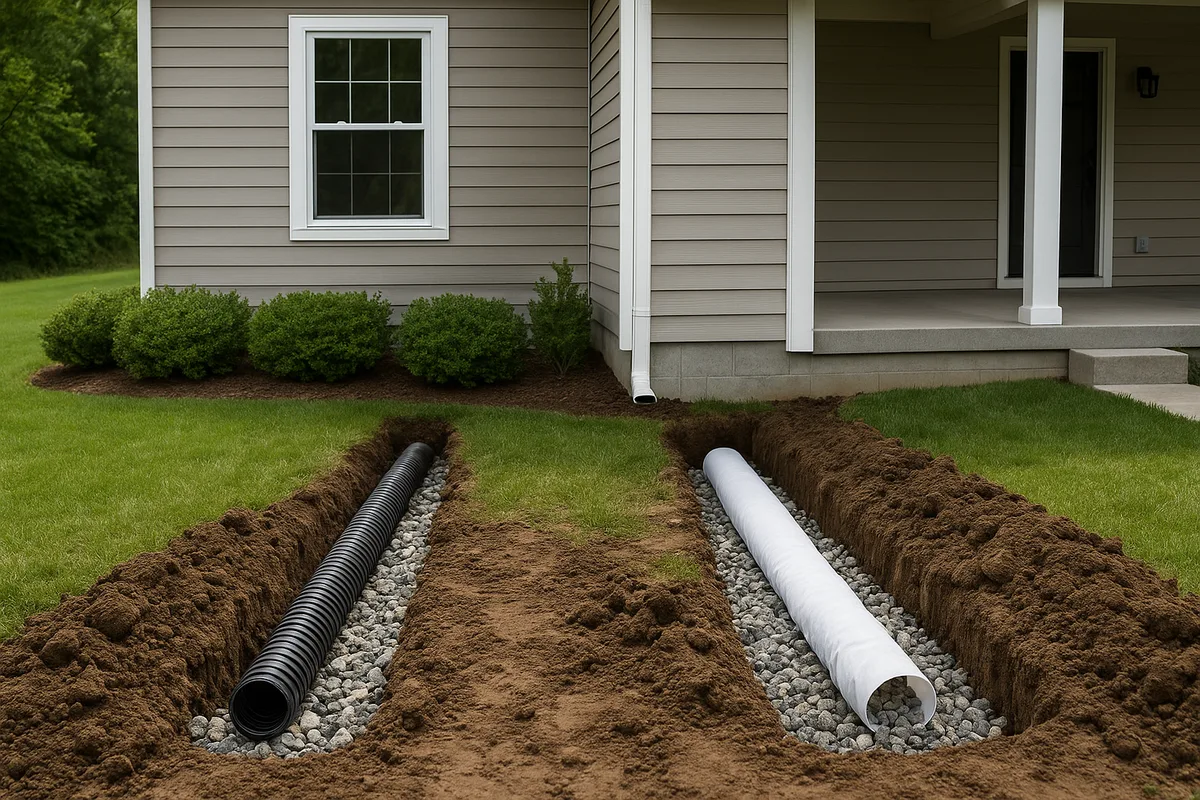
French drains — perforated pipe installed in gravel-filled trenches — are the workhorse solution for Sacramento drainage problems. They intercept subsurface water and redirect it to an approved discharge point (typically the storm drain system or a pop-up emitter in the landscape).
For Sacramento's clay soils, French drain design requires specific adaptations:
- Use filter fabric: Sacramento's fine clay particles will migrate into the gravel and clog the system within a few years if filter fabric is not used to wrap the entire trench. Use non-woven geotextile fabric rated for clay soil applications.
- Oversize the gravel reservoir: Because Sacramento clay drains so slowly, the gravel trench serves as a temporary storage reservoir, not just a conveyance channel. Use a minimum 12-inch-wide trench with 3/4-inch to 1-inch clean drain rock.
- Ensure positive outlet: Every French drain needs a discharge point. In Sacramento's flat terrain, this often means connecting to the city storm drain system, which requires a connection permit from the Department of Utilities. Alternatively, NDS drainage products such as pop-up emitters can discharge water to landscape areas, but only if the receiving area has adequate capacity and slope to prevent re-pooling.
- Consider cleanout access: Install cleanout risers at turns and every 50-75 feet of run to allow for future maintenance and flushing.
Typical cost for French drain installation in Sacramento: $25-$50 per linear foot, with most residential projects running $3,000-$8,000 total.
Channel Drains and Surface Collection
For driveways, patios, and other hardscape areas where water pools, channel drains (also called trench drains) collect surface water and redirect it. These are particularly useful in Sacramento because the flat terrain and clay soils mean that hardscape areas often have inadequate slope for sheet drainage.
Channel drains installed at the base of driveways, at the threshold of garage doors, or along patio edges can prevent water from entering garages, flowing toward foundations, or pooling on walkways. The American Society of Landscape Architects provides design guidance for integrating drainage infrastructure with landscape design — an important consideration in Sacramento where outdoor living spaces are used extensively during the dry season.
Typical cost for channel drain installation: $50-$100 per linear foot installed, depending on material and complexity.
Sump Pump Systems
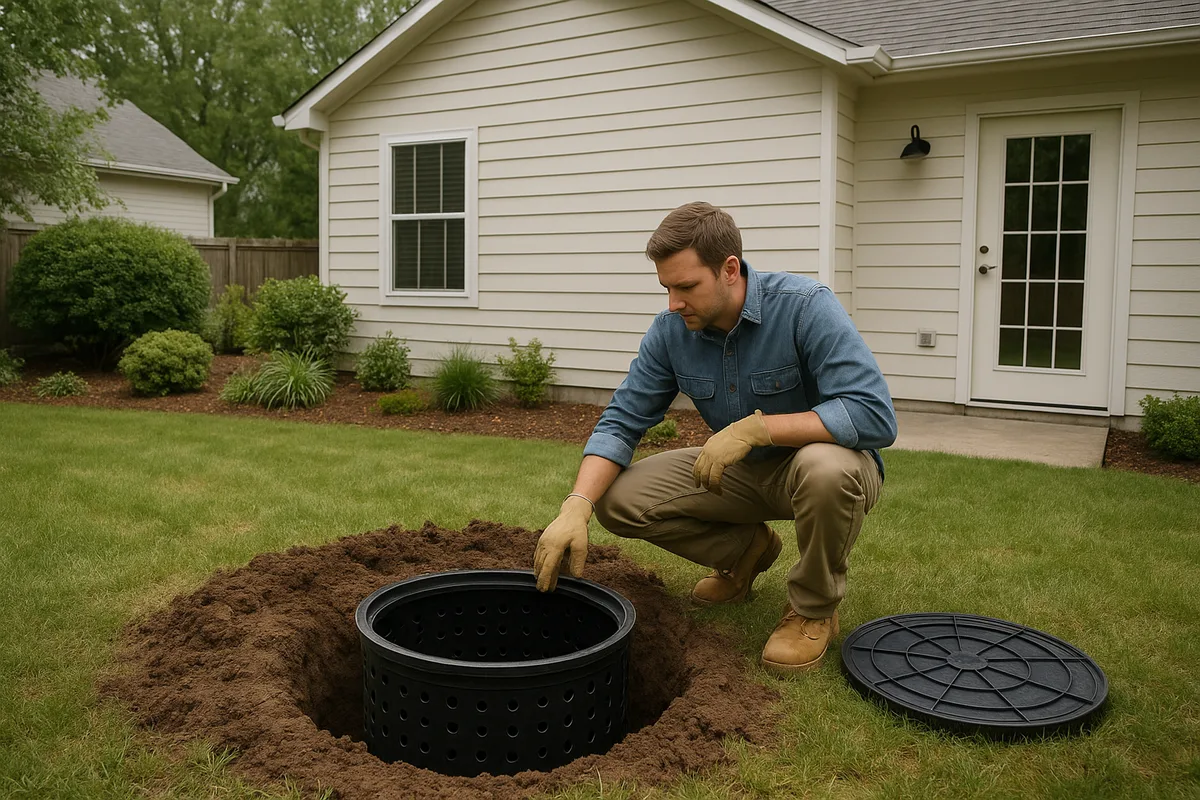
For Sacramento properties with crawl spaces that experience standing water, sump pump systems are often the most practical solution. A sump basin is installed at the lowest point of the crawl space, and a pump automatically activates when water reaches a set level, discharging the water to an approved location outside the home.
Key considerations for Sacramento sump pump installations:
- Battery backup is essential: Sacramento's winter storms frequently cause power outages, and a sump pump is useless without power precisely when you need it most. Install a battery backup system or a water-powered backup pump.
- Discharge location matters: Sump pump discharge must go to the storm drain system or to a landscape area — never to the sanitary sewer. Verify that your discharge point won't create problems for neighboring properties.
- Address the source: A sump pump manages the symptom (water in the crawl space) but doesn't fix the cause. Combine sump pump installation with exterior grading corrections and perimeter drainage to reduce the volume of water reaching the crawl space.
Typical cost for sump pump installation in Sacramento: $1,200-$3,500 including basin, pump, backup system, and discharge line.
Downspout Management
Roof runoff is one of the largest contributors to foundation drainage problems, and it's one of the easiest to address. A typical Sacramento home with a 2,000-square-foot roof footprint generates approximately 27,000 gallons of runoff during an average rain year. If that water is deposited directly at the foundation via short downspouts, it concentrates enormous moisture load exactly where you don't want it.
Effective downspout management in Sacramento includes:
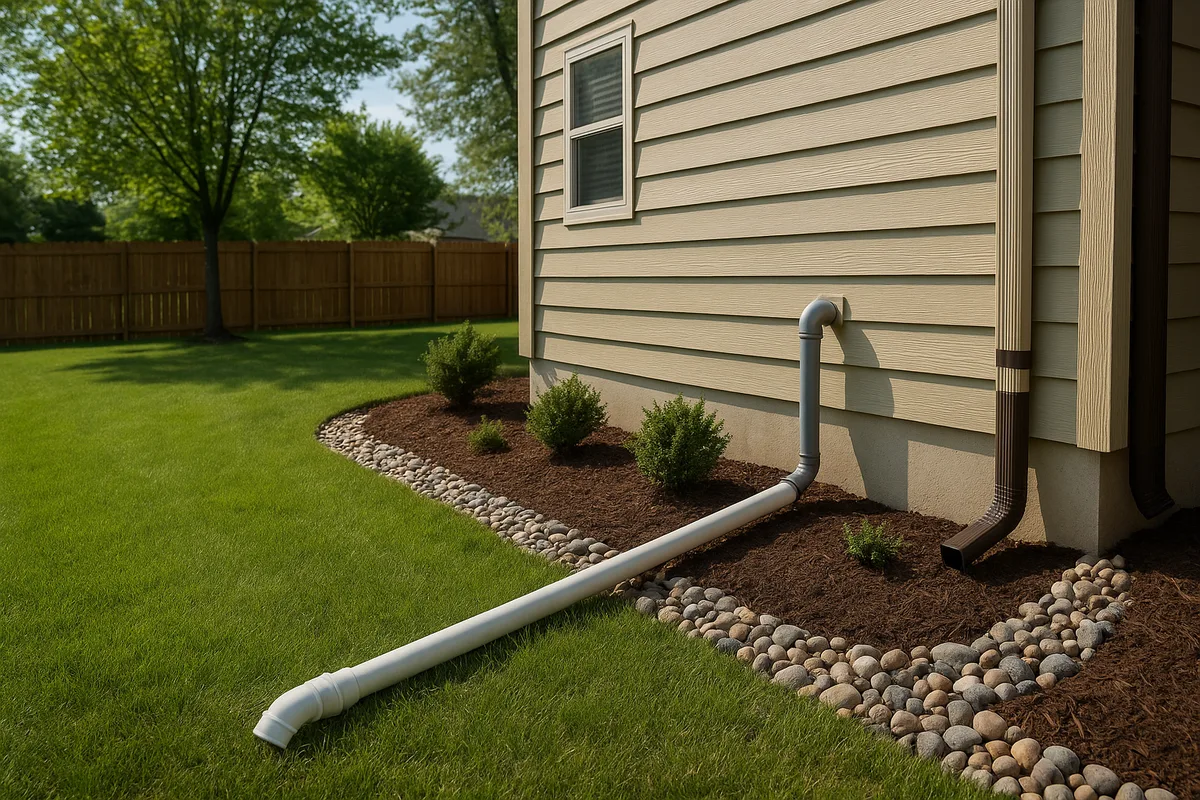
- Extend downspouts: Route downspout discharge at least 6-10 feet from the foundation via buried solid pipe (not perforated). In clay soils, the water needs to travel far enough that it doesn't migrate back through the soil toward the foundation.
- Connect to the drainage system: The most effective approach is to connect downspouts directly to a French drain or to a dedicated underground line that discharges to the storm drain or a pop-up emitter in the front yard.
- Avoid splash blocks: Splash blocks are inadequate for Sacramento's clay soils. They deposit water 2-3 feet from the foundation, which in clay soil is essentially the same as depositing it at the foundation.
Typical cost for comprehensive downspout rerouting: $1,000-$3,000 for a typical Sacramento home.
Rain Gardens and Bioretention
Rain gardens — shallow, planted depressions designed to capture and infiltrate stormwater — are increasingly popular in Sacramento and are actively encouraged by the city's stormwater program. However, Sacramento's clay soils present a significant design challenge: standard rain garden designs assume reasonable soil infiltration rates, which Sacramento clay does not provide.
Successful rain gardens in Sacramento require:
- Engineered soil media: Excavate the native clay and replace it with a designed bioretention soil mix (typically 60% sand, 20% compost, 20% topsoil) to a depth of 18-24 inches. This creates an artificial infiltration zone.
- Underdrain: Install a perforated pipe at the base of the rain garden connected to the storm drain system. Without an underdrain, a rain garden in Sacramento clay will simply become a permanent pond.
- Appropriate plant selection: Use plants adapted to Sacramento's wet winters and dry summers — a challenging combination. Native species like deer grass (Muhlenbergia rigens), California fuchsia, and sedge varieties perform well.
The Low Impact Development Center provides detailed design guidance for bioretention in clay soil conditions. Sacramento's stormwater program also offers resources for homeowners interested in green infrastructure approaches.
Typical cost for a residential rain garden in Sacramento: $2,000-$6,000 depending on size and complexity.
Retaining Walls and Terracing
While Sacramento is generally flat, many properties have grade changes at property lines, along creek banks, or where fill was placed during construction. Retaining walls can manage these grade transitions while directing drainage. For properties along the American River bluffs or near creek corridors, properly engineered retaining walls with integrated drainage (weep holes, drainage aggregate behind the wall, and collection systems at the base) are essential to prevent hydrostatic pressure buildup that can cause wall failure.
The American Society of Civil Engineers publishes standards for retaining wall design that account for the lateral earth pressure created by saturated expansive soils — a critical consideration in Sacramento where clay soils behind a retaining wall can generate significantly more pressure when wet than when dry.
Seasonal Drainage Maintenance Calendar for Sacramento
September-October: Pre-Season Preparation
- Clean all gutters and downspouts. Sacramento's street trees (especially the ubiquitous sycamores and elms) drop enormous volumes of leaves that clog gutters quickly.
- Inspect and clear all surface drain inlets, channel drains, and French drain cleanouts.
- Check grading around the foundation. After a long dry summer, clay soils may have shrunk and settled, creating reverse slopes.
- Test sump pumps and verify battery backup systems are functional.
- Clear the storm drain inlet nearest your property of accumulated leaves and debris. While this is technically the city's responsibility, a clogged inlet in front of your home affects your property first.
November-January: Active Monitoring
- Observe drainage during the first significant rain events. This is your best opportunity to identify new problems or confirm that existing systems are functioning.
- Check crawl spaces after major storms for standing water.
- Monitor downspout discharge points to ensure they're not eroding landscape areas or creating pooling.
- Keep gutters clear — Sacramento's leaf drop continues well into December.
February-March: Assessment and Planning
- By February, Sacramento's soils are typically at peak saturation. This is when chronic drainage problems are most visible and most accurately assessed.
- Document any standing water, foundation moisture, or erosion with photos and measurements. This documentation is valuable for contractor consultations, insurance claims, and real estate disclosures.
- Begin planning and scheduling drainage improvement projects for spring installation. Sacramento drainage contractors are busiest from October through February — scheduling work for March through May often results in better availability and pricing.
April-May: Project Season
- This is the optimal window for drainage construction in Sacramento. Soils are moist enough to work but not saturated, and you have the entire dry season ahead for the work to settle and establish before the next wet season.
- Complete grading corrections, French drain installations, and other earthwork during this window.
- Plant rain gardens and bioretention areas in spring to allow establishment before summer heat.
June-August: Dry Season Maintenance
- Inspect drainage infrastructure for settlement, displacement, or damage.
- Manage irrigation carefully. Over-irrigation in Sacramento's clay soils creates the same drainage problems as rain — saturated soil, foundation stress, and pooling. The Irrigation Association recommends deep, infrequent watering for clay soils rather than frequent shallow watering.
- Address any landscape changes (new patios, garden beds, raised planters) with drainage in mind. Every modification to your landscape is a modification to your drainage.
Cost Considerations for Sacramento Drainage Projects
Drainage project costs in Sacramento are influenced by several local factors:
- Soil difficulty: Sacramento's clay is hard to excavate when dry (it's essentially rock-hard) and messy to work when wet. Contractors factor this into pricing, and projects in heavy clay areas typically cost 15-25% more than equivalent projects in sandier soils.
- Disposal costs: Excavated clay soil is heavy and expensive to haul. A typical French drain project generates 2-4 tons of spoil material per 100 linear feet.
- Permit fees: City of Sacramento grading permits range from $200-$1,500 depending on project scope. Storm drain connection permits add additional cost.
- Utility locates: Sacramento has extensive underground utility infrastructure, and locating and working around existing lines adds time and cost to subsurface drainage projects.
Typical Sacramento Drainage Project Costs (2026)
| Project | Typical Cost Range |
|---|---|
| Grading correction (full perimeter) | $1,500 - $4,500 |
| French drain (50-100 linear feet) | $2,500 - $5,000 |
| Full perimeter French drain system | $6,000 - $15,000 |
| Channel drain (driveway or patio) | $1,500 - $4,000 |
| Sump pump system with backup | $1,200 - $3,500 |
| Downspout rerouting (whole house) | $1,000 - $3,000 |
| Rain garden with underdrain | $2,000 - $6,000 |
| Comprehensive drainage system | $10,000 - $25,000 |
These ranges reflect typical Sacramento-area contractor pricing. Projects in areas with difficult access, deep excavation requirements, or complex permit situations may exceed these ranges.
For properties that have experienced flood damage, the Small Business Administration offers low-interest disaster loans that can be used for drainage improvements as part of flood damage repair. These loans are available after federally declared disasters and can cover mitigation measures that reduce future flood risk.
When to Hire a Professional
Many Sacramento drainage issues can be addressed by a knowledgeable homeowner — extending downspouts, improving surface grading, and maintaining existing drainage infrastructure are all reasonable DIY projects. However, professional help is warranted when:
- Foundation damage is present or suspected: If you're seeing cracks, settlement, or structural movement, you need a professional assessment before proceeding with drainage work. In Sacramento, the drainage fix and the foundation fix are often interrelated, and doing them in the wrong order can make things worse.
- The problem involves subsurface water: Standing water in crawl spaces, wet basement walls, or hydrostatic pressure issues require professional diagnosis to determine the water source and appropriate solution.
- You need to connect to the storm drain system: This requires permits and must be done to city or county specifications.
- The problem involves neighboring properties: If your drainage issue is caused by or affects neighboring properties, professional documentation and engineered solutions help avoid disputes and potential liability.
- You're buying or selling a property: A professional drainage assessment provides objective documentation of conditions that protects both parties in a transaction.
Choosing a Sacramento Drainage Contractor
When selecting a drainage contractor in Sacramento, verify:
- California Contractor's State License Board (CSLB) license: Drainage work typically requires a C-36 (plumbing) or C-12 (earthwork and paving) license, depending on the scope of work. General contractors (B license) can also perform drainage work.
- Local experience: Sacramento's clay soils require specific techniques. Ask contractors about their experience working in your specific neighborhood and soil type.
- Permit compliance: Any reputable contractor will pull required permits. If a contractor suggests skipping permits to save money, find a different contractor.
- Warranty: Look for contractors who offer at least a 2-year warranty on drainage work. In Sacramento's expansive soils, problems with inadequate installation often don't appear until the second or third wet season.
The Water Environment Federation and National Association of Flood and Stormwater Management Agencies both maintain resources on stormwater management best practices that can help you evaluate whether a contractor's proposed solution meets industry standards.
Sacramento's Evolving Flood Risk
Sacramento's relationship with flood risk is changing. The extensive levee improvement program — a multi-billion-dollar effort by the US Army Corps of Engineers, the Central Valley Flood Protection Board, and local reclamation districts — has significantly improved the region's protection against catastrophic river flooding. The Folsom Dam auxiliary spillway, completed in recent years, provides additional flood storage capacity on the American River.
However, these improvements address riverine flooding. The drainage challenges that affect individual Sacramento properties — localized ponding, foundation saturation, crawl space water, and overwhelmed storm drains — are not solved by levee improvements. In fact, as Sacramento continues to develop and add impervious surfaces, the volume of stormwater that must be managed at the neighborhood and property level continues to increase.
Climate projections from NOAA suggest that Sacramento will experience more intense individual storm events even if total annual precipitation remains relatively stable. This means that drainage systems designed for historical rainfall intensities may be inadequate for future conditions. The American Rivers organization has highlighted the Sacramento region as one where green infrastructure and natural flood management approaches are particularly important for building long-term resilience.
For homeowners, the practical implication is clear: drainage is not a one-time fix. It requires ongoing attention, maintenance, and periodic reassessment as conditions change. The FEMA preparedness resources recommend that all homeowners in flood-prone areas maintain an updated understanding of their property's flood risk and drainage capacity.
The Role of Drainage in Sacramento Real Estate
Drainage conditions have become an increasingly important factor in Sacramento real estate transactions. Buyers are more aware of drainage risks, lenders are more attentive to flood zone designations, and inspectors are more likely to flag drainage concerns.
For sellers, unresolved drainage problems can reduce property value by $10,000-$50,000 or more, depending on severity. Foundation damage attributable to poor drainage — common in Sacramento — can reduce value even further. Proactively addressing drainage issues before listing, and documenting the work with permits and professional assessments, protects sellers from post-sale disputes and demonstrates responsible property stewardship.
For buyers, understanding a property's drainage conditions before purchase is essential. Standard home inspections in Sacramento typically include basic drainage observations, but a dedicated drainage assessment provides significantly more detail about soil conditions, grading adequacy, infrastructure condition, and flood risk.
For real estate professionals, drainage literacy has become a competitive advantage. Agents who can identify drainage red flags, explain flood zone implications, and connect clients with appropriate resources provide measurably better service in a market where water-related property issues are among the most common sources of post-transaction disputes.
Get a Drainage Intelligence Report™ for Your Sacramento Property
Every Sacramento property has a unique drainage story shaped by its specific soil conditions, grading, infrastructure, flood zone status, and surrounding development. Understanding that story — before water damage occurs, before a real estate transaction closes, before you invest in solutions that may not address the actual problem — is the smartest investment you can make in your property.
A Low Point Labs Drainage Intelligence Report™ provides a comprehensive, data-driven assessment of your Sacramento property's drainage conditions. Using soil data, topographic analysis, flood zone mapping, infrastructure assessment, and site-specific evaluation, we deliver a clear, actionable report that tells you exactly where your property stands and what, if anything, needs to be done.
Whether you're a homeowner concerned about standing water in your Natomas yard, a buyer evaluating a property in Land Park, a real estate agent who wants to provide clients with best-in-class due diligence, or a contractor who needs baseline data to design an effective drainage system — a Drainage Intelligence Report™ gives you the information you need to make confident decisions.
Don't wait for the next atmospheric river to reveal what's happening with water on your property. Get your Drainage Intelligence Report™ today.
Read more in our statewide drainage guide or explore the US Drainage Guide.
Frequently Asked Questions
The Low Point Labs Drainage Intelligence™ platform is accessible via invitation-led onboarding.