New Construction Drainage Problems in Sacramento's Fast-Growing Suburbs
Sacramento County added over 35,000 new housing units between 2020 and 2025, with the lion's share concentrated in the suburban growth corridors of Elk Grove, Folsom, Rancho Cordova, and Natomas. These communities represent some of the fastest-growing zip codes in California — and they're also generating a rising tide of new construction drainage problems in Sacramento that catch homeowners off guard. The assumption that a brand-new home comes with flawless grading and stormwater management is, unfortunately, one of the most expensive misconceptions in residential real estate.
This article examines why Sacramento's newest suburbs are uniquely vulnerable to drainage failures, what specific problems homeowners are encountering, and how to protect your property before water damage compounds into a six-figure foundation repair.
Why Sacramento's Growth Corridors Are a Drainage Minefield
Sacramento sits at the confluence of the American and Sacramento Rivers in the heart of California's Central Valley — a broad, flat alluvial plain that was historically marshland and seasonal floodplain. The region's natural hydrology is defined by high water tables, heavy clay soils, and terrain so flat that even a one-inch elevation error can redirect stormwater onto the wrong property. When you layer rapid suburban expansion on top of these geological realities, drainage problems become almost inevitable.
The growth pressure is immense. California's housing shortage has pushed development outward from Sacramento's urban core into agricultural land south of Elk Grove, east into the Folsom Plan Area, and across Highway 50 into Rancho Cordova's Sunrise Douglas Community Plan area. These master-planned communities are being built at scale — hundreds or thousands of homes at a time — on land that was recently rice paddies, cattle pasture, or seasonal wetland. The native soil conditions in these areas were never designed to support residential density, and the transition from open land to impervious surfaces (rooftops, driveways, sidewalks) fundamentally alters how water moves across the landscape.
Sacramento infill development drainage presents its own distinct challenges. Within the city's established grid, builders are squeezing homes onto smaller lots, converting commercial parcels, and building accessory dwelling units (ADUs) in backyards that were already marginal from a drainage standpoint. Infill projects often connect to aging stormwater infrastructure that was sized for lower-density land use, creating capacity mismatches that result in localized flooding during even moderate rain events.
The Soil Problem Beneath Sacramento's New Homes
The dominant soil types across Sacramento's growth areas are classified in USDA Hydrologic Soil Groups C and D — the two categories with the poorest infiltration rates. Group D soils, which are prevalent in south Sacramento County and large portions of Elk Grove, have infiltration rates below 0.05 inches per hour. In practical terms, this means that when it rains, almost all of the water stays on the surface rather than soaking into the ground. Homeowners can verify the soil conditions on their specific lot using the NRCS Web Soil Survey, which provides detailed soil maps and hydrologic classifications down to the parcel level.
These clay-heavy soils also exhibit significant shrink-swell behavior. During Sacramento's long, dry summers (May through October typically sees less than one inch of total rainfall), the clay contracts and cracks. When the winter rains arrive — often in concentrated atmospheric river events — the soil swells rapidly, creating heaving pressure against foundations and dramatically reducing its already-minimal capacity to absorb water. This seasonal cycle is particularly punishing for new construction, where the soil has been recently disturbed by grading equipment and hasn't had time to consolidate.
Common Drainage Defects in Elk Grove's New Developments
Elk Grove has been one of Sacramento County's fastest-growing cities for two decades, and the pace of construction shows no signs of slowing. The Southeast Policy Area, the Kammerer Road corridor, and the Laguna Ridge Specific Plan area have added thousands of rooftops in recent years. Elk Grove drainage problems in new homes fall into several recurring categories that homeowners should recognize.
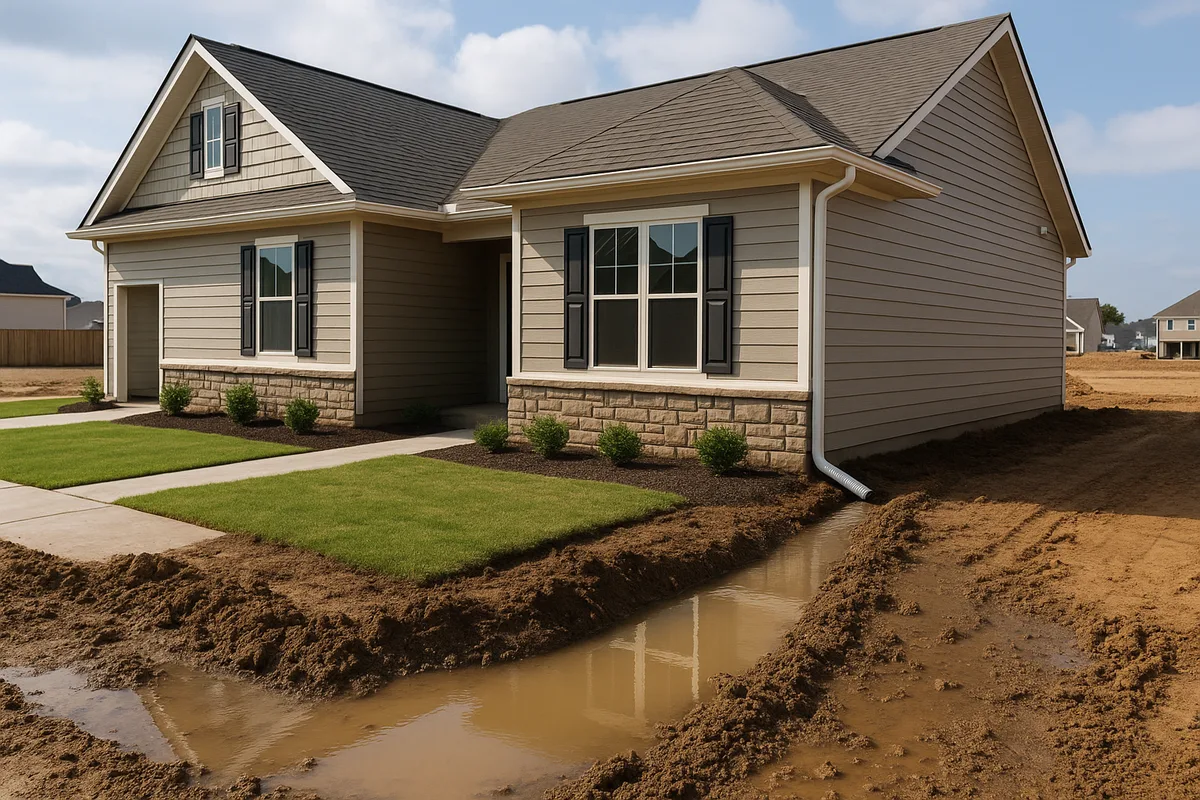
The most prevalent issue is inadequate lot-to-lot drainage coordination. In a typical Elk Grove subdivision, homes are built on lots that slope gently from back to front, with the expectation that surface water will flow from the rear yard, along the side yards, and out to the street gutter. This system works on paper, but it requires precise grading across multiple adjacent lots — and when one builder's subcontractor leaves a lot even slightly high or creates an unintended berm at the property line, the entire drainage chain breaks down. Water pools in the low point, which is often the neighbor's yard.
Another common defect in Elk Grove's newer communities is the failure of area drains and subsurface drainage systems. Many new homes in this area include small area drains (catch basins) in the rear yard that connect via 4-inch PVC pipe to the street storm drain system. These systems are frequently installed with insufficient slope (less than the recommended 1% minimum grade on the pipe), leading to sediment accumulation and eventual blockage within the first two to three years of occupancy. Homeowners often don't discover the problem until their first significant rain event after the builder's warranty has expired.
The Flat-Lot Grading Challenge
Elk Grove's terrain is extraordinarily flat — typical lot elevations vary by less than two feet across an entire subdivision. This means that the grading tolerances for proper drainage are measured in fractions of an inch. Sacramento County's improvement standards require a minimum 2% slope away from the foundation for the first 10 feet, but achieving and maintaining that grade on Elk Grove's expansive clay soils is difficult. Post-construction settlement, landscape installation, and even the weight of patio furniture on saturated soil can alter grades enough to reverse drainage flow back toward the foundation.
Homeowners in Elk Grove's newer developments should pay particular attention to the interface between their concrete flatwork (patios, walkways) and the adjacent soil grade. Concrete doesn't settle at the same rate as the surrounding soil, and within two to three years it's common to see a gap or lip form where the concrete edge meets the yard — creating a dam that traps water against the foundation.
Folsom's Unique Drainage Challenges in New Development Areas
Folsom new development drainage presents a fundamentally different set of challenges than what's seen in Elk Grove or Rancho Cordova. The Folsom Plan Area — the massive expansion south of Highway 50 that has been under development since the mid-2010s — sits on terrain that transitions from the valley floor up into the Sierra Nevada foothills. This means builders are working with variable topography, rocky subsurface conditions, and soils that change character dramatically over short distances.
The rocky, decomposed granite soils common in Folsom's eastern developments actually drain better than the valley clay — but they create different problems. These soils are difficult to compact properly during grading, and they erode easily when concentrated stormwater flows across exposed surfaces. New homeowners in Folsom frequently report erosion channels forming in their yards within the first rainy season, particularly on slopes that were seeded with hydrospray but hadn't established root systems before the first storm.
Folsom's hillside developments also contend with the challenge of managing offsite drainage. Unlike flat subdivisions where water moves predictably from lot to lot, hillside communities must intercept and redirect sheet flow and concentrated flow coming from upslope open space areas. This is typically accomplished through a system of V-ditches, brow ditches, and terrace drains — but these features require ongoing maintenance that builders rarely communicate to new homeowners. A single clogged brow ditch above a row of hillside homes can redirect thousands of gallons of stormwater into backyards that were never designed to handle that volume.
Retaining Walls and Slope Drainage in Folsom
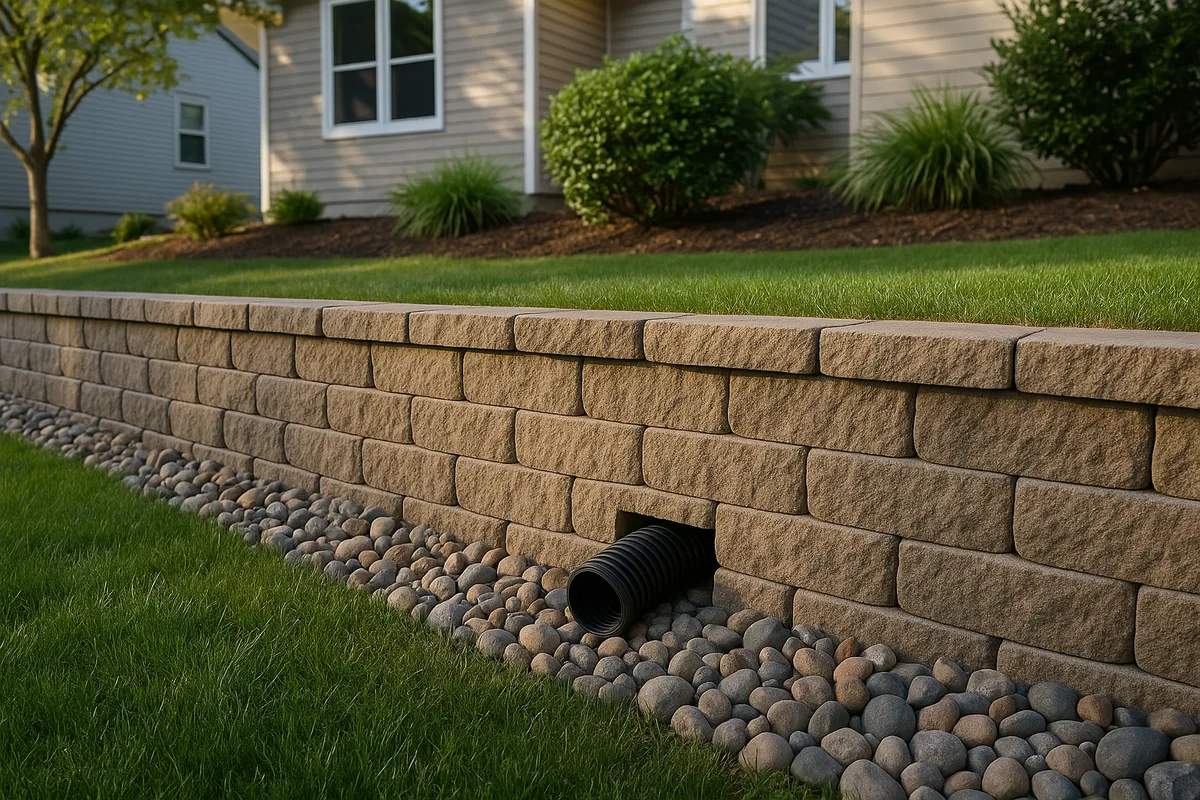
Many of Folsom's newer homes feature retaining walls to create usable yard space on sloped lots. These walls introduce a critical drainage consideration: hydrostatic pressure. When water saturates the soil behind a retaining wall and has no path to escape, the pressure builds until the wall fails — either by tilting, cracking, or blowing out the base. Properly constructed retaining walls include a drainage aggregate backfill and a perforated pipe (French drain) at the base that routes water to a discharge point. However, cost-cutting during construction sometimes results in walls built with native soil backfill and no drainage provisions.
Homeowners in Folsom should inspect their retaining walls for weep holes (small openings near the base that allow water to pass through) and verify that the area behind the wall doesn't remain saturated for extended periods after rain. Efflorescence — white mineral deposits on the wall face — is an early indicator that water is migrating through the wall structure and the drainage system may be inadequate.
Rancho Cordova: Where Infrastructure Meets Rapid Growth
Rancho Cordova drainage issues in new construction are often rooted in the tension between the city's ambitious growth plans and the limitations of its existing stormwater infrastructure. Incorporated as a city only in 2003, Rancho Cordova has been playing catch-up on infrastructure while simultaneously approving large-scale residential developments in the Sunrise Douglas, Rio del Oro, and Anatolia areas.
The Sunrise Douglas Community Plan area, which spans over 6,000 acres south of Highway 50, is being developed on land that drains naturally toward Morrison Creek and its tributaries. The regional drainage plan for this area relies on a network of detention basins and improved channels to manage the increased runoff from development — but the timing of infrastructure construction doesn't always align with home construction. It's not uncommon for homes to be occupied before the downstream detention basin or channel improvement that's supposed to handle their stormwater has been completed. During this interim period, drainage performance can be significantly degraded.
Rancho Cordova's newer developments also face challenges related to the depth to groundwater. In portions of the city, the seasonal high water table can rise to within three to five feet of the surface during wet winters. This is close enough to affect foundation performance, basement feasibility (in the rare cases where basements are built), and the effectiveness of subsurface drainage systems. A French drain that's designed to collect and redirect surface water doesn't work properly when the pipe itself is submerged in groundwater.
The Detention Basin Dilemma
Detention basins — the engineered depressions that temporarily store stormwater runoff before releasing it slowly into the downstream system — are a defining feature of Sacramento's newer suburbs. Nearly every master-planned community in Rancho Cordova, Elk Grove, and Folsom includes multiple detention basins, and many homeowners specifically choose lots adjacent to these basins for the open-space views they provide.
What these homeowners often don't realize is that detention basins are designed to flood. That's their purpose. During a design storm event (typically the 100-year storm for Sacramento County), the water surface in these basins can rise 6 to 10 feet above the basin floor. Homes adjacent to detention basins should have their finished floor elevations set well above the basin's design high-water mark — and they usually are — but the yards, fences, and landscaping of adjacent lots can still experience periodic inundation. This is functioning as designed, not a defect, but it's a reality that's rarely explained to buyers during the sales process.
Why Builder Grading Fails: The Construction Sequence Problem
Understanding why new construction drainage problems are so common in Sacramento requires examining the construction sequence itself. The grading of a residential subdivision happens in phases, and each phase introduces opportunities for error.
Mass grading is the first phase, where the overall site is shaped to establish the drainage master plan — crowns in streets, swale locations, pad elevations, and detention basin geometry. This work is typically performed by the land developer (not the homebuilder) and is subject to inspection by the local jurisdiction. Mass grading in Sacramento's clay soils is heavily weather-dependent; if the soil is too wet, it can't be properly compacted, and if it's too dry, it becomes rock-hard and difficult to shape.
Pad grading follows, where individual lot pads are fine-graded to the elevations specified on the grading plan. This is where the first problems often emerge. The pad must be graded to drain away from the planned foundation location, but the tolerances are tight — typically ±0.1 feet of the plan elevation. On Sacramento's flat lots, that tenth of a foot makes the difference between water flowing away from the house and water flowing toward it.
Final grading occurs after the home is built, when the builder's grading subcontractor returns to shape the yard, install swales, and establish the finished grades that will direct water off the lot. This is arguably the most failure-prone phase, because it happens under intense schedule pressure. Builders in Sacramento's competitive market are pushing to close homes as quickly as possible, and final grading is one of the last items on the punch list. It's often completed in a single day by a crew that may not have seen the original grading plan.
The Landscape Contractor's Role in Drainage Failure
Even when the builder's final grading is correct, the landscape contractor can undo it. Front yard landscaping in Sacramento's newer subdivisions is typically installed by the builder as part of the purchase package, while rear yards are left to the homeowner. Both scenarios create drainage risks.
Builder-installed front yard landscaping frequently involves adding several inches of topsoil and mulch over the finished grade. If this material is applied uniformly without regard to the underlying drainage slopes, it can flatten out the critical 2% grade away from the foundation. Worse, if decorative bark or mulch is mounded against the foundation stem wall, it creates a moisture bridge that can lead to wood rot, termite access, and efflorescence on the concrete.
Homeowner-installed rear yard landscaping is an even bigger variable. Raised planter beds, artificial turf installations, paver patios, and swimming pools all alter the drainage patterns established by the original grading plan. Without a clear understanding of how their lot drains — where the high points are, where the swales are, and where the water is supposed to exit — homeowners can inadvertently create ponding conditions that threaten their foundation and their neighbors' properties.
Sacramento County and City Drainage Standards: What's Required
Sacramento County, the City of Sacramento, and the incorporated cities of Elk Grove, Folsom, and Rancho Cordova each maintain their own grading and drainage standards, but they share common principles rooted in the Sacramento County Improvement Standards and the Central Valley Regional Water Quality Control Board's stormwater permit requirements.
Key drainage requirements for new residential construction in the Sacramento region include:
- Minimum 2% slope away from the foundation for the first 10 feet (or to the property line, whichever is less)
- Positive drainage across all lot areas — no ponding allowed except in designated detention areas
- Side yard swales with a minimum 1% longitudinal slope to convey water from the rear yard to the front street gutter
- Lot-to-lot drainage easements where one lot must accept drainage from an adjacent lot as part of the subdivision's master drainage plan
- Finished floor elevations set a minimum of 12 inches above the adjacent street gutter flow line (18 inches in some jurisdictions)
- Stormwater quality measures including source control BMPs, on-site treatment, and hydromodification management
The challenge is enforcement. Municipal building departments in Sacramento's fast-growing suburbs are stretched thin, processing thousands of permits annually with limited inspection staff. Grading inspections are conducted at key milestones (rough grade, final grade), but the inspector may spend only 15 to 20 minutes on a lot — enough to verify general compliance but not enough to catch subtle grade reversals or drainage path obstructions.
Homeowners should understand that passing a final grading inspection does not guarantee long-term drainage performance. The inspection confirms that grades were acceptable on the day of the inspection, but subsequent settlement, construction activity on adjacent lots, and landscape modifications can all alter conditions after the inspector has signed off.
How to Identify Drainage Problems in Your New Sacramento Home
The best time to identify drainage problems is during the first significant rain event after you take occupancy — but you need to know what to look for. Here's a systematic approach to evaluating drainage performance on a new home in Sacramento's suburbs.
Walk the perimeter during rain. Put on rain gear and walk around your home during an active rainstorm. Observe where water is flowing, where it's ponding, and whether it's moving away from the foundation on all sides. Pay particular attention to the corners of the house, where downspouts discharge, and where the garage slab meets the driveway. These are the most common failure points.
Check the side yards. In Sacramento's typical subdivision layout, the side yards are the primary drainage corridors. Water from the rear yard should flow through the side yards to the front street gutter. Walk the side yards and verify that water is moving — not standing. If you see ponding in the side yard, there's likely a grade reversal or an obstruction (utility box, AC condenser pad, fence post footing) blocking the flow path.
Inspect downspout discharge points. Each downspout should discharge at least 5 feet away from the foundation, either through a splash block or a connected underground pipe. In many new Sacramento homes, downspouts connect to a subsurface pipe that routes to the street or to a pop-up emitter in the front yard. Verify that these pop-up emitters are actually popping up and discharging water during rain. If they're not, the underground pipe may be clogged, crushed, or improperly sloped.
Look for staining and mineral deposits. After the rain stops, walk the perimeter again and look for water staining on the foundation stem wall. Horizontal stain lines indicate the depth of ponding against the foundation. White crystalline deposits (efflorescence) indicate that water is penetrating the concrete and carrying dissolved minerals to the surface — a sign of chronic moisture exposure.
Monitor your rear yard for 24-48 hours after rain. Sacramento's clay soils drain slowly, but standing water that persists for more than 48 hours after rain stops indicates a drainage problem that needs correction. Use a simple rain gauge to correlate ponding duration with rainfall amounts — if half an inch of rain creates ponding that lasts two days, you have a grading deficiency.
Using Technology to Assess Your Lot's Drainage
Beyond visual observation, homeowners can leverage several tools to understand their property's drainage characteristics. The USGS 3DEP (3D Elevation Program) provides high-resolution elevation data that can help you understand the broader topographic context of your lot — where the regional high and low points are, and which direction water naturally wants to flow across your neighborhood.
For lot-level analysis, a professional topographic survey remains the gold standard. A licensed surveyor will establish spot elevations across your property at a grid spacing tight enough to identify grade reversals, quantify slopes, and map drainage flow paths. This survey becomes the baseline document for any drainage remediation work and is invaluable if you need to pursue a warranty claim or neighbor dispute.
Protecting Your Investment: Prevention and Remediation
If you're purchasing a new home in Sacramento's suburbs, there are proactive steps you can take to minimize drainage risk — both before and after closing.
Before closing, request a copy of the lot's grading plan from the builder. This document shows the designed pad elevation, the intended drainage flow directions, and the locations of any drainage easements or subsurface systems. Compare the plan to what you observe on the ground. If the home is still under construction, consider hiring an independent inspector to verify the final grading before you accept the property.
During the warranty period (typically one year for grading defects in California), document any drainage issues immediately and submit written warranty claims. Take photos and videos during rain events. California Civil Code Section 896 (the "Right to Repair" law, also known as SB 800) specifically includes drainage and grading in its list of construction defect standards, giving homeowners a statutory framework for pursuing claims against builders.
After the warranty expires, drainage problems become the homeowner's responsibility. Common remediation measures for Sacramento's new construction drainage issues include:
Regrading — Reshaping the soil surface to restore proper slopes away from the foundation. This is the most straightforward fix but requires understanding the lot's complete drainage picture to avoid shifting the problem to a neighbor.
French drains — Installing perforated pipe in a gravel-filled trench to intercept and redirect subsurface water. Effective in Sacramento's clay soils when properly designed, but the pipe must discharge to an approved point (street gutter, storm drain, or dry well).
Channel drains — Linear surface drains installed across driveways, patios, or other hardscape areas where regrading isn't feasible. These collect sheet flow and route it to the storm drain system.
Sump pumps — In areas with high water tables (common in parts of Rancho Cordova and Natomas), a sump pump may be necessary to manage groundwater that rises above the foundation footing level.
Downspout extensions and underground routing — Extending downspout discharge points further from the foundation and connecting them to a dedicated underground pipe network that outlets to the street.
The cost of these remediation measures ranges from a few hundred dollars for simple regrading to $15,000 or more for comprehensive French drain systems with sump pumps. However, these costs are modest compared to the $40,000 to $100,000+ price tag for foundation repair resulting from chronic moisture exposure — making early intervention one of the best investments a Sacramento homeowner can make.
The Role of Topographic Intelligence in New Home Drainage
The core challenge with new construction drainage in Sacramento is information asymmetry. Builders have access to detailed grading plans, soils reports, and drainage studies — but homeowners typically receive none of these documents at closing. Without understanding the designed drainage patterns on their lot, homeowners are flying blind when it comes to maintaining proper grades, planning landscape improvements, or diagnosing problems when they appear.
This is where topographic drainage intelligence becomes essential. A comprehensive drainage assessment goes beyond a simple visual inspection — it combines high-resolution elevation data, soil analysis, and hydrologic modeling to create a complete picture of how water interacts with your property. For new construction in Sacramento's suburbs, this type of assessment can identify latent grading defects that haven't yet manifested as visible problems, quantify the risk to your foundation, and provide a prioritized remediation plan.
Whether you've just closed on a new home in Elk Grove's latest phase, you're watching water pool against your Folsom hillside retaining wall, or you're dealing with a soggy backyard in Rancho Cordova's newest subdivision, understanding your property's drainage is the first step toward protecting your investment. Low Point Labs specializes in exactly this kind of topographic drainage intelligence — providing homeowners, inspectors, and contractors with the detailed, data-driven analysis needed to identify problems early and solve them permanently. Explore our drainage assessment services to see how we can help you take control of your property's water management before the next rainy season arrives.
See Drainage Intelligence in Practice
Talk with our team or request an invitation to the platform.
Frequently Asked Questions
Yes, drainage problems are surprisingly common in new Sacramento homes due to the region's flat terrain, heavy clay soils, and the pace of construction. Tight grading tolerances, post-construction soil settlement, and landscape modifications frequently create grade reversals that direct water toward foundations rather than away from them.
Under California's SB 800 (Civil Code Section 896), builders are responsible for drainage and grading defects. The statute of limitations for filing an action is generally 10 years from substantial completion for most construction defects, but the express builder warranty for grading issues is typically one year. Document any problems with photos and written claims as early as possible.
Sacramento County and its incorporated cities generally require a minimum 2% slope (approximately ¼ inch per foot) away from the foundation for the first 10 feet. This means the soil elevation should drop at least 2.5 inches over the first 10 feet from the foundation wall. Steeper slopes of 5% or more are preferable where lot dimensions allow.
Standing water in Elk Grove backyards is typically caused by a combination of the area's heavy clay soils (which absorb water very slowly), insufficient grading slopes, and blocked or improperly installed yard drains. The flat terrain in most Elk Grove subdivisions means even minor grading errors can create low spots where water collects.
Yes. The NRCS Web Soil Survey (websoilsurvey.nrcs.usda.gov) provides free, detailed soil maps for any address in the United States, including hydrologic soil group classifications that indicate how well the soil drains. Lots with Group D soils — common in Sacramento's southern suburbs — have the poorest natural drainage.
Absolutely. A pre-closing or early-occupancy drainage assessment can identify grading defects while they're still covered under the builder's warranty. An independent inspection provides documentation that strengthens warranty claims and can save you tens of thousands of dollars in future foundation repair costs.
Related Articles
Soggy Lawn That Never Dries: 9 Common Causes and How to Fix Them
Hillside and Slope Drainage: Controlling Erosion and Runoff