What Sacramento Home Buyers Need to Know About Drainage Before Making an Offer
Sacramento sits at the confluence of two major rivers in a broad, flat valley that was historically one of the most flood-prone cities in the United States. While massive infrastructure projects have tamed the worst of the flooding, Sacramento home drainage issues remain one of the most overlooked — and most expensive — problems that buyers encounter in this market. Understanding drainage before you make an offer isn't just smart due diligence; it's the difference between a sound investment and a money pit.
Whether you're looking at a mid-century ranch in Land Park, a new build in Natomas, or a Victorian in Midtown, the drainage characteristics of your prospective property deserve as much scrutiny as the roof, the HVAC system, or the kitchen finishes. This guide walks you through everything you need to know about evaluating drainage when buying a home in the Sacramento region — from the geological realities that make this area uniquely challenging to the specific red flags you should look for during walkthroughs and inspections.
Why Sacramento's Geography Creates Unique Drainage Challenges
Sacramento's position at the meeting point of the Sacramento and American Rivers, combined with the flat topography of the Central Valley, creates a drainage environment unlike most other major metro areas. The city sits at an elevation of roughly 30 feet above sea level, and much of the surrounding development — particularly in areas like Natomas and the Pocket — sits at or below the flood stage of nearby waterways. This means that gravity, the primary force that moves water away from structures, has very little room to work with on many Sacramento properties.
The region's Mediterranean climate compounds the problem. Sacramento receives the vast majority of its annual 18–20 inches of rainfall between November and March, often in intense atmospheric river events that can dump several inches in a matter of days. Properties that appear perfectly dry during the long, hot summer months can reveal devastating drainage failures during winter storms. If you're touring homes between May and October — which many buyers do — you're seeing the property at its driest and most deceptive.
The soils underlying Sacramento add another layer of complexity. Much of the region is underlain by heavy clay soils, particularly the Redding and San Joaquin soil series, which have extremely low permeability. These soils swell when wet and shrink when dry, creating a cycle that can damage foundations, crack slabs, and cause retaining walls to fail. When rain falls on clay-heavy lots, the water has nowhere to go — it pools on the surface, saturates the upper soil layers, and creates hydrostatic pressure against foundation walls and slabs. You can research the specific soil types on any Sacramento property using the NRCS Web Soil Survey, which provides detailed soil maps and drainage classifications for free.
Understanding Sacramento Flood Zones and What They Mean for Buyers
Before you even schedule a showing, you should check whether a Sacramento property falls within a designated flood zone. FEMA's flood maps divide areas into risk categories, and in Sacramento, this matters enormously. Properties in Zone AE or Zone A are within the 100-year floodplain and require flood insurance if you're obtaining a federally backed mortgage. Properties in Zone X (shaded) are in the 500-year floodplain — lower risk, but not risk-free. Properties in Zone X (unshaded) are considered minimal risk.
Several Sacramento neighborhoods have complicated flood zone histories. North Natomas was famously reclassified into a high-risk flood zone in 2008 after FEMA determined that existing levees didn't meet certification standards. While the Natomas Basin has since seen significant levee improvements and portions have been remapped, the history illustrates how flood zone designations can change — and how they directly impact insurance costs, property values, and resale potential. The Pocket-Greenhaven area, surrounded on three sides by the Sacramento River and a network of levees, presents similar considerations.
You can check any Sacramento address against current FEMA flood maps using the FEMA National Flood Map Service Center. But don't stop at the federal maps. Sacramento County and the City of Sacramento maintain their own floodplain management programs with additional data that may not appear on FEMA maps. Pay attention to whether a property is in a "levee-protected" zone — this means the property would be in a floodplain if not for the levee system, and your risk profile is directly tied to levee maintenance and integrity.
How Flood Zone Status Affects Your Purchase
Flood zone designation impacts your purchase in three concrete ways. First, insurance costs: National Flood Insurance Program (NFIP) policies for high-risk zones can cost $1,500 to $5,000 or more annually in Sacramento, depending on the property's elevation relative to the base flood elevation. Second, financing: some lenders impose additional requirements or higher rates for properties in high-risk zones. Third, resale: properties with flood zone designations and histories of flooding can be significantly harder to sell, and price appreciation may lag comparable properties outside flood zones.
Even if a property is outside a designated flood zone, localized drainage problems can cause flooding that has nothing to do with river overflow. Poor grading, inadequate stormwater infrastructure, and upstream development can all create flood conditions on individual lots that FEMA maps don't capture. This is where property-level drainage analysis becomes essential.
Red Flags to Watch for During Sacramento Property Walkthroughs
When you're touring a Sacramento home, you need to train your eye to see drainage indicators that most buyers miss entirely. These visual cues can tell you more about a property's drainage health than any seller's disclosure, and they're visible year-round if you know what to look for.
Exterior Warning Signs
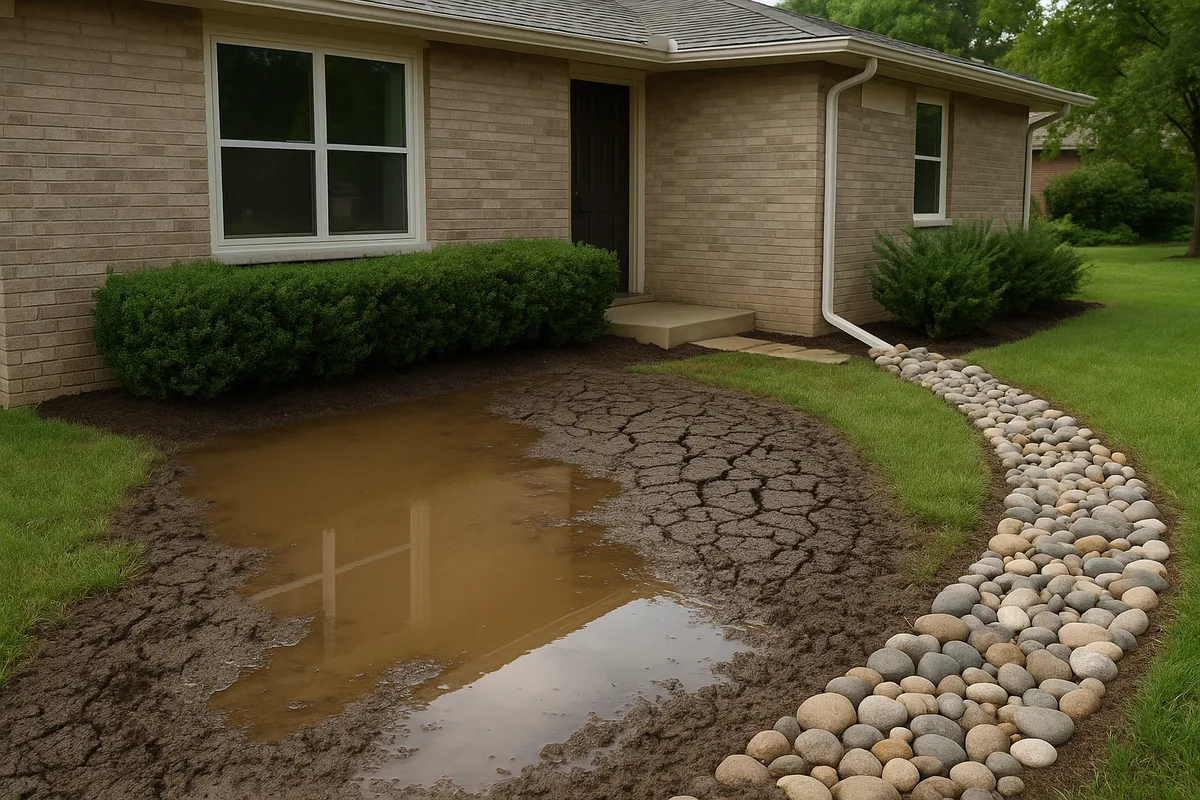
Start at the perimeter of the property and work your way in. The single most important thing to observe is the grade — the slope of the ground relative to the foundation. Every home should have the soil sloping away from the foundation at a minimum of 2% grade (roughly a 6-inch drop over the first 10 feet). In Sacramento's flat terrain, achieving and maintaining this grade is a persistent challenge. Look for areas where soil has settled against the foundation, where mulch or landscaping has been built up to the point where it's level with or above the foundation line, or where concrete patios and walkways slope toward the house rather than away.
Examine the foundation itself for horizontal cracks, stair-step cracks in brick or block, or efflorescence — the white, chalky mineral deposits that indicate water has been migrating through the concrete. In Sacramento's clay soils, foundation movement is common, and drainage is almost always a contributing factor. Look at the bottom 12 inches of exterior siding or stucco for water staining, discoloration, or damage that suggests standing water has been in contact with the structure.
Check downspouts and gutters carefully. Are downspouts connected to underground drain lines, or do they simply dump water at the foundation? If they connect to underground lines, where do those lines discharge? Many older Sacramento homes have downspouts connected to the city's combined sewer system — a practice that's been prohibited for new construction and that the city has been actively working to eliminate. Disconnected or improperly routed downspout drains are one of the most common sources of foundation drainage problems in Sacramento.
Walk the yard and look for areas of standing water, unusually green or lush grass (which can indicate subsurface moisture), exposed tree roots, or soil erosion channels. Pay special attention to the areas between your prospective property and neighboring properties — in Sacramento's subdivisions, the low point between two lots is often where drainage problems concentrate, especially when one neighbor has regraded or added hardscape without considering the impact on adjacent properties.
Interior Warning Signs
Inside the home, drainage problems manifest in ways that sellers sometimes try to conceal. In homes with basements or below-grade spaces — less common in Sacramento but present in some older neighborhoods — look for water stains on walls, musty odors, efflorescence on concrete block, and evidence of sump pump installations (which indicate a known water intrusion problem). Fresh paint on basement walls is a classic concealment tactic.
On slab-on-grade homes, which are the majority in Sacramento, look for cracks in floor tile (especially near exterior walls), doors that stick or don't close properly, and uneven floors. These can indicate slab movement caused by expansive clay soils that are cycling between wet and dry conditions due to poor drainage. Check the baseboards and lower drywall for water damage, bubbling paint, or recent patching that might indicate past flooding.
In the garage, look at the floor-to-wall junction. Water staining here is extremely common in Sacramento homes with drainage problems, as garage slabs are often at or near grade level and water follows the path of least resistance through the joint between the slab and the stem wall.
What a Standard Home Inspection Misses About Drainage
Many Sacramento home buyers assume that a standard home inspection will catch drainage problems. While a competent inspector will note obvious issues — missing downspout extensions, visible standing water, foundation cracks — the reality is that Sacramento home inspection drainage evaluations are typically superficial. Most home inspectors are generalists who spend 2–4 hours examining every system in the house. They're not drainage specialists, and they're not equipped to perform the kind of topographic analysis that reveals how water actually moves across a property.
A standard inspection is a snapshot in time. If the inspection happens during Sacramento's dry season (which spans roughly May through October), there may be zero visible evidence of drainage problems that become severe during winter rains. The inspector can note the grade appears flat or the downspouts lack extensions, but they can't tell you that the property sits in a topographic depression that collects runoff from three neighboring lots, or that the street's storm drain system is undersized and backs up during heavy rain events.
The Value of Specialized Drainage Assessment
This is where specialized drainage intelligence becomes invaluable. A comprehensive drainage assessment goes beyond visual inspection to analyze the actual topography of the property and its surroundings using elevation data, soil analysis, and stormwater flow modeling. It can identify low points on the property where water collects, determine whether the lot's grading meets minimum standards, evaluate the capacity and condition of any existing drainage infrastructure, and assess the property's vulnerability to off-site runoff.
For Sacramento buyers specifically, a drainage assessment should also evaluate the property's relationship to the local storm drain system, identify any easements or drainage corridors that cross the property, and determine whether the property has been subject to any city or county drainage complaints or violations. This level of analysis can't be performed during a 3-hour general home inspection — it requires specialized tools, data, and expertise.
Common Drainage Problems in Sacramento Neighborhoods
Different Sacramento neighborhoods face different drainage challenges based on their age, topography, soil conditions, and infrastructure. Understanding the common issues in the area where you're shopping can help you ask better questions and spot problems more quickly.
Older Neighborhoods: Land Park, Curtis Park, East Sacramento, Midtown
Sacramento's older neighborhoods, many developed between the 1920s and 1950s, present a specific set of drainage challenges. These areas often have mature tree canopies — beautiful and valuable, but the root systems can infiltrate and crush underground drain lines, clog French drains, and heave concrete flatwork to create reverse grades. Many homes in these neighborhoods were built with clay tile drain lines that have deteriorated over the decades and may be partially or fully collapsed.
These neighborhoods also tend to have older, smaller-capacity storm drain systems that were designed for a different era of rainfall assumptions and impervious surface coverage. As homeowners have added driveways, patios, room additions, and other hardscape over the years, the volume of runoff has increased while the infrastructure capacity has remained the same. Street flooding during heavy rain events is common in parts of Land Park and East Sacramento.
Another issue specific to older Sacramento neighborhoods is the presence of combined sewer systems in some areas, where stormwater and sanitary sewage share the same pipes. During heavy rain events, these systems can become overwhelmed, leading to sewage backups into homes — a nightmare scenario that goes well beyond simple drainage problems.
Newer Subdivisions: Natomas, Elk Grove, Rancho Cordova, Folsom
Newer Sacramento-area subdivisions built from the 1980s onward generally have better-engineered drainage systems, but they come with their own set of issues. Many of these developments were built on former agricultural land that was laser-leveled flat for irrigation — great for farming, challenging for residential drainage. Builders are required to grade lots to drain, but the margins are often razor-thin, and settling over the first few years after construction can eliminate the minimal grade that was established.
In Natomas specifically, the combination of flat topography, high water table, and heavy clay soils creates conditions where even properly graded lots can experience drainage problems. The area's extensive levee system means that internal drainage must be managed entirely through pumping stations — if the pumps fail or are overwhelmed, there's no gravity outlet for stormwater.
Elk Grove and Rancho Cordova developments often rely on retention and detention basins to manage stormwater. If you're buying near one of these basins, understand that they're designed to hold water during and after storms — they're not parks, even if they look like parks during dry weather. Properties adjacent to basins may experience higher groundwater levels and should be evaluated accordingly.
Foothill Properties: Fair Oaks, Orangevale, El Dorado Hills
As you move east into the foothills, the topography changes dramatically and so do the drainage dynamics. Properties in Fair Oaks, Orangevale, and El Dorado Hills often have significant slope, which means water moves faster and with more erosive force. Drainage swales and channels on foothill properties need to be properly engineered to handle concentrated flows without eroding, undermining structures, or directing water onto neighboring properties.
Foothill properties also tend to have different soil conditions — decomposed granite and rocky soils that drain much better than valley clay but can create problems of their own. Water moves quickly through these soils and can emerge at unexpected locations downslope, potentially undermining retaining walls or saturating areas far from where the rain actually fell.
How to Use Drainage Findings in Your Purchase Negotiation
Discovering drainage problems Sacramento real estate transactions is not necessarily a deal-breaker — but it absolutely should be a negotiation point. The key is understanding the severity of the problem, the cost to remediate, and the long-term risk if the problem isn't addressed.
Categorizing Drainage Issues by Severity
Not all drainage problems are equal. Minor issues — like missing downspout extensions, small areas of negative grade that can be corrected with topsoil, or clogged gutters — are inexpensive to fix and shouldn't significantly impact your offer. Budget $500 to $2,000 for these kinds of corrections.
Moderate issues — such as the need for a French drain system along one or more sides of the foundation, regrading of significant portions of the yard, or replacement of failed underground drain lines — typically cost $3,000 to $15,000 to address. These should absolutely be factored into your offer price or requested as seller repairs.
Severe issues — including structural foundation damage caused by long-term drainage failure, properties that sit in documented flood-prone areas without adequate infrastructure, or lots with fundamental topographic problems that would require engineered solutions like retaining walls, pump systems, or major regrading — can cost $15,000 to $50,000 or more to remediate. In some cases, the cost of correction may exceed the value it adds to the property, and walking away may be the wisest financial decision.
Negotiation Strategies
When you've identified drainage issues during your due diligence, you have several negotiation options. You can request a price reduction equal to the estimated cost of remediation plus a contingency factor (typically 15–25% above the estimate, since drainage work often reveals additional problems once excavation begins). You can request that the seller complete specific repairs before closing, with verification by a qualified inspector. Or you can request a credit at closing earmarked for drainage improvements.
In Sacramento's competitive market, sellers may resist significant concessions. In that case, having detailed, professional documentation of the drainage issues and their estimated remediation costs gives you leverage. A seller who dismisses your concerns may face the same issues with the next buyer — and if they've now been made aware of the problems, they may have disclosure obligations going forward.
One critical point: California law requires sellers to disclose known material defects, including drainage problems and flooding history. Review the Transfer Disclosure Statement (TDS) and the Natural Hazard Disclosure (NHD) report carefully. If the seller has disclosed drainage issues, take them seriously. If they haven't disclosed issues that are clearly visible or that should be known to them, that's a red flag about the seller's overall candor.
Drainage Improvements That Protect Your Sacramento Investment
If you decide to move forward with a Sacramento property that has drainage issues — or if you want to proactively protect a property with adequate but minimal drainage — understanding your improvement options is essential.
Surface Grading and Swales
The most fundamental and often most cost-effective drainage improvement is proper surface grading. Establishing a consistent 2–5% slope away from the foundation for the first 10 feet, and creating shallow swales to direct surface water to appropriate discharge points, can resolve a surprising number of drainage problems. In Sacramento's clay soils, surface drainage is especially important because the soil won't absorb water quickly enough to prevent pooling.
Regrading a typical Sacramento lot costs $1,500 to $5,000 depending on the extent of work needed, accessibility, and whether hardscape needs to be removed and replaced. It's one of the highest-value improvements you can make to a property with drainage concerns.
French Drains and Subsurface Systems
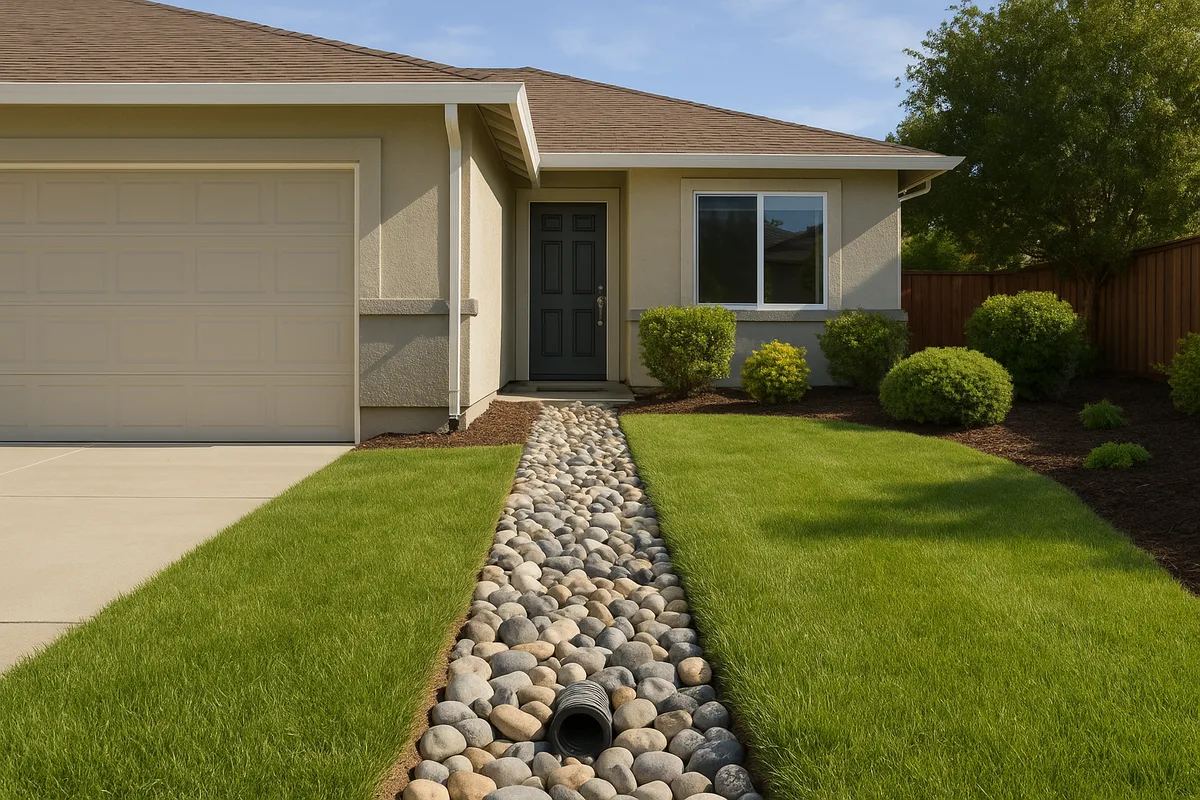
When surface grading alone isn't sufficient — which is common on flat Sacramento lots where there's limited fall to work with — subsurface drainage systems become necessary. A French drain is a gravel-filled trench containing a perforated pipe that collects subsurface water and conveys it to a discharge point. In Sacramento, French drains are commonly installed along foundation perimeters, at the base of slopes, and along property lines where water collects.
The key to a successful French drain installation in Sacramento is ensuring adequate discharge. The drain needs somewhere to send the water — typically a storm drain connection, a pop-up emitter in a lower area of the yard, or a dry well. In flat areas where none of these options are feasible, a sump pit with a pump may be necessary. A properly installed French drain system for a Sacramento home typically costs $3,000 to $12,000.
Channel Drains and Catch Basins
For hardscaped areas — driveways, patios, pool decks — where surface water can't be managed through grading alone, channel drains (also called trench drains) and catch basins collect surface water and route it to the storm drain system or other discharge points. These are particularly common and necessary in Sacramento homes where the driveway slopes toward the garage, a condition that's surprisingly prevalent in older neighborhoods.
Sump Pumps and Pump Systems
In areas of Sacramento with high water tables — particularly in Natomas and parts of the Pocket — sump pumps may be necessary to manage groundwater that rises during the wet season. A sump pump system consists of a pit (sump) installed below the lowest floor level, a pump, and a discharge line. When water enters the pit, the pump activates and sends it to an appropriate discharge point.
If you're buying a Sacramento home that already has a sump pump, that's important information. It means the property has a known water intrusion issue that requires mechanical intervention. Ask when the pump was installed, how often it runs, and whether there's a battery backup system (essential during power outages, which often coincide with the heavy storms that produce the most groundwater).
Long-Term Drainage Considerations for Sacramento Homeowners
Buying a home with good drainage — or improving drainage after purchase — isn't a one-time event. Sacramento's climate, soils, and development patterns create ongoing drainage dynamics that require attention throughout your ownership.
Climate change is altering precipitation patterns across California, and Sacramento is experiencing more intense rainfall events interspersed with longer dry periods. This means drainage systems designed for historical rainfall patterns may be inadequate for future conditions. The clay soils that underlie much of Sacramento become harder and less permeable during extended dry periods, which means that when rain does come, more of it runs off the surface rather than infiltrating. Properties that drained adequately ten years ago may not drain adequately under emerging rainfall patterns.
Upstream development also changes drainage dynamics over time. As more land in Sacramento County is converted from agricultural or open space to residential and commercial use, the volume and velocity of stormwater runoff increases. A property that sits downstream of new development may experience increased water flow even if nothing has changed on the property itself. Staying aware of development projects in your area and understanding how they might affect drainage on your property is an important part of long-term homeownership in Sacramento.
Regular maintenance is essential for any drainage system. Gutters and downspouts should be cleaned at least twice a year — once before the rainy season begins and once mid-season. Underground drain lines should be inspected and flushed every few years. French drains have a finite lifespan, typically 15–25 years, before sediment accumulation reduces their effectiveness. Surface grades should be checked annually, as settling, erosion, and landscaping changes can alter drainage patterns over time.
Finally, be a good neighbor when it comes to drainage. Sacramento municipal code prohibits directing concentrated stormwater runoff onto neighboring properties. If you're making improvements to your property — adding a patio, building a retaining wall, regrading your yard — consider how those changes will affect water flow on adjacent properties. Drainage disputes between neighbors are among the most common and contentious property conflicts in Sacramento, and they're almost always easier and cheaper to prevent than to resolve.
Making a Confident, Informed Offer on a Sacramento Home
The Sacramento real estate market moves quickly, and buyers often feel pressure to make fast decisions. But when it comes to buying a house with drainage problems Sacramento properties can present, speed should never override due diligence. A home is the largest purchase most people will ever make, and drainage problems that go undetected at purchase can cost tens of thousands of dollars to remediate — not to mention the stress, disruption, and potential health hazards of water intrusion.
Before making an offer on any Sacramento property, take the time to understand the drainage landscape. Walk the property after a rain event if at all possible. Check the flood zone status. Research the soil types. Look at the topography of the lot and surrounding area. Ask the seller direct questions about water intrusion, flooding history, and any drainage work that's been done. And consider investing in a specialized drainage assessment that goes beyond what a standard home inspection can provide.
At Low Point Labs, we specialize in topographic drainage intelligence — using advanced elevation data, soil analysis, and flow modeling to give homebuyers a clear, comprehensive picture of how water interacts with a property. Our assessments identify low points, evaluate grading, map flow paths, and flag potential drainage vulnerabilities before they become expensive problems. Whether you're under contract on a specific property or just beginning your Sacramento home search, understanding drainage is one of the smartest investments you can make. Explore our drainage assessment services to protect your next home purchase with the confidence that comes from truly understanding the ground beneath your feet.
See Drainage Intelligence in Practice
Talk with our team or request an invitation to the platform.
Frequently Asked Questions
Drainage problems are extremely common in Sacramento due to the region's flat topography, heavy clay soils, and concentrated winter rainfall. Properties across all neighborhoods and price points can be affected, though the specific issues vary by area. Older neighborhoods tend to have aging drainage infrastructure, while newer subdivisions may have minimal grading margins that degrade over time.
Not necessarily, but you should understand the full implications. Homes in FEMA-designated high-risk flood zones require flood insurance, which can cost $1,500 to $5,000+ annually. You should also research the levee system protecting the area and factor insurance costs into your total housing budget. Many desirable Sacramento neighborhoods, including parts of Natomas and the Pocket, fall within flood zones.
A standard home inspection may catch obvious drainage issues like missing downspout extensions or visible standing water, but it typically won't identify subsurface drainage problems, topographic low points, or how water flows across the property during storms. A specialized drainage assessment using elevation data and flow analysis provides a much more complete picture.
Costs vary widely depending on severity. Minor fixes like downspout extensions and small grading corrections cost $500 to $2,000. Moderate solutions like French drain installation or significant regrading run $3,000 to $15,000. Severe problems requiring engineered solutions, foundation repair, or pump systems can cost $15,000 to $50,000 or more.
Areas with the most significant drainage challenges include North Natomas (flat topography, high water table, levee-dependent), the Pocket-Greenhaven area (surrounded by river and levees), and older neighborhoods like Land Park and East Sacramento (aging infrastructure, mature tree root intrusion). However, drainage problems can occur in any Sacramento neighborhood depending on lot-specific conditions.
Yes. You can check FEMA flood maps for flood zone status, use the NRCS Web Soil Survey to identify soil types and drainage characteristics, and review topographic data to understand the property's elevation relative to its surroundings. These free tools provide valuable preliminary information, though an on-site assessment is still recommended before making an offer.
Related Articles

High Water Table in Sacramento: What It Means for Your Future Home
French Drains in Sacramento: Costs, Permits, and What to Expect