Jobber vs. LMN: The Missing Piece in Your Landscaping Management Tech Stack
If you run a landscaping business in 2026, you've almost certainly heard of Jobber and LMN. These two platforms dominate conversations about landscaping software, and for good reason—they each solve real, painful operational problems that landscape contractors face every day. Jobber streamlines field service management, scheduling, and client communication. LMN focuses on estimating accuracy, budgeting, and time tracking to protect your margins.
But here's the question almost nobody is asking: What critical data are both platforms missing?
After working with thousands of residential properties and the contractors who serve them, we at Low Point Labs have identified a significant blind spot in the landscaping tech stack—drainage and topographic intelligence. Neither Jobber nor LMN gives you the site-level drainage data you need to price grading work accurately, identify liability risks before they become callbacks, or deliver the kind of value that separates a true landscape professional from a mow-and-blow operation.
This article breaks down the Jobber vs. LMN comparison honestly, explains what each platform does well, and reveals the missing layer of data that can transform how you scope, price, and deliver landscaping projects.
Understanding Jobber: Field Service Management for Landscape Teams
Jobber has carved out a strong position as a field service management (FSM) platform built for home service businesses, including landscaping companies. At its core, Jobber is designed to solve the chaos of running crews in the field—missed appointments, lost quotes, and the endless back-and-forth with clients over scheduling and invoicing.
What Jobber Does Well
Jobber's strength lies in its client-facing workflow. The platform handles the full lifecycle from lead intake to final invoice: online booking, quote creation, job scheduling, GPS-tracked crew dispatching, automated client communications, invoicing, and payment collection. For a landscaping company doing recurring maintenance—weekly mowing, seasonal cleanups, fertilizer programs—Jobber is genuinely excellent. It reduces administrative overhead and gives small teams the polish of a much larger operation.
The scheduling engine is particularly well-designed for route-based work. You can optimize crew routes, assign jobs based on proximity, and push schedule changes to field teams in real time. Jobber also integrates with QuickBooks and Xero for accounting, Stripe and Square for payments, and offers a client hub where customers can approve quotes and pay invoices without a phone call.
Where Jobber Falls Short for Landscape Contractors
Jobber's limitations become apparent when you move beyond maintenance into design-build, hardscaping, grading, or drainage work. The estimating tools are relatively basic—adequate for line-item service quotes but not built for the complexity of a landscape construction bid. There's no built-in takeoff functionality, no material cost database tuned to landscape construction, and no way to account for site-specific variables like soil type, slope, or existing drainage patterns.
For a contractor bidding a regrading project or a French drain installation, Jobber gives you a clean way to send the quote and schedule the work, but it offers no help in determining whether the quote is actually accurate. The platform assumes you already know what the job requires—it doesn't help you figure that out.
Understanding LMN: Estimating and Budgeting for Landscape Profitability
LMN (Landscape Management Network) approaches the landscaping business from a completely different angle. Where Jobber focuses on operational workflow, LMN focuses on financial accuracy—helping landscape companies build estimates that actually protect their margins.
What LMN Does Well
LMN's estimating engine is the platform's crown jewel. It allows you to build detailed, cost-based estimates that account for labor hours, equipment usage, material costs, overhead allocation, and desired profit margins. Instead of guessing at a price or using a rough per-square-foot number, LMN forces you to think through every cost component of a job. The result is estimates that are defensible, consistent, and—critically—profitable.
The platform also includes time tracking that ties back to your estimates, so you can see in real time whether a job is running on budget. Over time, this creates a feedback loop: you learn which job types you consistently underbid, which crews are most efficient, and where your cost assumptions need adjustment. For landscape companies doing $500K+ in annual revenue, this kind of financial intelligence is often the difference between growing profitably and growing yourself into bankruptcy.
LMN also offers budgeting tools, a CRM, and crew management features. Their training resources and community—including the LMN Academy—are widely regarded as some of the best educational content in the landscape industry.
Where LMN Falls Short for Drainage and Grading Work
LMN's estimating power depends entirely on the quality of the inputs you feed it. The platform can calculate labor and material costs with impressive precision, but it can't tell you what a specific site actually needs. When it comes to drainage and grading projects, the critical inputs—existing slope, low point locations, soil permeability, water flow patterns, and drainage infrastructure—are exactly the data points that LMN doesn't provide.
Consider a common scenario: a homeowner calls about standing water in their backyard after heavy rain. You visit the site, walk the property, and make a visual assessment. Maybe you see the puddle. Maybe you notice the yard slopes toward the house. But without topographic data, you're estimating the scope of regrading work based on intuition, not measurement. LMN will help you price whatever scope you define, but if your scope is wrong—if you underestimate the volume of soil that needs to be moved, or miss a secondary low point that will cause problems after your fix—LMN can't save you.
This is the fundamental gap. LMN is a calculator. A brilliant one. But a calculator is only as good as the numbers you punch in.
Head-to-Head: Jobber vs. LMN Feature Comparison
To make a fair comparison, it helps to see these platforms side by side across the categories that matter most to landscaping businesses.
Scheduling and Dispatching
Jobber wins this category decisively. Its scheduling interface is intuitive, mobile-friendly, and built for the reality of managing multiple crews across dozens of daily stops. LMN has scheduling capabilities, but they're not the platform's primary focus and lack the route optimization and real-time dispatching features that Jobber offers.
Estimating and Job Costing
LMN wins here just as decisively. Its cost-based estimating methodology is far more sophisticated than Jobber's quoting tools. For any landscaping company that does project work—installations, renovations, hardscaping, drainage—LMN's estimating engine is in a different league. Jobber's quoting is fine for "mow this lawn for $45/week" but inadequate for a $15,000 patio installation with drainage considerations.
Client Communication and CRM
Jobber has the edge for client-facing communication. Automated appointment reminders, two-way texting, online booking portals, and a polished client hub make Jobber feel more modern from the customer's perspective. LMN's CRM is functional but more internally focused—it's built to track leads and sales pipeline rather than to create a seamless client experience.
Financial Reporting and Profitability Tracking
LMN is stronger here, particularly in connecting estimates to actual job costs. The ability to track labor hours against budgeted hours on a per-job basis gives landscape business owners visibility into their true profitability. Jobber provides basic revenue reporting but doesn't offer the same depth of job costing analysis.
Scalability
Both platforms scale, but they scale for different business models. Jobber scales well for high-volume maintenance operations—companies running 5-20 crews doing hundreds of recurring visits per week. LMN scales better for design-build and construction-focused landscape companies where each job is unique and margin management is critical.
The Data Gap Neither Platform Fills: Site-Level Drainage Intelligence
Here's where we need to have an honest conversation about what's missing from both platforms—and from most landscaping tech stacks in general.
Neither Jobber nor LMN provides any site-level topographic or drainage data. They don't show you where water flows on a property. They don't identify low points where water collects. They don't tell you the existing grade around a foundation or whether a property's drainage patterns create risk for the homeowner—or liability for you as the contractor.
This matters more than most landscape professionals realize.
Why Drainage Data Changes Everything for Landscape Contractors
Consider the economics. According to industry data, water damage is consistently among the most common and costly residential insurance claims. Foundation damage from poor drainage can cost homeowners $5,000 to $15,000 or more to repair. As a landscape contractor, you are reshaping the surface of a property every time you install a patio, build a retaining wall, regrade a lawn, or even change planting bed elevations. Every one of these actions affects how water moves across the site.
Without drainage intelligence, you're making changes to a system you don't fully understand. And when those changes cause water to pool against a foundation, flood a neighbor's yard, or erode a newly installed landscape, the callback—or the lawsuit—lands on you.
Topographic drainage data gives you three things no other tool in your tech stack provides:
- Pre-project risk identification — Know where water flows and collects before you break ground, so you can design solutions rather than create problems.
- Accurate scope definition — Understand exactly how much regrading is needed, where swales should be directed, and what drainage infrastructure the site requires.
- Professional differentiation — Present clients with data-driven assessments that demonstrate expertise and justify premium pricing.
What Proper Drainage Assessment Looks Like
A thorough drainage assessment goes far beyond walking a property and looking for puddles. It involves analyzing the topographic contours of the entire lot, identifying all low points and flow paths, evaluating the grade relative to the foundation (the industry standard is a minimum 2% slope—or roughly 6 inches of fall over the first 10 feet—away from the foundation), assessing soil types and their drainage characteristics, and understanding how the property interacts with adjacent lots and municipal stormwater systems.
This level of analysis requires elevation data. The USGS 3D Elevation Program (3DEP) provides high-resolution topographic data across the United States, and tools built on this data can reveal drainage patterns that are invisible to the naked eye. At Low Point Labs, we've built our entire platform around making this kind of topographic drainage intelligence accessible and actionable—for homeowners, inspectors, and the contractors who serve them.
How Drainage Intelligence Complements Your Existing Software
The good news is that you don't have to choose between Jobber, LMN, and drainage intelligence. These tools serve different functions and work best as layers in a complete tech stack.
For Jobber Users: Adding Drainage Data to Your Workflow
If you're a Jobber shop—likely running maintenance crews with some project work mixed in—drainage intelligence helps you in two key ways. First, it allows you to upsell drainage services to your existing maintenance clients. When you're already on a property every week, you're in the perfect position to identify drainage issues and propose solutions. Having actual topographic data to show the homeowner transforms a vague suggestion into a compelling, data-backed recommendation.
Second, drainage data protects you from liability on project work. Before you install that new paver patio, check the drainage patterns. If the patio will redirect water toward the foundation, you need to know that before construction, not after the homeowner's basement floods. You can document the pre-existing conditions, design appropriate drainage solutions into the project, and demonstrate due diligence if questions arise later.
For LMN Users: Feeding Better Data Into Your Estimates
If you're an LMN shop—likely a design-build firm focused on profitability—drainage intelligence solves your input problem. LMN can calculate the cost of moving 50 cubic yards of soil, but drainage data tells you whether it's actually 50 cubic yards or 120. It tells you where that soil needs to go to create proper drainage. It identifies whether you need a French drain, a dry well, a swale, or a combination.
Better inputs mean better estimates. Better estimates mean fewer budget overruns, fewer callbacks, and higher client satisfaction. Over time, the data compounds: you build a library of site assessments that make your estimating faster and more accurate on every subsequent project.
Building the Complete Landscaping Tech Stack
The most sophisticated landscape companies in 2026 are running a three-layer tech stack:
- Layer 1: Site Intelligence — Topographic and drainage data that tells you what a property actually needs. This is the foundation everything else is built on.
- Layer 2: Estimating and Financial Management — Tools like LMN that translate site requirements into accurate, profitable bids.
- Layer 3: Operations and Client Management — Platforms like Jobber that handle scheduling, communication, invoicing, and the day-to-day logistics of running crews.
Most companies have Layer 2 or Layer 3 (or both). Almost none have Layer 1. That's the gap—and it's the gap that creates the most expensive problems.
The Real Cost of Missing Drainage Data
Let's talk numbers, because this is ultimately a business decision.
A typical drainage-related callback costs a landscape contractor between $2,000 and $8,000 in rework, depending on the severity. That's direct cost—labor, materials, equipment. It doesn't include the indirect costs: the crew time pulled from revenue-generating work, the client relationship damage, the negative review, or the potential legal exposure.
Now consider the estimating side. Industry surveys consistently show that landscape contractors underbid drainage and grading work more than almost any other category. The reason is straightforward: without elevation data, contractors estimate volume and scope visually, and human visual assessment of subtle grade changes is notoriously unreliable. A slope that looks like 2% might actually be 0.5%. A low point that appears to be in one corner of the yard might actually have a secondary collection area on the opposite side.
The NRCS Web Soil Survey can tell you whether a property sits on well-draining sandy loam or poorly draining clay—information that dramatically affects how water behaves on the surface and how you should design drainage solutions. Yet most contractors never check soil data before bidding a drainage job.
When you combine topographic data with soil data, you get a complete picture of how water interacts with a specific property. That picture is what separates a $5,000 drainage bid that actually works from a $5,000 drainage bid that creates a $15,000 problem.
Choosing the Right Software: Decision Framework for Landscape Companies
So which platform should you choose—Jobber or LMN? The honest answer depends on your business model, your growth stage, and where your biggest pain points are today.
Choose Jobber If...
Your business is primarily maintenance-based. You're running recurring service routes and need to tighten up scheduling, reduce no-shows, improve client communication, and get paid faster. You're doing fewer than 50 unique project bids per year, and your project work is relatively straightforward—cleanups, mulch installations, simple plantings. You want a platform that's easy to learn, quick to implement, and immediately reduces administrative chaos.
Jobber is also a strong choice for companies in the $100K-$500K revenue range that need to professionalize their operations without overwhelming their team with complex software.
Choose LMN If...
Your business is project-heavy. You're doing design-build work, hardscaping, landscape construction, or drainage installations where every job is unique and margins are tight. You've been burned by underbidding and you need a system that forces estimating discipline. You want to track job costs in real time and build a data-driven understanding of your true profitability by job type.
LMN is particularly valuable for companies in the $500K-$5M range that are growing fast and need to ensure that growth is profitable.
Choose Both If...
You're a full-service landscape company doing both maintenance and project work. Many companies in this position use LMN for estimating and budgeting on project work and Jobber for scheduling and managing their maintenance divisions. The platforms don't overlap much, so running both isn't redundant—it's complementary.
Add Drainage Intelligence Regardless
No matter which platform you choose, topographic drainage data fills a gap that neither Jobber nor LMN addresses. If you do any work that affects how water moves on a property—and virtually all landscape work does—you need site-level drainage intelligence to scope work accurately, avoid liability, and deliver results that actually solve your clients' problems.
The Competitive Advantage of Data-Driven Landscaping
The landscaping industry is evolving. Homeowners are more informed, expectations are higher, and the contractors who thrive are the ones who bring expertise and data to the table—not just equipment and labor.
Think about how you currently sell a drainage or grading project. You walk the property, maybe take a few photos, and put together a quote based on your experience and gut feel. Now imagine a different approach: you arrive at the consultation with a topographic drainage map of the property. You show the homeowner exactly where water flows, where it collects, and why their basement is damp or their lawn is soggy. You point to the specific low points that need to be addressed and explain, with data, how your proposed solution will redirect water away from the foundation and off the property.
Which contractor wins that job? Which one commands a higher price? Which one gets the five-star review and the referral to the neighbor?
Data-driven landscaping isn't just about avoiding mistakes—it's about elevating your entire value proposition. It's the difference between being seen as a laborer and being seen as a trusted advisor. And in a market where the average homeowner gets three quotes for any significant project, that perception gap is worth thousands of dollars per job.
The landscaping software you choose matters. Jobber and LMN are both excellent platforms that solve real problems. But the most important data in your tech stack isn't your schedule or your estimate—it's your understanding of the land itself. That's the missing piece.
At Low Point Labs, we provide the topographic drainage intelligence that completes your landscaping tech stack. Whether you're a Jobber shop, an LMN shop, or running both, our drainage assessments give you the site-level data you need to bid accurately, build confidently, and deliver results that last. Explore our drainage assessment services to see how topographic intelligence can transform your next project.
See Drainage Intelligence in Practice
Talk with our team or request an invitation to the platform.
Frequently Asked Questions
Yes, many landscape companies use both platforms simultaneously. LMN handles detailed estimating and job costing for project work, while Jobber manages scheduling, dispatching, and client communication for maintenance operations. The two platforms serve different functions with minimal overlap.
For small landscaping companies (under $500K in revenue) focused primarily on maintenance services, Jobber is typically the better starting point due to its ease of use and immediate impact on scheduling and invoicing. If your small company focuses on project-based work like installations or drainage, LMN's estimating tools may be more valuable.
Estimating software like LMN calculates costs based on the inputs you provide, but it can't tell you what a specific property actually needs. Drainage and topographic data reveals existing slopes, low points, and water flow patterns—the critical site information you need to define an accurate scope before you ever start estimating costs.
Without topographic data, contractors estimate grading and drainage work based on visual assessment, which is unreliable for detecting subtle slope changes. This leads to underestimating soil volumes, missing secondary low points, or inadvertently redirecting water toward foundations. These errors result in callbacks that typically cost $2,000 to $8,000 in rework.
The industry standard is a minimum 2% slope away from the foundation, which translates to approximately 6 inches of fall over the first 10 feet. This grade ensures surface water drains away from the structure and reduces the risk of foundation damage and basement moisture issues.
No, neither Jobber nor LMN includes topographic, elevation, or drainage data for properties. Both platforms are designed for business operations—scheduling, estimating, and financial management—rather than site analysis. Topographic drainage intelligence requires specialized tools and data sources like those provided by Low Point Labs.
Related Articles
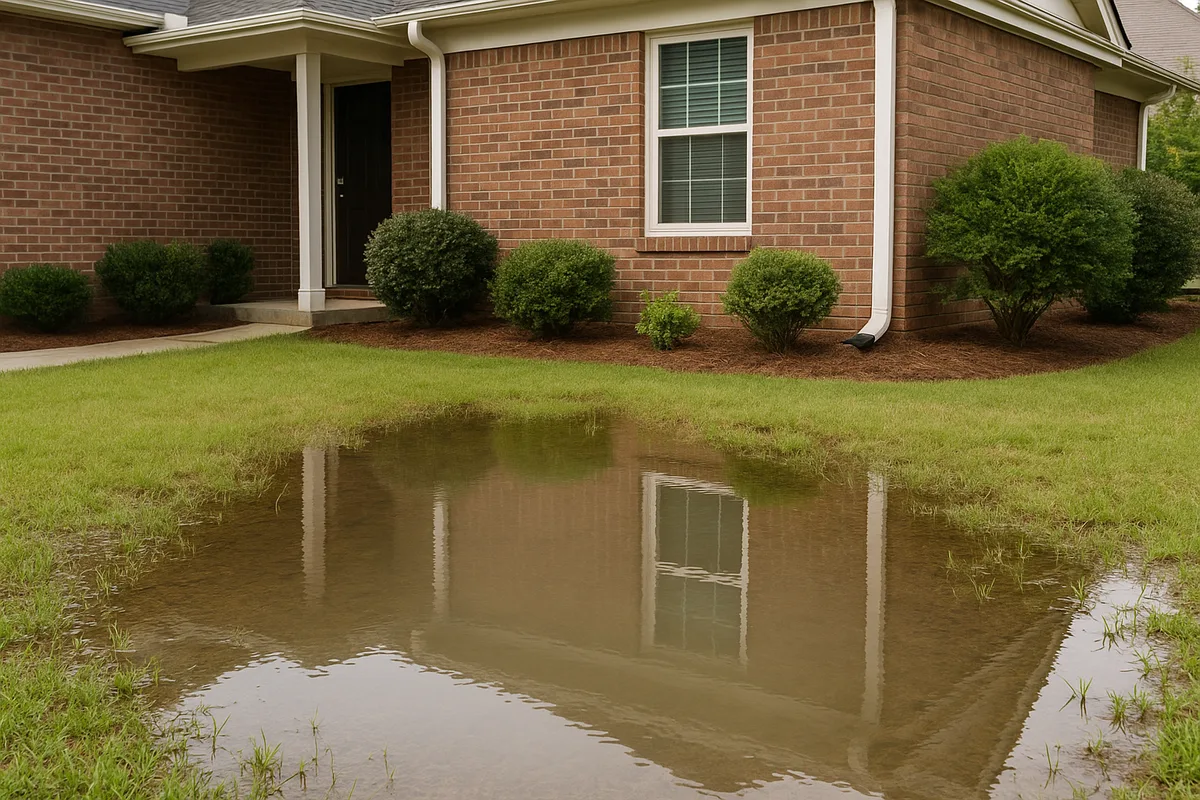
How Long Should Standing Water Last After Rain? A Drainage Guide
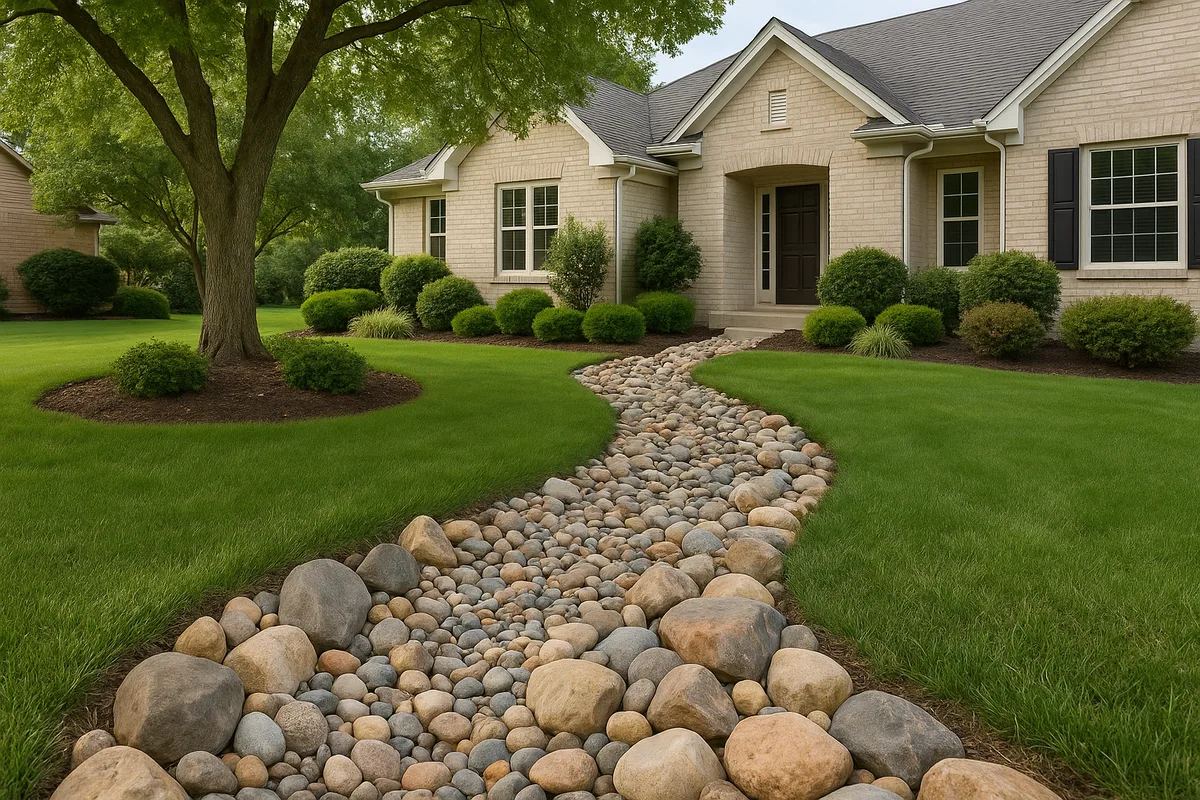
Dry Creek Beds for Drainage: When Function and Decoration Collide