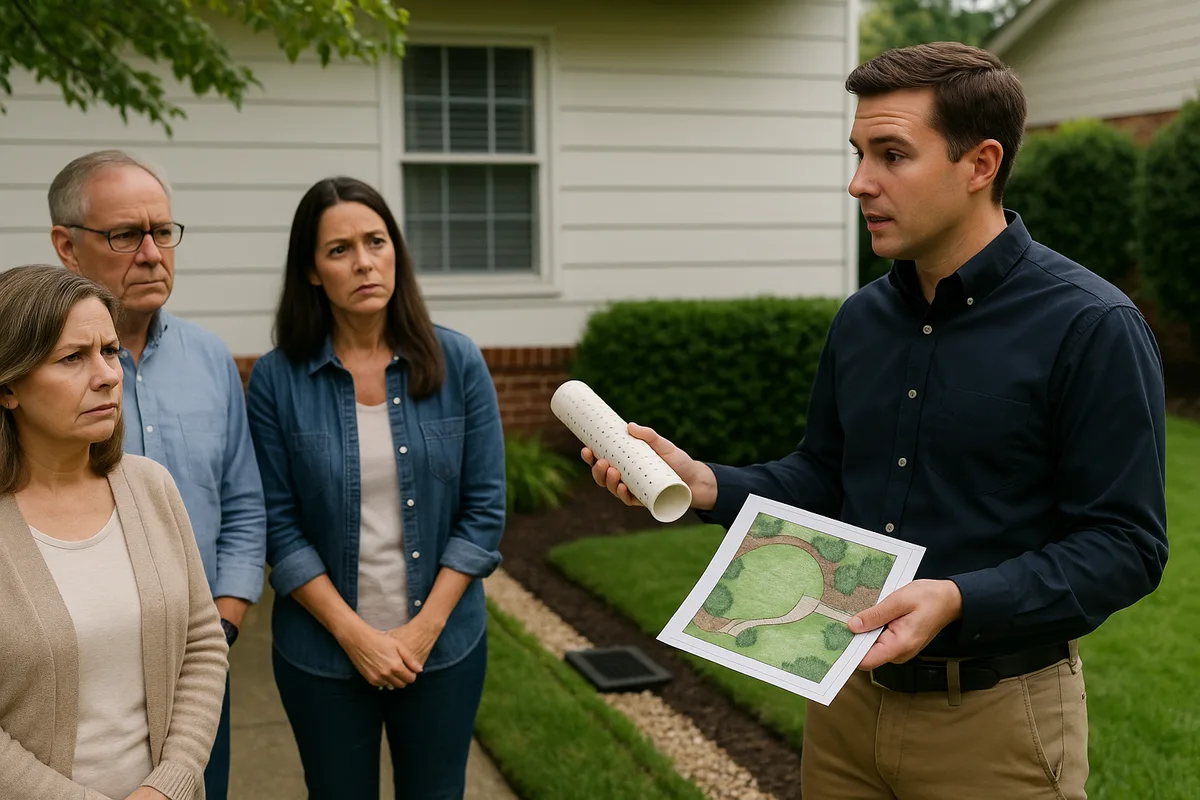
How to Pitch Drainage and Grading Solutions to Skeptical HOA Boards
Convincing a homeowners association board to invest in drainage and grading improvements is one of the most challenging sales environments in the residential construction industry. HOA boards are composed of volunteer homeowners who are spending other people's money, answering to an entire community of stakeholders, and often operating with limited technical knowledge about HOA drainage issues. They are skeptical by design — and rightfully so.
But drainage problems don't resolve themselves. Standing water, eroding common areas, flooded basements, and deteriorating pavement are liabilities that compound over time. The contractor or consultant who can bridge the gap between technical necessity and board-level decision-making will not only win the commercial drainage bid but also build a pipeline of referral-driven work across entire communities. This guide breaks down the art and science of presenting drainage and grading solutions to HOA boards in a way that earns trust, demonstrates value, and gets proposals approved.
Understanding the HOA Decision-Making Landscape
Before you craft your first slide or write a single line of your proposal, you need to understand the unique dynamics of HOA governance. An HOA board is not a single decision-maker like a private homeowner, nor is it a seasoned commercial property manager with a facilities background. It is a committee of volunteers — typically three to seven people — who may include a retired accountant, a stay-at-home parent, a software engineer, and a real estate agent. Their expertise is diverse, their patience for jargon is limited, and their fiduciary responsibility to the community makes them inherently cautious with large expenditures.
Most HOA boards operate under governing documents — CC&Rs (Covenants, Conditions, and Restrictions), bylaws, and architectural guidelines — that dictate how reserve funds and special assessments can be used. Any HOA drainage project that exceeds a certain dollar threshold (often $5,000–$25,000, depending on the community) may require a full membership vote. This means your proposal doesn't just need to convince five board members; it may need to be compelling enough that those board members can, in turn, sell it to hundreds of homeowners.
The approval cycle for HOA projects is notoriously slow. Boards typically meet monthly, and a drainage proposal may need to pass through an initial presentation, a committee review, a bid comparison phase, a legal review, and finally a vote. From first contact to signed contract, six to twelve months is common. Understanding this timeline is critical: if you present with urgency that feels like pressure, you'll lose the room. If you present with patience and structured follow-through, you'll outlast competitors who give up after the second meeting.
Finally, recognize that board members are managing risk — both financial and political. Approving a $150,000 drainage project that fails or that homeowners perceive as unnecessary can end board members' volunteer tenure and create community conflict. Your job is to de-risk the decision. Every element of your pitch should reduce the perceived risk of saying yes.
Conducting a Pre-Pitch Site Assessment That Builds Credibility
The single most effective thing you can do before presenting to an HOA board is conduct a thorough, data-driven site assessment — ideally at no cost or at a modest fee that gets credited toward the project. This accomplishes two things: it demonstrates your expertise before you ever ask for money, and it gives you the ammunition to make an evidence-based case that is difficult to argue against.
Start by gathering publicly available data about the property. Topographic information from the USGS 3D Elevation Program can provide baseline elevation data for the community. Soil data from the NRCS Web Soil Survey will tell you the hydrologic soil group classification for the site — whether the community sits on well-draining Group A sandy soils or problematic Group D clay soils with high runoff potential. These data points are free, authoritative, and immediately elevate your proposal above competitors who show up with nothing but a verbal estimate.
Walk the property during or immediately after a rain event if possible. Photograph standing water, saturated turf, erosion channels, staining on foundation walls, and any evidence of previous drainage attempts (failed French drains, clogged catch basins, undersized culverts). Measure slopes with a digital level or transit — document areas where grade falls toward buildings rather than away from them, noting specific measurements. The International Residential Code calls for a minimum 6 inches of fall over 10 feet (a 5% slope) within the first 10 feet of a foundation; many HOA common areas fail to meet even a 2% slope standard.
Compile your findings into a professional assessment report with photographs, annotated site maps, and a clear summary of problems identified. This document becomes the foundation of your pitch. When a board member asks, "How do we know this is really a problem?" you don't offer an opinion — you hand them a 15-page report with photographic evidence, soil data from federal agencies, and measured slopes that violate building code standards.
Leveraging Technology for Visual Impact
Modern surveying and mapping tools give drainage contractors an enormous advantage in HOA presentations. If you have access to drone-based photogrammetry or LiDAR scanning, use it. A 3D terrain model of the community that shows water flow paths in vivid color is worth more than an hour of verbal explanation. Board members who struggle to understand contour lines will immediately grasp a color-coded elevation map where blue arrows show exactly where water is flowing — and where it's pooling.
Even without advanced equipment, you can create compelling visuals. Overlay drainage flow arrows on aerial imagery from Google Earth. Create before-and-after grading diagrams showing existing vs. proposed slopes. Use cross-section drawings that show how water currently moves through a swale or parking area versus how it will move after your proposed improvements. Visual communication is not optional in HOA presentations — it is essential.
Structuring Your Commercial Drainage Bid for Maximum Clarity
A commercial drainage bid for an HOA must balance technical completeness with readability. Board members will compare your proposal against two or three competitors, and the one that is easiest to understand — while still demonstrating competence — will have a significant advantage.
Structure your bid document with these sections, in this order:
Executive Summary (1 page): A plain-language overview of the problem, your proposed solution, the total cost, and the expected outcome. This is the only page some board members will read. Make it count.
Site Assessment Findings: Reference or include your pre-pitch assessment. Summarize the drainage deficiencies identified, with key photographs and measurements.
Proposed Scope of Work: Detail every element of the project — regrading areas with specific slope targets, installation of catch basins and storm drain piping (specify sizes and materials), French drain systems, channel drains, downspout extensions, erosion control measures, and final restoration (sod, seed, mulch). Use clear, descriptive language rather than trade shorthand.
Phasing Options: If the project is large, offer a phased approach. Phase 1 might address the most critical drainage failure points (e.g., water intrusion into building foundations), while Phase 2 addresses secondary issues (e.g., standing water in common area turf). Phasing gives the board flexibility and makes the financial commitment feel more manageable.
Detailed Cost Breakdown: Itemize costs by area or phase. Lump-sum bids feel opaque and invite suspicion. A line-item breakdown — excavation, pipe materials, labor, equipment, hauling, restoration — shows the board exactly where their money goes. Include unit prices where applicable (e.g., "4-inch perforated PVC: $4.50/linear foot installed").
Timeline and Phasing Schedule: Provide a realistic project timeline with milestones. HOAs need to communicate disruptions to residents, so be specific about which areas will be affected and for how long.
Warranty and Maintenance: Offer a meaningful warranty — two years on workmanship is standard, but if you can offer longer coverage, it becomes a differentiator. Include a recommended maintenance schedule for any installed drainage infrastructure.
Company Qualifications: Licenses, insurance certificates, references from other HOA projects, and any relevant certifications. HOA boards are risk-averse; proof of insurance and a track record with similar communities is reassuring.
Pricing Strategy for HOA Work
Pricing a commercial drainage bid for an HOA requires a different mindset than pricing residential work. HOAs expect competitive pricing because they are soliciting multiple bids — often three to five. However, the lowest bid rarely wins with sophisticated boards. Boards that have been burned by cheap contractors in the past (and most have) are looking for the best value, not the lowest number.
Position your pricing in the middle-to-upper range and justify the premium with specifics: higher-quality pipe materials (Schedule 40 PVC vs. corrugated), deeper excavation for longer system life, proper compaction testing, detailed as-built documentation, and a stronger warranty. Quantify the cost of inaction — if the board delays drainage repairs, what will foundation damage, pavement deterioration, and landscape replacement cost over the next five years? When your $120,000 proposal is compared against $300,000 in projected damage, the math becomes compelling.
Consider offering an annual maintenance contract as an add-on. HOAs are accustomed to recurring service contracts for landscaping, pool maintenance, and pest control. A drainage maintenance contract ($2,000–$5,000 annually for inspection and cleaning of catch basins, inlets, and drain lines) creates recurring revenue for you and peace of mind for the board.
Delivering the Presentation: Techniques That Win the Room
The board meeting presentation is where proposals are won or lost. You may have 15 to 30 minutes — sometimes less — to make your case. Every minute must be purposeful.
Open with the problem, not your company. Board members don't care about your founding story or your mission statement. They care about the water pooling in Building C's parking lot and the three homeowners who have filed complaints about wet basements. Start with a photograph of the worst drainage failure on their property and say, "This is what's happening to your community right now, and here's what it's costing you." You have their attention.
Present the technical solution in plain language. Instead of saying, "We'll install a 12-inch HDPE trunk line with 6-inch lateral connections at 50-foot intervals feeding into a detention basin with a controlled outlet structure," say, "We're going to install an underground pipe network that collects water from across the property and routes it to a designated holding area where it's released slowly, preventing flooding downstream." Then show the technical drawing for those who want the details.
Anticipate objections and address them proactively. The most common objections from HOA boards are:
"This costs too much." Counter with phasing options, cost-of-inaction analysis, and financing alternatives (some HOAs can use reserve funds, obtain HOA loans, or levy special assessments spread over 12–24 months).
"How do we know this will work?" Counter with engineering calculations, reference projects, and your warranty. If possible, offer a performance guarantee — for example, "If standing water persists in the graded areas within 12 months of project completion, we will return and correct the issue at no additional cost."
"We need more bids." This is legitimate and expected. Don't fight it. Instead, say, "Absolutely — we encourage you to compare our proposal with others. We're confident that when you evaluate scope, materials, warranty, and qualifications side by side, our proposal will stand out." Then make sure your bid document is the most professional and detailed one they receive.
"Can't we just fix the worst spots?" Sometimes the answer is yes, and you should be honest about that. Offering a targeted repair option alongside a comprehensive solution shows integrity and gives the board a decision framework rather than an all-or-nothing choice.
Bringing a Visual Presentation
Prepare a concise slide deck — 10 to 15 slides maximum. Include:
- Aerial photo of the property with problem areas marked
- Close-up photographs of drainage failures
- Soil data and slope measurements
- Proposed solution diagram overlaid on the site plan
- Before-and-after cross-section drawings
- Phased cost summary
- Timeline
- Reference project photos (with permission from other HOA clients)
- Your contact information and next steps
Bring printed copies of the full proposal for every board member. Many board members are older homeowners who prefer paper documents they can review at home. A printed, bound proposal signals professionalism and makes your bid memorable when it's sitting on a board member's kitchen counter next to a competitor's emailed PDF.
Addressing the Financial Concerns Head-On
Money is the elephant in every HOA boardroom. Drainage and grading projects are expensive, and unlike a new pool or clubhouse renovation, they don't generate visible amenity value that makes homeowners feel good about their investment. You're asking the board to spend significant community funds on infrastructure that, when done correctly, is invisible.
Reframe the investment in terms board members understand:
Property value protection. Persistent drainage problems — standing water, foundation damage, eroding slopes, flooded parking areas — directly impact property values in the community. Cite data: homes in communities with known drainage or flooding issues sell for 10–25% less than comparable homes in well-maintained communities. Every homeowner in the association has a financial stake in protecting their property value.
Liability reduction. Standing water creates slip-and-fall hazards. Saturated soils can cause retaining wall failures. Flooded common areas can breed mosquitoes, creating public health concerns. If someone is injured due to a known drainage deficiency that the board failed to address, the association's liability exposure is significant. Most HOA attorneys will confirm that documented knowledge of a hazard combined with inaction is a recipe for litigation.
Reserve fund compliance. Many states require HOAs to maintain adequate reserve funds for infrastructure maintenance and replacement. Drainage systems are a reserve component. If the community's reserve study identifies drainage deficiencies and the board fails to act, they may be in violation of their fiduciary duty. Reference the community's most recent reserve study if one exists — it may already support your proposal.
Cost escalation. Construction costs increase 3–7% annually. Materials like PVC pipe, aggregate, and geotextile fabric are subject to supply chain fluctuations. A project that costs $120,000 today may cost $140,000 in two years. Additionally, drainage problems cause secondary damage that compounds: soil erosion undermines pavement, water intrusion damages building envelopes, and saturated subgrade leads to premature failure of roads and sidewalks. The longer the board waits, the more expensive the total solution becomes.
Present a simple cost comparison table:
| Scenario | Year 1 | Year 3 | Year 5 |
|---|---|---|---|
| Proposed drainage project | $120,000 | $120,000 (done) | $120,000 (done) |
| Deferred maintenance + damage repair | $15,000 (patching) | $85,000 (escalating repairs) | $210,000 (full rebuild + damage) |
This kind of financial modeling resonates with board treasurers and budget-conscious members far more than technical specifications.
Building Trust Through Transparency and References
Skepticism from HOA boards often stems from past negative experiences with contractors. Many communities have been burned by contractors who underbid, underdelivered, or disappeared after collecting payment. Your pitch must actively counter this baggage.
Transparency is your most powerful trust-building tool. Share your contractor's license number and invite them to verify it. Provide your certificate of insurance and name the association as an additional insured on your policy before they ask. Offer a list of five or more HOA references — not just names and phone numbers, but specific project descriptions, contract values, and completion dates. If possible, arrange a site visit to a completed project so board members can see your work firsthand.
Consider offering a phased payment structure tied to project milestones rather than requiring a large upfront deposit. A typical structure might be:
- 10% upon contract signing
- 25% upon completion of excavation and rough grading
- 25% upon completion of pipe installation and backfill
- 25% upon completion of finish grading and restoration
- 15% retained for 30 days after final inspection
This structure protects the association and demonstrates your confidence in delivering the work. Boards that have been burned by contractors who took 50% upfront and then dragged out the project will immediately appreciate this approach.
Navigating the Competitive Bid Process
Most HOA management companies and well-run boards will solicit three to five bids for any significant project. You cannot control what your competitors bid, but you can control how your bid is perceived in comparison.
Create a "bid comparison guide" — a one-page document that lists the key criteria the board should use to evaluate all bids side by side. Include categories like: scope of work completeness, material specifications, warranty terms, insurance coverage, HOA experience, timeline, and payment terms. This positions you as the expert who is helping the board make a good decision, not just selling a service. It also subtly ensures the evaluation criteria favor your strengths.
If your bid is higher than competitors, address it directly. "You may receive lower bids. We encourage you to ask those contractors to specify their pipe materials, compaction standards, and warranty terms. Our proposal uses Schedule 40 PVC with a 50-year service life, mechanical compaction to 95% Proctor density, and a 5-year workmanship warranty. These specifications matter because they determine whether this system works for 5 years or 50 years."
Handling Common Drainage Misconceptions in HOA Communities
HOA board members and community residents often hold misconceptions about drainage that can derail your proposal. Addressing these proactively — with patience and education rather than condescension — is essential.
"We never had drainage problems before." Drainage conditions change over time. Soil compaction from construction and foot traffic reduces infiltration rates. Aging infrastructure (original builder-installed drainage systems are often minimal and deteriorate after 15–20 years). Upstream development increases runoff volumes. Changes in precipitation patterns — more intense storms delivering more rain in shorter periods — stress drainage systems that were adequate when the community was built. NOAA's Atlas 14 precipitation frequency data has been updated in many regions to reflect increased rainfall intensities, meaning a system designed to handle a "10-year storm" in 1995 may now be undersized.
"Can't we just add some French drains?" French drains are one tool in the drainage toolkit, but they are not a universal solution. They work well for intercepting shallow subsurface water but are ineffective against surface runoff from impervious areas (roofs, driveways, parking lots). A comprehensive drainage plan may include French drains, surface grading, catch basins, area drains, channel drains, and potentially detention or retention facilities. Presenting a systems-level approach — rather than a single-product solution — demonstrates expertise.
"The city/county should fix this." In most jurisdictions, the HOA is responsible for stormwater management on its private property. Municipal stormwater systems handle runoff from public rights-of-way, but once water is on HOA common area property, it is the association's responsibility. Some communities have stormwater utility fees that fund municipal infrastructure, but these do not cover private property drainage improvements.
"We'll just regrade the lawn areas." Regrading is often a critical component of drainage improvement, but it must be done with an understanding of the entire drainage system. Simply pushing soil around without establishing proper flow paths to an outlet can move the problem from one area to another. Every regrading plan needs a defined outlet — somewhere for the water to go. That outlet might be a storm drain inlet, a bioswale, a dry well, or a connection to the municipal stormwater system. If no outlet exists, one must be created as part of the project.
Following Up and Staying in the Pipeline
The HOA approval process is slow, and the contractor who stays professionally engaged throughout the process has a significant advantage. After your initial presentation, send a thank-you email to the board president and property manager within 24 hours. Include a PDF of your proposal and offer to answer any questions.
If the board tables the decision (which is common), ask when they expect to revisit it and request permission to follow up at that time. Mark it on your calendar and follow through. Many contractors lose HOA contracts simply because they fail to follow up when the board is ready to move forward months later.
Offer to attend a subsequent board meeting to answer questions that arose after your initial presentation. Offer to meet with the board's chosen engineer or consultant if they hire one for an independent review. Offer to provide additional references or arrange site visits. Every touchpoint reinforces your professionalism and commitment.
If you lose the bid, ask for feedback. Understanding why the board chose a competitor helps you refine your approach for the next opportunity. And stay in touch — if the winning contractor underperforms (which happens frequently in HOA work), you want to be the first call the board makes.
Positioning Yourself as a Long-Term Community Partner
The most successful drainage contractors in the HOA space don't think in terms of individual projects. They think in terms of community relationships. A single HOA drainage project can lead to years of maintenance contracts, additional phase work, referrals to neighboring communities, and relationships with property management companies that manage dozens of associations.
After completing a project, provide the board with comprehensive as-built documentation — drawings showing exactly what was installed, where pipes are located, invert elevations, and connection points. This documentation is invaluable for future maintenance and demonstrates a level of professionalism that most competitors don't provide.
Offer to present an annual drainage system inspection report to the board. This keeps you engaged with the community, identifies maintenance needs before they become emergencies, and positions you as the trusted drainage expert for any future work.
Consider creating educational content — a one-page guide for homeowners on "How to Protect Your Home's Drainage" or a short presentation on "What Every HOA Board Should Know About Stormwater Management." Providing value beyond the transaction builds the kind of trust that generates referrals.
At Low Point Labs, we specialize in providing the topographic drainage intelligence that underpins successful HOA drainage projects. Our detailed property assessments, elevation analysis, and drainage flow mapping give contractors and HOA boards the data they need to make informed decisions about commercial drainage bid evaluation and project planning. Whether you're a contractor looking to strengthen your proposals or a board member trying to understand your community's drainage challenges, our tools and expertise can help you move from uncertainty to action. Explore our drainage assessment services to see how data-driven insights can transform the way your community manages water.
See Drainage Intelligence in Practice
Talk with our team or request an invitation to the platform.
Frequently Asked Questions
HOA drainage projects range widely based on community size and problem severity. Small targeted repairs (regrading, adding catch basins) may cost $10,000–$50,000, while comprehensive community-wide drainage systems can range from $100,000 to $500,000 or more. Phased approaches allow boards to spread costs over multiple budget years.
The HOA is typically responsible for stormwater management on its private common areas, including parking lots, landscaped areas, and shared infrastructure. Municipal stormwater systems generally only cover public rights-of-way. The association's CC&Rs and local ordinances define specific maintenance responsibilities.
HOA drainage project approval typically takes 3 to 12 months from initial presentation to signed contract. The process involves board presentations, committee reviews, competitive bidding, and potentially a community-wide vote for projects exceeding the board's spending authority. Patience and consistent follow-up are essential.
Yes, most HOAs can use reserve funds for drainage infrastructure repair and replacement if drainage systems are identified as reserve components in the community's reserve study. Board members should consult their reserve study and HOA attorney to confirm that the proposed project qualifies as a reserve expenditure under their governing documents.
Best practice is to solicit three to five competitive bids for any significant drainage project. Boards should evaluate bids not just on price but on scope completeness, material specifications, warranty terms, contractor experience with HOA communities, and insurance coverage. The lowest bid is not always the best value.
Ignoring drainage problems leads to escalating costs and increased liability. Water intrusion damages foundations and building envelopes, erosion undermines pavement and retaining walls, and standing water creates slip-and-fall hazards and mosquito breeding grounds. Documented knowledge of a drainage deficiency combined with board inaction can expose the association to significant legal liability.
Related Articles
How to Overcome the 'It Doesn't Rain That Much' Objection on Drainage Jobs

How to Use Landscaping Design Software to Justify a $15,000 Drainage Bid