How to Price a French Drain Install: A Contractor's Bidding Guide
Pricing a French drain installation is one of the most nuanced tasks a drainage contractor faces. Underbid and you're working for free—or worse, losing money. Overbid and you lose the job to a competitor who understood the site conditions better than you did. Accurate french drain bidding requires a systematic approach that accounts for site-specific variables, material costs, labor productivity, equipment needs, overhead, and profit. This guide walks contractors through every step of building a reliable drainage estimate pricing model that wins jobs and protects margins.
Whether you're a seasoned drainage specialist refining your process or a general contractor expanding into water management work, the principles here will help you build bids that are competitive, defensible, and profitable. We'll cover everything from the initial site assessment to the final number on your proposal, with real-world cost ranges and formulas you can adapt to your market.
Start With a Thorough Site Assessment
Every accurate French drain bid begins on-site, not behind a desk. The single biggest source of bidding errors is underestimating site complexity because the contractor relied on photos, homeowner descriptions, or satellite imagery instead of walking the property. A proper site assessment takes 30 to 90 minutes and should evaluate topography, soil conditions, existing drainage infrastructure, access constraints, and the scope of the water problem.
During your site visit, identify the water source and its behavior. Is the problem seasonal snowmelt, roof runoff that's not being managed by gutters, a high water table, or surface water migrating from an adjacent property? Each scenario demands a different French drain design—and therefore a different price. A shallow curtain drain intercepting surface sheet flow is a fundamentally different job than a deep footing drain installed at foundation depth to relieve hydrostatic pressure.
Measure the proposed trench route with a wheel or tape, noting any obstacles: tree roots, buried utilities, concrete walkways, retaining walls, or HVAC equipment pads. Each obstacle adds time and cost. Use a hand level or digital level to confirm fall along the proposed route, and identify the discharge point. If the site lacks a gravity outlet—no storm sewer, no daylight point, no swale—you may need to include a sump pump or dry well in your bid, which significantly changes the price.
Document soil conditions by probing or digging a test hole. Clay-heavy soils (hydrologic soil group C or D, per NRCS classifications) are harder to excavate, slower to drain, and may require more aggregate backfill or a wider trench cross-section. Sandy or gravelly soils are easier to dig but may indicate a high water table that complicates the install. Take photos and notes—this documentation protects you if the scope changes during construction.
Material Takeoff: Quantifying Every Component
A French drain is deceptively simple in concept—a gravel-filled trench with a perforated pipe—but the material list adds up quickly. Your takeoff should include every item that will be consumed or installed on the job.
Pipe
The backbone of any French drain is the perforated pipe. For residential work, 4-inch corrugated HDPE pipe is the industry standard for cost-effective installations, while 4-inch rigid PVC (SDR 35 or Schedule 40 with drilled perforations) is preferred for longevity and structural integrity. Rigid PVC costs roughly $1.50 to $3.00 per linear foot versus $0.50 to $1.00 for corrugated, but it resists crushing, root intrusion, and long-term deflection far better.
Calculate total pipe length as the trench length plus 10% for fittings, transitions, and minor routing adjustments. If the discharge transitions to solid pipe (which it should, for the last 5 to 10 feet before the outlet), include that solid pipe separately. Don't forget couplings, elbows, wye fittings, and end caps or cleanout risers.
Aggregate
Washed drainage stone—typically #57 or #2 stone—is the largest material cost on most French drain jobs. You need enough aggregate to surround the pipe with a minimum of 2 inches on all sides, though best practice calls for 4 to 6 inches of stone around and above the pipe. For a standard residential trench that is 12 inches wide and 18 inches deep, you'll need approximately 0.75 to 1.0 cubic yards of stone per 10 linear feet of trench.
Price aggregate delivered to the site, not picked up at the quarry. Delivery fees for a 10- to 15-ton load typically run $75 to $200 depending on distance. If the truck can't dump near the trench—common in backyard installs with limited access—add labor time for wheelbarrowing material, which can double your aggregate installation labor.
Filter Fabric
Non-woven geotextile filter fabric wraps the aggregate envelope to prevent soil migration and clogging. You'll need enough to line the trench bottom and sides with 6 to 12 inches of overlap at the top. For a 12-inch-wide, 18-inch-deep trench, plan on approximately 5 to 6 linear feet of fabric per linear foot of trench (accounting for the wrap). Non-woven geotextile runs $0.15 to $0.50 per square foot, making it a relatively minor line item—but forgetting it can blow your margin on a long run.
Additional Materials
Don't overlook the smaller items that add up: catch basin or inlet grates if you're collecting surface water, pop-up emitters or discharge fittings at the outlet, landscape staples to hold fabric, sod or seed for restoration, and any topsoil needed to re-grade the surface. A common bidding mistake is pricing the drain itself accurately but forgetting to account for the $300 to $800 in site restoration that the homeowner expects to be included.
Labor Estimation: Hours, Crew Size, and Productivity
Labor is typically the largest single cost component in a French drain installation, often representing 40% to 60% of the total bid. Estimating labor accurately requires honest assessment of your crew's productivity under the specific site conditions you documented during your assessment.
Hand-Dug vs. Machine-Excavated Trenches
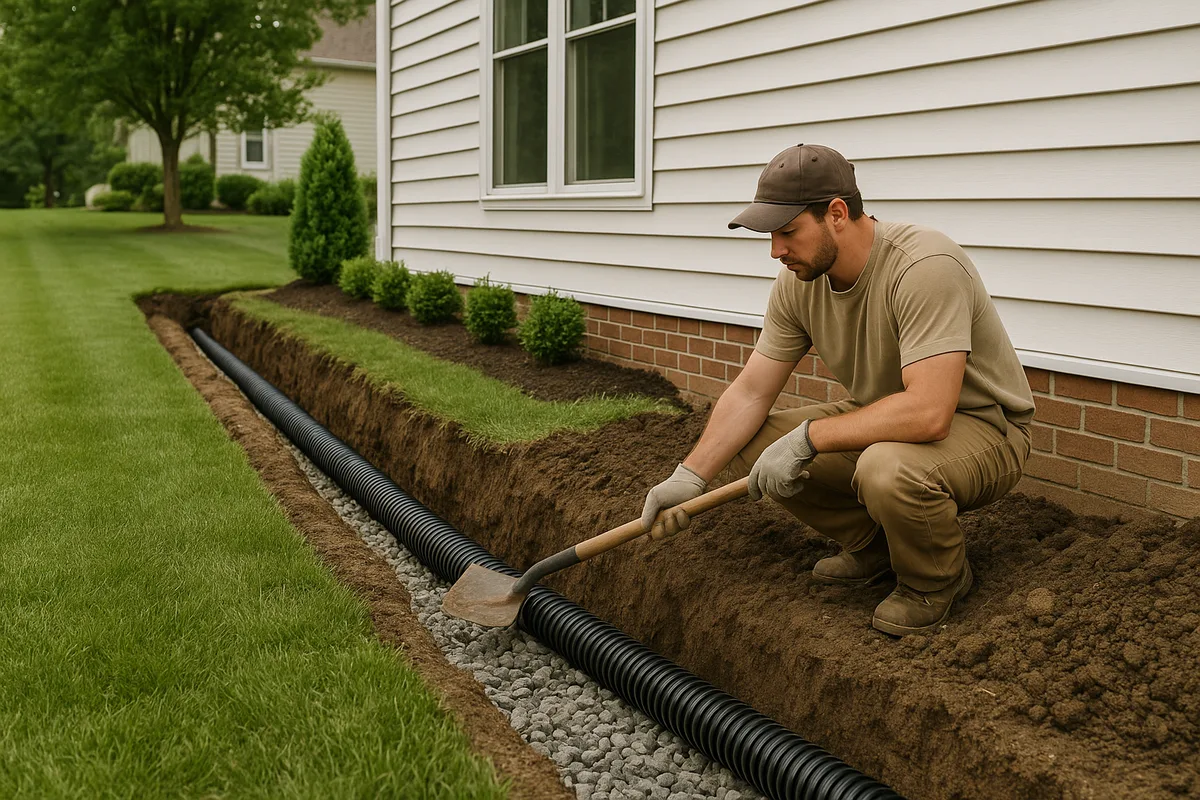
For short runs (under 30 linear feet) in accessible areas with few obstacles, hand digging may be the most practical approach. An experienced laborer can hand-dig approximately 10 to 15 linear feet of trench per hour in average soil at a depth of 18 inches and width of 12 inches. In heavy clay or rocky soil, that rate drops to 5 to 8 linear feet per hour.
For longer runs, a compact trencher or mini excavator dramatically improves productivity. A walk-behind trencher can cut 40 to 60 linear feet per hour in cooperative soil. A mini excavator with a 12-inch bucket is even faster and handles tough soil better but requires access width of at least 4 to 5 feet. Factor in the equipment rental cost—typically $200 to $400 per day for a trencher, $350 to $600 per day for a mini excavator—and weigh it against the labor hours saved.
Crew Composition
A typical residential French drain crew consists of two to three workers: one operating equipment or leading the dig, one handling material placement (pipe, stone, fabric), and one managing spoils, site protection, and restoration. For a straightforward 60-linear-foot exterior French drain in average soil with machine excavation, plan on a full day (8 hours) for a two-person crew or 5 to 6 hours for a three-person crew.
Interior French drains (basement perimeter systems) demand more labor per linear foot because of concrete cutting, confined-space work, jackhammer operation, and the need to protect the homeowner's living space. Interior systems typically require 1.5 to 2.5 times the labor hours of a comparable exterior run.
Labor Burden
Your labor cost isn't just the hourly wage you pay your crew. True labor burden includes payroll taxes (FICA, FUTA, SUTA), workers' compensation insurance, general liability insurance, health benefits, paid time off, and vehicle costs. For most small drainage contractors, the fully burdened labor rate is 1.3 to 1.6 times the base wage. If you pay a crew member $25 per hour, your true cost is $32.50 to $40.00 per hour. Failing to account for labor burden is one of the most common—and most damaging—bidding mistakes contractors make.
Equipment and Subcontractor Costs
Beyond the trencher or excavator, consider all equipment that will be on the job. Plate compactors for backfill, concrete saws for interior drains or cutting through sidewalks, pumps for dewatering if you're digging below the water table, and trucks for hauling spoils all carry costs that need to be in your bid.
Owned Equipment
If you own your equipment, charge an internal rental rate that covers depreciation, maintenance, fuel, and insurance. The Association of Equipment Manufacturers and various contractor associations publish equipment cost guides, but a simple approach is to calculate your annual ownership cost (purchase price divided by useful life, plus annual maintenance and insurance) and divide by your annual billable hours. A mini excavator purchased for $40,000 with a 10-year useful life, $2,000 per year in maintenance, and 800 billable hours per year has an internal rate of approximately $7.50 per hour—far less than rental, which is why owning equipment makes sense once you're running enough drainage jobs to justify it.
Rental Equipment
For equipment you don't own, get current rental quotes for your specific market. Rental rates vary significantly by region and season. During the busy spring season, availability may be limited and prices higher. Build rental delivery and pickup fees into your estimate—these can run $75 to $150 each way.
Utility Locates and Subcontractors
Always call 811 for utility locates before any excavation. While the locate service is free, you may need to hire a private utility locator for more precise identification, especially in areas with dense underground infrastructure. Private locates run $150 to $500 depending on the scope. If your trench route crosses a utility, you may need to hand-dig within the tolerance zone, which adds labor time.
If the job requires concrete work (pouring a new sidewalk section you had to cut through), electrical work (wiring a sump pump), or plumbing connections (tying into an existing storm sewer), subcontract those trades and include their quotes in your bid with appropriate markup.
Building Your Price: Direct Costs, Overhead, and Profit
With your material takeoff, labor estimate, and equipment costs in hand, you're ready to build the final price. The formula is straightforward, but each component requires careful calibration to your business.
Direct Job Costs
Sum all costs directly attributable to the specific job:
- Materials: Pipe, aggregate, fabric, fittings, catch basins, discharge hardware, restoration materials
- Labor: Total crew hours × fully burdened hourly rate
- Equipment: Rental fees or internal equipment charges, plus fuel
- Subcontractors: Any specialty trade work
- Permits: Some jurisdictions require grading or plumbing permits for French drain installations. Fees range from $50 to $500. Check your local requirements.
- Disposal: Spoils hauling and dump fees if soil can't be spread on-site. A 60-linear-foot trench generates approximately 1.5 to 2.5 cubic yards of spoils.
Overhead Recovery
Overhead includes all the costs of running your business that aren't tied to a specific job: office rent, insurance, vehicle payments, accounting, marketing, phone, software, continuing education, and your own salary when you're not on a job site. Calculate your annual overhead and divide it by your annual revenue (or projected revenue) to get your overhead rate as a percentage.
For most small drainage contractors, overhead runs 15% to 30% of direct costs. Apply this percentage to your total direct costs to determine the overhead allocation for the job. If your direct costs are $3,000 and your overhead rate is 25%, add $750 for overhead recovery, bringing your break-even cost to $3,750.
Profit Margin
Profit is not your salary—that should already be in overhead. Profit is the return on the risk you're taking, the capital you've invested in your business, and the value of your expertise. Healthy net profit margins for drainage contractors range from 10% to 20%, with 15% being a reasonable target for established contractors in competitive markets.
Apply your profit margin to the sum of direct costs plus overhead. Using the example above: $3,750 × 1.15 = $4,312.50. That's your bid price. Some contractors prefer to use a combined markup that covers both overhead and profit—often called a "markup factor" of 1.40 to 1.67 applied directly to direct costs. Either method works as long as you're consistent and honest about what the numbers include.
Price Per Linear Foot Benchmarking
While every job is unique, benchmarking your bids against per-linear-foot market rates helps you sanity-check your numbers. As of 2026, typical installed prices for residential exterior French drains fall in these ranges:
- Basic exterior French drain (12" wide × 18" deep, corrugated pipe, standard stone): $25 to $50 per linear foot
- Mid-range exterior French drain (12-18" wide × 24" deep, rigid PVC, washed stone, fabric wrap): $45 to $75 per linear foot
- Interior perimeter drain (basement system with sump pump): $60 to $120 per linear foot
- Deep curtain drain (36"+ deep, heavy equipment required): $70 to $150 per linear foot
If your calculated bid falls significantly outside these ranges for comparable work, revisit your assumptions. You may have missed a cost—or you may have identified a legitimate reason the job is more expensive than average, which you'll need to communicate clearly in your proposal.
Writing the Proposal: What to Include
Your drainage estimate pricing document is both a sales tool and a legal contract. A well-written proposal builds confidence, sets clear expectations, and protects you from scope creep. Here's what every French drain bid should include.
Scope of Work
Describe exactly what you will do in plain language. Specify the trench route (reference landmarks or provide a simple site sketch), dimensions (length, width, depth), pipe type and diameter, aggregate type and quantity, fabric specification, discharge method and location, and restoration work. Be explicit about what's included and what's not. If you're not responsible for gutter downspout connections, re-grading the entire yard, or landscaping beyond basic sod replacement over the trench, say so.
Itemized vs. Lump Sum Pricing
Contractors debate whether to itemize or lump-sum their bids. Itemizing (showing separate line items for materials, labor, equipment, etc.) builds transparency and trust with some clients but also invites line-by-line negotiation and exposes your margins. Lump-sum pricing is cleaner and protects your pricing strategy but may feel opaque to homeowners comparing multiple bids.
A middle-ground approach works well for French drain bids: present a lump-sum total but break the scope into logical phases or components. For example: "French drain installation (65 LF): $3,800. Sump pump and basin: $1,200. Site restoration: $600. Total: $5,600." This gives the client enough visibility to understand what they're paying for without exposing your cost structure.
Terms and Conditions
Include payment terms (deposit amount, progress payments, final payment), warranty information, timeline, permit responsibilities, and change-order procedures. A standard warranty for French drain work is 1 to 5 years on workmanship, with manufacturer warranties on pipe and components passed through to the client.
Address the most common source of disputes up front: "This bid is based on soil conditions observed during our site assessment. If unexpected conditions are encountered during excavation (rock, abandoned utilities, contaminated soil, water table higher than anticipated), additional costs will be addressed via written change order before work proceeds."
Differentiators
Your proposal should communicate why you're the right contractor for the job, beyond just price. Mention your drainage-specific experience, relevant licenses or certifications, insurance coverage, references from similar projects, and any diagnostic tools or technology you use. If you've used topographic data or drainage analysis to design the system—rather than just guessing where to put the pipe—say so. Homeowners increasingly value data-driven approaches to drainage, and it justifies premium pricing.
Common Bidding Mistakes and How to Avoid Them
Even experienced contractors make pricing errors that erode profitability. Here are the most common pitfalls in french drain bidding and how to sidestep them.
Underestimating Access Difficulty
Backyard French drains often require moving materials through side yards, over fences, or down slopes. If a skid steer can't reach the work area, every cubic yard of stone must be wheelbarrowed in and every cubic yard of spoils wheelbarrowed out. This can add 30% to 50% to your labor hours. During your site visit, physically walk the access route and measure gate widths, overhead clearances, and grade changes.
Ignoring Dewatering
If you're installing a French drain to solve a water problem, there's a good chance the trench will fill with water as you dig. Dewatering with pumps takes time and equipment. In severe cases, you may need to stage the work—dig, pump, place pipe and stone, move to the next section—which dramatically slows productivity. If the water table is within 12 inches of your trench bottom, add 20% to 40% to your labor estimate.
Forgetting Mobilization and Demobilization
The time and fuel cost of getting your crew, equipment, and materials to and from the job site is real. For a local job, mobilization might be an hour of crew time plus fuel. For a job 45 minutes away, it could be 3 or more crew-hours round trip. Include a mobilization line item or build it into your overhead.
Scope Creep Without Change Orders
The homeowner asks you to extend the drain another 15 feet while you're on-site. You agree because it seems small. But that's another $750 to $1,500 in direct costs that you're now absorbing. Establish a firm change-order process and stick to it. Verbal agreements on job sites are the enemy of profitability.
Competing on Price Alone
If you're consistently the lowest bidder, you're probably leaving money on the table—or worse, losing money. Compete on expertise, quality, and communication. Homeowners who choose the cheapest drainage bid often end up calling a second contractor when the first one's work fails. Position yourself as the contractor they call the first time—or the second time, at a premium.
Using Technology and Data to Improve Your Bids
Modern drainage contractors have access to tools that previous generations didn't, and leveraging them can improve both your bid accuracy and your close rate.
Topographic and elevation data from sources like the USGS 3D Elevation Program can help you understand the broader drainage context of a property before you ever visit the site. While LiDAR-derived elevation models don't replace on-site assessment, they can reveal watershed boundaries, natural flow paths, and downstream conditions that affect your design and pricing. A French drain that discharges into a natural low point visible on a topographic map is a different proposition than one that discharges toward a neighbor's property—the latter may require additional engineering, permitting, or alternative discharge solutions that affect your bid.
Drainage analysis software and GIS tools allow you to model water flow, calculate contributing drainage areas, and size systems more precisely. When you can show a homeowner a map of their property's drainage patterns and explain exactly why you're recommending a specific system, you differentiate yourself from competitors who are guessing. This data-driven approach supports premium pricing because it demonstrates expertise and reduces the risk of system failure.
Estimating software—whether drainage-specific or general construction platforms—helps you build consistent, professional proposals faster. Templates ensure you don't forget line items, and historical job data helps you refine your productivity assumptions over time. Track your actual costs against your estimates on every job. After 10 to 20 completed projects, you'll have a proprietary dataset that makes your bids more accurate than any industry average.
Putting It All Together: A Sample Bid Walkthrough
Let's walk through a realistic example to illustrate the complete drainage estimate pricing process.
The Job
A homeowner has water pooling against the rear foundation wall after heavy rain. The proposed solution is a 70-linear-foot exterior French drain along the back of the house, transitioning to solid pipe and discharging to daylight at a slope 25 feet away. The trench will be 14 inches wide and 24 inches deep. Access is through a 42-inch gate; no heavy equipment can reach the backyard. Soil is silty clay.
Material Costs
| Item | Quantity | Unit Cost | Total |
|---|---|---|---|
| 4" rigid PVC perforated pipe | 75 LF | $2.50/LF | $187.50 |
| 4" solid PVC pipe (discharge) | 30 LF | $2.00/LF | $60.00 |
| Fittings, couplings, cleanout | 1 lot | $85.00 | $85.00 |
| #57 washed stone (delivered) | 8 CY | $65.00/CY | $520.00 |
| Non-woven geotextile fabric | 420 SF | $0.25/SF | $105.00 |
| Pop-up emitter (discharge) | 1 | $15.00 | $15.00 |
| Sod for restoration | 200 SF | $0.75/SF | $150.00 |
| Topsoil | 1 CY | $45.00 | $45.00 |
| Materials Subtotal | $1,167.50 |
Labor Costs
With no machine access, this is a hand-dig job in clay soil. Estimated productivity: 8 LF per hour for trenching. Total trenching time: approximately 12 hours (including the solid pipe run). Pipe, stone, and fabric installation: approximately 8 hours. Backfill, grading, and sod: approximately 4 hours. Total labor: 24 crew-hours.
Two-person crew at a burdened rate of $38 per hour each: 24 hours × $38 × 2 workers = $1,824.00.
Wait—that math assumes both workers are productive for all 24 hours. In reality, with a two-person crew, the 24 crew-hours means 12 hours on-site (1.5 days). Total labor cost: 24 crew-hours × $38/hour = $912.00 per worker × 2 = $1,824.00. This checks out.
Equipment and Other Direct Costs
| Item | Cost |
|---|---|
| Wheelbarrows, hand tools (internal charge) | $50.00 |
| Plate compactor rental (1 day) | $85.00 |
| Spoils disposal (3 CY to dump) | $120.00 |
| Utility locate (private) | $200.00 |
| Mobilization (2 trips) | $150.00 |
| Equipment/Other Subtotal | $605.00 |
Building the Price
| Component | Amount |
|---|---|
| Materials | $1,167.50 |
| Labor | $1,824.00 |
| Equipment/Other | $605.00 |
| Total Direct Costs | $3,596.50 |
| Overhead (22%) | $791.23 |
| Break-Even Cost | $4,387.73 |
| Profit (15%) | $658.16 |
| Bid Price | $5,045.89 |
Rounded to a clean number: $5,050 or $5,100.
Per-linear-foot check: $5,100 ÷ 70 LF = $72.86/LF. This falls within the expected range for a mid-range exterior French drain with hand excavation in clay soil. The bid is defensible.
This example demonstrates why systematic french drain bidding matters. If you'd simply guessed "$50 per foot" based on a rule of thumb, you'd have bid $3,500 and lost $888 on the job. If you'd guessed "$100 per foot," you'd have bid $7,000 and likely lost the job to a more accurate competitor.
Final Thoughts on French Drain Bidding
Accurate drainage estimate pricing isn't just about math—it's about understanding the full picture of what a job demands. The best drainage contractors combine field experience with systematic estimation processes, and they refine their approach with every completed project. Track your actual costs, compare them to your estimates, and adjust your productivity rates and unit costs accordingly. Over time, your bids will become faster to produce and more reliably profitable.
Remember that your bid is also your first deliverable to the client. A clear, professional, well-organized proposal signals that the installation itself will be executed with the same care. Invest the time to do it right.
At Low Point Labs, we help contractors and homeowners understand the drainage dynamics of any property through advanced topographic analysis and drainage intelligence. Whether you're a contractor looking to validate your French drain design with elevation data, or a homeowner seeking an independent assessment before soliciting bids, our drainage assessment tools provide the data-driven foundation for smarter decisions. Explore our services to see how topographic intelligence can improve your next drainage project.
See Drainage Intelligence in Practice
Talk with our team or request an invitation to the platform.
Frequently Asked Questions
Residential French drain installations typically cost $25 to $75 per linear foot for exterior systems and $60 to $120 per linear foot for interior basement perimeter drains. The price varies based on trench depth, soil conditions, pipe material, access difficulty, and regional labor rates.
Most drainage contractors target a net profit margin of 10% to 20% on French drain installations, with 15% being a common benchmark for established contractors. This is applied after accounting for all direct costs and overhead recovery—profit should not be confused with the owner's salary, which belongs in overhead.
A typical 50- to 80-linear-foot residential exterior French drain takes 1 to 2 days for a two- to three-person crew with machine excavation, or 2 to 3 days if hand-dug. Interior basement French drains take longer due to concrete cutting and confined-space work, typically 2 to 4 days for a standard basement perimeter.
A hybrid approach works best: present a lump-sum total but break the scope into logical components like drain installation, sump pump, and site restoration. This gives homeowners enough transparency to understand the value without exposing your detailed cost structure to line-by-line negotiation.
The most common mistake is underestimating labor costs, particularly by failing to account for limited equipment access, dewatering needs, difficult soil conditions, and full labor burden (taxes, insurance, benefits). These factors can increase actual labor costs by 30% to 50% over a quick estimate.
Permit requirements vary by jurisdiction. Some municipalities require grading or plumbing permits for French drain installations, especially if you're connecting to a public storm sewer or altering drainage patterns that affect neighboring properties. Always check local requirements and include permit fees in your bid.
Related Articles
Dry Creek Beds for Drainage: When Function and Decoration Collide
Curtain Drains vs. Footing Drains: What's the Difference?