Neighbor's Water Draining Into Your Yard: Your Legal Rights and Practical Options
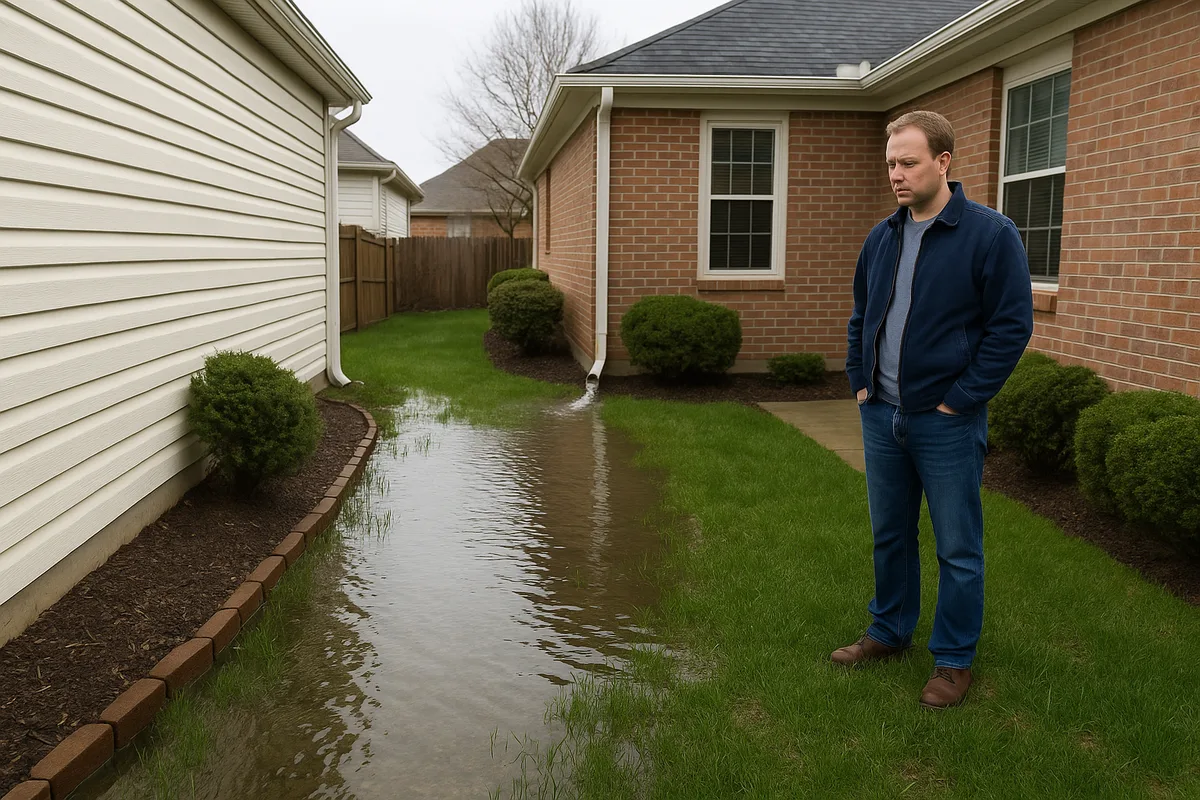
Few things are more frustrating than watching your yard turn into a swamp every time it rains — especially when the water is clearly coming from your neighbor's property. Whether it's the result of a new patio installation, regraded landscaping, or a gutter system that dumps directly toward your lot line, neighbor drainage runoff is one of the most common — and most contentious — property disputes in residential neighborhoods.
If you're dealing with water from your neighbor's yard pooling on your property, damaging your foundation, or killing your lawn, you're not powerless. The law, engineering, and common sense all provide avenues for resolution. This guide walks you through the legal frameworks that govern surface water drainage between properties, the practical steps you can take to diagnose and fix the problem, and the escalation strategies available when a neighborly conversation isn't enough.
Understanding Why Water Flows From One Yard to Another
Before you knock on your neighbor's door or call an attorney, it's critical to understand why water moves the way it does. Surface water follows gravity, flowing from higher elevations to lower ones along the path of least resistance. In a natural, undeveloped landscape, this flow pattern is established over centuries by the topography of the land itself. When homes are built, developers typically grade lots so that water drains away from foundations and toward designated collection points — streets, storm drains, swales, or retention areas.
Problems arise when someone alters this carefully engineered drainage pattern. Common triggers include:
- Regrading or filling: A neighbor adds soil to level their yard, raising the elevation and redirecting runoff toward your property.
- Impervious surfaces: New driveways, patios, pool decks, or outbuildings prevent water from soaking into the ground, increasing the volume and velocity of runoff.
- Gutter and downspout changes: Redirecting roof drainage toward your shared property line instead of toward the street.
- Retaining walls and berms: Structures that block natural drainage paths and force water to find new routes — often onto adjacent lots.
- Landscape alterations: Removing trees, regrading garden beds, or installing raised planters that change surface flow patterns.
It's also possible that the drainage problem isn't your neighbor's fault at all. Natural topography, rising water tables, aging municipal infrastructure, and even changes you've made to your own property can contribute. That's why accurate diagnosis matters before you assign blame.
The Legal Framework: How the Law Treats Surface Water Between Properties
Drainage law in the United States is primarily governed at the state level, and three major legal doctrines determine your rights when dealing with neighbor drainage runoff. Understanding which doctrine your state follows is the single most important step in evaluating your legal position.
The Common Enemy Doctrine
Under the common enemy doctrine, surface water is treated as a "common enemy" that every landowner has the right to fight off by any means necessary. Historically, this meant a property owner could grade, fill, dike, or divert water without liability — even if doing so sent more water onto a neighbor's land. The neighbor, in turn, had the same right to repel it.
This doctrine originated in English common law and was widely adopted in the eastern United States. However, most states that follow it have adopted a modified common enemy rule that adds a reasonableness standard. Under the modified version, you can still take defensive measures against surface water, but you cannot act negligently or make changes that unreasonably increase the burden on your neighbor's property. States following some version of this doctrine include Texas, New York, Virginia, and several others.
The Civil Law Rule (Natural Flow Doctrine)
The civil law rule, also called the natural flow doctrine, takes the opposite approach. It holds that lower-lying properties are burdened with a natural servitude — they must accept the natural flow of surface water from higher ground. However, the critical limitation is that upper landowners cannot alter the natural drainage pattern in ways that increase the volume, velocity, or concentration of water flowing onto the lower property.
This means if your neighbor's property has always sat higher than yours, you're generally obligated to accept the natural runoff. But if your neighbor builds a patio that concentrates sheet flow into a single stream aimed at your foundation, they've violated the civil law rule. States following this doctrine include Pennsylvania, Georgia, and many others throughout the Southeast and Mid-Atlantic.
The Reasonable Use Rule
The reasonable use rule is a modern hybrid that many states have adopted as a compromise. Under this framework, each landowner may make reasonable use of their property, including altering drainage, as long as they exercise due care and don't cause unnecessary harm to neighboring properties. Courts evaluate disputes by weighing factors such as:
- The necessity of the drainage alteration
- Whether the alteration was done with due care
- The foreseeability of harm to the neighbor
- The severity of the harm relative to the benefit gained
- Whether the harm could have been avoided through reasonable measures
Minnesota, California, and several other states follow the reasonable use rule. In practice, this standard often leads to fact-intensive litigation where the outcome depends on the specific circumstances of each case.
Municipal Ordinances and HOA Rules
Regardless of which state doctrine applies, local ordinances frequently impose additional requirements. Many municipalities have grading and drainage codes that specify minimum slopes away from foundations (typically 5% or 6 inches of fall over the first 10 feet), maximum impervious surface coverage, and stormwater management requirements for new construction or significant renovations. Homeowners' association covenants may add another layer of regulation, sometimes requiring drainage plans for any landscaping or hardscaping changes.
Check with your city or county building department and review your HOA's CC&Rs (Covenants, Conditions, and Restrictions) to see if your neighbor's alterations required a permit or violated any local standards.
How to Diagnose the Source and Severity of the Problem
Before you can fix a drainage problem or build a legal case, you need to document exactly what's happening. Anecdotal complaints like "my yard floods when it rains" won't carry much weight with a code enforcement officer, mediator, or judge. You need data.
Observe and Document During Rain Events
The most valuable evidence is real-time observation during moderate to heavy rainfall. Go outside during a storm (safely) and watch where the water comes from, how it moves across the property line, and where it accumulates. Take video with timestamps. Photograph standing water with reference objects for scale. Note the date, approximate rainfall amount, and duration.
Do this across multiple rain events to establish a pattern. A single occurrence could be dismissed as a fluke; a documented pattern over weeks or months is much harder to ignore.
Check Elevation and Grading
The fundamental question is whether the grade of the land directs water from your neighbor's property onto yours. You can get a rough sense of this with a long carpenter's level and a tape measure, but for accurate results, consider hiring a licensed surveyor to shoot elevations along the property line and across both yards. A topographic survey will reveal the precise drainage patterns and identify any areas where grading has been altered.
For a broader view of the terrain, the USGS 3D Elevation Program (3DEP) provides high-resolution elevation data that can help you understand the regional topography and natural drainage patterns affecting your neighborhood.
Assess Soil Conditions
Soil type plays a major role in how quickly water infiltrates versus how much runs off the surface. Clay-heavy soils (hydrologic soil groups C and D) drain slowly and generate significantly more runoff than sandy or loamy soils. If your yard sits on clay and your neighbor recently added impervious surfaces, the combined effect can overwhelm your property's ability to absorb water.
You can look up the soil types on your property and your neighbor's using the NRCS Web Soil Survey. This free tool provides detailed soil maps, drainage classifications, and hydrologic soil group designations for any address in the United States.
Quantify the Damage
Document any damage the runoff has caused: foundation cracks, basement leaks, erosion channels, dead vegetation, mold growth, or standing water that creates mosquito breeding habitat. Get repair estimates from qualified contractors. If the problem has affected your home's habitability or value, a professional appraisal or home inspection report can quantify the financial impact.
Talking to Your Neighbor: The Essential First Step
In the majority of neighbor drainage disputes, the person causing the problem doesn't realize they're doing it. They hired a contractor to build a patio, the contractor graded the site to drain away from the house, and the water ended up flowing toward your lot. There was no malice — just a failure to consider the downstream consequences.
That's why a calm, informed conversation is almost always the right first move. Here's how to approach it effectively:
Lead With Observation, Not Accusation
Instead of saying "Your new patio is flooding my yard," try "I've noticed water pooling along our property line since the landscaping changes, and I wanted to see if we could figure out what's going on together." Frame it as a shared problem rather than an accusation. Most people are more willing to cooperate when they don't feel attacked.
Bring Evidence, Not Emotion
Show your neighbor the photos and videos you've collected. Walk the property line together during or after a rain event if possible. Point out the flow patterns, the standing water, and any damage. When people can see the problem with their own eyes, they're far more likely to take it seriously.
Propose Solutions, Not Ultimatums
Come prepared with at least one or two practical solutions. Maybe a simple downspout extension would redirect their roof runoff away from your property line. Maybe a small swale or berm could intercept the flow. When you offer solutions, you signal that you're looking for resolution, not conflict.
Document the Conversation
After your conversation, send a brief follow-up email or letter summarizing what you discussed and any agreements you reached. This creates a paper trail that could be important later if the situation escalates. Keep the tone friendly and cooperative.
Practical Engineering Solutions for Neighbor Drainage Runoff
Whether your neighbor cooperates or not, there are numerous physical solutions you can implement on your own property to manage water from your neighbor's yard. Some require your neighbor's participation; others you can do unilaterally on your own land.
Solutions You Can Implement on Your Property
French Drains: A French drain is a trench filled with gravel and a perforated pipe that intercepts subsurface and surface water and redirects it to a designated outlet — typically a storm drain, dry well, or daylight point at a lower elevation. Installing a French drain along your property line can be highly effective at intercepting runoff before it reaches your foundation or living areas. The trench should be at least 12 inches wide and 18-24 inches deep, with the pipe sloped at a minimum of 1% (1/8 inch per foot) toward the outlet.
Swales and Berms: A swale is a shallow, vegetated channel designed to collect and convey surface water. A berm is a raised ridge of soil that redirects flow. Used together along a property line, they can intercept your neighbor's runoff and channel it to a safe discharge point. Swales should have gentle side slopes (3:1 or flatter) for mowing and maintenance, and a longitudinal slope between 1% and 5%.
Dry Wells: A dry well is an underground chamber filled with gravel or a prefabricated plastic structure that collects runoff and allows it to slowly infiltrate into the surrounding soil. They work best in sandy or loamy soils and are ideal for managing concentrated flows from downspouts or small drainage pipes. A typical residential dry well is 3-4 feet in diameter and 3-4 feet deep, sized to handle the runoff from a specific drainage area.
Rain Gardens: A rain garden is a shallow, planted depression designed to capture and infiltrate runoff. Positioned strategically, a rain garden can intercept water from your neighbor's yard while adding aesthetic value to your landscape. They're typically 4-8 inches deep and planted with native species that tolerate both wet and dry conditions. A well-designed rain garden can infiltrate 30% more water than a conventional lawn area.
Regrading: In some cases, the most effective solution is to regrade your own yard to redirect water away from vulnerable areas. The International Residential Code recommends a minimum slope of 6 inches of fall within the first 10 feet away from the foundation. If your yard has settled, been improperly graded, or lost its original drainage slope over time, regrading can restore proper drainage patterns.
Solutions That Require Neighbor Cooperation
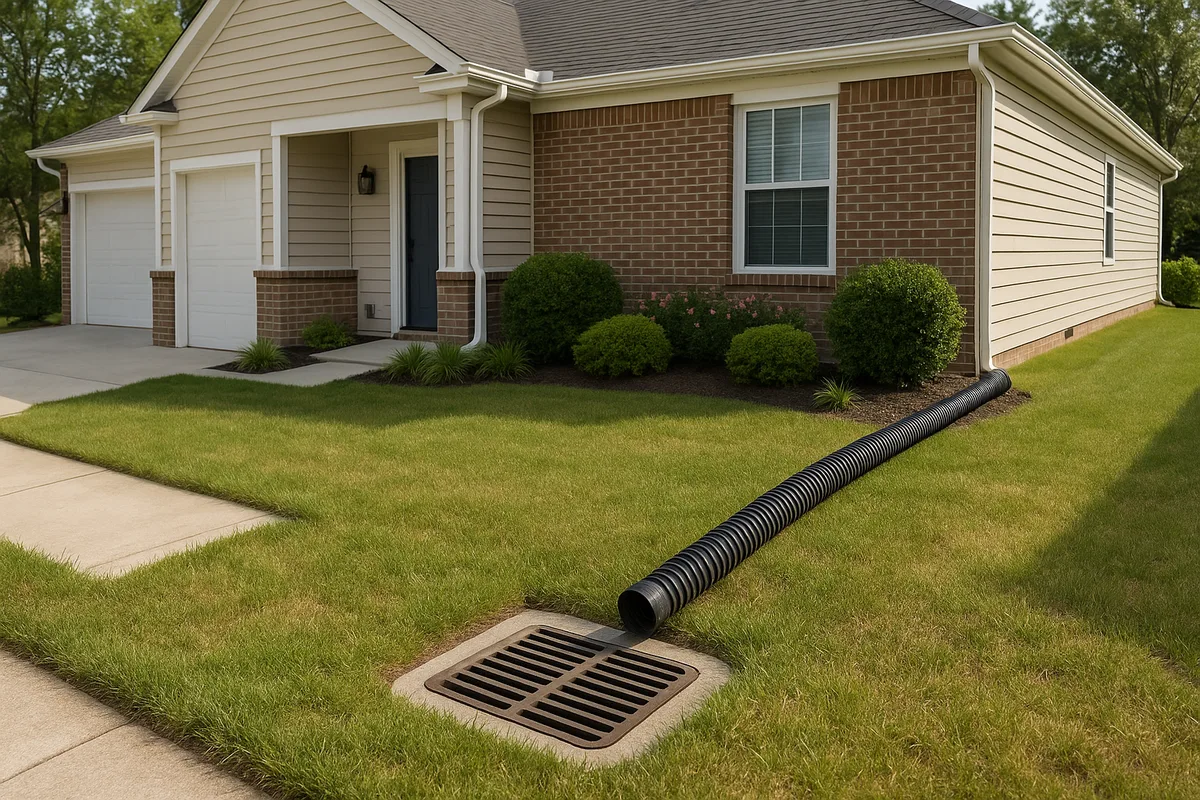
Downspout Redirection: If your neighbor's gutters are dumping roof runoff toward your property, asking them to add downspout extensions, redirect to a rain barrel, or connect to an underground pipe leading to the street can eliminate a major source of concentrated flow.
Shared Drainage Infrastructure: In some cases, the most cost-effective solution is a shared drainage system — a pipe or swale that runs along the property line and carries water from both properties to a common outlet. Shared systems require a written agreement (ideally recorded as a drainage easement) that addresses maintenance responsibilities, cost sharing, and access rights.
Grading Corrections: If your neighbor's regrading or construction caused the problem, asking them to restore proper drainage — or to install mitigation measures like a retaining wall with weep holes or a catch basin — is reasonable. If they obtained a permit for the work, the municipality may require them to correct any drainage deficiencies as a condition of final inspection.
What NOT to Do
Do not build a wall, berm, or dam along your property line that blocks natural drainage and causes water to back up onto your neighbor's property. In most jurisdictions, this can expose you to the same liability you're trying to avoid. Do not divert water onto a different neighbor's property — you'd simply be transferring the problem. And do not tamper with any municipal drainage infrastructure (storm drains, culverts, ditches) without permission.
Escalation: Code Enforcement, Mediation, and Legal Action
If your neighbor refuses to address the problem, or if the conversation goes nowhere, you have several escalation options. Each has costs and benefits, and the right approach depends on the severity of the problem, the value of the relationship, and the strength of your legal position.
Code Enforcement and Building Department Complaints
If your neighbor's construction or grading work was done without a permit, or if it violates local drainage codes, filing a complaint with your city or county code enforcement office can be an effective first escalation step. Code enforcement officers have the authority to inspect the property, issue violations, and require corrective action. This approach is particularly effective when the neighbor's work clearly violates a specific code provision — for example, directing roof drainage toward an adjacent property or exceeding maximum impervious surface coverage.
Be aware that code enforcement processes can be slow, and some jurisdictions are more responsive than others. Document your complaint in writing, include your evidence (photos, videos, dates), and follow up regularly.
HOA Dispute Resolution
If you live in a community with a homeowners' association, the HOA may have authority to enforce drainage-related provisions in the CC&Rs. Many HOAs require architectural review for landscaping and hardscaping changes, and some have specific drainage standards. Filing a complaint with the HOA's architectural review committee can trigger an investigation and enforcement action.
Mediation
Mediation is a structured negotiation process where a neutral third party helps you and your neighbor reach a voluntary agreement. It's faster, cheaper, and less adversarial than litigation, and it preserves the possibility of a continuing neighborly relationship. Many communities offer free or low-cost mediation services through community dispute resolution centers.
Mediation works best when both parties are willing to participate in good faith and when the dispute involves competing interests rather than clear-cut violations. A mediator can help identify creative solutions that neither party considered on their own.
Attorney Consultation and Demand Letters
If informal approaches fail, consulting a real estate attorney who handles drainage and property disputes is a wise investment. An attorney can evaluate the strength of your legal position under your state's specific drainage doctrine, review any applicable local ordinances, and send a formal demand letter to your neighbor. A well-crafted demand letter from an attorney often motivates action where personal requests have failed.
Litigation
Filing a lawsuit is the option of last resort, but it's sometimes necessary — particularly when the drainage problem is causing significant property damage and the neighbor refuses to take corrective action. Depending on the jurisdiction and the amount of damages, you may be able to file in small claims court (typically for claims under $5,000-$10,000, depending on the state) or you may need to file in civil court.
Common legal theories in drainage disputes include nuisance (private nuisance for interference with your use and enjoyment of your property), negligence (failure to exercise reasonable care in altering drainage), and trespass (unauthorized entry of water onto your property as a result of artificial conditions). Remedies can include monetary damages, injunctive relief (a court order requiring the neighbor to fix the problem), or both.
Litigation is expensive, time-consuming, and relationship-destroying. But when you're facing foundation damage, basement flooding, or a yard that's become unusable, it may be the only way to protect your investment.
Preventing Drainage Disputes Before They Start
Whether you're buying a new home, planning a renovation, or simply maintaining your property, there are proactive steps you can take to avoid becoming either the victim or the cause of a neighbor drainage dispute.
Before You Buy
During the home-buying process, pay close attention to drainage patterns during your property inspection. Walk the lot after a rain event if possible. Ask the seller about any history of drainage problems or disputes with neighbors. Review the grading plan from the original construction if available. Check whether the property is in a flood zone using FEMA's National Flood Map Service Center, and look at the topographic relationship between the lot and adjacent properties.
Before You Build or Remodel
Any time you're planning construction, hardscaping, or significant landscaping changes, consider the drainage implications for your property and your neighbors'. Hire a civil engineer or qualified landscape architect to prepare a drainage plan. Ensure that all roof drainage, surface runoff, and subsurface water is directed to appropriate outlets — not toward your neighbor's property line. Obtain all required permits, and make sure your contractor follows the approved grading plan.
Ongoing Maintenance
Drainage systems require maintenance to function properly. Clean gutters and downspouts at least twice a year. Inspect French drains, catch basins, and dry wells annually and clear any debris or sediment. Monitor your yard's grading over time — soil settles, erosion occurs, and what was once a proper slope can gradually flatten or reverse. Address small problems before they become big ones.
Know Your Property's Drainage Story
Understanding the topographic context of your property — where water comes from, where it goes, and what happens when the system is overwhelmed — is the foundation of effective drainage management. Low Point Labs specializes in exactly this kind of topographic drainage intelligence, helping homeowners understand the elevation data, flow patterns, and low points that define their property's relationship with water.
When Water From Your Neighbor's Yard Becomes a Bigger Problem
Sometimes what appears to be a simple neighbor-to-neighbor drainage issue is actually a symptom of a larger problem. Regional development, climate change, aging infrastructure, and rising water tables can all contribute to worsening drainage conditions that no single property owner can solve alone.
If you notice that drainage problems are getting worse over time, or that multiple properties in your neighborhood are experiencing similar issues, the problem may be systemic. New development upstream may be increasing runoff volumes beyond what the neighborhood's infrastructure was designed to handle. Municipal storm drains may be undersized, clogged, or failing. The water table may be rising due to changes in regional hydrology.
In these cases, working with your neighbors collectively — through your HOA, a neighborhood association, or direct engagement with your municipal public works department — may be more effective than trying to solve the problem property by property. Many municipalities have stormwater management programs that can assess neighborhood-wide drainage issues and implement solutions using public funds.
The Role of Climate and Changing Rainfall Patterns
It's worth noting that rainfall intensity is increasing in many parts of the United States. Storms that were once considered rare are becoming more frequent, and drainage systems designed for historical rainfall patterns may no longer be adequate. What worked for decades may suddenly fail when confronted with a storm that drops 2 inches of rain in 30 minutes instead of the 1-inch event the system was designed for.
This doesn't excuse your neighbor from liability for altering drainage patterns, but it does mean that both properties may need upgraded drainage infrastructure to handle current and future conditions. Thinking about drainage capacity in terms of future resilience — not just current adequacy — is increasingly important for every homeowner.
Key Takeaways for Dealing With Neighbor Drainage Runoff
Dealing with water from your neighbor's yard is rarely simple, but it's almost always solvable. The key is to approach the situation systematically: understand the hydrology, know your legal rights, document the problem thoroughly, communicate constructively, implement practical solutions, and escalate strategically when necessary.
Remember that neighbor drainage runoff disputes are governed by state-specific legal doctrines — the common enemy rule, the civil law rule, or the reasonable use rule — and that local ordinances and HOA rules add additional layers of regulation. Your rights and remedies depend on where you live, what your neighbor did (or didn't do), and whether the drainage pattern is natural or artificially altered.
Most importantly, remember that the goal is to solve the water problem, not to win a war with your neighbor. The best outcomes in drainage disputes are the ones where both parties end up with dry yards, intact foundations, and a relationship that can survive the next rainstorm.
See Drainage Intelligence in Practice
Talk with our team or request an invitation to the platform.
Frequently Asked Questions
Yes, in most states you can sue a neighbor whose actions artificially altered drainage patterns and caused water damage to your property. Common legal theories include private nuisance, negligence, and trespass. However, you generally cannot sue for natural runoff that follows the land's original topography — only for increased or redirected flow caused by your neighbor's modifications.
In most jurisdictions, yes. Concentrating roof runoff through gutters and downspouts and directing it toward a neighbor's property is considered an artificial alteration of natural drainage. Your neighbor has a responsibility to manage their roof drainage on their own property or direct it to an appropriate outlet like a street or storm drain.
Each property owner is generally responsible for managing drainage on their own land without unreasonably increasing runoff onto neighboring properties. If a shared drainage easement exists, the easement document typically specifies maintenance responsibilities. When disputes arise, the applicable state drainage doctrine (common enemy, civil law, or reasonable use) determines liability.
You can generally build a berm on your own property to redirect water, but you must be careful not to cause the water to back up and flood your neighbor's property or to redirect it onto a different neighbor's land. In states following the modified common enemy doctrine, your defensive measures must be reasonable and not cause unnecessary harm to others.
Costs vary widely depending on the solution. Downspout extensions and minor regrading may cost $200-$1,000. A French drain along a property line typically costs $2,000-$6,000. More extensive solutions like comprehensive regrading, dry wells, or engineered drainage systems can range from $3,000 to $15,000 or more. Getting multiple estimates from qualified drainage contractors is recommended.
A professional survey is highly recommended for significant drainage disputes. A topographic survey documents the exact elevations and drainage patterns on both properties, providing objective evidence of how water flows and whether grading has been altered. This evidence is valuable in code enforcement complaints, mediation, and litigation. Expect to pay $500-$2,000 depending on lot size and complexity.
Related Articles
Can You Legally Redirect Stormwater Off Your Property?
How Long Should Standing Water Last After Rain? A Drainage Guide