The Psychology of the $20k Yard Drainage Sale: From Guesswork to Proof
Every drainage contractor knows the feeling. You're standing in a homeowner's soggy backyard, pointing at saturated turf and explaining how water flows across the property. You can see the problem as clearly as daylight. But the homeowner — the person who has to write a check for $15,000, $20,000, or more — is squinting at the same yard and seeing... grass. Maybe a puddle. They nod politely, but behind their eyes, a question is forming: Is this really that serious?
This is the fundamental challenge of high-ticket drainage sales. You're not selling a visible product like a new kitchen or a fresh coat of paint. You're selling the correction of an invisible force — gravity acting on water across a three-dimensional landscape. And when the solution costs as much as a new car, "trust me" isn't a sales strategy. It's a liability.
The contractors who consistently close residential drainage sales at premium price points aren't necessarily better at installing French drains or grading swales. They're better at one thing: replacing guesswork with proof. They've learned that the psychology of a high-ticket purchase demands evidence, and they've built their entire sales process around delivering it.
This article breaks down the psychology behind why homeowners hesitate on major drainage investments, why traditional sales approaches fail at higher price points, and how a proof-based methodology transforms the contractor-homeowner dynamic from adversarial negotiation into collaborative problem-solving.
Why $20k Drainage Projects Are Psychologically Different
There's a reason most drainage contractors are comfortable quoting $3,000 jobs but stumble at $20,000 ones — and it's not just about scope. The psychology of the purchase changes fundamentally as the dollar amount climbs. Below roughly $5,000, homeowners operate in what behavioral economists call "low-consideration" territory. They see water in the basement, they call a contractor, they approve a fix. The pain is immediate, the solution is obvious, and the cost is within impulse-decision range for most homeowners.
Above $10,000, everything shifts. The homeowner enters "high-consideration" mode, where every dollar triggers a cascade of internal questions: Could we solve this cheaper? Is this contractor exaggerating the problem? What if we just live with it another year? Should we get more quotes? These aren't objections — they're the natural cognitive response to a purchase that represents a significant percentage of household savings. Research in consumer psychology consistently shows that as purchase price increases, the buyer's need for justification increases exponentially, not linearly.
The challenge specific to drainage is that the product is inherently abstract. A homeowner buying a $20,000 kitchen renovation can see the cabinets, touch the countertops, and browse inspiration photos. A homeowner buying a $20,000 drainage system is buying the absence of a future problem. They're paying to make water go somewhere they can't see, following paths they can't visualize, solving a problem that only manifests intermittently. This abstraction creates a trust gap that most sales processes aren't designed to bridge.
Compounding this challenge is the knowledge asymmetry between contractor and homeowner. The contractor has years of experience reading terrain, understanding soil behavior, and predicting water flow. The homeowner has none of this context. When a contractor says "your property has a reverse grade along the east foundation wall," the homeowner hears jargon. When they say "water is sheeting across your neighbor's lot onto yours," the homeowner thinks, but it looks flat to me. This gap between expert perception and homeowner perception is where most high-ticket drainage sales die.
The Three Trust Barriers That Kill High-Ticket Drainage Sales
Barrier 1: The Invisible Problem
The most fundamental barrier in residential drainage sales is that water problems are episodic. The homeowner calls you after a heavy rain when their yard is flooded or their crawl space is wet. But by the time you arrive for the estimate — often days later, on a sunny afternoon — the evidence has evaporated. Literally. You're now asking someone to spend $20,000 to solve a problem they can't currently see.
This creates what psychologists call the "present bias" — the tendency to discount future risks in favor of current comfort. Standing in a dry yard, the memory of last week's flooding fades quickly. The homeowner's internal calculus shifts from "I need to fix this" to "maybe it wasn't that bad." Every day between the flooding event and your proposal presentation, the urgency decays. Contractors who wait a week to deliver a quote are fighting against neuroscience.
Barrier 2: The Credibility Question
Homeowners are increasingly aware that contractors have a financial incentive to recommend work. This isn't cynicism — it's rational skepticism. When the person diagnosing the problem is also the person who profits from the solution, any reasonable person applies a credibility discount. The more expensive the proposed solution, the larger that discount becomes.
This is why the classic contractor sales approach — walk the yard, point at problems, quote a price — fails at higher price points. The homeowner can't independently verify anything the contractor is saying. They can't confirm that the grade is actually wrong, that the soil is actually clay, or that the water is actually flowing toward the foundation. They're being asked to take the contractor's word for it, and at $20,000, that's a lot of faith.
Barrier 3: The Comparison Trap
When homeowners get multiple bids — and on a $20,000 project, they almost always do — they inevitably receive wildly different proposals. One contractor recommends a French drain system for $8,000. Another proposes regrading plus a catch basin network for $14,000. A third presents a comprehensive plan including French drains, regrading, downspout rerouting, and a dry well system for $22,000. The homeowner has no framework to evaluate which approach is correct because they don't understand the underlying problem well enough to judge the proposed solutions.
Without objective data, the homeowner defaults to the only metric they can compare: price. The lowest bid wins not because it's the best solution, but because the homeowner lacks the information to justify paying more. This is devastating for contractors who do thorough work, because their comprehensive (and more expensive) approach looks like upselling rather than expertise.
Why Traditional Sales Tactics Backfire on Drainage Projects
The home improvement industry has developed a robust playbook of sales techniques — urgency closes, discount incentives, financing offers, testimonial books. These tactics work reasonably well for visible, desirable improvements like decks, patios, and bathroom remodels. They fail spectacularly for drainage work, and understanding why is critical for contractors who want to move upmarket.
Urgency tactics ("this price is only good for 48 hours") backfire because they amplify the homeowner's suspicion that they're being manipulated rather than helped. When someone is already uncertain about whether the problem is real, adding artificial time pressure doesn't create urgency — it creates distrust. The homeowner thinks, If this problem has been developing for years, why do I need to decide by Thursday?
Discount incentives ("I can take 10% off if you sign today") are equally counterproductive at high price points. On a $20,000 project, a 10% discount is $2,000 — a meaningful sum that immediately makes the homeowner wonder how inflated the original price was. If you can drop $2,000 that easily, were you overcharging? This erodes the price integrity that's essential for premium positioning.
Testimonials and before-and-after photos help but don't close the gap. They prove that other homeowners had drainage problems that you solved. They don't prove that this homeowner's specific property has the specific problem you're describing. Every property is unique in its topography, soil composition, and drainage patterns. Generic social proof doesn't address the specific trust gap on a specific property.
The fundamental issue is that traditional sales tactics are designed to overcome emotional resistance to a purchase the buyer already understands. Drainage sales require something different: they need to overcome informational resistance. The homeowner doesn't need to be persuaded — they need to be educated. And the education needs to come from objective data, not from the person selling the solution.
The Proof-Based Sales Framework: Replacing Opinions with Evidence
The contractors who consistently close high-ticket drainage projects have, whether consciously or not, adopted a proof-based sales framework. Instead of telling homeowners what's wrong, they show them. Instead of offering opinions, they present data. Instead of asking for trust, they provide evidence that makes trust unnecessary.
This framework rests on three pillars: objective measurement, visual communication, and third-party validation.
Objective Measurement
The single most powerful tool in a drainage contractor's sales arsenal is topographic data. When you can show a homeowner a precise elevation model of their property — with actual numbers showing that the grade falls 4 inches toward the foundation over 10 feet instead of rising — you've transformed a subjective opinion into an objective fact. The homeowner doesn't have to trust your eye; they can read the data themselves.
Modern elevation data and topographic analysis have made this kind of precision accessible. Resources like the USGS 3D Elevation Program (3DEP) provide high-resolution elevation data that can establish baseline topographic context for any property in the United States. When combined with property-specific survey data or detailed site measurements, this creates an evidence package that speaks for itself.
Soil data adds another layer of objective proof. The NRCS Web Soil Survey provides detailed soil composition and hydrologic soil group data for any location. When you can show a homeowner that their property sits on Group D soils (the lowest infiltration rate), the statement "your soil doesn't drain well" transforms from an opinion into a documented fact backed by federal soil science data.
The key psychological shift here is profound: you're no longer the source of the information. You're the interpreter. The data comes from objective, third-party sources. Your role becomes helping the homeowner understand what the data means for their specific situation — a position of expertise rather than salesmanship.
Visual Communication
Humans are visual processors. Research consistently shows that people retain 65% of information presented visually compared to only 10% of information presented verbally. In drainage sales, this means that a topographic map showing water flow arrows is worth more than 30 minutes of verbal explanation.
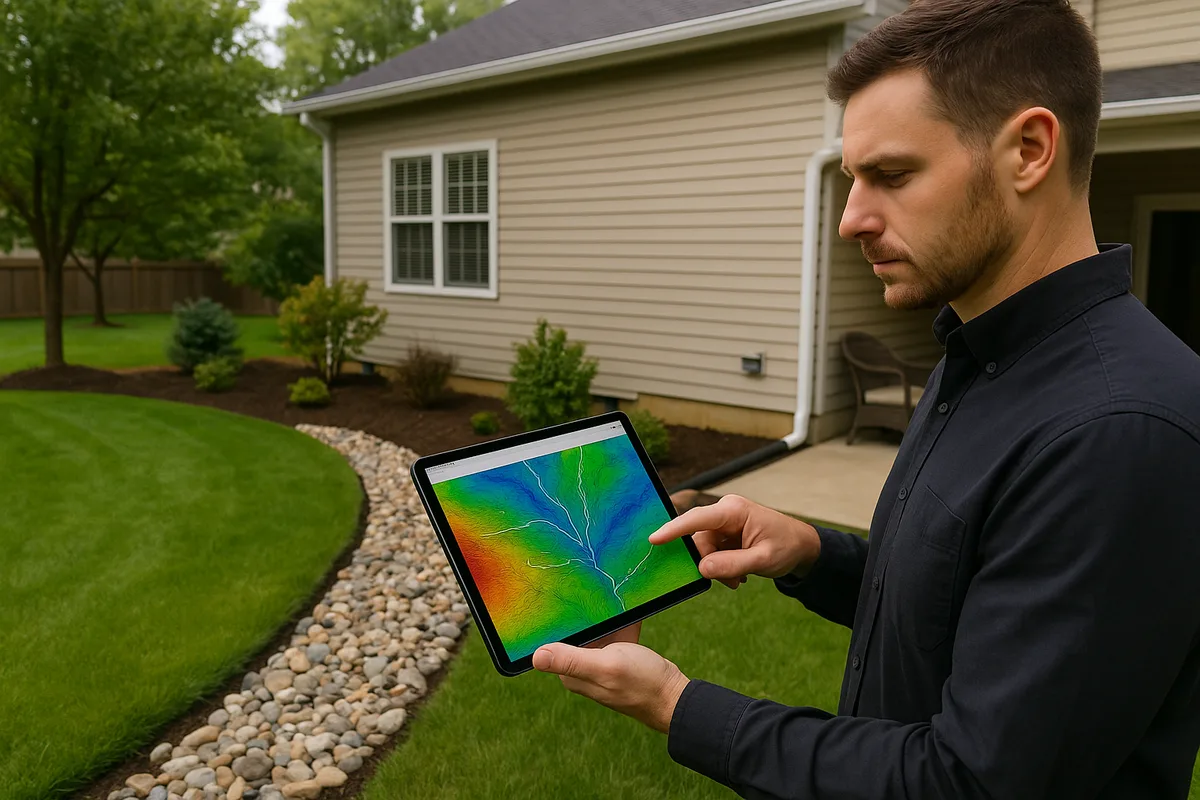
Effective visual communication for drainage sales includes several elements. Topographic contour maps of the property show elevation changes that are invisible to the naked eye. Color-coded drainage maps illustrate where water accumulates and which direction it flows. Cross-sectional diagrams show the relationship between surface grade, foundation depth, and water table. Overlay comparisons show the current drainage pattern versus the proposed corrected pattern.
These visuals serve a dual purpose. First, they help the homeowner understand the problem in a way that verbal explanation never could. When someone can see a red zone of water accumulation right against their foundation wall on a topographic map, the problem becomes real and urgent in a way that pointing at damp soil never achieves. Second, the visuals demonstrate the contractor's expertise and thoroughness. A contractor who shows up with detailed topographic analysis and engineered drainage plans signals a level of professionalism that justifies premium pricing.
Third-Party Validation
The most psychologically powerful element of proof-based selling is removing yourself as the sole authority. When the data comes from USGS elevation models, NRCS soil surveys, local rainfall intensity tables, and engineering calculations based on established formulas, the homeowner isn't relying on your credibility alone. They're seeing a convergence of independent data sources all pointing to the same conclusion.
This is why contractors who invest in drainage intelligence tools and topographic analysis close at higher rates and higher price points. They've effectively deputized federal agencies, soil scientists, and hydrological engineers as silent members of their sales team. When a homeowner's spouse asks, "Are you sure we need to spend this much?" the answer isn't "the contractor said so" — it's "the data shows it."
The Anatomy of a $20k Drainage Proposal That Closes
Let's walk through what a proof-based proposal looks like in practice, from initial contact through signed contract. This isn't theoretical — it's the methodology that top-performing drainage contractors use to close five-figure projects consistently.
Phase 1: The Discovery Visit (On-Site, 60-90 Minutes)
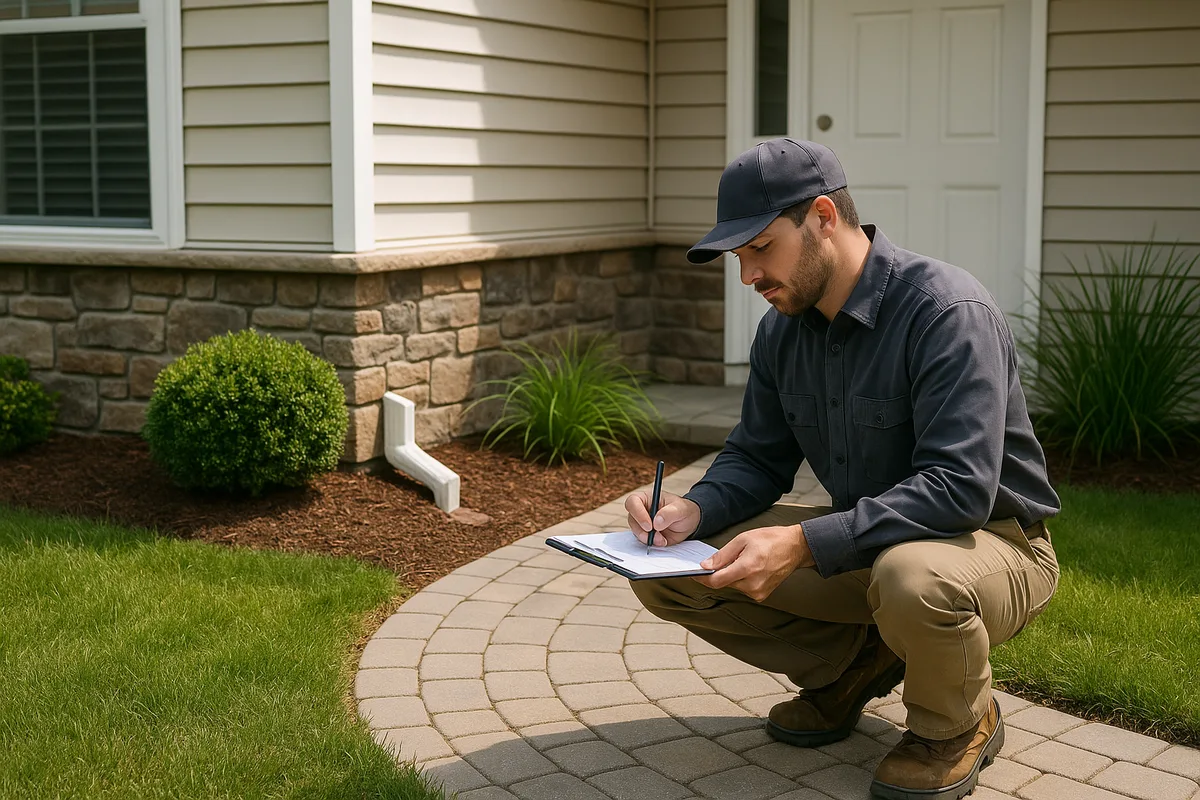
The first visit isn't a sales call — it's a diagnostic appointment. The contractor arrives with measurement tools, a camera, and a systematic process. They document visible symptoms (standing water, erosion channels, foundation staining, efflorescence on basement walls), take elevation readings at key points around the property, note downspout discharge locations, identify neighboring property contributions, and assess soil conditions.
Critically, the contractor does not quote a price during this visit. This is counterintuitive for many contractors who've been trained to "strike while the iron is hot." But for high-ticket projects, premature pricing is toxic. The homeowner hasn't yet been educated about the scope of the problem. Any number you throw out will feel arbitrary and will anchor the conversation to price rather than value. Instead, you explain that you need to analyze the data and prepare a comprehensive assessment. This positions you as thorough and methodical — exactly the qualities a homeowner wants in someone they're about to pay $20,000.
Phase 2: The Analysis (Off-Site, 2-4 Hours)
This is where proof-based contractors separate themselves from the competition. Using the data gathered on-site combined with topographic data, soil surveys, and local precipitation data, they build a complete picture of the property's drainage dynamics. They map existing drainage patterns, calculate runoff volumes for design storm events, identify all contributing factors, and design a solution that addresses root causes rather than symptoms.
The deliverable from this phase is a professional assessment document — not a one-page quote, but a multi-page analysis that includes topographic maps, drainage flow analysis, soil data, problem identification with supporting evidence, and a recommended solution with engineering rationale. This document becomes the centerpiece of the sales process.
Phase 3: The Presentation (On-Site or Virtual, 45-60 Minutes)
The proposal presentation is where the psychology of proof-based selling pays off. Instead of handing the homeowner a price and hoping for the best, you walk them through a narrative: here's what your property looks like topographically, here's where water goes when it rains, here's why it's going where it shouldn't, here's what that's doing to your foundation, and here's exactly how we fix it.
By the time you reach the price, the homeowner has been on a journey from ignorance to understanding. They now see the problem as clearly as you do — because you've given them the visual and analytical tools to see it. The price doesn't feel arbitrary; it feels proportional to the documented problem. And because the proposal is so thorough, the homeowner has a hard time comparing it to the one-page quote from the competitor who walked the yard for 15 minutes and said "you need French drains."
Phase 4: The Follow-Up (Strategic, Not Pushy)
Proof-based proposals have a built-in follow-up advantage: the assessment document itself. Because it's substantive and informative, homeowners actually read it. They share it with spouses, show it to neighbors, even take it to their home inspector for a second opinion. Every time someone reviews the document, it reinforces the legitimacy of the problem and the credibility of your solution.
Follow-up conversations become collaborative rather than adversarial. Instead of "have you made a decision yet?" the contractor asks "did you have any questions about the drainage analysis?" This reframes the interaction from sales pressure to professional consultation — a position that naturally leads to higher close rates and higher project values.
The ROI of Proof: Why This Approach Pays for Itself
Contractors often resist the proof-based approach because it requires more time per proposal. The analysis phase alone can take 2-4 hours, and the professional presentation adds another hour. Compared to the 30-minute walk-and-quote approach, this feels expensive.
But the math tells a different story. Consider two scenarios:
Contractor A (Traditional Approach): Quotes 20 drainage jobs per month. Average quote: $8,000. Close rate: 25%. Monthly revenue: $40,000. Time invested in estimates: 20 hours.
Contractor B (Proof-Based Approach): Quotes 10 drainage jobs per month (fewer, because each takes longer). Average quote: $18,000. Close rate: 50%. Monthly revenue: $90,000. Time invested in estimates: 50 hours.
Contractor B spends 2.5x more time on estimates but generates 2.25x more revenue. More importantly, they're doing fewer, larger projects — which means less mobilization, less overhead, and higher profit margins per job. The proof-based approach doesn't just close more sales; it attracts and justifies higher-value projects.
There's also a compounding referral effect. Homeowners who receive a thorough, data-driven assessment — even if they don't immediately buy — remember the experience. They refer friends and neighbors because the professionalism stood out. They become advocates for the contractor's expertise, generating warm leads that close at even higher rates.
Common Mistakes Contractors Make in High-Ticket Drainage Sales
Even contractors who understand the proof-based philosophy make tactical errors that undermine their effectiveness. Here are the most common pitfalls and how to avoid them.
Quoting Too Fast
The number one mistake is giving a price before the homeowner understands the problem. When you quote $20,000 in the first 15 minutes, the homeowner hears the number before they've heard the justification. The rest of the conversation becomes a defense of the price rather than an exploration of the problem. Discipline yourself to separate the diagnostic visit from the proposal presentation. The gap between them — during which you analyze data and prepare materials — builds anticipation and signals thoroughness.
Selling the Solution Instead of the Problem
Many contractors jump straight to "here's what we'll install" without adequately establishing "here's what's happening to your property." This is backwards. Homeowners don't buy French drains or catch basins or regrading — they buy dry basements, protected foundations, and usable yards. Spend 70% of your presentation on the problem (with supporting evidence) and 30% on the solution. When the problem is fully understood, the solution sells itself.
Overwhelming with Technical Jargon
Topographic data and drainage engineering involve technical concepts that are second nature to contractors but foreign to homeowners. Terms like "hydraulic conductivity," "time of concentration," and "return period storm event" create distance rather than connection. Translate everything into homeowner language: "Your soil absorbs water very slowly — about as fast as a parking lot" is more effective than "You have Group D hydrologic soils with a saturated hydraulic conductivity of 0.02 inches per hour."
Neglecting the Emotional Component
Proof-based selling doesn't mean emotionless selling. Data establishes credibility, but emotion drives decisions. After presenting the topographic analysis and drainage data, connect it to what the homeowner cares about: the safety of their foundation (their largest investment), the usability of their yard (where their kids play), their peace of mind during storms (no more 2 AM anxiety), and the long-term value of their property. The best presentations weave data and emotion together — the data gives the homeowner permission to act on the emotion they already feel.
Failing to Address the "Do Nothing" Option
Every high-ticket drainage proposal competes not just against other contractors but against inaction. The homeowner can always choose to do nothing — and for a $20,000 decision, that's a tempting default. Proof-based proposals should explicitly address the cost of inaction: progressive foundation damage (with typical repair costs of $10,000-$50,000), reduced property value, mold and moisture risks, and landscape degradation. When the data shows that the problem is active and progressive, "do nothing" becomes a conscious choice to accept escalating costs rather than a comfortable default.
Building Your Proof-Based Sales System
Transitioning from traditional quoting to proof-based selling doesn't happen overnight. It requires investment in tools, skills, and process. Here's a practical roadmap for contractors who want to make the shift.
Invest in topographic intelligence. The foundation of proof-based selling is accurate, property-specific drainage data. This means going beyond eyeball assessments to actual elevation measurement and topographic analysis. Services like Low Point Labs provide detailed drainage intelligence that gives contractors the objective data they need to build compelling, evidence-based proposals.
Develop your visual communication skills. Learn to create clear, compelling visual presentations of drainage data. This doesn't require graphic design expertise — it requires the ability to translate topographic data into maps, diagrams, and overlays that homeowners can immediately understand. Color-coded elevation maps, drainage flow arrows, and before-and-after comparisons are your most powerful sales tools.
Create a standardized assessment template. Develop a professional assessment document that you use for every project. This template should include property overview, topographic analysis, soil data, identified drainage issues with supporting evidence, recommended solution with engineering rationale, project scope and pricing, and maintenance recommendations. Consistency in your deliverable builds your brand and streamlines your process.
Practice your presentation narrative. The proof-based presentation follows a specific story arc: current conditions → identified problems → supporting evidence → consequences of inaction → recommended solution → investment required → expected outcomes. Practice this narrative until it flows naturally. The best drainage sales presentations feel like educational consultations, not pitches.
Track your metrics. Measure your close rate, average project value, and time-to-close before and after implementing the proof-based approach. The data will almost certainly show improvement across all three metrics, which reinforces the investment and helps you refine your process over time.
The Future of Residential Drainage Sales
The drainage industry is at an inflection point. Homeowners have more access to information than ever before. They research contractors online, read reviews, compare approaches, and arrive at consultations with baseline knowledge (and sometimes misinformation) about their drainage issues. The contractors who thrive in this environment will be the ones who meet informed homeowners with even better information.
The shift from guesswork to proof isn't just a sales tactic — it's a professional evolution. It elevates the drainage contractor from tradesperson to consultant, from vendor to trusted advisor. It justifies premium pricing not through persuasion but through demonstrated value. And it produces better outcomes for homeowners, who get solutions designed around actual data rather than assumptions.
High-ticket drainage sales will always require skill, confidence, and professionalism. But the era of closing $20,000 projects on charisma and a handshake is ending. The future belongs to contractors who can prove the problem, quantify the risk, and present solutions grounded in topographic reality.
Low Point Labs exists to give drainage professionals — and the homeowners they serve — the topographic intelligence that transforms drainage decisions from guesswork into confidence. Whether you're a contractor looking to elevate your proposals or a homeowner trying to understand what's really happening on your property, our drainage assessment tools provide the objective, data-driven foundation that high-stakes drainage decisions demand. Explore how Low Point Labs can bring proof to your next project.
See Drainage Intelligence in Practice
Talk with our team or request an invitation to the platform.
Frequently Asked Questions
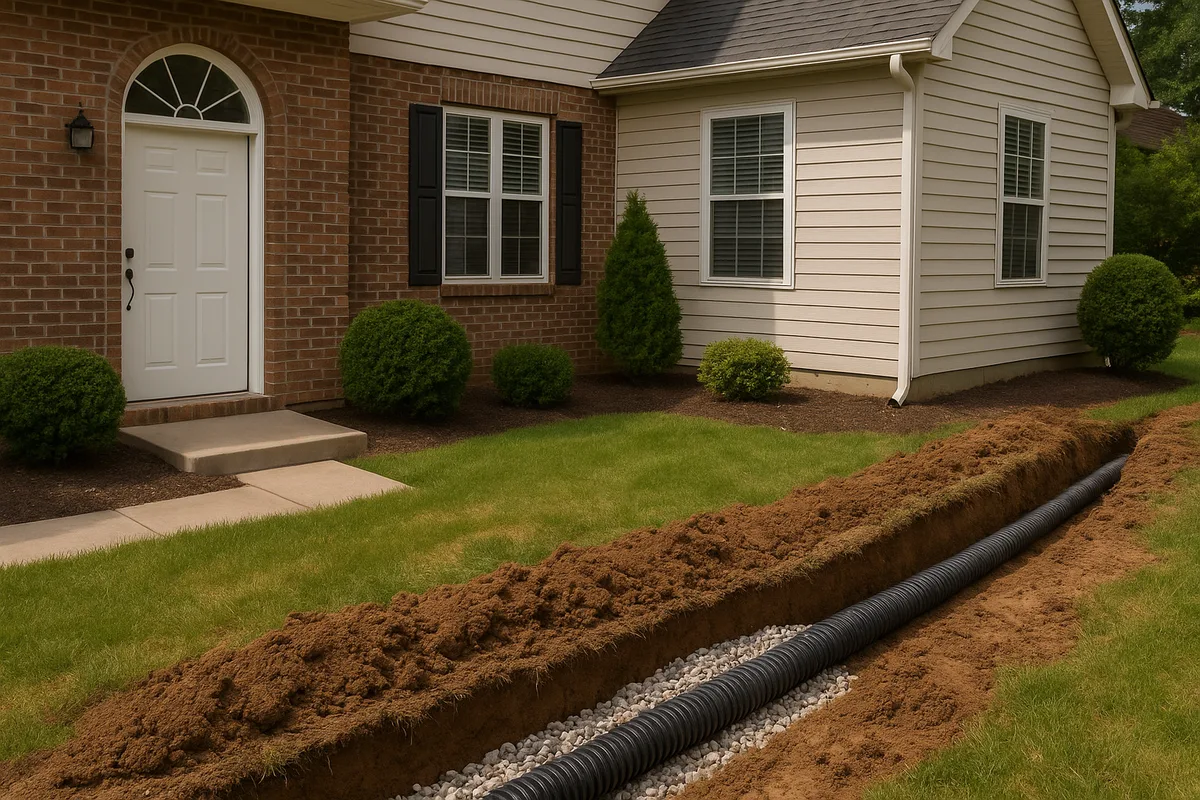
Large-scale drainage projects involve significant excavation, materials (perforated pipe, gravel, geotextile fabric, catch basins), grading work, and often multiple integrated systems like French drains, regrading, and downspout rerouting. The cost reflects the scope of earthwork required to permanently redirect water flow across an entire property, plus the engineering expertise needed to design an effective system.
Ask for objective evidence supporting their diagnosis. A credible contractor should be able to show you elevation data, soil analysis, or topographic maps that document the drainage problem — not just point at your yard and describe what they see. If a contractor can't provide data-backed evidence for a five-figure proposal, consider seeking a second opinion or an independent drainage assessment.
Yes, but focus on comparing diagnostic approaches rather than just prices. The lowest bid often reflects the least thorough assessment. Look for contractors who provide detailed analysis of your property's topography and drainage patterns, explain why they're recommending specific solutions, and present a comprehensive proposal rather than a one-line quote.
Proof-based drainage selling is an approach where contractors use objective data — topographic surveys, elevation models, soil analysis, and rainfall calculations — to document drainage problems rather than relying solely on visual observation and verbal explanation. This gives homeowners verifiable evidence to support their purchasing decision.
For a project in the $15,000-$25,000 range, expect a thorough contractor to spend 60-90 minutes on-site for the initial diagnostic visit, followed by several hours of off-site analysis before presenting a proposal. Be cautious of contractors who quote large projects after a brief walkthrough — the complexity of drainage systems demands careful assessment.
Drainage problems are progressive. Water that repeatedly saturates soil near your foundation causes hydrostatic pressure buildup, soil erosion, foundation settlement, and potential structural cracking. Foundation repairs typically cost $10,000 to $50,000 or more — often several times the cost of the drainage correction that would have prevented them. Mold remediation and landscape damage add further costs over time.
Related Articles

Tired of Losing Bids to Cheaper Competitors? The Data-Driven Pitch for Drainage Contractors
The Automated Watershed Map: The Tool Drainage Contractors Didn't Know They Needed