Rain Gardens: Do They Actually Solve Drainage Problems?
Rain gardens have become one of the most talked-about solutions in residential stormwater management. Municipalities promote them. Landscape designers love them. Environmental organizations champion them. But when you're standing in your backyard watching water pool against your foundation after every storm, the question is blunt: does a rain garden actually solve drainage problems, or is it just a pretty planting bed with good PR?
The answer is nuanced—and it matters, because choosing the wrong drainage solution can cost you thousands of dollars and years of frustration. A rain garden can be a powerful, effective tool for managing stormwater runoff on residential properties, but only when it's correctly sized, properly sited, and matched to the actual drainage problem you're facing. In this article, we'll cut through the hype and examine exactly how rain gardens work, what they can realistically handle, and when you need to look beyond them for a real fix.
What a Rain Garden Actually Is (And Isn't)
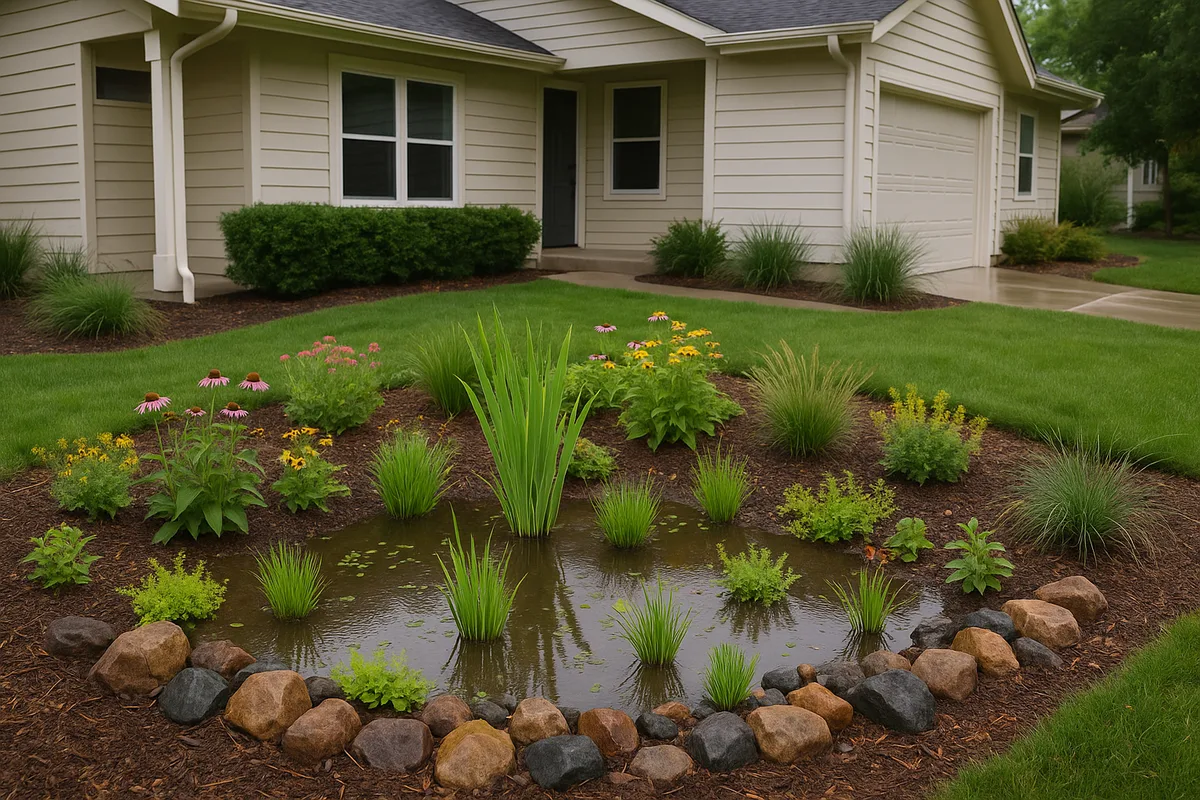
A rain garden is a shallow, planted depression designed to capture and infiltrate stormwater runoff from impervious surfaces like roofs, driveways, and walkways. It's a form of bioretention—a category of green infrastructure that uses engineered soil media and vegetation to temporarily store, filter, and absorb rainfall. The typical residential rain garden is 4 to 8 inches deep, filled with a specially blended soil mix (usually 50–60% sand, 20–30% compost, and 20–30% topsoil), and planted with native, water-tolerant perennials and grasses.
What a rain garden is not is a pond, a wetland, or a permanent water feature. A properly functioning rain garden should drain completely within 24 to 48 hours after a storm event. If water stands in it for longer than 72 hours, something is wrong—either the design, the soil media, or the underlying site conditions. This distinction is critical because the entire value proposition of a rain garden depends on its ability to cycle between wet and dry states. Standing water breeds mosquitoes, kills most rain garden plants, and indicates that the garden has exceeded its infiltration capacity.
It's also important to distinguish between a rain garden and a simple garden that gets rained on. A true rain garden has an engineered cross-section: an overflow mechanism, a ponding area, a prepared soil media layer (typically 18 to 30 inches deep), and often a gravel storage layer beneath. A flower bed in a low spot that collects water is not a rain garden—it's a drainage problem with plants in it.
The Hydrology Behind Rain Garden Drainage
To understand whether a rain garden can solve your drainage problem, you need to understand the basic hydrology at work. When rain falls on an impervious surface—your roof, for example—nearly 100% of that water becomes runoff. On a natural, undisturbed landscape with healthy soil, 40–50% of rainfall infiltrates into the ground, 10–20% becomes surface runoff, and the rest is absorbed by vegetation or evaporates. A rain garden attempts to restore that natural infiltration process for the runoff generated by your home and hardscape.
The key mechanism is infiltration rate—how quickly water moves through the rain garden's soil media and into the native soil below. The engineered soil mix in a well-designed rain garden typically infiltrates at 1 to 4 inches per hour. But the bottleneck is almost always the native soil underneath. If your property sits on sandy loam (Hydrologic Soil Group A), native infiltration rates might be 2+ inches per hour, and a rain garden will drain beautifully. If you're on heavy clay (Hydrologic Soil Group D), native infiltration might be 0.05 inches per hour, and the rain garden becomes a bathtub with no drain.
This is why soil testing is non-negotiable before installing a rain garden. A simple infiltration test—dig a hole 12 inches deep, fill it with water, let it drain, fill it again, and measure how fast the water level drops—tells you more about whether a rain garden will work on your property than any design guide or Pinterest board ever could. You can look up your soil's hydrologic group using the NRCS Web Soil Survey, which provides detailed soil maps for any address in the United States.
The Sizing Math That Most People Skip
Here's where rain garden drainage success or failure is usually determined: sizing. The general rule of thumb is that a rain garden should be 20–30% of the impervious area draining to it. For a 1,000-square-foot roof section, that means a rain garden of 200 to 300 square feet. Most homeowners dramatically undersize their rain gardens, creating something that looks nice but overflows in any storm larger than a light drizzle.
Let's run the numbers for a real scenario. Say you have a 1,200-square-foot roof draining to one downspout area, and you want to capture a 1-inch rainfall event (a common design standard). That's 1,200 square feet × 1 inch = 100 cubic feet of water, or about 748 gallons. If your rain garden is 6 inches deep (the ponding depth) and 250 square feet in area, it can temporarily store about 125 cubic feet of water in the ponding zone alone—plus additional storage in the soil media pore space below. That's a workable design for moderate storms.
But if you try to handle that same runoff with a 50-square-foot rain garden (which is what many homeowners actually install), you can only pond about 25 cubic feet at a time. The garden would need to infiltrate and re-fill nearly four times during a single 1-inch storm to handle the volume—and that's only possible if your soil drains extremely fast. For most soils, a 50-square-foot rain garden serving a 1,200-square-foot roof will overflow in the first 15 minutes of moderate rainfall.
Overflow Design: The Part Everyone Forgets
Every rain garden needs an overflow mechanism—a defined path for water to go when the garden reaches capacity. This might be a stabilized spillway, a connection to a storm drain, or a graded swale leading to a safe discharge point. Without overflow design, excess water goes wherever gravity takes it, which is often toward your foundation, your neighbor's yard, or across a sidewalk.
The overflow isn't a sign of failure; it's a sign of realistic design. No rain garden is designed to capture every drop from every storm. Most are engineered to handle the 1-year, 24-hour storm event (roughly 2 to 4 inches of rainfall depending on your region, which you can look up using NOAA Atlas 14). Larger storms will exceed the garden's capacity, and the overflow ensures that excess water is managed safely.
When Rain Gardens Genuinely Solve Drainage Problems
Rain gardens are legitimately effective solutions for specific categories of drainage problems. Understanding these scenarios helps you determine whether a rain garden is the right tool for your situation.
Roof Runoff Management
The single best application for a residential rain garden is capturing and infiltrating roof runoff from downspouts. Roof runoff is clean, predictable in volume (you know your roof area), and typically concentrated at a few discharge points. A properly sized rain garden located 10 or more feet from the foundation, positioned downslope from the downspout, and installed in soil with reasonable infiltration rates (0.5 inches per hour or better) can effectively eliminate the puddles, erosion, and soggy areas caused by concentrated roof discharge.
In this scenario, the rain garden is solving a real drainage problem: the conversion of rainfall into concentrated surface runoff by your roof. Before your house was built, that rainfall would have been distributed across the entire footprint and infiltrated naturally. The rain garden restores that function.
Driveway and Walkway Sheet Flow
Rain gardens positioned along the edges of driveways, patios, and walkways can effectively intercept sheet flow runoff from these impervious surfaces. Because the runoff is distributed along a linear edge rather than concentrated at a single point, a long, narrow rain garden (sometimes called a bioretention swale) can work very well. The key is ensuring the rain garden's length matches the edge of the impervious surface so that runoff enters the garden evenly rather than concentrating at one end.
Mild Low-Spot Ponding in Yards
If you have a shallow low spot in your yard where water ponds for a few hours after rain—not days—a rain garden can convert that nuisance into an asset. By excavating the low spot, installing engineered soil media, and planting appropriate species, you turn a soggy patch into a functional infiltration area. This works best when the ponding is caused by minor grading irregularities rather than a high water table or subsurface drainage obstruction.
Water Quality Improvement
Even when a rain garden doesn't completely eliminate a drainage issue, it provides significant water quality benefits. Research consistently shows that bioretention systems remove 80–90% of suspended sediments, 50–70% of nitrogen, 70–85% of phosphorus, and significant amounts of heavy metals and hydrocarbons from stormwater runoff. If your runoff currently flows untreated into a stream, lake, or storm drain, a rain garden provides measurable environmental benefit regardless of its drainage performance.
When Rain Gardens Don't Work (And What to Do Instead)
Here's where we get honest about the limitations of rain garden drainage. There are common residential drainage problems that rain gardens simply cannot solve, and attempting to use one in these situations leads to wasted money and ongoing frustration.
High Water Table Conditions
If the seasonal high water table on your property is within 2 feet of the ground surface, a rain garden will not function as designed. The engineered soil media needs to drain into the native soil below, and if that soil is already saturated, there's nowhere for the water to go. The rain garden becomes a permanent wet area rather than a cycling infiltration system. In high water table conditions, you typically need subsurface drainage (French drains, curtain drains) to intercept groundwater, or you need to raise the rain garden above grade and use an underdrain connected to a discharge point.
Heavy Clay Soils With Very Low Infiltration
Properties with Hydrologic Soil Group D soils (heavy clays with infiltration rates below 0.2 inches per hour) present a fundamental challenge for rain gardens. The rain garden's soil media will accept water quickly, but the native clay beneath acts as a near-impervious barrier. The result is a rain garden that fills up and stays full for days. Solutions include installing an underdrain (a perforated pipe at the bottom of the rain garden connected to a storm drain or daylight outlet), which converts the rain garden into more of a filtration system than an infiltration system. This works, but it changes the cost and complexity significantly.
Foundation Drainage Problems
If water is entering your basement or crawl space, a rain garden is not the solution—at least not the primary one. Foundation drainage problems require addressing the source directly: correcting negative grading (the ground should slope away from the foundation at a minimum of 5% for the first 10 feet), installing or repairing footing drains, waterproofing foundation walls, and ensuring downspouts discharge far from the foundation. A rain garden might be part of a comprehensive solution (as a receiving area for redirected downspouts), but it should never be the first line of defense against foundation water intrusion.
Large-Volume Concentrated Flow
If your drainage problem involves large volumes of water flowing across your property from uphill neighbors, street runoff, or natural drainage courses, a rain garden is almost certainly undersized for the job. These situations involve flow volumes that would require an enormous rain garden to manage—often larger than the available yard space. Concentrated flow problems typically require engineered solutions: swales, berms, French drains, catch basins, or in some cases, formal drainage easements and pipe systems.
Chronically Wet or Boggy Yards
A yard that stays wet for days after rain—or stays damp even during dry periods—usually has a subsurface drainage problem: a perched water table, an impervious soil layer (fragipan or hardpan), or subsurface water movement from an uphill source. A rain garden treats surface runoff; it does nothing to address water that's arriving from below or laterally through the soil profile. These conditions require subsurface investigation and typically subsurface drainage solutions.
How to Design a Rain Garden That Actually Works
If you've determined that a rain garden is appropriate for your drainage problem, here's how to design one that performs rather than just looks good.
Step 1: Assess Your Site
Before anything else, understand your site's topography, soil conditions, and drainage patterns. Identify where water comes from, where it goes, and where it causes problems. Measure the area of impervious surfaces draining to the proposed rain garden location. Perform a soil infiltration test at the proposed location. Check the depth to the water table (your county soil survey can provide seasonal high water table estimates). Ensure the proposed location is at least 10 feet from any building foundation, at least 25 feet from a septic system, and not over underground utilities.
Step 2: Size It Properly
Use the 20–30% rule as a starting point: the rain garden should be 20–30% of the contributing impervious area. Adjust upward for clay soils (closer to 30% or more) and downward for sandy soils (closer to 20%). The ponding depth should be 6 to 9 inches—deep enough to store meaningful volume but shallow enough to drain within 24 to 48 hours. The soil media layer should be 18 to 30 inches deep, with a composition of roughly 60% sand, 20% compost, and 20% topsoil by volume.
Step 3: Engineer the Cross-Section
A functional rain garden has distinct layers. From bottom to top: an optional gravel storage layer (6 to 12 inches of washed #57 stone), a geotextile fabric separation layer (to prevent soil migration into the gravel), the engineered soil media (18 to 30 inches), a thin mulch layer (2 to 3 inches of shredded hardwood—never use floating mulches like pine bark), and the plants. If your native soil infiltration rate is below 0.5 inches per hour, include a perforated underdrain pipe in the gravel layer, connected to a positive outlet.
Step 4: Design the Inlet and Overflow
The inlet—where water enters the rain garden—needs to be stabilized to prevent erosion. Use a small stone apron, a river rock channel, or a level spreader to dissipate the energy of incoming water. The overflow should be set at the maximum ponding depth (the top of the berm on the downhill side) and should direct excess water to a safe location: a lawn area, a swale, or a storm drain connection. The overflow elevation is critical—if it's too low, the garden never fills; if it's too high or nonexistent, water backs up in uncontrolled ways.
Step 5: Select the Right Plants
Rain garden plants must tolerate both periodic inundation and dry conditions between storms. Native species are strongly preferred because they develop deep root systems that enhance infiltration, require less maintenance, and support local pollinators and wildlife. Plant the center of the rain garden (the wettest zone) with species that tolerate standing water for 24 to 48 hours—sedges, blue flag iris, cardinal flower, and swamp milkweed are common choices depending on your region. Plant the edges and berm with species that prefer drier conditions—black-eyed Susan, little bluestem, and butterfly weed work well in many climates.
Step 6: Plan for Maintenance
A rain garden is not a "set it and forget it" installation. In the first two years, you'll need to water during dry spells to establish root systems, weed regularly (especially in spring), and inspect the inlet and overflow after every significant storm. After establishment, annual maintenance includes removing sediment buildup at the inlet, replacing mulch, cutting back dead plant material in late winter, and occasionally testing infiltration performance. If the rain garden starts draining more slowly over time, the soil media surface may need to be scarified (loosened) to break up a surface crust.
Rain Garden Costs vs. Alternative Drainage Solutions
Understanding the economics helps you make a rational decision about whether a rain garden is the right investment for your drainage problem.
A professionally installed residential rain garden typically costs $10 to $25 per square foot, depending on your region, soil conditions, and plant selections. For a 200-square-foot rain garden (appropriate for about 800 to 1,000 square feet of impervious area), expect to pay $2,000 to $5,000 installed. DIY installation can reduce this to $500 to $1,500 in materials, but requires significant labor—you're excavating and hauling several cubic yards of native soil and replacing it with engineered media.
For comparison, other common drainage solutions cost:
- French drain: $20 to $50 per linear foot installed. A 50-foot French drain runs $1,000 to $2,500.
- Downspout extensions and regrading: $500 to $2,000 for basic corrections around a home's perimeter.
- Catch basin and pipe system: $1,500 to $5,000 depending on length and complexity.
- Dry well: $1,000 to $3,000 per unit installed.
- Full yard regrading: $1,000 to $5,000+ depending on scope.
Many municipalities offer rebates or incentives for rain garden installation—sometimes $500 to $2,000—because rain gardens reduce the load on municipal stormwater systems. Check with your local stormwater authority or conservation district for available programs.
The important cost consideration isn't just installation—it's whether the solution actually fixes the problem. A $3,000 rain garden that doesn't address your actual drainage issue is infinitely more expensive than a $1,500 French drain that does.
The Verdict: Rain Gardens as Part of a Drainage Strategy
So, do rain gardens actually solve drainage problems? The honest answer is: sometimes yes, sometimes no, and almost always "it depends."
A rain garden is a highly effective tool for managing moderate volumes of surface runoff from impervious surfaces, provided it's correctly sized, installed in soil with adequate infiltration capacity, and equipped with a functional overflow. For the specific problem of "my downspouts dump water into my yard and it creates puddles and soggy areas," a well-designed rain garden is often the best solution available—better than a French drain (which just moves the water elsewhere), better than a dry well (which has no water quality benefit and no aesthetic value), and better than simply extending downspouts (which still concentrates runoff).
But a rain garden is not a universal drainage solution. It cannot fix foundation grading deficiencies, high water tables, subsurface flow problems, or large-volume concentrated runoff from off-site sources. Treating it as a cure-all leads to the common homeowner experience of installing a rain garden, watching it overflow or stay perpetually soggy, and concluding that rain gardens "don't work." They do work—but only for the problems they're designed to solve.
The best approach to residential rain garden drainage is to treat the rain garden as one component of a comprehensive drainage strategy. Start by understanding your property's topography and drainage patterns at a detailed level. Identify all sources of water—roof runoff, surface runoff, subsurface flow, off-site contributions. Address foundation-critical issues first with proper grading and subsurface drainage. Then use rain gardens to manage the remaining surface runoff in a way that's both functional and environmentally beneficial.
When you match the right solution to the right problem, rain gardens are genuinely excellent. They reduce runoff volume, improve water quality, recharge groundwater, support pollinators, add beauty to your landscape, and can increase property value. But they earn those benefits through engineering, not enthusiasm. Do the soil test. Run the sizing math. Design the overflow. Then plant your garden knowing it will actually work.
See Drainage Intelligence in Practice
Talk with our team or request an invitation to the platform.
Frequently Asked Questions
A rain garden should be approximately 20–30% of the impervious area draining to it. For a 1,000-square-foot roof section, plan for a rain garden of 200 to 300 square feet. Increase the size toward 30% or more if you have clay soils with slow infiltration rates.
A properly functioning rain garden should drain completely within 24 to 48 hours after a storm. If water stands for more than 72 hours, the garden may be undersized, the soil media may be compacted, or the native soil beneath may have insufficient infiltration capacity.
Yes, but you'll likely need to install a perforated underdrain pipe at the bottom of the rain garden connected to a storm drain or daylight outlet. Without an underdrain, clay soils (Hydrologic Soil Group D) drain too slowly for a standard rain garden to function properly.
A rain garden should be located at least 10 feet from any building foundation, and it should be positioned downslope so that water flows away from the structure, not toward it. Placing a rain garden too close to a foundation can worsen water intrusion problems.
A properly designed rain garden does not attract mosquitoes because it drains within 24 to 48 hours—mosquito larvae require 7 to 10 days of standing water to develop. If your rain garden holds water for more than 72 hours, it needs design corrections to improve drainage.
A rain garden alone will not fix a wet basement. Basement water intrusion is typically caused by improper grading, failed footing drains, or hydrostatic pressure from a high water table. These issues require direct solutions like regrading, waterproofing, and subsurface drainage. A rain garden can be part of a broader strategy by managing downspout runoff away from the foundation.
Related Articles
Dry Creek Beds for Drainage: When Function and Decoration Collide
Catch Basins vs. Channel Drains: Choosing the Right Surface Drainage