Soggy Lawn That Never Dries: 9 Common Causes and How to Fix Them
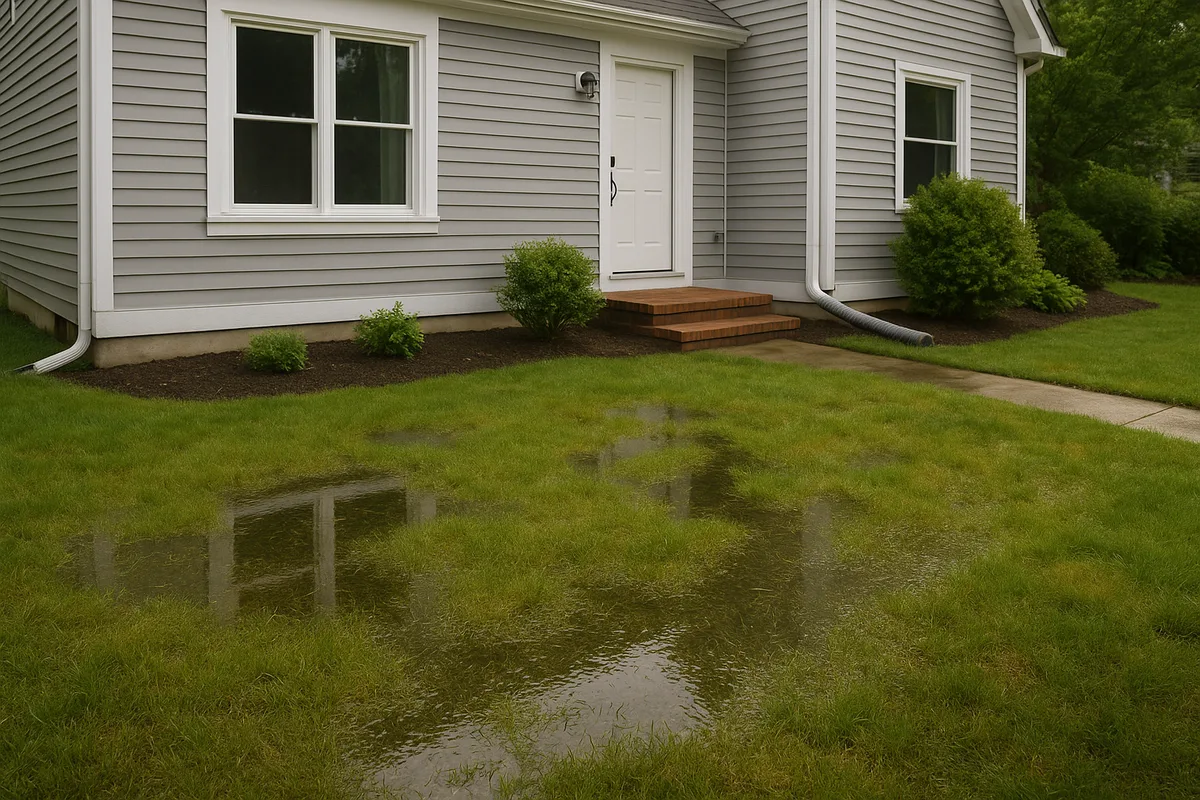
A soggy lawn that stays wet long after the rain stops is more than an inconvenience—it's a symptom of a drainage failure that can damage your foundation, kill your turf, breed mosquitoes, and steadily erode your property's value. If your lawn is always wet, the moisture has to be coming from somewhere and going nowhere. Understanding that equation is the first step toward a permanent fix.
At Low Point Labs, we analyze residential topography and drainage pathways every day. The pattern we see most often is a homeowner who has lived with a perpetually mushy yard for years, tried a few surface-level remedies, and assumed the problem was unsolvable. It almost never is. The key is diagnosing the specific cause—because a soggy lawn driven by compacted clay soil requires a completely different intervention than one caused by a high water table or an underground spring.
This guide walks through the nine most common reasons your lawn never dries, explains how to identify which one (or which combination) is affecting your property, and lays out the proven fixes for each.
Why a Soggy Lawn Is a Serious Problem
Before diving into causes and solutions, it's worth understanding why a persistently wet yard demands attention. Many homeowners treat a soggy lawn as a cosmetic nuisance—muddy shoes, squishy footsteps, patches of thin grass. But the consequences run much deeper.
Structural and Property Damage
Water that pools near your home's perimeter is the number-one threat to your foundation. Hydrostatic pressure from saturated soil pushes against basement walls, causing cracks, bowing, and water intrusion. Over time, even a slab-on-grade foundation can shift or settle unevenly when the surrounding soil cycles between saturated and dry conditions. The repair costs for foundation damage routinely run into five figures.
Beyond the foundation, a lawn that never dries accelerates deterioration of fences, retaining walls, decks, and any hardscape that sits in or near the saturated zone. Wood rots. Metal corrodes. Concrete spalls. These are slow-motion failures that homeowners often don't connect to the wet lawn 15 feet away.
Turf Health and Landscape Loss
Most common turfgrass species—Kentucky bluegrass, bermudagrass, tall fescue—need well-drained soil to thrive. Roots in waterlogged soil are starved of oxygen, making them vulnerable to root rot, fungal diseases like pythium blight and brown patch, and eventual die-off. If you notice your grass thinning, yellowing, or being overtaken by moss, sedge, or nutsedge, persistent moisture is almost certainly the driver. Sedge, in particular, is a reliable biological indicator of poor drainage: if it's growing in your lawn, your soil is staying wet far too long.
Health and Safety Hazards
Standing water and saturated soil are prime breeding habitat for mosquitoes, which need as little as one tablespoon of standing water to lay eggs. A soggy lawn also creates slip hazards, attracts nuisance wildlife (particularly moles, which follow earthworms into wet soil), and can contribute to mold and mildew issues inside the home if moisture migrates through the foundation.
Cause 1: Poor Grading and Negative Slope
The single most common reason for a lawn that is always wet is improper grading—the ground slopes toward your house or toward a low area in the yard instead of directing water away. The International Residential Code calls for a minimum of 6 inches of fall over the first 10 feet from the foundation, which translates to roughly a 5% slope. Many properties, especially older ones or those where landscaping has been modified over the years, fail to meet this standard.
How to Identify It
Walk your property after a moderate rain and observe where water flows and where it collects. If you see pooling against the foundation, along a fence line, or in the center of the yard, you likely have a grading deficiency. For a more precise diagnosis, you can use a laser level or even a long carpenter's level with a measured shim to check slope direction and magnitude.
Look for subtle clues as well: splash erosion patterns on siding, mineral staining on foundation walls, and soil that has settled around utility penetrations or backfilled areas are all indicators that surface water is flowing the wrong direction.
How to Fix It
Regrading is the most direct fix. For minor issues, adding topsoil and reshaping the grade to achieve a consistent 2–5% slope away from the house can be a weekend project. For larger properties or more severe negative slopes, you may need a landscape contractor with a skid steer to move significant volumes of soil.
When regrading, always:
- Establish a target elevation at the foundation and a target elevation at the drainage outlet (swale, storm drain, or property edge).
- Strip existing sod if you plan to reuse it, or plan for reseeding.
- Add fill in lifts of 2–3 inches, compacting lightly between lifts to prevent future settling.
- Maintain at least 6 inches of clearance between the soil surface and any wood siding or framing.
- Verify the finished grade with a level before replanting.
Cause 2: Compacted Soil
Soil compaction is the silent killer of lawn drainage. When soil particles are pressed tightly together—by foot traffic, vehicle traffic, construction equipment, or even years of mowing the same path—the pore spaces between particles collapse. Those pore spaces are what allow water to infiltrate and percolate downward. Without them, rainwater sits on the surface or in the top inch of soil with nowhere to go.
How to Identify It
The simplest test is the screwdriver test: push a long screwdriver into the soil by hand. In healthy, uncompacted soil, it should slide in with moderate pressure to a depth of 6 inches or more. If you can barely penetrate 2 inches, your soil is compacted. You can also look for visual signs: water that sheets across the surface during rain rather than soaking in, thin or bare patches of grass, and a hard, almost concrete-like feel when you walk on the lawn.
For a more scientific assessment, a soil penetrometer (available for under $50) gives you a quantitative reading in PSI. Readings above 300 PSI indicate compaction severe enough to restrict root growth and water infiltration.
How to Fix It
Core aeration is the standard remedy for compacted lawns. A core aerator pulls 2–3 inch plugs of soil out of the ground, creating channels for air, water, and roots. For moderately compacted soil, aerating once or twice per year (spring and fall for cool-season grasses, late spring for warm-season grasses) can restore infiltration within one to two seasons.
For severely compacted soil, aeration alone may not be enough. Consider:
- Deep tine aeration: Penetrates 8–12 inches, well below the depth of standard core aeration.
- Amending with organic matter: After aerating, topdress with 1/4 to 1/2 inch of compost. Over time, biological activity from earthworms and microorganisms will incorporate the organic matter deeper into the soil profile, improving structure and porosity.
- Reducing traffic: Identify and redirect foot traffic patterns. Install stepping stones or pathways in high-traffic zones.
Cause 3: Heavy Clay Soil
Clay soil is a drainage challenge in its own right, separate from (though often compounded by) compaction. Clay particles are extremely small—less than 0.002 mm in diameter—and they pack together tightly, creating a soil matrix with very low permeability. A pure clay soil might have a hydraulic conductivity of less than 0.01 inches per hour, meaning a single inch of rainfall could take over four days to percolate through just the top foot of soil.
If you live in a region with heavy clay soils—much of the Midwest, parts of the Southeast, and large swaths of Texas, for example—your soggy lawn may be a function of geology rather than anything you or a builder did wrong.
How to Identify It
Perform a simple ribbon test: take a moist handful of soil, squeeze it, and try to form a ribbon by pushing the soil between your thumb and forefinger. If you can form a ribbon longer than 2 inches that holds together without cracking, you have clay or clay-heavy soil. You can also check your property's soil type using the NRCS Web Soil Survey, which provides detailed soil maps and hydrologic soil group classifications for any address in the United States. Soils classified as Hydrologic Soil Group D have the highest runoff potential and the slowest infiltration rates.
How to Fix It
You can't replace the soil under your entire lawn, but you can improve it incrementally:
- Organic amendment: Incorporate 2–4 inches of compost into the top 6–8 inches of soil. This is most practical when establishing a new lawn or renovating an existing one. Organic matter improves clay soil structure by promoting aggregation—clumping clay particles into larger units with pore spaces between them.
- Gypsum application: Gypsum (calcium sulfate) can improve clay soil structure in sodic (high-sodium) soils by displacing sodium ions and promoting flocculation. However, it is not a universal fix—it has minimal effect on non-sodic clays. A soil test will tell you whether gypsum is appropriate for your situation.
- Strategic drainage installation: In many cases, the most cost-effective approach for heavy clay is to install subsurface drainage (French drains or curtain drains) to intercept and redirect water rather than trying to change the soil's fundamental character.
Cause 4: High Water Table
A high water table means the zone of saturated soil is close to the surface—sometimes within 12 to 24 inches. When the water table is that high, your lawn is essentially sitting on top of a shallow underground pool. Even without rain, moisture wicks upward through capillary action, keeping the root zone perpetually damp.
High water tables are common in coastal areas, river floodplains, and regions with flat topography and poor regional drainage. They can also be seasonally variable, rising in spring when snowmelt and rain recharge the aquifer and dropping in late summer.
How to Identify It
Dig a test hole 2–3 feet deep and observe it over 24–48 hours. If water seeps in and stabilizes at a level within 18 inches of the surface, you have a high water table. The water will be clear (not muddy) and will maintain a consistent level regardless of recent rainfall—that's the distinction between a high water table and surface water that hasn't drained yet.
You can also check local well logs and geological surveys, which often document water table depths in your area. Your county extension office or local USGS water resources office may have this data.
How to Fix It
You cannot lower the regional water table on your own, but you can manage its effects:
- Raised beds and berms: Elevating planting areas and portions of the lawn above the water table influence zone is one of the most reliable strategies. Adding 6–12 inches of well-draining topsoil over the existing grade effectively raises the root zone above the saturated zone.
- Subsurface drainage systems: A properly designed French drain or curtain drain installed at or just below the water table level can intercept groundwater and redirect it to a suitable outlet (storm drain, drainage ditch, or dry well). The drain must be installed with the correct slope (minimum 0.5–1% grade) and must discharge to a point lower than the drain inlet.
- Selecting water-tolerant species: If the water table is persistently within 12 inches of the surface, consider transitioning to grass species and landscape plants adapted to wet conditions. St. Augustinegrass, rough bluegrass (Poa trivialis), and certain fine fescues tolerate wetter soils better than most turf species.
Cause 5: Underground Springs or Seepage
Sometimes a soggy lawn has nothing to do with rainfall at all. Underground springs, seeps, and lateral water movement through permeable soil layers can deliver a constant supply of water to your yard from uphill sources. This is especially common on hillside properties or at the base of slopes where a permeable soil layer (sand or gravel) sits on top of an impermeable layer (clay or bedrock), forcing water to travel laterally until it emerges at the surface.
How to Identify It
The hallmark of a spring or seep is a soggy area that stays wet even during extended dry periods. If your neighbors' lawns dry out after a week without rain but yours remains spongy, subsurface water movement is a likely culprit. You may also notice:
- Iron-staining (orange or rust-colored deposits) on the soil surface or on nearby concrete
- A localized area of lush, green growth surrounded by drier turf
- Water emerging from a hillside or retaining wall
How to Fix It
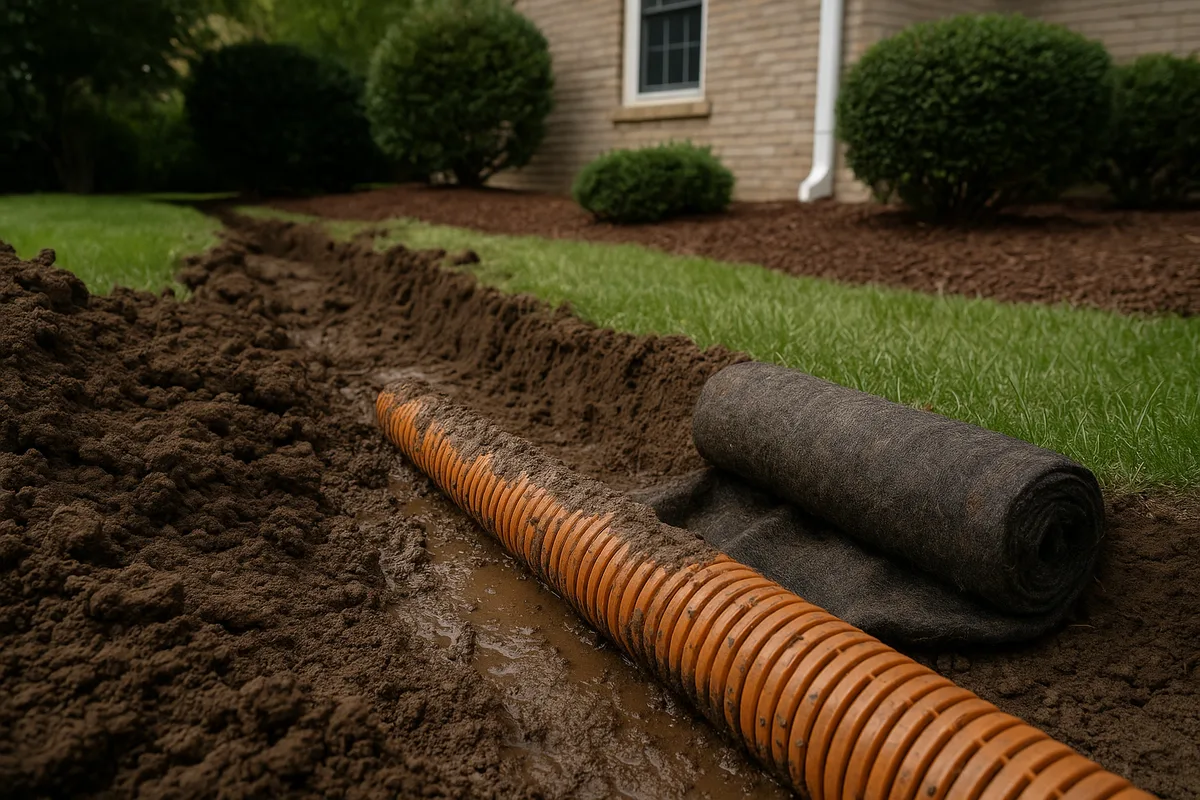
The standard fix for intercepting subsurface seepage is a curtain drain (also called an interceptor drain). This is a trench dug perpendicular to the direction of water flow, lined with filter fabric, filled with washed gravel, and fitted with a perforated pipe at the bottom. The trench intercepts the lateral water flow and redirects it to a controlled outlet.
Key design considerations:
- The trench must be deep enough to reach the impermeable layer or at least the depth of the water-bearing stratum.
- The perforated pipe should be placed with holes facing down (to collect water rising from below) and sloped at a minimum of 1% toward the outlet.
- Filter fabric must wrap the entire gravel column to prevent soil migration and clogging.
- The outlet must discharge to a legal and appropriate point—never onto a neighbor's property.
Cause 6: Thatch Buildup and Organic Layer Problems
Thatch is the layer of dead and living organic material that accumulates between the green grass blades and the soil surface. A thin layer of thatch (less than 1/2 inch) is actually beneficial—it insulates roots and reduces evaporation. But when thatch exceeds 3/4 inch, it becomes a sponge that holds water at the surface and prevents infiltration into the soil below.
Excessive thatch is common in lawns that are over-fertilized (particularly with synthetic nitrogen), over-watered, or maintained with grass species that produce heavy thatch (bermudagrass, Kentucky bluegrass, and zoysiagrass are notable thatch producers).
How to Identify It
Cut a small wedge out of your lawn with a knife and measure the brown, spongy layer between the green grass and the soil. If it's more than 3/4 inch thick, thatch is likely contributing to your drainage problem. You'll also notice that the lawn feels unusually soft and spongy underfoot—almost like walking on a mattress.
How to Fix It
- Dethatching: Use a power dethatcher (vertical mower) to mechanically remove the thatch layer. This is best done during active growing season so the lawn can recover quickly.
- Core aeration: Aeration punches through the thatch layer and introduces soil cores to the surface, which contain microorganisms that accelerate thatch decomposition.
- Topdressing with compost: A light application of compost after aeration introduces beneficial microbes that break down thatch naturally.
- Adjusting maintenance practices: Reduce nitrogen fertilization to recommended rates, mow at the proper height for your grass species, and avoid returning excessive clippings to the lawn.
Cause 7: Overwatering and Irrigation System Issues
It may seem obvious, but one of the most common causes of a soggy lawn is simply too much irrigation. Homeowners frequently set their sprinkler systems and forget about them, running the same schedule in September that they ran in July—even though evapotranspiration rates have dropped by 30–50%. The result is a lawn that receives far more water than it can use or absorb.
How to Identify It
If your lawn is wet in areas that correspond to sprinkler zones but dry in unirrigated areas, overwatering is the likely cause. Other signs include:
- Mushroom growth in the lawn (fungi thrive in consistently moist conditions)
- Algae or moss on the soil surface
- A sour or sulfurous smell when you dig into the soil (indicating anaerobic conditions)
- Runoff occurring during or shortly after irrigation cycles
Also inspect your irrigation system for malfunctions: stuck valves, broken heads, leaking pipes, and misaligned rotors can all deliver water to unintended areas or in excessive quantities.
How to Fix It
- Audit your irrigation system: Run each zone manually and inspect for leaks, broken heads, and coverage overlap. Measure output by placing catch cups (or tuna cans) across the zone and running for 15 minutes. Calculate the application rate and compare it to your soil's infiltration rate.
- Water deeply but infrequently: Most lawns need 1 to 1.5 inches of water per week, including rainfall. Apply this in 2–3 sessions rather than daily light watering. Deep, infrequent watering encourages deeper root growth and allows the soil surface to dry between cycles.
- Install a smart controller or rain sensor: A rain sensor is a $25 device that prevents your system from running during and after rainfall. A smart controller adjusts schedules based on weather data and can reduce water use by 20–40%.
- Adjust seasonally: Reduce irrigation frequency and duration as temperatures cool and days shorten. Many lawns in temperate climates need no supplemental irrigation from October through March.
Cause 8: Impervious Surface Runoff
Every square foot of roof, driveway, patio, and sidewalk on your property generates runoff that has to go somewhere. A typical 2,000-square-foot roof produces over 1,200 gallons of runoff from a single inch of rainfall. If that water is discharged onto your lawn via short downspout extensions—or worse, via downspouts that dump directly at the foundation—it can overwhelm your yard's ability to absorb it.
As properties add impervious surfaces over time (driveway expansions, patios, pool decks, accessory structures), the volume of runoff directed to the remaining pervious area increases proportionally. A lawn that drained adequately when the house was built may become a soggy mess after a patio addition doubles the runoff load.
How to Identify It
Trace the path of water from every impervious surface on your property. Where do your downspouts discharge? Where does driveway runoff flow? Does the neighbor's property sheet-drain onto yours? During a moderate rain, walk the property and observe. You'll often find that the soggy area in your lawn corresponds precisely to the discharge point of a major runoff source.
How to Fix It
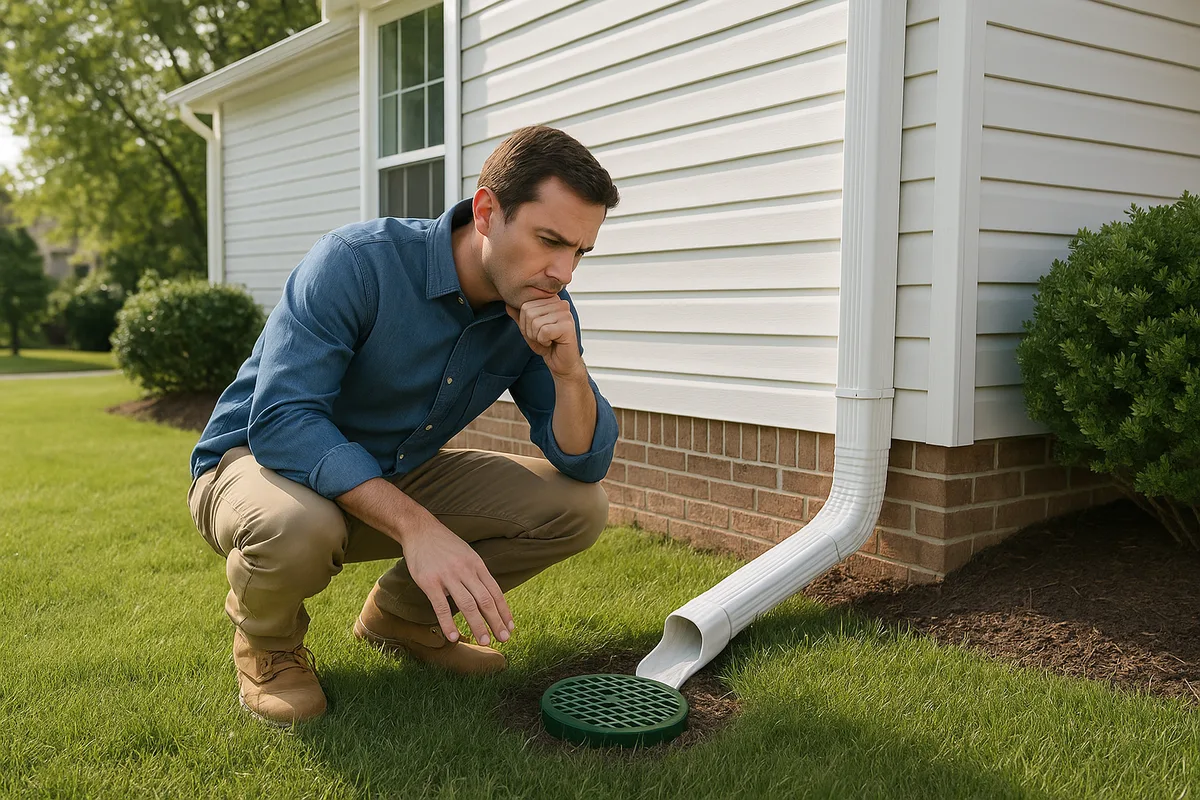
- Extend downspouts: Downspout extensions should carry roof runoff at least 6–10 feet from the foundation, ideally to a swale, rain garden, or drainage inlet. Buried downspout extensions with pop-up emitters are a clean, effective solution.
- Install a dry well: A dry well is an underground chamber (typically 30–50 gallons for residential use) filled with gravel or fitted with a proprietary plastic chamber that receives concentrated runoff and allows it to slowly infiltrate into the surrounding soil. Dry wells are ideal for managing roof runoff in areas where you can't easily direct water to a surface outlet.
- Build a rain garden: A rain garden is a shallow, planted depression designed to capture and infiltrate runoff. Properly sized (typically 10–20% of the contributing impervious area) and planted with deep-rooted native species, a rain garden can handle most residential runoff events while adding aesthetic value to the landscape.
- Install channel drains: Where driveway or patio runoff sheets onto the lawn, a channel drain (also called a trench drain) installed at the hardscape-lawn interface can intercept the flow and pipe it to an appropriate outlet.
Cause 9: Buried Debris and Construction Fill
This is the cause that homeowners almost never suspect, but contractors and inspectors see regularly. During construction, builders sometimes bury stumps, lumber scraps, concrete chunks, and other debris in the yard before final grading. As organic debris decomposes, it creates voids and settling. Inorganic debris like concrete and rock creates impermeable barriers that trap water in pockets.
Similarly, if the builder backfilled foundation excavations with the excavated clay subsoil rather than importing clean structural fill, that backfill zone often becomes a water-retaining trough around the foundation—exactly where you don't want moisture to accumulate.
How to Identify It
Buried debris problems often manifest as localized soggy spots that don't correspond to any obvious topographic low point. The ground may feel unusually soft or spongy in one area and firm everywhere else. In some cases, you'll see sinkholes or depressions forming as buried organic material decomposes. Probing with a metal rod can sometimes reveal buried obstructions.
How to Fix It
Unfortunately, the fix for buried debris usually involves excavation. You need to remove the debris, replace it with clean, compactable fill, and regrade the area. For buried stumps, which can take decades to fully decompose, the sooner you remove them, the less settling and drainage disruption you'll experience.
If excavation isn't practical (for example, if the debris is under a mature landscape), you can sometimes work around it by installing drainage around the perimeter of the affected area to intercept water before it reaches the debris zone.
A Systematic Approach to Diagnosing Your Soggy Lawn
Most soggy lawns involve more than one contributing cause. A property might have clay soil (Cause 3) combined with poor grading (Cause 1) and excessive downspout discharge (Cause 8). Fixing only one of the three will produce disappointing results. Here's a systematic diagnostic approach:
Step 1: Observe During and After Rain
Spend 30 minutes walking your property during a moderate rainfall. Note where water flows, where it pools, and how quickly it recedes after the rain stops. Take photos and videos. This observational data is more valuable than any test you can run.
Step 2: Check Your Soil
Perform the screwdriver test for compaction, the ribbon test for clay content, and dig a test hole for water table depth. These three simple tests will rule in or rule out three major causes in under an hour.
Step 3: Map Your Drainage Pathways
Trace every source of water on your property: downspouts, irrigation zones, neighbor runoff, and natural overland flow paths. Understanding where water enters your lawn and where it's supposed to exit is essential for designing an effective fix.
Step 4: Prioritize Fixes by Impact
Address grading issues first—they're the most fundamental and affect everything downstream. Then tackle soil improvements (aeration, amendment). Finally, install drainage infrastructure (French drains, dry wells, rain gardens) to handle whatever volume the soil can't absorb on its own.
When to Call a Professional
Many soggy lawn problems can be diagnosed and fixed by a capable homeowner. Regrading a small area, aerating, extending downspouts, and adjusting irrigation are all DIY-friendly projects. However, certain situations warrant professional help:
- Persistent water against the foundation: This is a structural risk that justifies hiring a drainage contractor or civil engineer to design a proper solution.
- Suspected underground spring: Locating and intercepting subsurface water flow requires experience and sometimes specialized equipment.
- Large-scale grading work: Moving more than a few cubic yards of soil usually requires equipment and expertise beyond what most homeowners possess.
- Permit requirements: Many municipalities require grading permits for earthwork that changes drainage patterns, especially if the work could affect neighboring properties. Check with your local building department before starting any significant grading project.
A qualified drainage contractor will typically start with a topographic survey of your property, identify the low points and flow paths, and design a system that moves water from where it collects to where it can safely discharge. The investment in professional design often pays for itself by avoiding the trial-and-error approach that leads to multiple failed DIY attempts.
Long-Term Maintenance for a Dry, Healthy Lawn
Fixing a soggy lawn isn't a one-time event—it requires ongoing maintenance to keep drainage systems functioning and soil conditions favorable.
Annual Tasks
- Aerate in fall (cool-season grasses) or late spring (warm-season grasses) to counteract compaction from mowing and foot traffic.
- Inspect and clean drainage outlets: French drain outlets, dry well inlets, and pop-up emitters can clog with sediment and debris. Check them at least twice a year.
- Audit irrigation: Adjust schedules seasonally and inspect for leaks and malfunctions.
- Check gutters and downspouts: Clogged gutters cause overflow that bypasses your downspout extensions and dumps water at the foundation.
Periodic Tasks
- Topdress with compost every 1–2 years to maintain soil organic matter and biological activity.
- Re-evaluate grading every 3–5 years or after any significant landscaping changes. Soil settles, mulch beds build up, and grading can change incrementally over time.
- Monitor for new soggy spots: Changes in neighboring properties (new construction, regrading, tree removal) can alter drainage patterns and create new problems on your property.
A soggy lawn is a solvable problem. The key is accurate diagnosis, targeted intervention, and consistent maintenance. Whether your yard is battling clay soil, a high water table, poor grading, or all three, the right combination of grading corrections, soil improvements, and drainage infrastructure will get your lawn dry and keep it that way. The worst thing you can do is nothing—because water problems only get worse with time.
See Drainage Intelligence in Practice
Talk with our team or request an invitation to the platform.
Frequently Asked Questions
A lawn that stays wet without recent rainfall typically indicates a high water table, an underground spring or seep, or a leaking irrigation system. Dig a test hole 2–3 feet deep and check if water seeps in from below—if it does, you're dealing with groundwater rather than surface drainage issues.
Improve clay soil drainage by core aerating annually, topdressing with compost to promote soil aggregation, and installing subsurface French drains to intercept and redirect water. For severe cases, adding 2–4 inches of compost worked into the top 6–8 inches of soil during a lawn renovation can significantly improve infiltration rates.
Adding sand to clay soil is generally not recommended. Sand mixed with clay in the wrong proportions can create a concrete-like mixture that drains worse than pure clay. Compost and organic matter are far more effective at improving clay soil structure and drainage.
Costs vary widely depending on the cause and fix. DIY aeration and downspout extensions may cost $100–$300. Professional French drain installation typically runs $25–$50 per linear foot. Full yard regrading by a contractor can range from $1,000 to $5,000 or more depending on the scope.
Yes. Saturated soil around your foundation creates hydrostatic pressure that can cause basement wall cracks, bowing, and water intrusion. Persistent moisture also leads to uneven settling and can compromise the structural integrity of both basement and slab foundations over time.
St. Augustinegrass, rough bluegrass (Poa trivialis), and certain fine fescues tolerate wet conditions better than most turf species. For extremely wet areas, consider transitioning to moisture-loving ground covers or installing a rain garden with native wetland plants instead of fighting to maintain traditional turf.
Related Articles
Why French Drains Fail: Clogging, Sediment, and Bad Installs
How to Evaluate a Property After a Storm Event: A Complete Guide