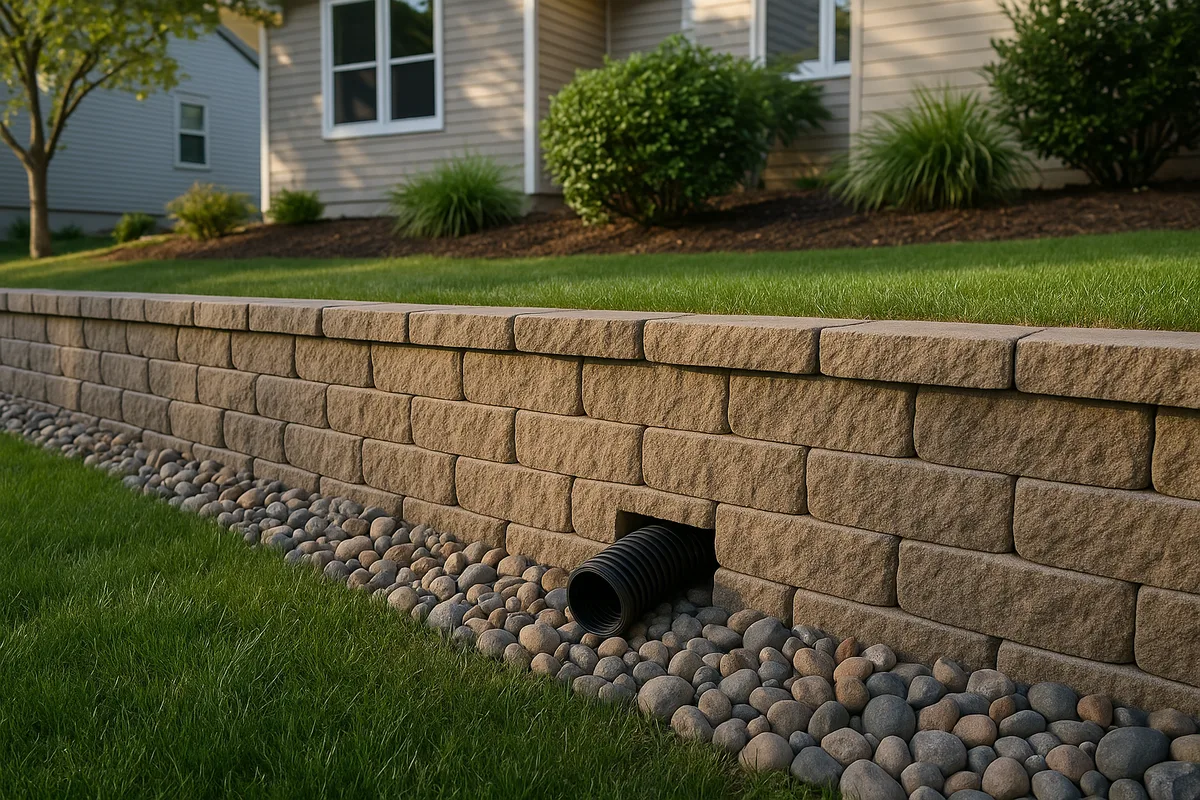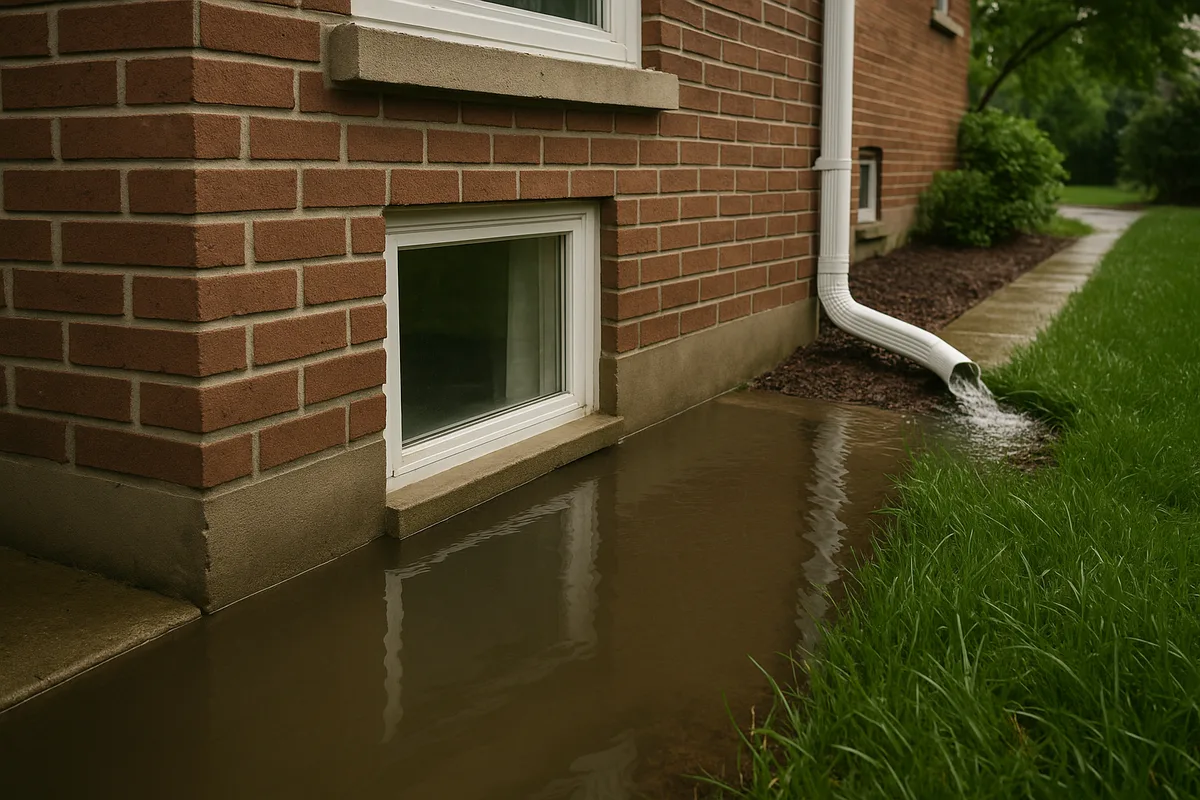
Water in Your Basement After Rain: How to Diagnose the Source
Finding water in your basement after rain is one of the most unsettling experiences for any homeowner. It can ruin stored belongings, damage finishes, promote mold growth, and signal deeper structural problems that worsen over time. Yet the most common mistake homeowners make isn't ignoring the water — it's treating the symptom instead of diagnosing the source. A tube of hydraulic cement or a coat of waterproofing paint might stop a visible trickle, but if the underlying cause is poor lot grading or a failed perimeter drain, the water will find another path.
This guide walks you through a systematic diagnostic process — the same logic professional inspectors and drainage engineers use — to determine exactly why your basement leaks when it rains and what it takes to fix the root cause permanently.
Understanding How Water Reaches Your Basement
Before you can diagnose the source, you need to understand the three fundamental mechanisms by which water enters a below-grade space. Every case of basement water intrusion falls into one or a combination of these categories: surface water intrusion, lateral subsurface flow, and hydrostatic pressure from below.
Surface water intrusion occurs when rainwater flows across the ground surface and enters the basement through above-grade openings — window wells, stairwell drains, the joint where the sill plate meets the foundation wall, or even through the basement door itself. This is the most common and, fortunately, the most correctable cause of water in your basement after rain.
Lateral subsurface flow happens when water saturates the soil adjacent to your foundation wall and is pushed horizontally through cracks, porous concrete, mortar joints, or pipe penetrations. The driving force is the difference in hydraulic head between the saturated soil outside and the dry interior. Even a hairline crack in a poured concrete wall can admit a surprising volume of water when the surrounding soil is fully saturated.
Hydrostatic pressure from below is the most serious mechanism. When the water table rises — temporarily during heavy rain or seasonally — it exerts upward pressure on the basement slab. Water can push through slab cracks, the cold joint where the slab meets the footing, or even permeate through the concrete itself if no vapor barrier was installed beneath the slab. Hydrostatic pressure problems are the hardest to solve because you're fighting gravity in reverse.
Understanding which mechanism is at work — or which combination — determines the correct fix. A surface drainage problem doesn't need an interior French drain. A hydrostatic pressure problem won't be solved by regrading your yard. Diagnosis first, solution second.
Step One: Observe the Timing and Location of Water Entry
The single most valuable diagnostic tool is careful observation. When you find water in your basement after rain, resist the urge to clean it up immediately. Instead, document everything.
Timing Relative to Rainfall
Note how quickly water appears after rain begins. If water shows up during or within minutes of a heavy downpour, you're almost certainly dealing with surface water intrusion. The speed of onset tells you the water is traveling a short, direct path — across the ground surface and in through an opening. If water doesn't appear until 12 to 48 hours after rain, the mechanism is more likely lateral subsurface flow or a rising water table. The delay represents the time it takes for water to percolate through soil and build up pressure against the foundation.
Also pay attention to whether water appears only during intense storms or after prolonged gentle rain. Intense storms overwhelm surface drainage — gutters, swales, and grading — and point to capacity problems in those systems. Prolonged rain saturates the soil column and raises the water table, which points to subsurface issues.
Location on the Walls and Floor
Map exactly where water appears. Use painter's tape and a marker to label wet spots with the date and time. Over two or three rain events, patterns will emerge.
- Water high on the wall (above grade or near the top of the foundation) strongly suggests surface water intrusion. Check for window wells, hose bibs, or utility penetrations at that height.
- Water at the base of the wall, particularly along the cold joint where the wall meets the floor slab, is the hallmark of lateral subsurface pressure or hydrostatic uplift. The cold joint is the weakest point in most basement construction.
- Water in the center of the floor or coming up through slab cracks indicates hydrostatic pressure from a high water table.
- Water on one wall only suggests a localized problem — a downspout discharging against that wall, negative grading on that side, or a crack in that specific section.
Volume and Flow Characteristics
A damp wall with efflorescence (white mineral deposits) tells a different story than a stream of water running across the floor. Efflorescence means water is migrating through the concrete slowly and evaporating on the interior surface, leaving minerals behind. This is chronic low-volume moisture, often from soil contact without adequate waterproofing. Active flow — visible rivulets, puddles that grow, or water spurting from a crack — indicates significant pressure and a more urgent problem.
Step Two: Inspect the Exterior Drainage System
Once you've characterized the water intrusion from inside, move outside. The majority of basement water problems originate at the surface, and the majority of surface problems come down to two things: gutters and grading.
Gutters and Downspouts
A single 1,000-square-foot roof section can shed over 600 gallons of water during a one-inch rainstorm. If that water isn't captured and directed far from the foundation, it concentrates exactly where you don't want it — in the soil immediately adjacent to your basement walls.
Inspect every element of the gutter system:
- Gutters themselves: Are they clogged with debris? Sagging or pulling away from the fascia? Overflowing during rain? A gutter that overflows is worse than no gutter at all because it concentrates roof runoff into a narrow band along the foundation.
- Downspouts: Are they connected and sealed? A disconnected downspout section can dump hundreds of gallons per storm directly against the foundation wall.
- Downspout discharge points: This is the most critical element. Downspouts should discharge at least 4 to 6 feet from the foundation, and ideally 10 feet or more. Extensions, splash blocks, or buried discharge pipes should carry water to a point where the grade slopes away. If your downspouts terminate right at the foundation wall, you've likely found a major contributor to your problem.
You can use data from NOAA Atlas 14 to look up the rainfall intensity for your specific location and understand the volume of water your roof and drainage system must handle during design storms.
Lot Grading and Surface Drainage
The ground around your foundation should slope away from the house at a minimum grade of 5% — meaning a 6-inch drop over the first 10 feet. This is the standard recommended by building codes and home inspection standards alike. Walk the perimeter of your home with a level or simply observe the terrain with a critical eye.
Common grading failures include:
- Settled backfill: When a home is built, the excavated trench around the foundation is backfilled with loose soil. Over years, this backfill settles, creating a trough that funnels water directly toward the foundation. This is one of the most common reasons a basement leaks when it rains, especially in homes 3 to 15 years old.
- Negative grading from landscaping: Mulch beds, raised garden borders, and added topsoil can inadvertently reverse the grade, directing water toward the house instead of away.
- Hardscape pitched toward the foundation: Patios, sidewalks, and driveways that have settled or were installed with incorrect slope can channel enormous volumes of water to the foundation.
- Neighboring property runoff: If an adjacent lot is graded to drain toward your home, their stormwater becomes your basement water.
During a rainstorm, go outside with an umbrella and watch where water flows. You'll learn more in 15 minutes of observation than from any amount of dry-weather inspection.
Step Three: Evaluate the Foundation for Entry Points
With exterior drainage assessed, turn your attention to the foundation itself. Even with perfect grading and gutters, a compromised foundation can admit water.
Cracks in Poured Concrete Walls
Poured concrete foundations develop cracks — it's a matter of when, not if. Shrinkage cracks appear as the concrete cures, typically within the first few years. Settlement cracks develop as the soil beneath the footing shifts. Most cracks are cosmetic and structurally insignificant, but even a hairline crack can be a water entry point when the soil outside is saturated.
Vertical cracks are the most common and usually result from concrete shrinkage. They're typically not structural concerns but are frequent water entry points. Horizontal cracks, on the other hand, can indicate lateral soil pressure against the wall and may represent a structural issue that requires engineering evaluation.
To confirm a crack is the water entry point, examine it during or immediately after rain. Active leaks through cracks are usually obvious — you'll see water weeping or streaming from the crack line. In between rains, look for staining, mineral deposits, or damp streaks that trace the crack's path.
Block Foundation Walls
Concrete block (CMU) foundations present a different challenge. The hollow cores of the blocks can fill with water that enters through deteriorated mortar joints, cracks, or the top of the wall. Once inside the cores, water can travel vertically and horizontally before emerging at a point far from where it entered. This makes diagnosis more difficult — the wet spot on the inside doesn't necessarily correspond to the entry point on the outside.
If you have a block foundation and see water seeping from mortar joints at the base of the wall, the water may be entering much higher up and flowing down through the block cores. Check the top of the wall where it meets the sill plate, and check any above-grade mortar joints for deterioration.
Pipe and Utility Penetrations
Every pipe, conduit, or wire that passes through the foundation wall is a potential leak point. Water lines, sewer lines, electrical conduits, HVAC refrigerant lines, and radon mitigation pipes all create penetrations that were sealed at the time of construction but may have lost their seal due to settlement, vibration, or deterioration of the sealant.
Inspect each penetration from the inside. Look for dampness, staining, or active dripping around the pipe or conduit. From the outside, check that the sealant is intact and that the grade hasn't settled to expose the penetration to surface water.
The Cove Joint (Cold Joint)
The cove joint — where the basement floor slab meets the foundation wall — is the most common single entry point for basement water. In most construction, the footing is poured first, the wall is poured on top of the footing, and the slab is poured last against the wall. None of these elements are monolithically bonded. The cold joints between them are natural weak points.
When lateral soil pressure or hydrostatic pressure builds, water follows the path of least resistance — and the cove joint is almost always that path. If you see a consistent line of water or dampness along the base of the wall all the way around the basement (or along one or more walls), the cove joint is your entry point, and the driving force is subsurface water pressure.
Step Four: Investigate Subsurface Conditions
If your exterior drainage is adequate and the foundation has no obvious entry points, or if water is entering through the cove joint or slab, the problem may be subsurface. This is where diagnosis becomes more complex and where professional tools and data sources become valuable.
Soil Type and Drainage Capacity
The soil surrounding your foundation has a profound impact on basement water intrusion. Clay soils, which are common across much of the United States, drain very slowly — often less than 0.06 inches per hour. When rain saturates clay soil, it holds water against the foundation like a bathtub. Sandy and gravelly soils drain quickly and rarely create sustained lateral pressure.
You can look up the soil type for your property using the NRCS Web Soil Survey. This free tool provides detailed soil maps and data for any address in the United States, including hydrologic soil group classifications (A through D, with D being the poorest-draining soils). If your property sits on Group C or D soils, you're inherently more susceptible to subsurface water problems and may need more aggressive drainage solutions.
Water Table Depth
A high water table — one that rises to within a few feet of the basement slab during wet seasons — can create persistent hydrostatic pressure problems that no amount of surface grading will solve. Water table depth varies by region, season, and recent precipitation.
Signs of a high water table include:
- Water entering through the center of the basement floor, not just at the walls
- Persistent dampness or standing water even during dry weather
- A sump pump that runs frequently or continuously during wet seasons
- Neighbors with similar basement water problems
If you suspect a high water table, a geotechnical engineer can install monitoring wells to measure seasonal fluctuations. Local well drillers and county geological surveys can also provide water table data for your area.
Footing Drain Condition
Most homes built after the 1950s have a footing drain (also called a perimeter drain or drain tile) installed around the base of the foundation during construction. This drain — typically a perforated pipe surrounded by gravel — is designed to intercept subsurface water before it builds pressure against the foundation and direct it to a sump pit or daylight outlet.
Footing drains fail for several reasons:
- Clogging with silt and sediment: Without a filter fabric wrap, fine soil particles migrate into the gravel and pipe over decades, reducing flow capacity.
- Root intrusion: Tree roots seek moisture and can infiltrate perforated pipe, blocking it completely.
- Crushing or collapse: Soil settlement or construction activity can crush the pipe.
- Improper installation: Some builders cut corners — using insufficient gravel, omitting the drain entirely, or failing to connect it to a discharge point.
A failed footing drain is a common reason a basement that was dry for years suddenly starts leaking. The drain was doing its job silently for decades until it clogged, and now subsurface water has nowhere to go but through the foundation.
Diagnosing a failed footing drain usually requires a plumber with a drain camera to scope the pipe (if accessible) or an excavation to physically inspect it. If your home was built before the 1960s, there may be no footing drain at all.
Step Five: Rule Out Non-Rain Sources of Water
Not all basement water comes from rain. Before committing to an expensive drainage solution, make sure the water you're seeing is actually stormwater and not from an internal source.
Condensation
In humid weather, warm moist air contacting cool basement walls and pipes can produce significant condensation — enough to create puddles on the floor. Condensation is often mistaken for a leak. The telltale sign is that it occurs during warm, humid weather regardless of rain. You can test this by taping a piece of plastic sheeting to the wall: if moisture forms on the room-facing side, it's condensation; if it forms between the plastic and the wall, it's water migrating through the wall.
Plumbing Leaks
A leaking supply line, drain pipe, water heater, washing machine connection, or water softener can produce water on the basement floor that appears to correlate with rain simply by coincidence or because increased groundwater pressure shifts pipes slightly. Check all visible plumbing connections. Run each fixture individually and watch for drips. Check the water meter with all fixtures off — if it's still moving, you have a leak.
Sewer Backup
During heavy rain, combined sewer systems or overloaded sanitary sewers can push sewage back up through basement floor drains, laundry sinks, or toilet connections. This water will have an odor and may contain solids. Sewer backup is a health hazard and a distinct problem from stormwater intrusion, though it can occur simultaneously.
HVAC Condensate
Air conditioning systems and high-efficiency furnaces produce condensate that's typically piped to a floor drain or condensate pump. A disconnected, clogged, or overflowing condensate line can produce a steady water supply that has nothing to do with rain.
Ruling out these non-rain sources is essential. If you implement an expensive exterior drainage solution for what turns out to be a plumbing leak, you've wasted thousands of dollars and still have a wet basement.
Matching the Diagnosis to the Right Solution
Once you've identified the mechanism and entry point, the appropriate solution becomes clear. Here's a framework for matching diagnosis to repair.
Surface Water Problems: Fix the Grade and Gutters First
If your diagnosis points to surface water intrusion — fast onset during rain, water high on walls, identifiable surface flow paths — the fix is exterior drainage correction. This is the least expensive and most impactful category of repair:
- Extend downspouts a minimum of 6 feet from the foundation, preferably to a point where the grade continues to fall away. Buried solid PVC pipe with pop-up emitters is the most reliable long-term solution.
- Regrade the soil around the foundation to achieve a minimum 5% slope (6 inches of fall in 10 feet) away from the house on all sides. Use clay-rich fill soil that sheds water rather than absorbing it, and compact it in lifts.
- Repair or install window well covers and drains. Window wells should have covers to exclude direct rainfall and drains connected to the footing drain system or a dedicated gravel sump.
- Address hardscape drainage. If a patio or walkway directs water toward the foundation, install a channel drain at the junction or re-pour the slab with correct slope.
These surface corrections solve the majority of basement water problems. Industry estimates suggest that 85% to 95% of wet basements can be corrected with proper grading and gutter management alone.
Lateral Subsurface Pressure: Seal and Drain
If water is entering through wall cracks or the cove joint after a delay following rain, and the soil is saturated against the foundation, you need to address both the entry point and the water pressure:
- Crack injection with expanding polyurethane foam can seal individual cracks in poured concrete walls from the interior. This is effective for isolated cracks but doesn't address the water pressure — it just redirects it to the next weakest point.
- Exterior waterproofing membrane applied to the foundation wall after excavation is the gold standard. A rubberized asphalt or sheet membrane, combined with a drainage board, prevents water from contacting the concrete at all.
- Exterior footing drain repair or installation intercepts subsurface water at the base of the wall and directs it away before pressure builds. This requires excavation to the footing level.
- Interior perimeter drain system (interior French drain) is a less invasive alternative when exterior excavation is impractical. A channel is cut in the basement slab along the perimeter, perforated pipe is installed, and water is directed to a sump pit with a pump. This doesn't prevent water from reaching the foundation — it manages the water after it arrives.
Hydrostatic Pressure: Manage the Water Table
If water is coming up through the slab or the cove joint due to a high water table, the only reliable solution is an active water management system:
- Sump pump system with a properly sized pit, a primary pump, and a battery backup pump. The sump pit should be connected to the footing drain system (if functional) or an interior perimeter drain.
- Sub-slab depressurization drainage — a network of drainage channels or matting beneath the slab that collects water and directs it to the sump. This is typically installed during major renovations when the slab is replaced.
- Exterior curtain drains or French drains installed uphill of the foundation to intercept groundwater before it reaches the house. This works when the water table rise is driven by a specific source (hillside seepage, for example) rather than a regional water table.
Hydrostatic pressure problems require ongoing mechanical management. There's no passive, install-it-and-forget-it solution when the water table periodically rises above your slab elevation.
When to Call a Professional
Many homeowners can diagnose and correct surface drainage problems themselves. Regrading soil, extending downspouts, and cleaning gutters are within the capability of most DIY-oriented homeowners. However, certain situations warrant professional involvement.
Structural Concerns
Horizontal cracks in foundation walls, walls that are bowing inward, or stair-step cracking in block walls can indicate structural failure from lateral soil pressure. These conditions require evaluation by a structural engineer before any waterproofing work is done. Waterproofing a structurally compromised wall without addressing the structural issue is dangerous.
Persistent Water Despite Surface Corrections
If you've corrected the grading, extended the downspouts, and sealed obvious cracks, but water still enters the basement after rain, the problem is subsurface and likely requires excavation, drain installation, or an interior drainage system. These are jobs for experienced waterproofing contractors.
Mold Remediation
If chronic basement moisture has led to mold growth — visible mold on walls, floors, or stored items, or a persistent musty odor — address the mold before or simultaneously with the water problem. Mold remediation in areas larger than 10 square feet should be handled by a qualified remediation professional following EPA guidelines.
Choosing the Right Contractor
The basement waterproofing industry, unfortunately, has its share of companies that sell expensive interior systems to homeowners who need nothing more than a $200 gutter repair. Get at least three opinions. Be wary of any contractor who recommends an interior drainage system without first evaluating your exterior grading, gutters, and downspouts. The exterior should always be addressed first — it's less expensive, less invasive, and solves the problem at its source rather than managing it after it's already inside your foundation.
Ask contractors specifically what they believe the water entry mechanism is and how their proposed solution addresses it. A good contractor will explain the diagnosis, not just the product they want to sell.
Long-Term Prevention and Monitoring
Fixing the immediate problem is only half the battle. Basement water intrusion tends to recur if the underlying conditions aren't maintained over time.
Seasonal Maintenance Checklist
Establish a routine that addresses the most common failure points:
- Spring and fall: Clean gutters and downspouts. Check that extensions are in place and discharge points are clear.
- Spring: Walk the foundation perimeter and check for settled soil, especially in areas where snow piled against the house. Add fill soil and compact it to restore positive grade.
- After major storms: Check the basement for any signs of water, even if it's just dampness or a musty smell. Early detection prevents damage.
- Annually: Test the sump pump by pouring water into the pit and confirming the pump activates, runs, and shuts off correctly. Replace the battery backup annually or per manufacturer recommendations.
Landscaping Considerations
Your landscaping choices directly affect foundation drainage. Avoid planting large trees within 10 to 15 feet of the foundation — their roots can clog footing drains and create soil shrinkage that alters grading. Use ground cover or shallow-rooted shrubs near the foundation instead. Maintain a 6-inch gap between mulch or soil and any wood framing (siding, sill plate) to prevent both water intrusion and pest access.
If you install an irrigation system, ensure that spray heads don't direct water against the foundation wall. Drip irrigation near the foundation should be used sparingly and only with careful attention to the volume of water being introduced to the soil adjacent to the basement.
Monitoring Tools
Simple, inexpensive tools can provide early warning of water intrusion:
- Water alarms: Battery-powered sensors that sound an alarm when they detect water. Place them at the base of foundation walls, near the sump pit, and near any previously repaired leak points.
- Humidity monitors: A hygrometer in the basement can track relative humidity trends. Basement humidity above 60% promotes mold growth and may indicate moisture intrusion even if you don't see standing water.
- Sump pump cycle counters or smart plugs: Monitoring how often your sump pump runs provides insight into subsurface water conditions and early warning of pump failure.
Finding water in your basement after rain is a solvable problem — but only if you diagnose the source correctly before reaching for a solution. Start with observation, work from the outside in, rule out non-rain sources, and match your repair strategy to the actual mechanism of water entry. The most expensive fix isn't always the right one, and the right one is almost always the one that addresses the root cause rather than the symptom.
See Drainage Intelligence in Practice
Talk with our team or request an invitation to the platform.
Frequently Asked Questions
A basement that leaks only during heavy rain typically has a surface drainage problem — overwhelmed gutters, inadequate downspout extensions, or insufficient grading away from the foundation. These systems can handle light rain but fail when volume exceeds their capacity. Fixing gutters and regrading soil usually resolves this type of intermittent leak.
Track whether the water appears only after rainfall or regardless of weather. You can also check your water meter with all fixtures off — if it's still running, you have a plumbing leak. Stormwater intrusion typically appears along walls or the floor-wall joint, while plumbing leaks often originate near pipes, water heaters, or appliances.
Standard homeowners insurance typically does not cover water damage from surface water, groundwater, or sewer backup. These are generally excluded as flood or maintenance-related issues. Separate flood insurance through FEMA's National Flood Insurance Program may cover some scenarios, and sewer backup riders can be added to most policies.
Costs vary enormously depending on the cause. Extending downspouts and regrading soil may cost $500 to $2,000. Crack injection runs $300 to $800 per crack. A full interior perimeter drain system with sump pump typically costs $5,000 to $15,000. Exterior excavation and waterproofing can range from $10,000 to $30,000 or more depending on the home's size and accessibility.
Whenever possible, fix from the outside first. Exterior solutions address the root cause by preventing water from reaching the foundation. Interior solutions manage water after it has already entered and are best reserved for situations where exterior access is impractical or when hydrostatic pressure requires an active drainage system inside the basement.
Yes. Mulch beds that raise the soil level against the foundation, flower beds with landscape edging that traps water, and irrigation systems that spray against the house can all contribute to basement water intrusion. Tree roots can also clog footing drains. Maintain positive grading and keep soil and mulch at least 6 inches below any wood framing.
Related Articles
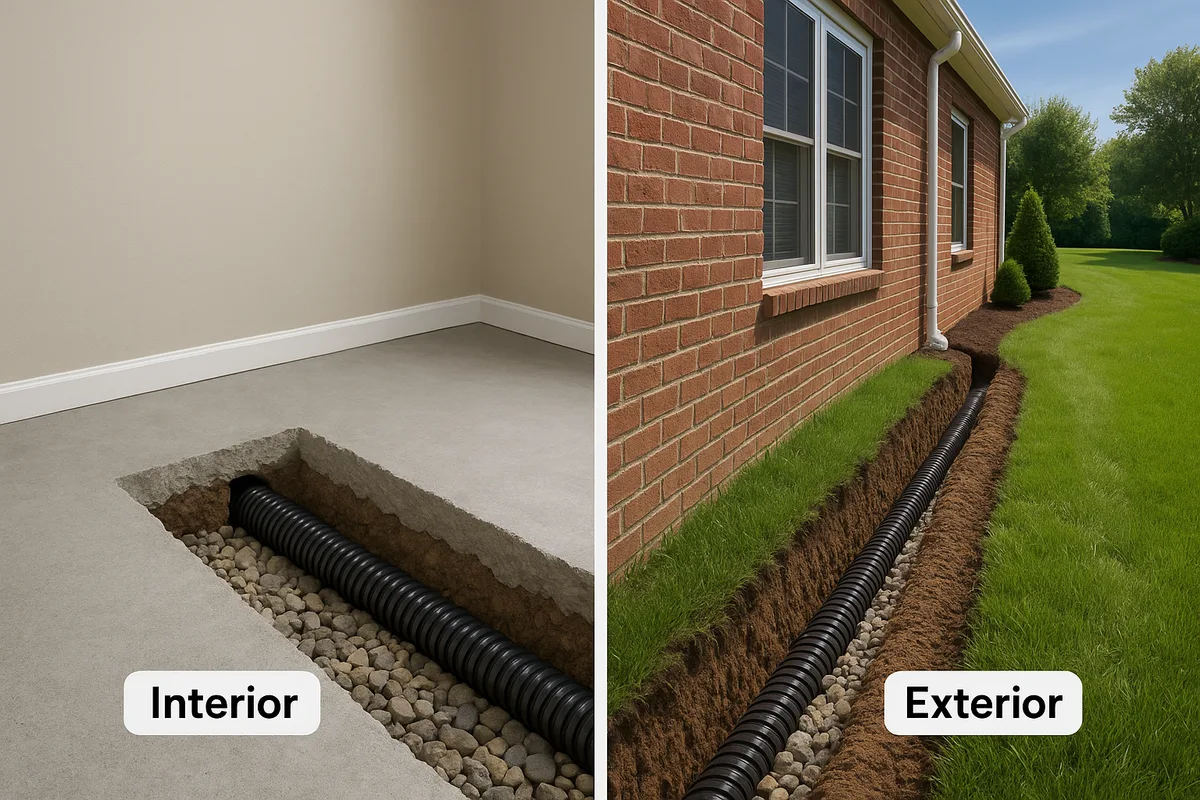
Interior vs. Exterior French Drains: Which One Solves Your Problem?
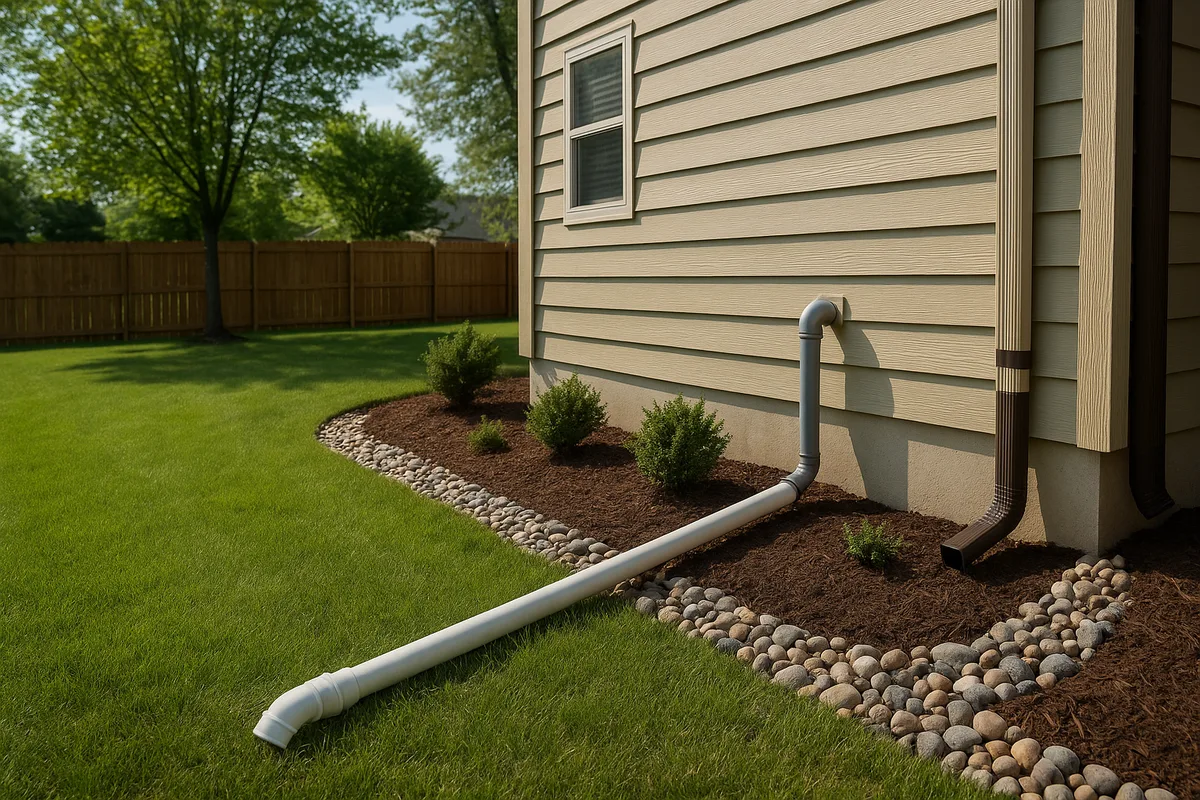
Where Should Your Sump Pump Discharge? Rules, Distances, and Mistakes