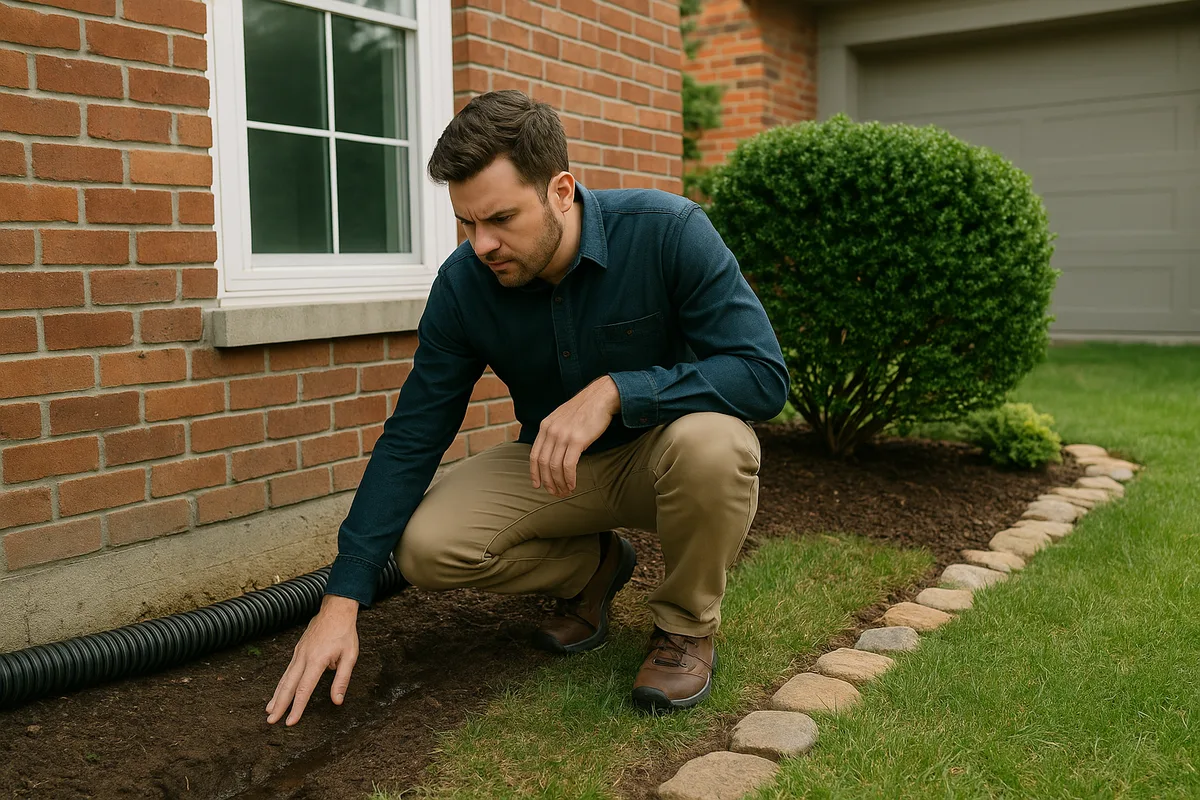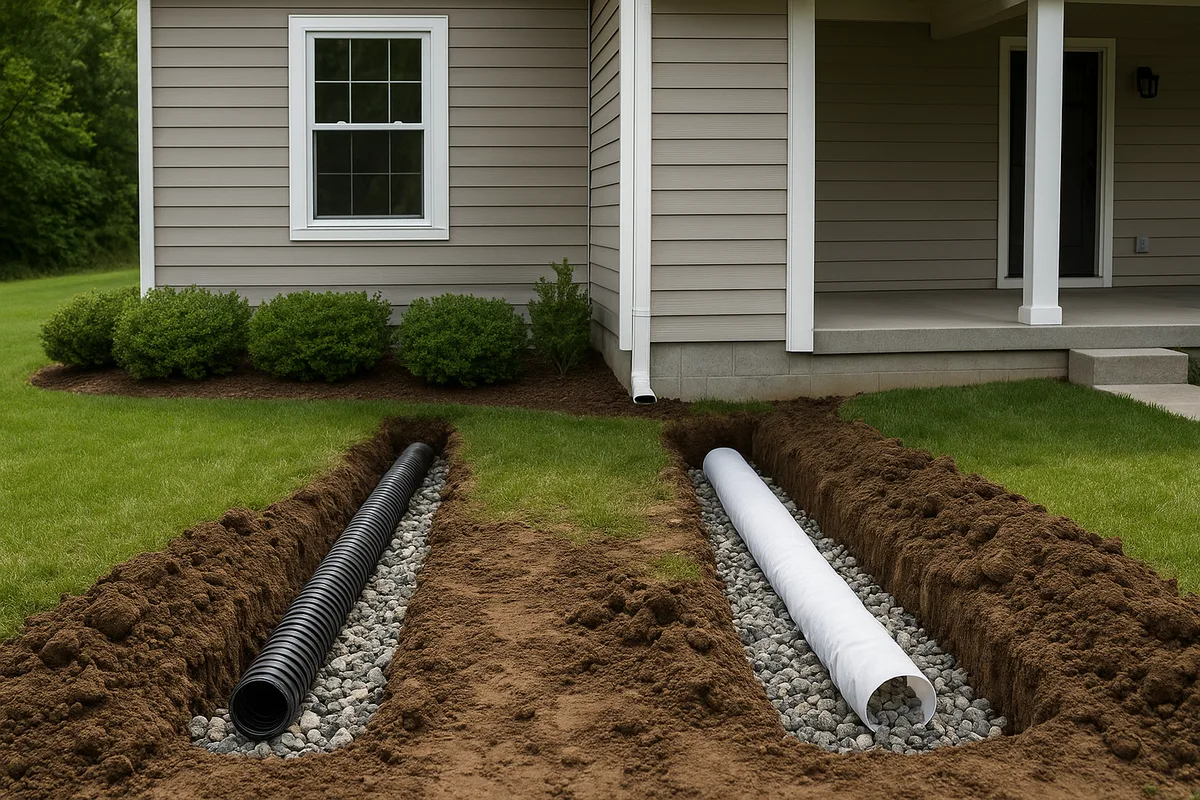
Curtain Drains vs. Footing Drains: What's the Difference?
If you've ever dealt with a wet basement, soggy yard, or water pooling near your foundation, you've probably encountered the terms curtain drain and footing drain — and possibly wondered whether they're just two names for the same thing. They're not. While both are subsurface drainage systems that use perforated pipe and gravel to intercept and redirect groundwater, they serve fundamentally different purposes, are installed in different locations, and solve different problems. Understanding the difference between a curtain drain and a footing drain is essential for any homeowner, contractor, or inspector trying to diagnose drainage issues and prescribe the right solution.
At Low Point Labs, we analyze topographic drainage patterns for residential properties every day. One of the most common mistakes we see is a homeowner installing the wrong type of drain — or a contractor recommending one system when the site conditions clearly call for the other. This guide will break down exactly how each system works, where it belongs, when you need one versus the other (or both), and how to avoid the costly errors that come from conflating the two.
How Subsurface Drainage Systems Work
Before diving into the differences, it helps to understand the basic mechanics that curtain drains and footing drains share. Both systems rely on the same fundamental principle: gravity moves water downhill, and perforated pipe surrounded by aggregate provides a preferential flow path for that water. When groundwater encounters a trench filled with clean, angular gravel and a slotted or perforated pipe, it enters the gravel matrix far more easily than it moves through the surrounding native soil. The pipe then carries the collected water to a designated discharge point — a daylight outlet, dry well, storm sewer connection, or detention area.
The key variables that distinguish one subsurface drain from another are location, depth, orientation relative to the structure, and the water source it's designed to intercept. A curtain drain and a footing drain may use identical pipe materials — typically 4-inch corrugated or rigid perforated PVC or HDPE — and similar aggregate specifications. But their placement and purpose couldn't be more different.
Both systems also depend on proper slope to function. A minimum gradient of 1% (roughly 1/8 inch per foot) is recommended, though 2% is preferred for reliable performance. Without adequate slope, water stagnates in the pipe, sediment accumulates, and the system eventually fails. This is why understanding your property's topography — the natural high points, low points, and flow paths — is a prerequisite for designing either type of drain effectively.
The Role of Filter Fabric
Both curtain drains and footing drains typically incorporate geotextile filter fabric, which wraps around the aggregate to prevent fine soil particles (silt and clay) from migrating into the gravel and clogging the system. The fabric must be non-woven and have an appropriate flow rate — too tight, and it restricts water entry; too loose, and it admits sediment. Some installers wrap the pipe itself in a filter sock, while others line the entire trench. The best practice for long-term performance is lining the trench with fabric, placing the aggregate and pipe, and then folding the fabric over the top before backfilling with native soil or topsoil.
What Is a Curtain Drain?
A curtain drain — sometimes called an interceptor drain, cut-off drain, or cross drain — is a subsurface drainage trench installed uphill from the area you want to protect. Its purpose is to intercept groundwater or subsurface flow as it moves laterally through the soil and redirect it around or away from a structure, yard, or other vulnerable area. Think of it as a curtain of drainage that catches water before it reaches the problem zone.
Curtain drains are typically installed perpendicular to the direction of groundwater flow. If your property sits at the base of a slope and water migrates downhill through the subsurface toward your house, a curtain drain placed across that slope — between the water source and your foundation — will intercept the flow and channel it to a safe discharge point on either side of your property.
The typical curtain drain trench is 12 to 24 inches wide and 18 to 36 inches deep, though depth varies based on the depth of the water-bearing soil layer you're trying to intercept. The trench is lined with filter fabric, filled with clean washed stone (typically 3/4-inch to 1-1/2-inch angular aggregate), and contains a 4-inch perforated pipe near the bottom. The perforations face downward so the pipe collects water that rises into the gravel rather than capturing surface runoff from above.
When You Need a Curtain Drain
Curtain drains are the right solution when the water problem originates from an uphill source. Common scenarios include:
- Hillside properties where groundwater flows through permeable soil layers toward the home
- Yards that stay perpetually soggy because subsurface water migrates from a neighbor's property or an adjacent hillside
- Septic drain field protection, where you need to divert groundwater away from the leach field to maintain proper function
- Garden and landscape areas that suffer from waterlogged soil due to a high seasonal water table on a sloped site
- Retaining wall backfill, where hydrostatic pressure from trapped water can cause structural failure
The critical design consideration for a curtain drain is placement. It must be located far enough uphill from the protected area to intercept the water before it arrives, and it must extend wide enough laterally to capture the full width of the subsurface flow. A curtain drain that's too short simply diverts water around its ends, where it continues downhill toward the structure.
Curtain Drain Discharge
Because curtain drains are installed in the yard — often 10 to 50 feet or more from the house — they typically discharge to daylight at a lower elevation on the property. The pipe exits the ground on a downhill slope, and water flows out freely. This is one of the advantages of curtain drains: they usually don't require a sump pump because they can leverage the natural topography for gravity discharge. However, on flat lots or properties where the drain must traverse a long distance, maintaining adequate slope can be challenging and may require careful grading or deeper trenching.
What Is a Footing Drain?
A footing drain — also called a foundation drain, perimeter drain, or drain tile — is installed directly adjacent to the building's foundation footings, at or below the level of the basement or crawl space floor. Its purpose is to collect water that accumulates around the foundation and lower the local water table to prevent hydrostatic pressure from forcing water through the foundation walls or up through the floor slab.
Footing drains are the last line of defense against basement water intrusion. While a curtain drain intercepts water before it reaches your house, a footing drain deals with water that has already arrived at the foundation. It sits in the most critical location — right at the base of the structure — and prevents that water from entering the living space.
A properly installed footing drain consists of a 4-inch perforated pipe placed alongside (and slightly below the top of) the foundation footing. The pipe is surrounded by clean washed aggregate, typically extending 6 to 12 inches on each side and above the pipe. The entire assembly is wrapped in filter fabric to prevent soil infiltration. In new construction, the footing drain is installed during the foundation phase, before backfill. In existing homes, installing or repairing a footing drain requires excavating down to the footing — a major undertaking that can cost $8,000 to $25,000 or more depending on the home's perimeter and site conditions.
Interior vs. Exterior Footing Drains
Footing drains come in two configurations: exterior and interior. Exterior footing drains are installed on the outside of the foundation wall, at the base of the footing. This is the preferred location because it intercepts water before it contacts the foundation wall, reducing hydrostatic pressure and keeping the wall drier. Exterior footing drains are standard in modern building codes for homes with basements.
Interior footing drains are installed inside the basement, along the interior perimeter of the foundation wall. They're typically used as a retrofit solution when exterior excavation is impractical or cost-prohibitive. The basement floor is jackhammered along the perimeter, a trench is dug below the slab, perforated pipe and gravel are installed, and the slab is repoured. Interior footing drains don't prevent water from reaching the foundation wall — they simply collect it after it seeps through and channel it to an interior sump pit, where a sump pump ejects it to the surface.
While interior footing drains are a legitimate and often necessary solution, they are fundamentally reactive rather than preventive. They manage water that has already penetrated the building envelope, whereas exterior footing drains prevent that penetration in the first place.
When You Need a Footing Drain
Footing drains are essential in the following situations:
- Any home with a basement in an area with moderate to high water table levels
- Homes experiencing basement water intrusion through walls or floor, especially during rain events or seasonal water table rises
- New construction with basements or below-grade living spaces, where building codes typically require perimeter footing drains
- Crawl spaces with standing water or persistent moisture problems
- Homes with visible efflorescence, spalling, or mineral deposits on interior foundation walls — signs of water migrating through the concrete
Most residential building codes — including the International Residential Code (IRC) Section R405 — require foundation drainage for habitable or usable spaces below grade. The code specifies that drain tile or perforated pipe must be installed around the perimeter of the foundation at or below the area to be protected, and that the system must discharge by gravity or mechanical means to a point where the water will not re-enter the building.
Key Differences Between Curtain Drains and Footing Drains
Now that we've defined each system individually, let's put them side by side to highlight the critical distinctions.
Location: A curtain drain is installed in the yard, uphill from the area being protected. A footing drain is installed directly at the foundation, adjacent to the footing. This is the single most important difference. A curtain drain might be 20, 30, or 50 feet from the house. A footing drain is literally touching it.
Purpose: A curtain drain intercepts and redirects subsurface water before it reaches the foundation. A footing drain manages water that has already arrived at the foundation and prevents it from entering the structure. One is an interceptor; the other is a last-resort collector.
Depth: Curtain drains are typically 18 to 36 inches deep, sized to intercept the water-bearing soil layer. Footing drains are as deep as the foundation footing — often 6 to 8 feet below grade for a full basement, or 2 to 3 feet for a crawl space.
Orientation: Curtain drains run perpendicular to the slope (across the direction of water flow) to intercept lateral subsurface movement. Footing drains run parallel to the foundation walls, forming a perimeter loop around the structure.
Discharge: Curtain drains almost always discharge to daylight via gravity. Footing drains may discharge to daylight if the topography allows, but frequently require a sump pit and pump, especially for interior systems or on flat sites where gravity discharge isn't feasible.
Installation complexity: Curtain drains are relatively straightforward — a backhoe or trencher cuts a trench in the yard, and the system is assembled in place. Footing drains on existing homes require deep excavation adjacent to the foundation (exterior) or demolition and reconstruction of the basement slab (interior), making them significantly more expensive and disruptive.
Cost: A curtain drain typically costs $2,000 to $8,000 depending on length, depth, and site conditions. An exterior footing drain on an existing home can cost $10,000 to $25,000 or more. An interior footing drain with sump pump typically runs $5,000 to $15,000.
Common Mistakes: When the Wrong Drain Gets Installed
One of the most expensive mistakes in residential drainage is installing the wrong type of system — or installing the right type in the wrong location. Here are the scenarios we see most often.
Installing a Curtain Drain When You Need a Footing Drain
A homeowner has water seeping into their basement. A contractor recommends a "French drain" in the yard, 15 feet uphill from the house. The curtain drain is installed, and the yard dries out — but the basement is still wet. Why? Because the water entering the basement isn't just coming from the uphill subsurface flow. It's also coming from rain falling directly on the backfill zone around the foundation, from downspout discharge pooling near the walls, or from a water table that rises above the basement floor during wet seasons. A curtain drain 15 feet away does nothing to address water that's already at the foundation. The homeowner needed a footing drain — or at minimum, needed the curtain drain combined with a footing drain.
Installing a Footing Drain When You Need a Curtain Drain
A homeowner has a perpetually soggy backyard that kills their landscaping and creates mosquito habitat. A contractor recommends excavating around the foundation and installing a footing drain. The work costs $18,000. The foundation stays dry (it was already dry — the basement never leaked), but the yard is still a swamp. The water problem was subsurface flow from an adjacent hillside saturating the yard 30 feet from the house. A $4,000 curtain drain across the uphill property line would have solved the problem. The footing drain was an expensive solution to a problem that didn't exist at the foundation.
Confusing "French Drain" Terminology
The term "French drain" is maddeningly ambiguous. Depending on who's using it, a French drain can refer to a curtain drain, a footing drain, a shallow yard drain, or even a surface-level gravel trench. This linguistic confusion leads to miscommunication between homeowners and contractors, resulting in incorrect installations. When discussing drainage with a contractor, always specify the location (yard vs. foundation), the depth, and the problem you're trying to solve. Don't rely on the term "French drain" alone — it means different things to different people.
Neglecting Surface Drainage
Neither a curtain drain nor a footing drain is designed to handle surface water runoff. If your gutters are dumping water directly against the foundation, if the grade slopes toward the house, or if surface water from the driveway or patio flows toward the structure, subsurface drains alone won't solve the problem. The first priority is always to manage surface water through proper grading (minimum 5% slope or 6 inches of fall in the first 10 feet away from the foundation), functional gutters and downspout extensions, and surface drainage features like swales or catch basins. Subsurface drains address what's happening below grade; surface drainage addresses what's happening above it. You typically need both.
How Topography Determines Which Drain You Need
The topography of your property — its slopes, contours, high points, and low points — is the single most important factor in determining which drainage system is appropriate. Topographic analysis reveals where water comes from, how it moves across and through the soil, and where it accumulates.
On a sloped lot where the home sits at the base of a hill, a curtain drain is often the primary solution. The slope delivers subsurface water toward the foundation, and intercepting it uphill is the most efficient strategy. However, if the home has a basement, a footing drain is still necessary as a secondary defense — no curtain drain captures 100% of subsurface flow, and local water table fluctuations can still create hydrostatic pressure at the foundation.
On a flat lot with a high water table, a footing drain is typically the primary solution. There's no uphill slope delivering water laterally — instead, the water table rises uniformly across the property during wet periods, and the footing drain lowers it locally around the foundation. A curtain drain has limited utility on a flat lot because there's no directional subsurface flow to intercept.
On a complex lot with multiple slopes, varying soil types, and mixed drainage patterns, you may need both systems working in concert. A curtain drain uphill intercepts the bulk of subsurface flow, while a footing drain at the foundation handles residual water and water table fluctuations. This layered approach is the gold standard for foundation protection on challenging sites.
Understanding your property's topographic drainage patterns is the foundation (no pun intended) of any effective drainage strategy. Tools like the USGS 3D Elevation Program provide high-resolution elevation data that can help identify slopes, flow paths, and low points on your property. At Low Point Labs, we use advanced topographic analysis to map exactly how water moves across and beneath your property, so you can make informed decisions about drainage investments.
Design and Installation Best Practices
Whether you're installing a curtain drain or a footing drain, certain best practices apply to both systems. Following these guidelines will maximize performance and longevity.
Aggregate Selection
Use clean, washed, angular aggregate — not rounded river rock, and never recycite or crusite that contains fines. Angular stone interlocks and creates stable void spaces for water flow. Round stone shifts and settles, reducing void space over time. The most common specification is 3/4-inch to 1-1/2-inch washed stone. Avoid limestone in areas with acidite soils, as it can dissolve over decades. Never use sand as the primary aggregate — it lacks sufficient void space and clogs quickly.
Pipe Selection
For curtain drains, 4-inch corrugated perforated HDPE pipe is common and cost-effective. For footing drains, rigid 4-inch perforated PVC (Schedule 40 or SDR 35) is preferred because it resists crushing under the weight of deep backfill and has a smoother interior that resists sediment buildup. Regardless of pipe type, perforations should face downward (at the 4 and 8 o'clock positions) so the pipe collects water rising from below rather than capturing sediment falling from above.
Slope and Grade
Maintain a minimum 1% slope (1/8 inch per foot) throughout the entire pipe run. For curtain drains, this is usually achievable by following the natural contour of the site. For footing drains, which must run level around the foundation perimeter, slope is achieved by starting higher on one side and gradually dropping to a low point where the pipe exits the building or enters a sump pit. On a 60-foot foundation wall, a 1% slope means the pipe drops about 7 inches from high point to low point.
Backfill and Compaction
For curtain drains, the trench above the aggregate is typically backfilled with native soil and topped with topsoil and seed or sod. For exterior footing drains, the backfill material matters enormously. Never backfill against a foundation with heavy clay soil — it traps water against the wall. Use granular, free-draining backfill (sand-gravel mix) for at least the first 12 inches against the wall, transitioning to native soil further out. Compact backfill in 6- to 8-inch lifts to prevent future settlement that could alter surface grades.
Cleanouts and Access
Install cleanout risers at each end of the drain run and at any changes in direction greater than 45 degrees. Cleanouts are simply vertical sections of solid pipe that extend from the drain pipe to the surface, capped with a removable fitting. They allow you to flush the system with a garden hose or inspect it with a camera if performance degrades. A drain without cleanouts is a drain you can never maintain.
Waterproofing Coordination
For footing drains, the drain itself is only one component of a comprehensive foundation waterproofing system. The exterior foundation wall should also receive a waterproof membrane or coating (not just dampproofing — there's a significant difference), and a drainage board or dimple mat should be installed over the membrane to channel water downward to the footing drain. The drain handles the water; the membrane keeps it out of the wall; the drainage board connects the two. Omitting any component weakens the entire system.
Soil Types and Their Impact on Drain Performance
The soil on your property has a profound effect on how water moves through the subsurface — and therefore on which type of drain you need and how it should be designed.
Sandy and gravelly soils (Hydrologic Soil Group A) drain quickly and rarely create persistent subsurface water problems. However, they can transmit large volumes of water rapidly, meaning a curtain drain in sandy soil may need to handle higher flow rates. The good news is that these soils are easy to trench and provide excellent natural drainage around the aggregate.
Silty soils (Hydrologic Soil Group B) have moderate permeability and can create subsurface flow problems on sloped sites. Curtain drains work well in these soils because water moves through them at a manageable rate. Filter fabric selection is critical — silt particles are the most common cause of drain clogging.
Clay soils (Hydrologic Soil Groups C and D) are the most problematic for drainage. They have very low permeability, which means water moves through them slowly — but it also means water that reaches the foundation stays there, creating sustained hydrostatic pressure. Clay soils swell when wet and shrink when dry, which can crack foundation walls and create new pathways for water entry. In clay soils, footing drains are especially critical because the soil's low permeability prevents water from draining away from the foundation naturally. Curtain drains in clay soil must be designed carefully — the trench must penetrate deep enough to reach the water-bearing layer, and the aggregate zone must be wide enough to collect water from the slow-draining surrounding soil.
You can investigate the soil types on your property using the NRCS Web Soil Survey, a free tool that provides detailed soil maps and hydrologic soil group classifications for any address in the United States. Knowing your soil type before designing a drainage system can save you from costly design errors.
When You Need Both Systems
In many real-world situations, the answer to "curtain drain or footing drain?" is "both." These systems are complementary, not competing. A well-designed drainage strategy often layers multiple systems to address water at every stage of its journey across and through your property.
Consider a home with a walkout basement built into a hillside. The uphill side of the house receives subsurface water flowing downslope through a silty-clay soil layer. During spring snowmelt and heavy rain events, the basement leaks along the uphill wall. The optimal solution involves three components:
- Surface grading to direct runoff away from the foundation on all sides
- A curtain drain installed 15 to 25 feet uphill from the foundation, running the full width of the house plus 10 feet on each side, intercepting the bulk of subsurface flow and redirecting it around the house
- An exterior footing drain along the uphill foundation wall (at minimum), connected to a discharge pipe that daylights on the downhill side of the property
This layered approach addresses surface water (grading), subsurface flow from uphill (curtain drain), and residual water at the foundation (footing drain). No single system handles all three water sources. Homeowners who invest in only one layer often find that their problem is reduced but not eliminated — because they've addressed one water source while ignoring the others.
The decision about which systems to install — and in what combination — should be based on a thorough analysis of your property's topography, soil conditions, water table behavior, and the specific symptoms you're experiencing. A drainage assessment that maps your property's low points, flow paths, and water accumulation zones provides the data you need to make smart investments rather than expensive guesses.
Long-Term Maintenance and Lifespan
Both curtain drains and footing drains are designed to be long-lasting, low-maintenance systems — but "low maintenance" doesn't mean "no maintenance." Understanding what can go wrong and how to prevent it will extend the life of your drainage investment.
Curtain Drain Maintenance
Curtain drains are relatively accessible because they're shallow and located in the yard. The most common failure mode is sediment clogging, which occurs when filter fabric degrades or when the trench is installed without fabric. Signs of a failing curtain drain include the return of soggy conditions in previously dry areas, standing water in cleanout risers, and surface depressions along the trench line (indicating aggregate settlement from sediment infiltration).
Maintenance involves flushing the system annually through the cleanout risers with a garden hose, inspecting the discharge outlet for blockages (roots, debris, animal nests, sediment), and monitoring the ground surface above the trench for settlement. A well-installed curtain drain with proper filter fabric and clean aggregate should last 20 to 30 years or more before requiring rehabilitation.
Footing Drain Maintenance
Footing drains are inherently difficult to maintain because they're buried deep and often inaccessible. Exterior footing drains can't be accessed without excavation — which is why getting the installation right the first time is so important. Interior footing drains are somewhat more accessible through the sump pit, where a plumber can snake or jet the pipe.
The most common footing drain failure is root intrusion, particularly from trees planted near the foundation. Tree roots seek out the moisture and nutrients in drain pipes and can completely block a pipe within a few years. Keep trees at least 10 to 15 feet from the foundation, and further for species with aggressive root systems (willows, maples, poplars). Iron ochre — a slimy, rust-colored bacterial deposit — is another common clogging agent in footing drains, particularly in areas with iron-rich groundwater. Iron ochre requires periodic flushing and, in severe cases, chemical treatment.
Sump pumps associated with footing drains should be tested quarterly by pouring water into the pit and verifying that the pump activates and discharges properly. Battery backup or water-powered backup pumps are strongly recommended — a primary pump failure during a storm is the most common cause of basement flooding in homes with otherwise functional drainage systems.
Making the Right Decision for Your Property
Choosing between a curtain drain and a footing drain — or determining that you need both — requires understanding not just the systems themselves, but the specific drainage dynamics of your property. Every lot is unique: the slopes, soil types, water table depth, impervious surfaces, neighboring drainage patterns, and foundation design all influence which solution is appropriate.
The most costly approach is guessing. Installing a $15,000 footing drain when a $4,000 curtain drain would have solved the problem wastes money. Installing a curtain drain when the real issue is hydrostatic pressure at the foundation wastes money and leaves your basement unprotected. The most cost-effective approach is always to diagnose before you prescribe — to understand where the water comes from, how it moves, and where it accumulates before committing to a solution.
At Low Point Labs, we specialize in exactly this kind of analysis. Our topographic drainage assessments map your property's elevation contours, identify natural flow paths and low points, evaluate slope and grading conditions, and provide actionable intelligence about where water goes — and where it shouldn't. Whether you're troubleshooting an existing problem or planning drainage for new construction, understanding your property's drainage topology is the essential first step. Explore our drainage assessment services to get the data-driven insights you need to protect your home and invest wisely in the drainage systems that will actually solve your problem.
See Drainage Intelligence in Practice
Talk with our team or request an invitation to the platform.
Frequently Asked Questions
A curtain drain is installed in the yard uphill from a structure to intercept subsurface water before it reaches the foundation. A footing drain is installed directly at the base of the foundation to collect water that has already arrived and prevent it from entering the basement or crawl space. They serve different purposes and are located in different places.
The term 'French drain' is ambiguous and can refer to either system depending on who is using it. To avoid confusion, always specify whether you mean a yard interceptor drain (curtain drain) or a foundation perimeter drain (footing drain) when discussing drainage with contractors.
A curtain drain typically costs $2,000 to $8,000 depending on length and depth. An exterior footing drain on an existing home costs $10,000 to $25,000 or more due to deep excavation. An interior footing drain with sump pump usually runs $5,000 to $15,000.
Many properties benefit from both systems working together. A curtain drain intercepts the bulk of subsurface flow uphill, while a footing drain handles residual water at the foundation. Homes on hillsides with basements are the most common candidates for a combined approach.
A properly installed curtain drain with filter fabric and clean aggregate should last 20 to 30 years or more. Footing drains can last the life of the home if installed correctly, but are vulnerable to root intrusion and iron ochre clogging. Regular maintenance extends the lifespan of both systems.
Curtain drains are one of the more DIY-friendly drainage projects because they're relatively shallow (18-36 inches) and located in the yard. However, proper design — including correct placement, slope, aggregate selection, and filter fabric — is critical. Footing drains should almost always be installed by professionals due to the depth and structural risks involved.
Related Articles
Modern Construction Techniques for Drainage & Foundation Work
Designing a Swale vs French Drain: How to Choose the Right System