How to Turn a Basic Yard Maintenance Customer into a High-Ticket Drainage Client
Every week, landscape maintenance crews walk properties that are silently suffering from drainage problems. Standing water in the corner of the yard. Moss creeping across a patio. A foundation wall with suspicious efflorescence. These are signals — and for contractors who know how to read them, each one represents an opportunity to transform a basic mowing and trimming account into a high-ticket drainage client. The landscaping upsell from routine maintenance to drainage remediation isn't just good for your bottom line — it's genuinely good for the homeowner, who often doesn't realize that the soggy patch by the fence is slowly undermining their foundation or killing their expensive plantings.
This article is a comprehensive playbook for landscape professionals, property maintenance companies, and home service entrepreneurs who want to add drainage services to their revenue mix. We'll cover how to spot problems, how to educate homeowners without being pushy, how to price and propose drainage work, and how to deliver results that generate referrals for years to come.
Why Drainage Is the Highest-Value Service in Landscaping
Most landscape maintenance contracts are commoditized. Mowing, edging, blowing — the barriers to entry are low, the margins are thin, and customer loyalty is fragile. A competitor with a newer truck and a price that's $20 cheaper per visit can poach your client in a heartbeat. Drainage work is fundamentally different. It requires diagnostic skill, technical knowledge, and execution precision that most lawn care operators simply don't possess. That scarcity translates directly into higher margins and stronger client relationships.
Consider the economics. A typical residential mowing contract might generate $150–$250 per month, or roughly $1,800–$3,000 annually. A single French drain installation runs $3,000–$10,000 depending on scope. A comprehensive yard regrading project can reach $5,000–$15,000. A full drainage system with catch basins, subsurface piping, and a dry well or rain garden can exceed $20,000. One drainage project can equal an entire year — or multiple years — of maintenance revenue from that same client.
Beyond the immediate revenue, drainage work creates a fundamentally different relationship with the homeowner. You're no longer the person who cuts their grass. You're the expert who protected their $400,000 home from water damage. That shift in perceived value makes your maintenance contract nearly untouchable by competitors and opens the door to additional high-value work like retaining walls, patio installations, and landscape renovations.
Training Your Crews to Spot Drainage Problems in the Field
The most powerful asset in the landscaping upsell process isn't a sales script — it's a trained pair of eyes on the ground every week. Your maintenance crews are already walking the property. They just need to know what to look for and how to document it.
The Weekly Walk-Through Checklist
Create a simple drainage observation checklist that crew leaders complete during each visit. It doesn't need to be complicated. Focus on these high-signal indicators:
- Standing water more than 24 hours after rain
- Soil erosion channels or exposed roots near slopes
- Moss or algae growth on hardscapes, which indicates persistent moisture
- Soggy or spongy turf that doesn't firm up between rain events
- Downspout discharge that pools against the foundation or flows toward the house
- Efflorescence (white mineral deposits) on foundation walls or retaining walls
- Mildew smell near basement windows or crawl space vents
- Settling or heaving of pavers, walkways, or patios
- Gutter overflow during moderate rain events
- Negative grading — ground that slopes toward the structure rather than away
Train crews to take quick smartphone photos with location tagging whenever they observe these conditions. A photo library built over multiple visits — especially before, during, and after rain events — becomes extraordinarily persuasive evidence when you sit down with the homeowner.
Understanding the Root Causes
To convert observations into credible recommendations, your team needs a basic understanding of why drainage problems occur. The most common residential drainage issues stem from a handful of root causes:
- Inadequate grading: The International Residential Code recommends a minimum 6-inch drop over the first 10 feet from the foundation — roughly a 5% slope. Many properties, especially older homes or those with additions, fail to meet this standard.
- Soil compaction: Years of foot traffic, vehicle parking, and construction activity compress soil particles, reducing infiltration rates and creating surface runoff where water once percolated naturally.
- Impervious surface expansion: Driveways, patios, and pool decks added after original construction increase runoff volume without corresponding drainage infrastructure.
- Failed or absent subsurface drainage: Older French drains clog with sediment and root intrusion. Many homes were built without any subsurface drainage at all.
- Altered watershed dynamics: Upstream development — a neighbor's new garage, a subdivision uphill — can redirect stormwater onto your client's property.
When your crew can articulate not just what they see but why it's happening, the homeowner perceives expertise rather than a sales pitch. That distinction is everything.
The Art of the Educational Conversation
The transition from observation to conversation is where most contractors stumble. They either ignore the problem (leaving money on the table) or they come across as pushy salespeople (damaging the trust they've built). The key is to approach the conversation as an educator, not a closer.
Timing and Context
Don't bring up drainage concerns while the crew is running leaf blowers. Wait for a natural touchpoint — a scheduled walk-through, a seasonal property review, or even a casual conversation when the homeowner is outside. The best opening is a genuine question: "Hey, I've noticed this area stays wet for days after it rains. Has that always been like this, or is it getting worse?"
This question accomplishes three things. First, it demonstrates that you're paying attention to their property beyond the scope of your contract. Second, it invites the homeowner to share their own frustration — and most homeowners with drainage problems have plenty of frustration. Third, it positions you as curious and concerned rather than transactional.
Show, Don't Tell
Walk the homeowner to the problem area. Show them the evidence. "See how the soil has eroded here and created this channel? That's carrying water from your downspout directly toward your foundation wall. Over time, that hydrostatic pressure can cause cracks and basement seepage." Use the photos your crew has collected over previous visits: "Here's what this area looked like after last month's storm — you can see three inches of standing water."
Visual evidence is far more persuasive than verbal warnings. If you have access to topographic data or elevation information, this is where it becomes incredibly powerful. A simple elevation analysis can show the homeowner exactly where water flows on their property and why it's collecting where it is. Tools like the USGS 3DEP (3D Elevation Program) provide publicly available elevation data that can supplement your field observations with hard topographic numbers.
Quantify the Risk
Homeowners respond to concrete numbers more than vague warnings. Help them understand the financial stakes:
- The average basement water damage claim costs $10,000–$25,000 to remediate
- Foundation crack repair ranges from $2,000–$7,000 per crack
- Mold remediation averages $3,000–$10,000 and can exceed $30,000 for severe cases
- A chronically wet yard can reduce property value by 5–15%
Frame the drainage investment as insurance: "A $6,000 French drain system is a lot less expensive than a $20,000 foundation repair. And it actually adds value to the property."
Building a Drainage Services Menu
To successfully convert a basic maintenance customer into a drainage client, you need a clearly defined service offering. Homeowners can't buy what they can't understand. Develop a tiered menu that ranges from simple, low-cost interventions to comprehensive drainage systems.
Tier 1: Quick Wins ($500–$2,000)
These are entry-level services that solve immediate problems and build confidence in your drainage capabilities:
- Downspout extensions and redirections: Running downspouts away from the foundation with buried solid PVC, discharging at least 10 feet from the structure
- Surface regrading of small areas (under 200 square feet) to correct negative slope
- Splash block replacement and repositioning
- Gutter cleaning and repair to restore proper roof drainage
- Pop-up emitter installation for existing downspout lines
Tier 1 services are ideal first projects. They're affordable enough that the homeowner doesn't need to agonize over the decision, and they produce visible results quickly. Once the homeowner sees that the puddle by the back door is gone, they're primed for a larger conversation.
Tier 2: Targeted Solutions ($2,000–$8,000)
These projects address specific drainage failures and require more planning and execution:
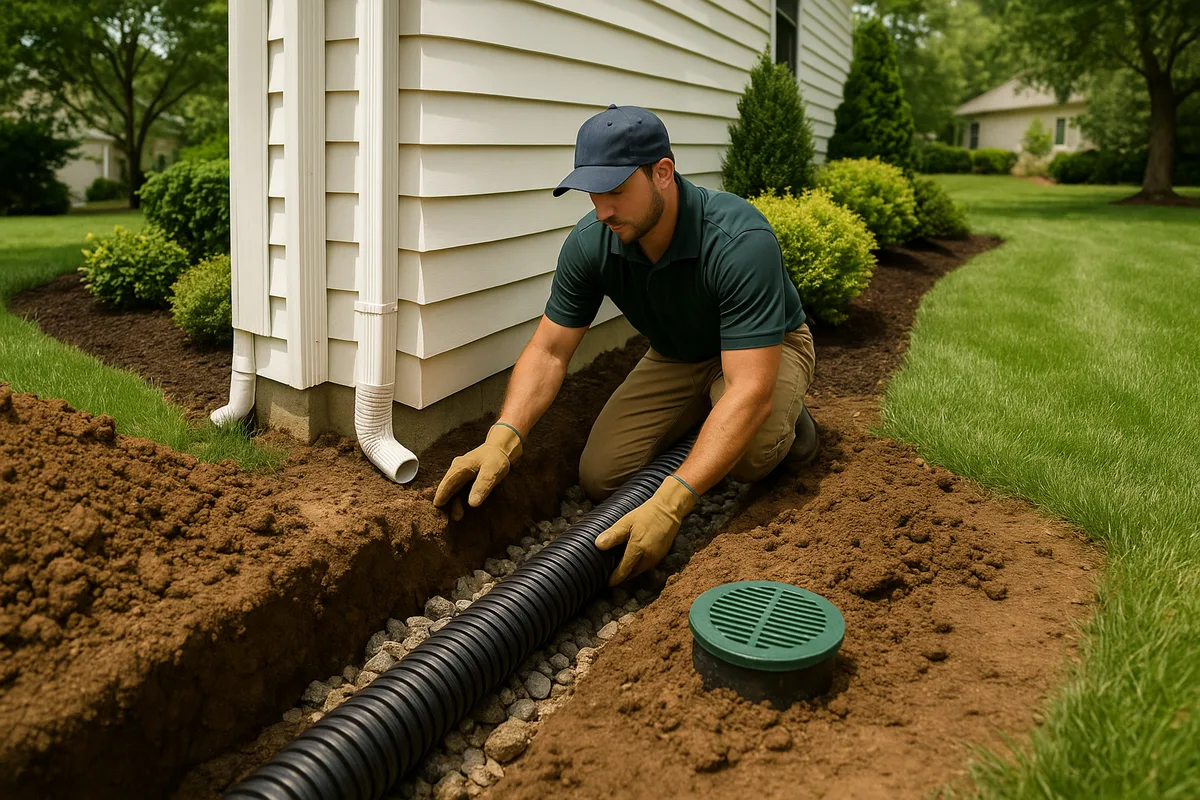
- French drain installation along foundation walls or across problem areas
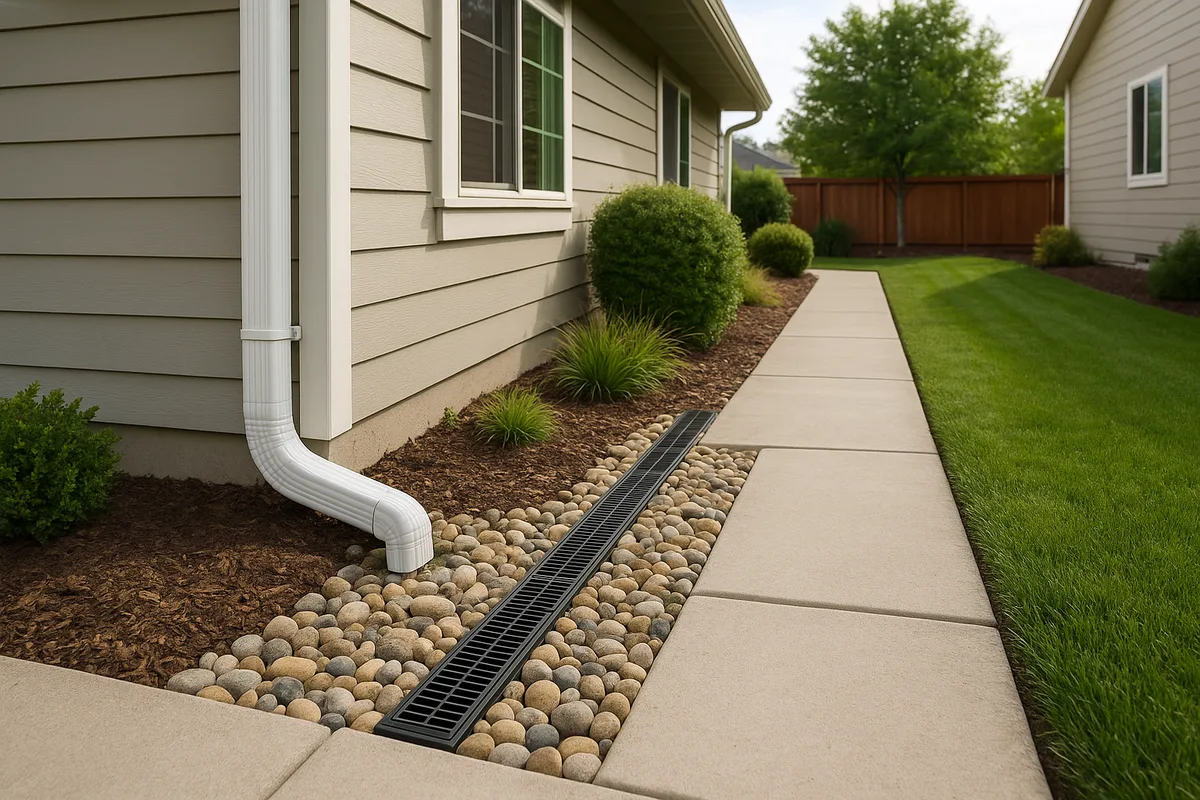
- Channel drain (trench drain) installation across driveways, patios, or walkways
- Catch basin and underground piping systems to collect and redirect surface water
- Dry well installation for on-site stormwater infiltration
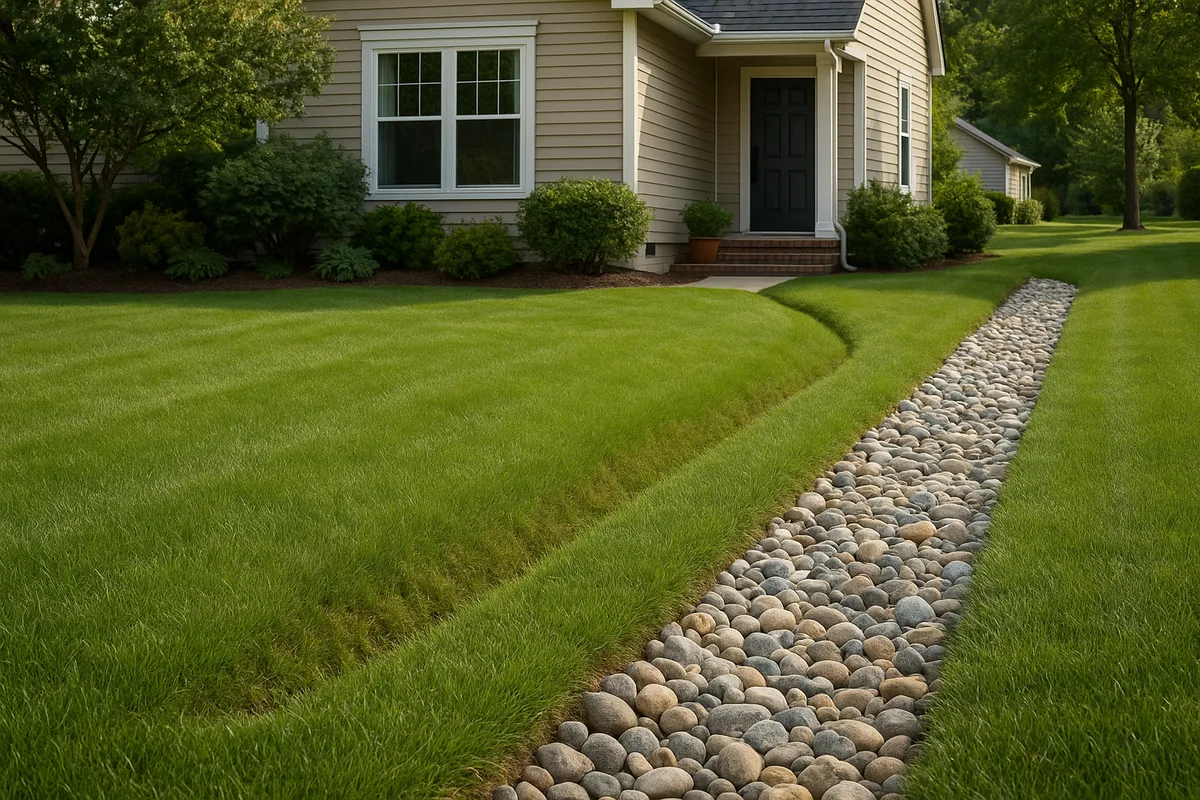
- Swale construction to redirect overland flow
- Yard regrading of larger areas (200–1,000 square feet)
Tier 3: Comprehensive Systems ($8,000–$25,000+)
These are full-property drainage solutions that often involve engineering-level planning:
- Complete property regrading with imported fill material
- Multi-run French drain networks with manifold connections
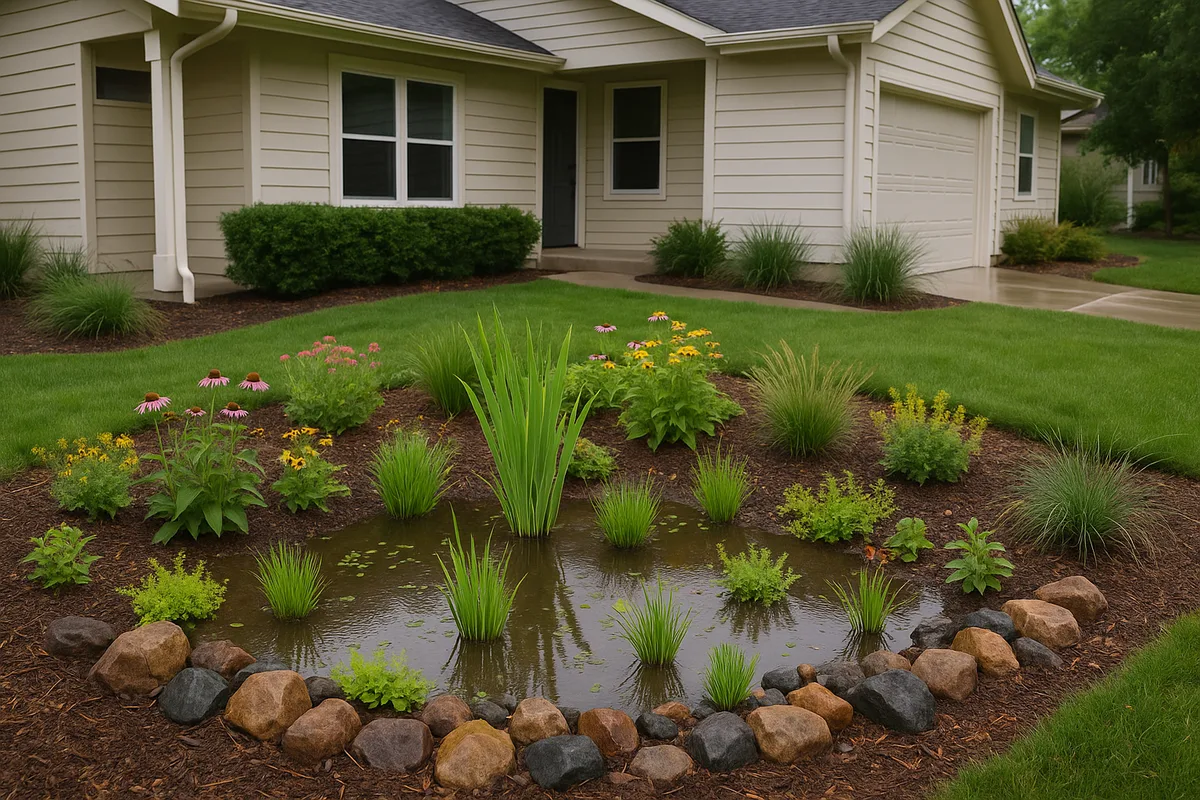
- Rain garden design and installation for sustainable stormwater management
- Retaining wall systems with integrated drainage
- Sump pump and discharge line installation
- Comprehensive roof-to-street drainage systems connecting gutters, subsurface drains, and discharge points
Presenting these tiers gives the homeowner a sense of control. They can start small and expand over time, or they can invest in a comprehensive solution upfront. Either way, you've opened a revenue channel that didn't exist when you were just cutting their grass.
Using Data and Technology to Close the Deal
The contractors who command premium pricing for drainage work are the ones who bring data to the table, not just opinions. Modern tools make it possible to present homeowners with objective, visual evidence of their drainage situation — and that evidence is extraordinarily persuasive.
Topographic Analysis
Understanding the topography of a residential lot is the foundation of any drainage plan. Even subtle elevation changes — a 2-inch depression across a 20-foot span — can create persistent ponding. Professional-grade RTK GPS units can map a residential lot to sub-inch accuracy, but even consumer-grade tools and publicly available elevation data can provide valuable insights.
A topographic drainage assessment identifies the property's natural low points, flow paths, and watershed boundaries. It answers the fundamental question: where does water go when it rains? When you can show a homeowner a color-coded elevation map of their property with arrows indicating flow direction, you've moved beyond opinion into evidence. That's the difference between a $3,000 proposal that gets filed away and a $12,000 proposal that gets signed.
Soil Analysis
Drainage solutions must account for soil type. A French drain installed in clay soil behaves very differently than one installed in sandy loam. Before proposing a solution, understand the soil conditions using the NRCS Web Soil Survey, which provides free, detailed soil maps for any address in the United States. Pay particular attention to the hydrologic soil group classification:
- Group A: High infiltration rate (sand, gravel). Water percolates readily.
- Group B: Moderate infiltration rate (silt loam). Generally drains well.
- Group C: Slow infiltration rate (sandy clay loam). Drainage challenges likely.
- Group D: Very slow infiltration rate (clay, high water table). Significant drainage infrastructure required.
When you tell a homeowner, "Your property sits on Group D clay soil with an infiltration rate of less than 0.05 inches per hour — that's why water sits on the surface for days," you've demonstrated a level of expertise that justifies premium pricing and eliminates the competition.
Before-and-After Visualization
Invest in simple visualization tools that show the homeowner what the finished project will look like. This doesn't require expensive software. A marked-up aerial photo from Google Earth showing drain locations, flow arrows, and discharge points can be remarkably effective. For larger projects, a basic CAD drawing or even a clean hand-drawn plan with measurements communicates professionalism and planning.
Pricing Strategy and Proposal Structure
How you present the price is almost as important as the price itself. Drainage projects involve significant investment, and homeowners need to feel confident that they're getting value — not just paying for a trench in their yard.
Cost-Per-Problem vs. Lump Sum
Break your proposal into clearly defined line items tied to specific problems. Instead of "Drainage system installation — $9,500," present it as:
- Foundation perimeter French drain (85 linear feet) — $4,200
- Downspout connection and underground routing (4 downspouts) — $2,400
- Catch basin and surface drain at patio low point — $1,200
- Dry well installation for system discharge — $1,700
This approach lets the homeowner see exactly what they're paying for and gives them the option to phase the work if budget is a concern. It also makes the total feel less monolithic — four manageable components rather than one intimidating number.
The Maintenance Tie-In
Here's where your existing relationship becomes a strategic advantage. Offer a drainage maintenance add-on to your existing maintenance contract. For an additional $30–$50 per month, you'll inspect catch basin grates, flush drain lines annually, check pop-up emitters for debris, and monitor system performance after major storms. This creates recurring revenue, extends the client relationship, and ensures the drainage system continues to perform — which protects your reputation and generates referrals.
Financing Options
For projects above $5,000, consider offering financing through a third-party provider. Many homeowners want the work done but can't write a $12,000 check. A $200/month payment plan makes the decision dramatically easier. Several contractor financing platforms cater specifically to home improvement projects and can be set up with minimal overhead.
Overcoming Common Objections
Even when the problem is obvious and the solution is sound, homeowners will have objections. Anticipating and addressing these objections is essential to converting a drainage client from a prospect to a signed contract.
"It's not that bad — it only happens when it rains really hard."
This is the most common objection, and it's the most dangerous for the homeowner. Respond with data: "According to NOAA precipitation frequency data, your area receives a storm of this intensity approximately 4–6 times per year. Each event is pushing water against your foundation. The damage is cumulative — you won't see it until it's already expensive to fix." Emphasize that drainage problems never improve on their own. They only get worse as soil settles, compacts, and erodes.
"I'll just have my landscaper add some dirt and regrade it."
This objection actually works in your favor if you are the landscaper. Explain that regrading without understanding the full drainage picture often moves the problem rather than solving it. "If we add fill here to push water away from the foundation, where does it go? We need to make sure we're not creating a new problem at the property line or flooding your neighbor's yard." This reinforces the need for a comprehensive approach.
"I got a cheaper quote from another company."
Don't compete on price. Compete on expertise and accountability. "I'd be happy to review their proposal with you. The key questions to ask are: Did they analyze the soil type? Do they know the elevation changes across your yard? Are they using perforated pipe with a filter sock, or bare pipe that will clog in three years? And will they be here next week maintaining your property and monitoring the system's performance?" Your ongoing maintenance relationship is a competitive moat that one-time contractors can't match.
"Can't I just do this myself?"
Some homeowners are handy and genuinely capable of basic drainage work. Don't fight this — use it. "Absolutely, you could install a simple downspout extension yourself. But for the French drain along the foundation, you're looking at excavating a trench 18–24 inches deep and 12 inches wide for 85 feet, installing proper filter fabric, graded gravel, perforated pipe at the correct slope, and connecting it to a discharge point that complies with local stormwater regulations. That's typically a 3–4 day project with a crew and equipment. I'd hate for you to spend a weekend digging and end up with a system that doesn't perform." Respect their capability while being honest about the scope.
Building a Referral Engine from Drainage Projects
Drainage projects are inherently visible to neighbors. Excavation equipment in the driveway, trenches across the yard, pipe deliveries — the work generates curiosity. Smart contractors leverage this visibility into a referral engine.
The Neighbor Letter
Before starting a drainage project, send a brief, professional letter to the 6–8 nearest neighbors. Inform them that you'll be performing drainage improvement work at the property, apologize in advance for any noise or truck traffic, and include a line like: "Drainage issues often affect multiple properties in a neighborhood due to shared topography and soil conditions. If you've noticed standing water, soggy areas, or foundation moisture on your property, we'd be happy to provide a complimentary drainage assessment." This single tactic can generate 1–2 leads per project.
The Completion Walk-Through
When the project is finished, schedule a walk-through with the homeowner — ideally after the next rain event. Show them the system working. Point out the water flowing into the catch basin, the pop-up emitter discharging away from the house, the previously soggy area that's now firm and dry. Take photos and videos. Ask for permission to use them in your marketing. Then ask the question: "Do you know anyone else in the neighborhood who's dealing with water issues? I'd love to help them the way we helped you."
Document Everything
Create a project case study for every significant drainage job. Include before-and-after photos, a brief description of the problem and solution, and — with the homeowner's permission — a testimonial. These case studies become your most powerful sales tools for future drainage clients. A portfolio of 10–15 completed drainage projects with documented results will close more deals than any sales training.
Scaling Your Drainage Division
Once you've completed a handful of drainage projects and built confidence in your team's capabilities, it's time to think about scaling. The transition from "landscaper who occasionally does drainage" to "drainage specialist who also maintains properties" is a strategic repositioning that can transform your business.
Invest in Training and Certification
Send key team members to drainage-specific training programs. Organizations like the National Association of Landscape Professionals (NALP) and equipment manufacturers offer courses in water management, grading, and drainage system design. Certifications add credibility and justify premium pricing.
Invest in Equipment
Drainage work requires specific equipment that most maintenance-focused companies don't own: trenchers, mini excavators, laser levels, pipe-cutting tools, and compaction equipment. Renting works for the first few projects, but once you're completing 2–3 drainage projects per month, ownership makes financial sense. A compact excavator in the $30,000–$50,000 range pays for itself within 5–8 projects.
Build Relationships with Complementary Professionals
Drainage work intersects with several other trades and professions. Build referral relationships with:
- Home inspectors who identify drainage deficiencies during property transactions
- Real estate agents who need drainage issues resolved before closing
- Foundation repair contractors who address structural damage but don't fix the water problem that caused it
- Waterproofing companies that handle interior solutions but need exterior drainage partners
- Civil engineers who design systems for complex sites but don't perform installation
Each of these relationships can become a consistent source of high-ticket drainage leads.
Leverage Technology for Competitive Advantage
The most forward-thinking drainage contractors are using topographic intelligence to differentiate their services. Rather than relying solely on visual observation and experience, they're incorporating elevation data, soil analysis, and watershed modeling into their assessments and proposals. This data-driven approach produces better outcomes, commands higher prices, and creates a competitive moat that's nearly impossible for less sophisticated competitors to cross.
From Mower to Trusted Advisor: The Long Game
The landscaping upsell from maintenance to drainage isn't a one-time transaction — it's a relationship evolution. The contractor who mows the lawn is replaceable. The contractor who diagnosed a drainage problem, designed a solution, installed it correctly, and now maintains both the landscape and the drainage system is indispensable. That contractor doesn't compete on price. They compete on trust, expertise, and results.
Every property you maintain is a potential drainage client. Every rain event is a diagnostic opportunity. Every soggy corner, every eroded slope, every damp foundation wall is a conversation waiting to happen. The question isn't whether your customers have drainage problems — statistically, a significant percentage of them do. The question is whether you're equipped to identify those problems, articulate the risks, propose credible solutions, and deliver results.
At Low Point Labs, we specialize in the topographic drainage intelligence that powers these conversations. Our assessments provide the elevation data, flow analysis, and low-point identification that transform subjective observations into objective, actionable drainage plans. Whether you're a landscape contractor looking to add drainage services to your portfolio or a homeowner wondering why your yard never dries out, understanding where water flows — and where it collects — is the essential first step. Explore our drainage assessment services to see how topographic intelligence can elevate your property decisions.
See Drainage Intelligence in Practice
Talk with our team or request an invitation to the platform.
Frequently Asked Questions
Look for standing water that persists more than 24 hours after rain, soil erosion channels, moss or algae on hardscapes, spongy turf, and downspouts discharging toward the foundation. Train crews to photograph these conditions at each visit to build a visual evidence library over time.
A single residential drainage project typically ranges from $3,000 to $15,000 or more, which can equal one to five years of revenue from a standard monthly mowing contract. Drainage work also commands higher margins because it requires specialized knowledge and equipment that most competitors lack.
Approach the conversation as an educator, not a salesperson. Show the homeowner the problem area, share photos from previous visits, and explain the potential consequences using specific data points like repair costs. Let the evidence create urgency rather than using high-pressure tactics.
Requirements vary by state and municipality. Many jurisdictions require a general contractor's license or specific earthwork permits for excavation beyond a certain depth. Check your local building department's requirements and consider industry certifications from organizations like NALP to build credibility.
At minimum, you'll need a trencher or mini excavator, laser level, pipe-cutting tools, and compaction equipment. For your first few projects, renting this equipment is cost-effective. Once you're completing 2–3 drainage projects per month, purchasing typically makes better financial sense.
Free tools like the NRCS Web Soil Survey reveal the hydrologic soil group for any property. Showing a homeowner that their lot sits on Group D clay soil with very slow infiltration rates provides scientific evidence for why water pools on their property and why professional drainage infrastructure is necessary.
Related Articles
Designing a Swale vs French Drain: How to Choose the Right System
Rain Gardens: Do They Actually Solve Drainage Problems?