Why French Drains Fail: Clogging, Sediment, and Bad Installs
A French drain is one of the most widely recommended solutions for managing subsurface water, redirecting surface runoff, and protecting foundations from hydrostatic pressure. When properly designed and installed, it can last decades with minimal maintenance. But here's the uncomfortable truth: French drains fail far more often than they should, and the reasons are almost always preventable.
If your French drain is clogged or your drainage system has stopped performing, you're not alone. Thousands of homeowners discover every year that their once-effective French drain is no longer moving water. The culprits are predictable—sediment infiltration, poor installation practices, inadequate grading, wrong materials, and deferred maintenance. Understanding why French drains fail is the first step toward either fixing the one you have or ensuring your next installation actually lasts.
This article breaks down every major failure mode, explains the science behind each one, and gives you the practical knowledge to diagnose, prevent, and address French drain problems on your property.
How a French Drain Is Supposed to Work
Before diagnosing failure, it helps to understand what success looks like. A French drain is a subsurface drainage system consisting of a perforated pipe laid in a trench filled with gravel or crushed stone. The trench is excavated along a gradient—typically a minimum slope of 1% (1/8 inch per foot), though 2% is preferred—so that gravity pulls water through the aggregate, into the pipe perforations, and along the pipe to a designated discharge point.
The system relies on three principles working in concert: gravity, permeability, and filtration. Water moves from areas of higher elevation to lower elevation through the gravel bed, which acts as a highly permeable conduit. The perforated pipe collects and concentrates this flow, transporting it efficiently to a storm drain, dry well, rain garden, or daylight outlet. The gravel surrounding the pipe serves double duty—it provides void space for water to flow freely while also acting as a coarse filter to keep soil particles from reaching the pipe.
When any one of these three principles is compromised, the drain begins to fail. Insufficient slope means water sits instead of flowing. Reduced permeability from sediment or compaction means water can't reach the pipe. And failed filtration means fine particles migrate into the aggregate and pipe, eventually choking the system entirely.
The #1 Killer: Sediment Infiltration and Clogging
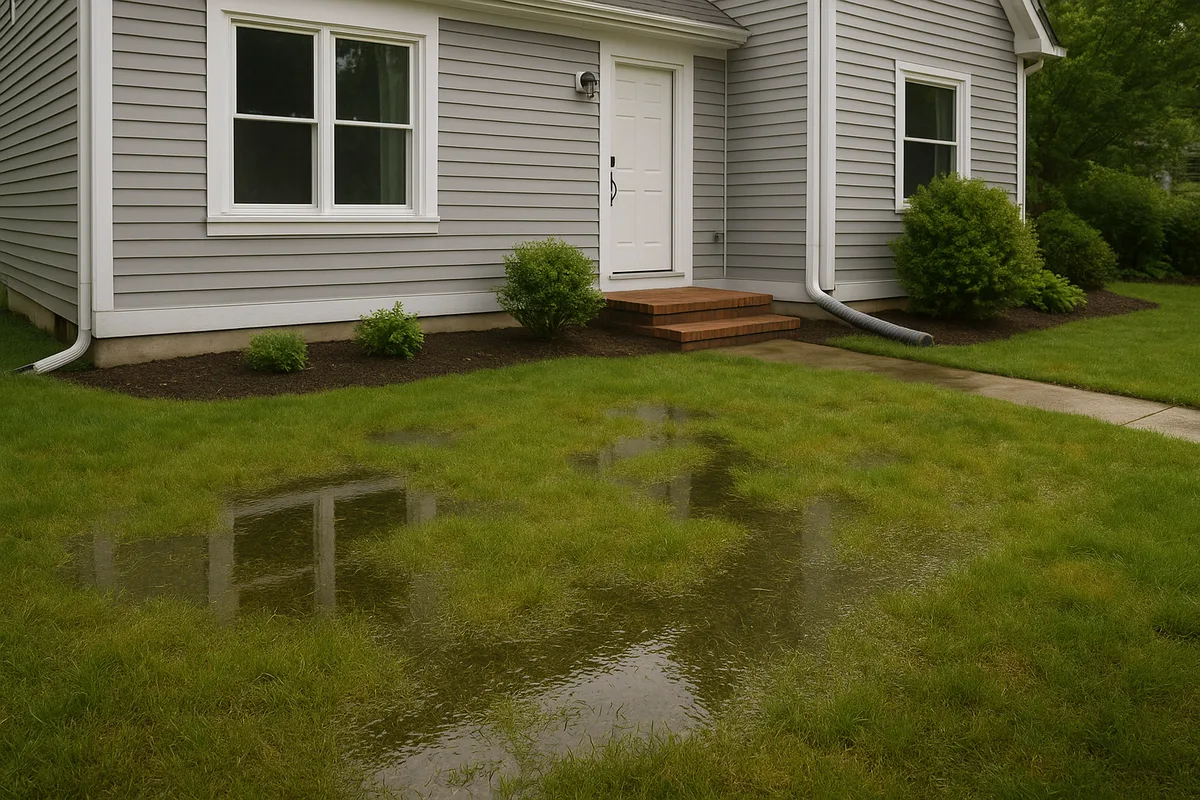
The most common reason a French drain stops working is sediment infiltration. Over time, fine soil particles—silt, clay, and organic matter—migrate into the gravel bed and pipe, reducing the system's ability to transmit water. This process is gradual and often invisible until the drain has lost most of its capacity.
How Sediment Gets In
Sediment enters a French drain through several pathways. The most significant is soil migration from the trench walls and bottom. Without adequate filtration fabric or with improperly installed fabric, native soil particles are carried by water flow into the gravel voids. Clay soils are particularly problematic because their particles are so fine (less than 0.002 mm in diameter) that they can pass through even moderately effective barriers.
Surface water carrying suspended sediment can also enter from above if the trench lacks a proper cap or if the landscape above the drain is prone to erosion. Downspout connections that dump roof runoff directly into a French drain without a sediment trap introduce asphalt granules, leaf debris, and other particulates. Even biological activity—root growth, decomposing organic matter, and biofilm formation—contributes to progressive clogging.
The Clogging Timeline
A French drain installed without filter fabric in clay soil can begin showing reduced performance in as little as 2–3 years. With proper fabric and clean aggregate, the timeline extends to 15–25 years or more. However, most residential French drains fall somewhere in between because of partial measures—fabric that was installed but lapped incorrectly, aggregate that contained too many fines, or surface conditions that overwhelm the system's filtration capacity.
The clogging process follows a predictable curve. Initially, sediment fills the smallest voids in the gravel bed, reducing porosity but not yet impacting flow significantly. As more fines accumulate, the gravel bed's hydraulic conductivity drops sharply. Eventually, a layer of low-permeability material forms around the pipe—sometimes called a "sediment sock"—that prevents water from entering the perforations at all. At this point, the French drain is effectively clogged, and the system behaves as if the pipe weren't there.
Signs Your French Drain Is Clogged
Homeowners often miss early warning signs because the drain is buried. Watch for these indicators:
- Standing water above the trench after rain events that previously drained quickly
- Saturated soil adjacent to the drain that wasn't saturated in prior years
- Water emerging at the surface along the trench line during heavy rain
- Reduced or no flow at the discharge point during storms
- Foundation moisture or basement seepage returning after a period of being dry
- Musty odors from crawlspaces or basements that had been resolved by the drain
If your discharge point is accessible, check it during a rainstorm. A healthy French drain should produce a steady flow within 15–30 minutes of moderate rainfall. Little to no flow during active rain is a strong indicator that the system is compromised.
Installation Mistakes That Doom French Drains From Day One
Many French drains are destined to fail before the trench is even backfilled. Installation errors are the second most common cause of French drain failure, and they're entirely preventable with proper knowledge and technique.
Insufficient or Reverse Slope
A French drain relies on gravity to move water. The pipe must maintain a consistent downhill slope from the collection area to the discharge point. The minimum recommended slope is 1% (approximately 1/8 inch per foot), but 2% (1/4 inch per foot) provides a much more reliable system with better self-cleaning velocity.
One of the most common installation errors is inconsistent slope—sections of pipe that are level or even slope slightly uphill due to uneven trench excavation. These low points become sediment traps where particles settle out and accumulate. Over time, they create blockages that back water up through the system.
Even worse is a drain installed with an overall reverse slope, directing water away from the discharge point. This happens more often than you'd think, particularly on properties where the topography is subtle and installers rely on visual estimation rather than actual grade measurements. A laser level or transit should be used for every French drain installation—no exceptions.
Wrong Aggregate
The gravel surrounding the pipe is not just filler; it's a critical functional component. The ideal aggregate for a French drain is clean, washed, angular crushed stone in the 3/4-inch to 1-1/2-inch range. "Clean" means free of fines—dust, sand, and clay particles that would reduce void space. "Washed" means the aggregate has been rinsed during processing to remove these fines. "Angular" means the stones have rough, fractured surfaces that interlock and resist compaction better than smooth river rock.
Common aggregate mistakes include:
- Using unwashed gravel that contains 10–15% fines by weight, dramatically reducing initial permeability
- Using pea gravel (3/8-inch smooth stone) that compacts more easily and has smaller void spaces
- Using round river rock that shifts under load and creates channels where water bypasses the pipe
- Mixing aggregate sizes inconsistently, which allows smaller particles to fill voids between larger ones (a process called "gradation collapse")
The difference between washed #57 stone and unwashed pit-run gravel can be the difference between a 20-year drain and a 5-year drain.
Improper or Missing Filter Fabric
Geotextile filter fabric (also called landscape fabric in consumer contexts, though professional-grade geotextile is a different product) serves as the barrier between native soil and the gravel bed. It must allow water to pass through while blocking soil particles—a function defined by its apparent opening size (AOS) and permittivity ratings.
Installation mistakes with filter fabric include:
- Omitting it entirely, which is surprisingly common in DIY and budget contractor installations
- Wrapping only the pipe instead of lining the entire trench, which leaves the gravel exposed to soil migration from the trench walls
- Using the wrong weight or type—woven fabrics can clog faster than non-woven fabrics in fine-grained soils
- Failing to overlap seams by at least 12 inches, creating gaps where soil enters
- Placing fabric directly against perforations without a gravel buffer, which can cause fabric blinding (surface clogging of the fabric itself)
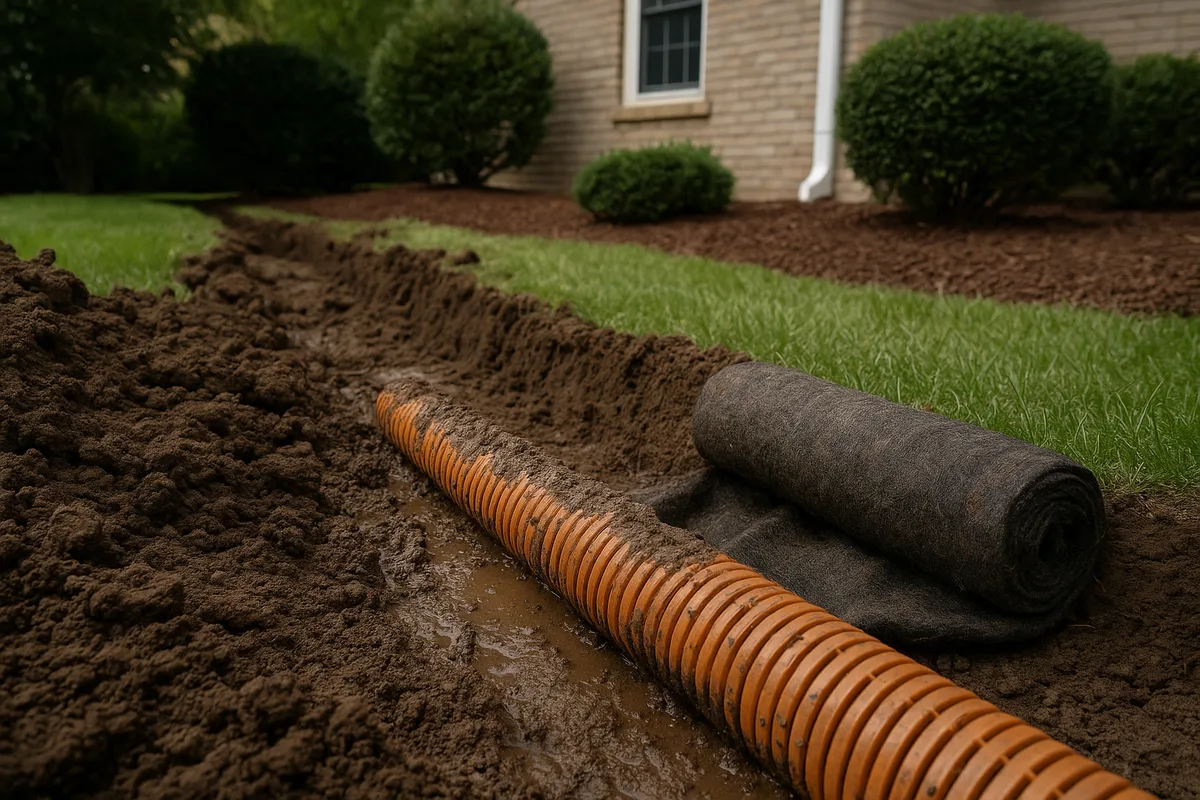
The correct method is to line the entire trench—bottom and sides—with non-woven geotextile, place a bed of clean gravel, set the pipe, backfill with more gravel to within 2–4 inches of the surface, fold the fabric over the top with adequate overlap, and then cap with topsoil or sod.
Inadequate Trench Dimensions
A French drain trench should be a minimum of 12 inches wide for residential applications, and 18–24 inches wide is better for areas with heavy water loads or clay soils. The pipe should sit on at least 2 inches of gravel at the bottom, with at least 3–4 inches of gravel on each side and 2–4 inches above.
Trenches that are too narrow don't provide enough aggregate volume to serve as an effective collection and filtration zone. The gravel bed isn't just protecting the pipe—it's the primary water collection mechanism. A 6-inch-wide trench with a 4-inch pipe leaves almost no functional gravel bed, and the system's capacity is limited to whatever water can enter the pipe perforations directly.
Depth matters too. For foundation drainage, the trench must extend to the base of the footing—or at least to the bottom of the basement slab. A French drain that sits 12 inches above the footing will not intercept water that's applying hydrostatic pressure at the foundation's base.
The Role of Soil Type in French Drain Performance
Not all soils interact with French drains equally, and failing to account for soil conditions is a major contributor to premature failure. The NRCS Web Soil Survey is an invaluable free tool for understanding what soil types exist on your property before designing a drainage system.
Clay Soils: The Worst-Case Scenario
Clay soils (Hydrologic Soil Group D) have extremely low permeability—often less than 0.06 inches per hour. This creates two problems for French drains. First, water moves so slowly through clay that it creates sustained hydrostatic pressure against the drain system, demanding higher capacity. Second, clay particles are so fine that they penetrate most filter fabrics over time, especially if the fabric is under pressure from saturated soil.
In heavy clay, French drains require more robust design: wider trenches, heavier-duty non-woven geotextile with appropriate AOS ratings for fine-grained soils, and sometimes a two-stage filtration approach with a sand layer between the native soil and the gravel bed.
Sandy and Silty Soils
Sandy soils (Hydrologic Soil Group A) are the most forgiving for French drains because they have high permeability and their particles are too large to migrate through standard geotextile. However, silty soils (often Group B or C) can be deceptive—they feel coarse but contain particles in the 0.002–0.05 mm range that are small enough to migrate through fabric and accumulate in gravel voids.
Silt is sometimes called the "silent killer" of French drains because it doesn't clog as dramatically as clay but steadily reduces system capacity over years. Properties with silty soils should use geotextile with a smaller AOS rating and may benefit from a sand filter envelope around the gravel bed.
Expansive Soils and Seasonal Movement
In regions with expansive clay soils—common across Texas, Colorado, the Carolinas, and much of the Southeast—seasonal shrink-swell cycles can physically damage French drain installations. As soil expands when wet, it can compress the gravel bed and deform flexible pipe. As it contracts when dry, it can create voids and channels that redirect water away from the drain or allow surface water to bypass the system entirely.
Rigid or semi-rigid corrugated pipe handles these forces better than flexible single-wall pipe, and wider trenches with more aggregate provide a buffer against soil movement.
Pipe Problems: Material, Diameter, and Configuration Errors
The pipe itself is another common failure point, and the choices made during installation have long-term consequences.
Single-Wall vs. Dual-Wall Corrugated Pipe
Single-wall corrugated pipe (the flexible black pipe with slots sold at home improvement stores) is the most commonly used pipe in residential French drains—and it's also the most failure-prone. Its corrugated interior creates turbulence that slows water flow and traps sediment in the valleys between corrugations. Over time, these sediment deposits reduce the pipe's effective diameter and can create complete blockages.
Dual-wall corrugated pipe (corrugated exterior, smooth interior) is significantly better. The smooth interior allows water and sediment to flow freely, and the corrugated exterior provides structural strength. It costs more but dramatically extends the life of the drain.
Rigid PVC pipe (Schedule 20 or SDR 35 with drilled holes) is the gold standard for longevity. Its smooth bore maximizes flow velocity and self-cleaning action, and it resists crushing and deformation. The trade-off is that it's more difficult to install on curved paths and requires fittings at direction changes.
Undersized Pipe Diameter
A 4-inch pipe is standard for most residential French drains, but it may be undersized for properties with significant water loads—large roof areas, high water tables, or heavy clay soils that concentrate runoff. A 4-inch smooth-bore pipe flowing at 1% slope can handle approximately 30 gallons per minute. If your system needs to manage more than that during peak events, a 6-inch pipe should be considered.
Undersized pipes don't just limit flow capacity—they clog faster because sediment represents a larger percentage of the available cross-section. A small amount of sediment in a 6-inch pipe is an inconvenience; the same amount in a 4-inch pipe can be a critical restriction.
Perforations Facing the Wrong Direction
This is a surprisingly contentious topic, but the physics are straightforward. For drains collecting subsurface groundwater (water table management), perforations should face downward (the 4 and 8 o'clock positions). This allows water to rise into the pipe from below as the water table reaches the pipe's invert elevation, while minimizing sediment entry from above.
For drains collecting surface runoff that percolates down through the gravel bed, perforations facing upward or to the sides may allow faster water entry. In practice, many installers use pipe with perforations on all sides (360-degree perforation), which works adequately when proper filtration is in place but increases clogging risk if filtration is inadequate.
Environmental and Site-Specific Causes of Failure
Even a well-installed French drain can fail if environmental conditions change or if site-specific factors weren't accounted for in the original design.
Root Intrusion
Tree and shrub roots are drawn to the moisture and nutrients inside French drain systems. Roots can enter through pipe perforations, joints, or cracks and grow to fill the pipe entirely. Species with aggressive root systems—willows, maples, poplars, and some ornamental grasses—are the worst offenders.
Root intrusion is best prevented by maintaining a buffer zone of at least 10 feet between the drain and any trees or large shrubs. Where this isn't possible, root barriers (physical or chemical) can be installed alongside the trench. Copper sulfate treatments are sometimes used to discourage root growth near drain lines, but they must be applied carefully to avoid harming desirable plants and contaminating discharge water.
Iron Ochre and Biological Clogging
In areas with iron-rich groundwater, a reddish-orange gelatinous substance called iron ochre can form inside French drains. This is the result of iron-oxidizing bacteria that thrive in the aerobic environment created where groundwater meets air inside the pipe. Iron ochre can coat pipe walls, block perforations, and clog the surrounding gravel bed.
Iron ochre is particularly common in the Northeast, Upper Midwest, and Pacific Northwest. It's extremely difficult to prevent entirely, but its effects can be managed through regular flushing, the use of larger-diameter pipe (to maintain flow even with coating), and the installation of cleanout access points for periodic jetting.
Changes in Uphill Drainage Patterns
A French drain designed for a specific water load can be overwhelmed if conditions change upstream. New construction on adjacent or uphill properties, changes in impervious surface coverage (new driveways, patios, or pool decks), regrading by neighbors, or even changes in municipal stormwater infrastructure can redirect water onto your property and exceed your drain's capacity.
This is why understanding your property's position in the broader topographic context matters. A French drain sized for the water load in 2020 may be undersized by 2026 if surrounding development has increased runoff to your lot. Periodic reassessment of drainage conditions is essential, especially in areas experiencing growth and development.
Freeze-Thaw Damage
In cold climates, water trapped in a French drain system can freeze, expanding and potentially cracking rigid pipes or deforming corrugated ones. More commonly, freeze-thaw cycles affect the gravel bed itself—ice lenses can form in the aggregate, displacing stones and creating channels that persist after thawing. Over many cycles, this can disrupt the gravel bed's uniform structure and create preferential flow paths that bypass the pipe.
French drains in freeze-prone regions should be installed below the frost line where possible (typically 36–48 inches in northern states) and should always maintain positive drainage to prevent standing water in the system during winter.
Diagnosing and Fixing a Failed French Drain
If your French drain is not working, systematic diagnosis will help you determine whether the system can be rehabilitated or needs replacement.
Step 1: Inspect the Discharge Point
Start at the outlet. Is it clear and unobstructed? Is water flowing during rain? A blocked discharge point—collapsed pipe, sediment buildup, or obstruction from landscaping—can back up the entire system. This is the easiest fix and should be checked first.
Step 2: Check Cleanout Access Points
If your system has cleanout risers (vertical pipe connections that provide access to the horizontal drain), open them during a rain event. Water standing in the cleanout above the pipe invert suggests a downstream blockage. No water in the cleanout during rain suggests the pipe isn't collecting water—pointing to clogged aggregate or failed fabric upstream.
If your system doesn't have cleanouts, this is a significant limitation. Any future installation or replacement should include cleanouts every 50–75 feet and at every change in direction.
Step 3: Camera Inspection
A plumbing camera (available for rent at many equipment rental centers) can be fed through cleanouts or the discharge point to visually inspect the pipe interior. This will reveal sediment buildup, root intrusion, pipe collapse, separated joints, or iron ochre accumulation. Camera inspection is the single most diagnostic step you can take.
Step 4: Flow Testing
Insert a garden hose into a cleanout or the upstream end of the system and run water at full volume. Measure how long it takes to appear at the discharge point and estimate the flow rate. Compare this to the theoretical capacity of the pipe at the installed slope. Significant reduction indicates partial clogging.
Rehabilitation Options
Depending on the diagnosis, several rehabilitation approaches may be viable:
- High-pressure jetting can clear sediment and root intrusion from the pipe interior. Professional jetting services use specialized nozzles that scour pipe walls at 3,000–4,000 PSI. This is effective for pipe-only blockages but does nothing for clogged aggregate.
- Snaking or augering can break through localized blockages but is less effective than jetting for distributed sediment.
- Chemical root treatment with copper sulfate or foaming root killer can address root intrusion, though it's a temporary measure if roots have access to the pipe.
- Partial excavation and aggregate replacement may be warranted if the gravel bed is clogged but the pipe is intact. This is labor-intensive but less expensive than full replacement.
When Full Replacement Is Necessary
If the pipe is crushed, separated at joints, or if the aggregate bed is thoroughly saturated with fine sediment, full replacement is usually the most cost-effective long-term solution. When replacing, treat it as an opportunity to correct any original design flaws—upgrade to dual-wall or rigid pipe, use properly sized and washed aggregate, install appropriate geotextile, add cleanouts, and verify slope with instruments.
Preventing French Drain Failure: Best Practices for Longevity
The most effective strategy is preventing failure in the first place. Whether you're planning a new installation or evaluating an existing system, these best practices dramatically extend French drain life.
Design for Your Specific Conditions
Cookie-cutter French drain installations ignore the most important variable: your property's unique combination of soil type, topography, water sources, and discharge options. A proper design starts with understanding the site—soil permeability, water table depth, contributing drainage area, rainfall intensity for your region, and available slope. Tools like the NOAA Atlas 14 precipitation frequency data can help you size the system for actual storm events rather than guesswork.
Specify the Right Materials
Every component matters:
- Pipe: Dual-wall corrugated (smooth interior) or rigid PVC, minimum 4-inch diameter
- Aggregate: Clean, washed, angular crushed stone, 3/4" to 1-1/2" (ASTM #57 or #2 stone)
- Geotextile: Non-woven, with AOS and permittivity ratings appropriate for your soil type
- Cleanouts: At every direction change and every 50–75 linear feet
- End caps and connectors: Properly fitted, not improvised with tape or friction fittings
Maintain Proper Surface Grading
A French drain is not a substitute for proper surface grading. The ground surface above and around the drain should be graded to direct surface water away from the trench where possible, reducing the sediment load on the subsurface system. The general recommendation is to maintain a minimum 5% slope (6 inches of fall over 10 feet) away from foundations for the first 10 feet, then a minimum 2% slope beyond that.
Schedule Regular Maintenance
French drains are not install-and-forget systems. An annual inspection of the discharge point, cleanouts, and surface conditions above the drain takes less than 30 minutes and can catch problems early. Every 3–5 years, consider a professional camera inspection and preventive jetting to clear any early-stage sediment accumulation.
Keep the area above the drain free of fine-grained mulch, topsoil amendments, and other materials that could wash into the system. If the drain runs beneath a lawn, maintain healthy turf cover to prevent erosion of the soil cap.
Document Everything
Record the drain's location, depth, slope, materials, and discharge point. Photograph the installation before backfilling. This information is invaluable for future maintenance, troubleshooting, and for any inspector or contractor who needs to work on the system years later. It also adds value to your property by demonstrating professional-grade drainage infrastructure.
Understanding Your Property's Drainage Before Installing a French Drain
A French drain is a tool, not a universal solution. Before committing to an installation—or trying to diagnose why an existing one has failed—you need to understand the full picture of how water moves across and beneath your property. Surface topography, subsurface soil conditions, contributing drainage areas, and the location of natural low points all influence whether a French drain is the right solution and, if so, where it should go and how it should be designed.
This is where most homeowners and even many contractors fall short. A French drain installed in the wrong location, at the wrong depth, or without accounting for the broader drainage context is a French drain that's likely to underperform or fail. The cost of getting it right the first time is almost always less than the cost of excavating and replacing a failed system.
At Low Point Labs, we specialize in topographic drainage intelligence—helping homeowners, contractors, and inspectors understand exactly how water interacts with a property. If your French drain is not working, or if you're planning a new installation and want to ensure it's designed for your specific conditions, our drainage assessment services provide the detailed, data-driven analysis that separates lasting solutions from expensive mistakes. Explore our tools and services to get the drainage clarity your property deserves.
See Drainage Intelligence in Practice
Talk with our team or request an invitation to the platform.
Frequently Asked Questions
Common signs of a clogged French drain include standing water above the trench after rain, saturated soil near the drain line, water surfacing along the trench during storms, and little to no flow at the discharge outlet. If your basement or crawlspace moisture problems have returned after being resolved by the drain, clogging is a likely cause.
A properly installed French drain with clean washed aggregate, appropriate geotextile fabric, and correct slope can last 15–25 years or more. However, drains installed without filter fabric, with unwashed gravel, or in heavy clay soils may begin failing in as little as 2–5 years due to sediment clogging.
In some cases, yes. If the clog is limited to the pipe interior, high-pressure jetting through cleanout access points can clear sediment and root intrusion. However, if the gravel bed surrounding the pipe is saturated with fine soil particles, the aggregate must be excavated and replaced for the system to function properly again.
Clean, washed, angular crushed stone in the 3/4-inch to 1-1/2-inch range (ASTM #57 or #2 stone) is ideal. The aggregate must be free of fines—dust, sand, and clay—that would reduce void space and accelerate clogging. Avoid pea gravel, unwashed pit-run gravel, and round river rock.
For subsurface groundwater collection, perforations should face downward (4 and 8 o'clock positions) so water rises into the pipe from below while minimizing sediment entry from above. For surface runoff collection through a gravel bed, perforations facing upward or to the sides can work, but proper geotextile filtration is essential regardless of orientation.
The most common causes are a clogged pipe or gravel bed, a blocked discharge outlet, insufficient slope, or the system being overwhelmed by a water volume it wasn't designed to handle. Start by inspecting the discharge point for obstructions, then check cleanouts for standing water, which indicates a downstream blockage.
Related Articles
How Long Should Standing Water Last After Rain? A Drainage Guide
Neighbor's Water Draining Into Your Yard: Your Legal Rights and Practical Options