The City Built on Red Clay: Why Charlotte Has a Drainage Problem Unlike Any Other
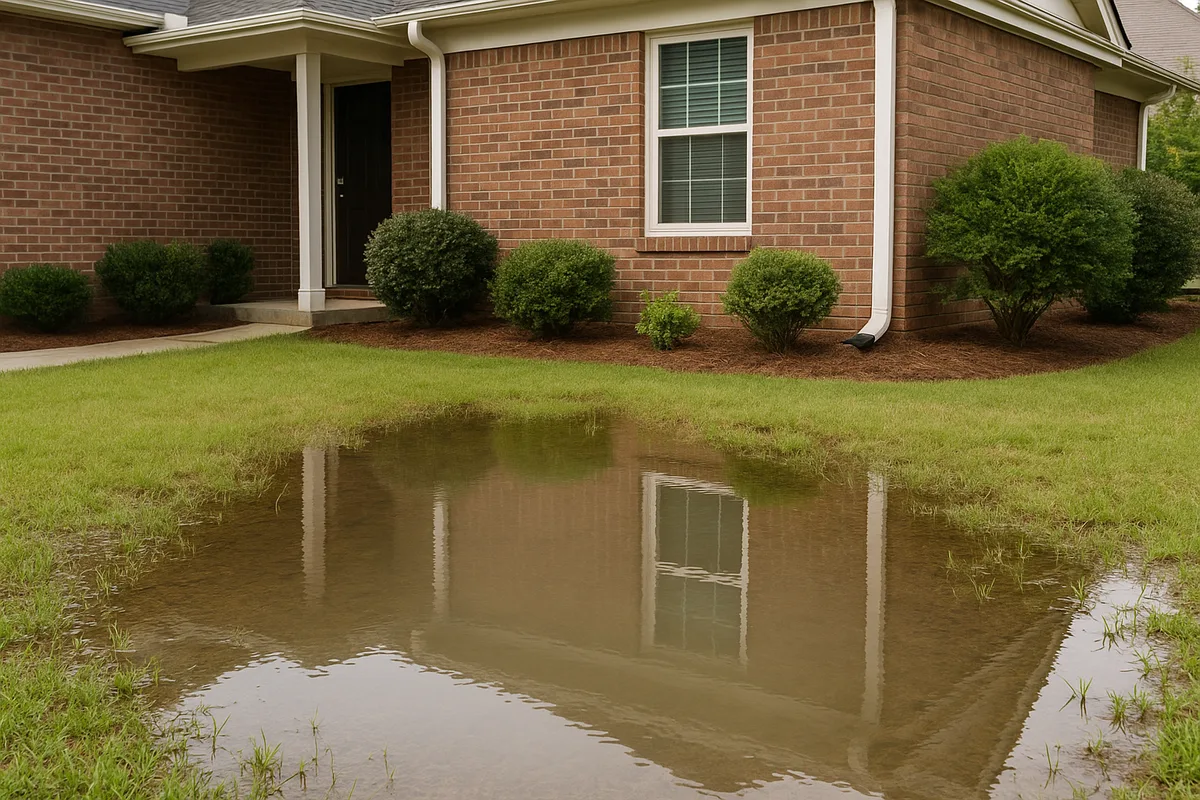
Charlotte sits squarely in the heart of North Carolina's Piedmont province, and its drainage challenges are defined by a single geological reality that shapes nearly every property in Mecklenburg County: the city is built on top of some of the most impermeable clay soils in the eastern United States. Piedmont red clay — technically classified as Cecil and related soil series — has a saturated hydraulic conductivity so low that during a sustained rain event, water simply has nowhere to go. It pools in yards, presses against foundation walls, seeps into crawl spaces, and overwhelms storm drains that were often sized for a smaller, less developed city.
What makes Charlotte's situation particularly acute in 2026 is the convergence of three forces. First, the city has added roughly 200,000 residents in the past decade, and the resulting development has replaced permeable surfaces with rooftops, driveways, and parking lots at a staggering pace. Second, Charlotte's average annual rainfall of approximately 50 inches — delivered increasingly in intense, short-duration bursts rather than gentle soaking rains — means the stormwater system is tested harder and more frequently than ever. Third, many of Charlotte's most desirable neighborhoods were developed in eras when grading standards were minimal, drainage easements were an afterthought, and builders routinely compacted already-tight clay soils with heavy equipment, creating properties that were essentially waterproofed against infiltration from the day the first family moved in.
If you own property in Charlotte, understanding how red clay, topography, development patterns, and stormwater regulations interact isn't optional — it's the difference between a dry basement and a costly remediation project. This guide covers everything Charlotte homeowners need to know.
Charlotte's Soil: Understanding Piedmont Red Clay at the Property Level
The dominant soil series across Mecklenburg County is the Cecil series — a deep, well-drained (in geological terms) residual soil derived from the weathering of igneous and metamorphic rocks, primarily granite and gneiss. The term "well-drained" in soil science refers to the soil profile's internal drainage over geological time, not to how your yard handles a Tuesday afternoon thunderstorm. The critical distinction for homeowners is between the upper soil horizons and the subsoil.
The A horizon — the topsoil — in undisturbed Cecil soils is typically a sandy clay loam, maybe 6 to 10 inches deep, with moderate permeability. It's the subsoil — the B horizon — that creates Charlotte's drainage nightmares. This is the dense, sticky, bright-red clay that everyone recognizes. It has a permeability rate that often falls below 0.6 inches per hour, and when it's been compacted by construction equipment, that rate can drop to 0.2 inches per hour or less. For context, a moderate Charlotte rainstorm can deliver 1 to 2 inches per hour. The math doesn't work.
You can look up the specific soil types on your property using the USDA Web Soil Survey, which provides detailed maps showing soil series, drainage class, depth to restrictive layers, and hydrologic soil group. Most of Mecklenburg County falls into Hydrologic Soil Group B or C, meaning moderate to slow infiltration rates. Properties closer to creek floodplains may show alluvial soils with different characteristics, but the dominant theme across Charlotte is clay.
What Construction Does to Already-Tight Soils
Here's the part that soil maps won't tell you: the condition of the soil on a developed lot is almost always worse than the native soil profile suggests. During construction, heavy equipment — excavators, dump trucks, concrete trucks — drives repeatedly across the lot, compacting the subsoil to near-impervious conditions. Builders then spread a thin layer of topsoil (often only 2 to 4 inches, despite Mecklenburg County's current requirement for a minimum of 4 inches) over the compacted subgrade, lay sod, and call it done.
The result is a property where the top few inches of soil can absorb water, but the compacted layer beneath acts like a bathtub liner. Water saturates the thin topsoil layer and then moves laterally — downhill, toward foundations, into window wells, against retaining walls. This is why so many Charlotte homeowners report standing water in their yards even on properties that appear to have adequate slope. The USDA Natural Resources Conservation Service provides extensive guidance on soil compaction and remediation, and their research confirms that construction-compacted soils can take decades to recover natural permeability without active intervention.
Soil Variation Across Charlotte's Neighborhoods
While Cecil clay dominates, Charlotte's soil landscape isn't perfectly uniform. Properties in South Charlotte near the South Carolina border — in areas like Ballantyne, Marvin, and Weddington — tend to sit on slightly sandier variants of Piedmont soils, with marginally better drainage in some spots. Neighborhoods along the Catawba River corridor, including areas near Mountain Island Lake and Lake Wylie, often have alluvial soils that are wetter and more prone to seasonal high water tables.
In the University City area, NoDa, and parts of Plaza Midwood, the underlying geology shifts to include more mafic rock (dark-colored igneous rock), which weathers into even heavier, more expansive clay. Properties in these areas sometimes experience soil shrink-swell behavior — clay that expands when wet and contracts when dry — which can crack foundations and create preferential pathways for water intrusion.
Older neighborhoods like Dilworth, Myers Park, and Eastover sit on rolling Piedmont terrain with mature tree canopies that help with interception and transpiration, but many of these properties have aging or nonexistent drainage infrastructure, and the gentle slopes that looked adequate in the 1920s are now surrounded by impervious surfaces that concentrate runoff in ways the original builders never anticipated.
Charlotte's Topography and How It Drives Water Movement
Charlotte's topography is often described as "gently rolling," which is accurate at a regional scale but misleading at the property scale. The city sits on a series of low ridges and shallow valleys carved by the Catawba River watershed and its tributaries. The major creeks — Briar Creek, Little Sugar Creek, McAlpine Creek, Irwin Creek, McMullen Creek, Mallard Creek, and others — form the drainage backbone of the city, and every property in Charlotte ultimately drains to one of these waterways.
The practical implication is that Charlotte's topography creates thousands of small drainage micro-basins. A typical Charlotte lot might have only 3 to 5 feet of elevation change across its width, but that's enough to direct all surface water toward a single low point — which, all too often, is a foundation wall, a patio, or a neighbor's property. The US Geological Survey provides topographic data and streamflow information for Charlotte's watersheds that can help homeowners understand where their property sits in the larger drainage picture.
The Creek Corridor Problem
Charlotte's creek corridors are ground zero for the city's most serious drainage problems. Properties adjacent to Briar Creek (which runs through some of Charlotte's most expensive neighborhoods in Eastover and Myers Park), Little Sugar Creek (which passes through Midtown, Elizabeth, and the Dilworth area), and McAlpine Creek (which drains much of South Charlotte) face a dual threat: surface runoff from their own lots and rising creek levels during storms.
Mecklenburg County's floodplain maps, based on FEMA modeling, designate significant areas along these corridors as Special Flood Hazard Areas (Zone AE), meaning they have a 1% or greater annual chance of flooding. But the mapped floodplain doesn't capture the full picture. Many properties just outside the mapped flood zone experience chronic wet conditions, backyard flooding, and creek bank erosion that technically isn't "flooding" by FEMA's definition but is absolutely a drainage problem.
Mecklenburg County Storm Water Services has been aggressive about buying out properties in the most flood-prone areas — the county has acquired and demolished hundreds of homes along Little Sugar Creek and other corridors since the early 2000s — but thousands of properties remain in or near flood-prone zones.
Climate Patterns and What They Mean for Charlotte Drainage
Charlotte's humid subtropical climate delivers approximately 50 inches of precipitation annually, distributed fairly evenly across the calendar year. But averages mask the reality. Charlotte's most damaging drainage events aren't caused by total annual rainfall — they're caused by intensity.
The National Oceanic and Atmospheric Administration tracks precipitation intensity data, and Charlotte's trends are clear: the frequency of storms delivering 2 or more inches in a single event has increased measurably over the past two decades. A 2-inch rainfall event on saturated Piedmont clay generates enormous volumes of surface runoff. When that runoff hits the impervious surfaces of a developed city, it concentrates and accelerates.
Charlotte also experiences occasional tropical storm remnants that can deliver 5 to 10 inches or more over 24 to 48 hours. These events overwhelm even well-designed drainage systems and can cause catastrophic flooding along creek corridors. Monitoring forecasts through the National Weather Service is essential for Charlotte homeowners, particularly those near creek floodplains.
Seasonal Drainage Patterns
Charlotte's drainage challenges follow a distinct seasonal rhythm:
- Winter (December–February): Soils are typically near saturation from fall rains and reduced evapotranspiration. Frozen ground is rare but does occur during cold snaps, temporarily reducing infiltration to near zero. This is the season when crawl spaces and basements are most likely to show chronic moisture problems.
- Spring (March–May): Intense thunderstorms begin, often hitting saturated soils. This is Charlotte's highest-risk period for yard flooding and foundation water intrusion. Spring is also when most homeowners first notice drainage problems that developed over the winter.
- Summer (June–August): Intense, localized thunderstorms can drop 2+ inches in under an hour. Between storms, high temperatures and active vegetation can dry the upper soil layer, creating a false sense of security. The clay subsoil remains relatively impermeable regardless of surface conditions.
- Fall (September–November): Tropical storm season peaks. Charlotte is far enough inland that wind damage from hurricanes is usually moderate, but rainfall from tropical systems is the city's single largest flooding threat. Leaves clogging storm drains and yard inlets compound the problem.
Mecklenburg County Stormwater Regulations: What Property Owners Must Know
Mecklenburg County operates one of the most comprehensive stormwater management programs in the Southeast through Charlotte-Mecklenburg Storm Water Services (CMSWS). Understanding the regulatory environment is essential for any homeowner considering drainage improvements.
The Stormwater Fee
Every developed property in Charlotte pays a monthly stormwater fee based on the amount of impervious surface on the lot. This fee funds flood control, water quality programs, and creek restoration projects. Residential properties are assessed based on a standard billing unit. Homeowners can receive credits for on-site stormwater management practices like rain gardens and permeable pavement, though the credit application process requires documentation and inspection.
Post-Construction Stormwater Ordinance
Charlotte's post-construction stormwater ordinance applies to any development or redevelopment that disturbs 12,000 square feet or more of land. For individual homeowners, this means that major additions, large patio or driveway projects, or significant regrading may trigger stormwater management requirements. The ordinance requires that post-development runoff rates and volumes not exceed pre-development conditions — in practical terms, this means you may need to install detention or retention features if your project adds significant impervious surface.
Floodplain Development Regulations
Mecklenburg County's floodplain regulations are stricter than the federal minimum. The county maintains its own flood study data and floodplain maps, which in some areas show larger flood zones than the FEMA maps. If your property is in or near a mapped floodplain, any construction — including grading, fill, fences, and retaining walls — requires a floodplain development permit. Violations can result in fines and mandatory removal of unpermitted structures.
Homeowners can check their property's flood zone status through Mecklenburg County's online GIS system. If you're in a Special Flood Hazard Area, you're required to carry flood insurance if you have a federally backed mortgage. The National Flood Insurance Program provides information on coverage options and costs.
Grading Permits
Any grading that disturbs more than one acre requires an erosion control permit from Mecklenburg County Land Use and Environmental Services Agency (LUESA). For smaller projects, a grading permit from the city may still be required depending on the scope and location. Even if your drainage project doesn't technically require a permit, the county's setback requirements from creeks, wetlands, and property lines still apply.
Neighbor Disputes and the Common Enemy Doctrine
North Carolina follows a modified version of the "reasonable use" rule for surface water drainage. You cannot artificially collect and concentrate water and discharge it onto a neighbor's property in a manner that causes damage. This is a frequent source of disputes in Charlotte, where lot sizes are shrinking and homes are being built closer together. If your drainage project redirects water onto a neighbor's lot, you may be liable for damages. Conversely, if a neighbor's construction or landscaping is flooding your property, you may have legal recourse. The Environmental Protection Agency provides general guidance on stormwater management responsibilities, though specific legal questions should be directed to a North Carolina attorney familiar with property law.
Diagnosing Drainage Problems on Your Charlotte Property
Before spending money on solutions, you need to understand exactly what's happening with water on your property. Here's a systematic approach to diagnosing drainage problems in Charlotte's Piedmont clay environment.
Step 1: Walk Your Property During Rain
This is the single most valuable diagnostic step, and it costs nothing. The next time Charlotte gets a moderate to heavy rain (0.5 inches or more in an hour), put on boots and walk your entire property. Observe:
- Where water pools: Look for standing water that persists for more than 30 minutes after rain stops. In Charlotte's clay soils, some temporary pooling is normal, but water standing for hours indicates a grading problem or compaction issue.
- Where water flows: Follow the surface runoff paths. Where does roof water go after it leaves the downspouts? Where does water from the driveway and sidewalks flow? Does water from the street enter your property?
- Where water enters the house: Check the perimeter of the foundation for water intrusion. Look at basement walls, crawl space vents, and the threshold of garage doors.
- Erosion patterns: Look for ruts, exposed roots, washed-out mulch, or sediment deposits. These tell you where concentrated flow is occurring.
Step 2: Check Your Grading
The International Residential Code (and Charlotte's local building code) requires a minimum of 6 inches of fall in the first 10 feet away from the foundation. In practice, many Charlotte homes don't meet this standard — either because they were built before the requirement existed, because soil has settled over time, or because landscaping and additions have altered the original grade.
You can check your grading with a simple string level or a 10-foot board and a carpenter's level. Place one end of the board against the foundation at grade level and extend it outward. The far end should be at least 6 inches lower than the foundation end. Do this at multiple points around the house.
Step 3: Inspect Your Gutters and Downspouts
In Charlotte's clay environment, roof runoff management is arguably the single most important drainage element on your property. A 2,000-square-foot roof will generate approximately 1,245 gallons of water from a 1-inch rainfall. If that water is dumped at the foundation via short downspout extensions — or worse, directly into splash blocks sitting against the house — it's going straight into the soil next to your foundation, where the clay will hold it against the wall.
Check that:
- Gutters are clean, properly pitched, and not overflowing
- Downspouts are connected and intact
- Downspout discharge points are at least 6 feet from the foundation (10 feet is better)
- Underground downspout drains, if present, are flowing freely and not clogged
Step 4: Look for Signs of Chronic Moisture
Even between rain events, Charlotte properties with drainage problems often show telltale signs:
- Musty odors in the basement or crawl space
- Efflorescence (white mineral deposits) on foundation walls — this indicates water is migrating through the concrete
- Mold or mildew on lower walls, stored items, or floor joists in the crawl space
- Sticking doors and windows that may indicate foundation movement from soil moisture changes
- Cracks in foundation walls — particularly horizontal cracks in block foundations, which can indicate lateral pressure from saturated clay soil
- Damp or buckled flooring on slab-on-grade homes
Step 5: Understand Your Property's Position in the Watershed
Your property doesn't exist in isolation. It receives water from uphill neighbors, streets, and sometimes entire subdivisions. Use Mecklenburg County's online mapping tools to understand:
- Your property's elevation relative to neighbors
- The location of stormwater infrastructure (pipes, inlets, ditches) near your property
- Whether any drainage easements cross your property
- Your proximity to creeks and mapped floodplains
Common Drainage Solutions for Charlotte Properties
Charlotte's clay soils and rolling topography demand specific approaches. Solutions that work well in sandy coastal soils or flat Midwestern terrain may perform poorly here. Below are the most effective drainage interventions for Charlotte properties, ranked roughly by complexity and cost.
Grading Corrections
What it is: Reshaping the soil surface around your home to direct water away from the foundation and toward appropriate discharge points.
Why it works in Charlotte: Grading is the most fundamental drainage intervention and often the most effective. Because Charlotte's clay soils resist infiltration, surface grading has an outsized impact — water will follow the surface contour rather than soaking in.
Key considerations:
- Establish a minimum 5% slope (6 inches in 10 feet) away from the foundation on all sides
- Use compacted fill (not topsoil) to build up grade against the foundation, then cap with 4-6 inches of topsoil
- Avoid creating low spots or berms that trap water against the house
- Tie regrading into a comprehensive plan that considers where the water goes after it leaves the foundation area
- In Charlotte's clay, even a 1-2 inch correction in grade can make a dramatic difference in water behavior
Typical Charlotte cost: $1,500–$5,000 for foundation perimeter regrading on a standard residential lot; more for extensive yard regrading requiring equipment.
Downspout Extensions and Underground Roof Drain Systems
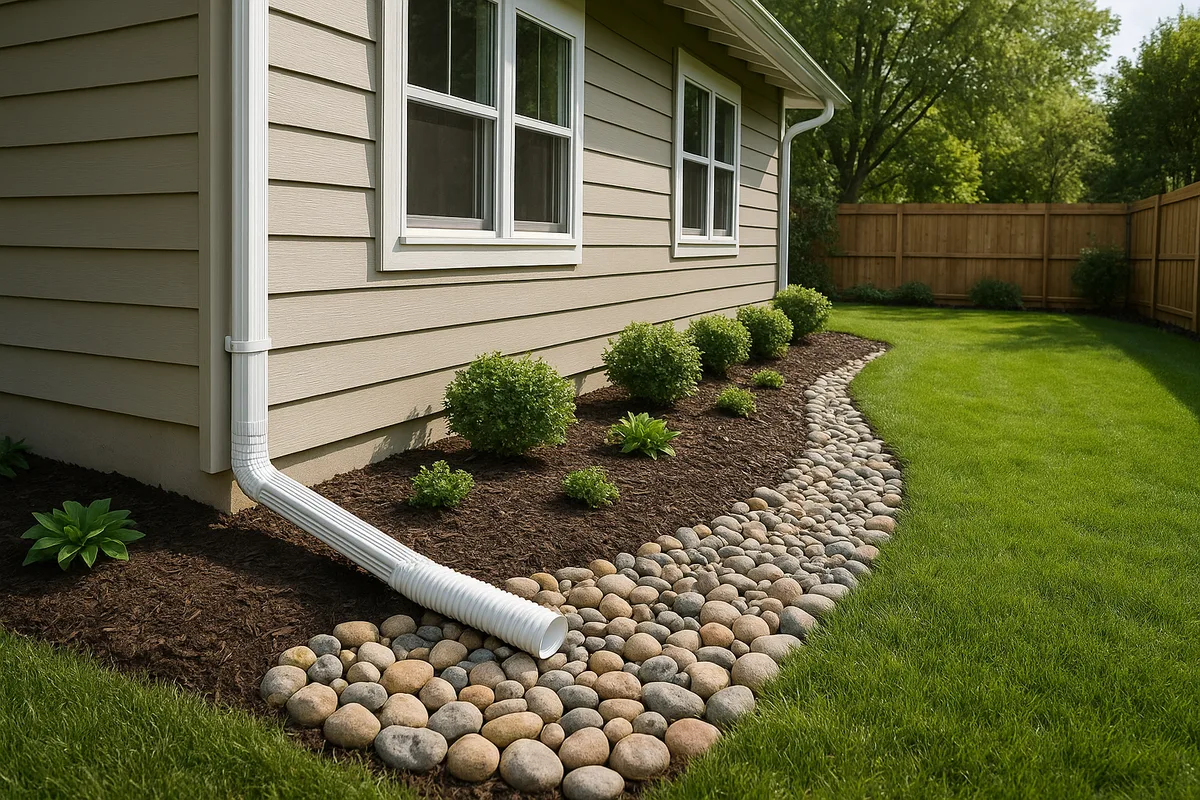
What it is: Extending downspout discharge points away from the foundation, either with above-ground extensions or buried solid PVC pipe that carries roof water to a safe discharge point (typically the street, a drainage swale, or a dry well).
Why it works in Charlotte: Roof runoff is the single largest controllable source of water near most Charlotte foundations. Getting it away from the house is high-impact and relatively low-cost.
Key considerations:
- Use solid 4-inch PVC pipe (not corrugated flex pipe, which clogs easily in Charlotte's silty clay environment)
- Maintain a minimum 1% slope on buried pipe (1/8 inch per foot)
- Discharge to daylight where possible — avoid terminating in the middle of the yard, where the clay soil can't absorb the volume
- Install cleanout access points at direction changes
- Pop-up emitters work well at discharge points and keep the system closed when not flowing
- NDS manufactures a full line of residential drainage products including pop-up emitters, catch basins, and channel drains commonly used in Charlotte installations
Typical Charlotte cost: $200–$600 per downspout for underground extension with pop-up emitter; $2,000–$6,000 for a complete whole-house underground roof drain system.
French Drains (Subsurface Drainage)
What it is: A trench filled with gravel and containing a perforated pipe that collects subsurface water and conveys it to a discharge point.
Why it works in Charlotte (with caveats): French drains are effective for intercepting subsurface water that moves laterally through the soil — which is exactly what happens in Charlotte's clay when the thin topsoil layer saturates. However, French drains in clay soils require careful design.
Key considerations:
- The trench must be deep enough to intercept water before it reaches the foundation — typically 18 to 24 inches minimum
- Use filter fabric to wrap the gravel and pipe — Charlotte's clay produces fine sediment ("fines") that will clog an unprotected system within a few years
- Rigid perforated PVC pipe (4-inch minimum) is strongly preferred over corrugated pipe in clay soils
- The system must have positive outfall — a French drain with no discharge point is just a buried bathtub that will fill up and stop working
- In heavy Charlotte clay, French drains often need to be combined with surface grading corrections for maximum effectiveness
- French drains along foundation walls ("footing drains") are a different system from yard French drains and typically require more extensive excavation
Typical Charlotte cost: $25–$50 per linear foot installed; a typical 100-foot residential French drain system runs $3,000–$6,000.
Surface Swales and Grassed Waterways
What it is: Shallow, vegetated channels designed to collect and convey surface water across a property.
Why it works in Charlotte: Swales work with Charlotte's clay soils rather than against them. Because the clay doesn't absorb water quickly, a properly graded swale can collect sheet flow and channel it to an appropriate outlet without requiring infiltration.
Key considerations:
- Swales should have a gentle V or U shape, with side slopes no steeper than 3:1 (3 feet horizontal for every 1 foot vertical)
- Minimum longitudinal slope of 1% to keep water moving; maximum of about 5% to prevent erosion
- Establish dense turf grass (fescue or bermuda, depending on sun exposure) to stabilize the swale
- Swales can be combined with check dams (small stone barriers) to slow water and reduce erosion on steeper slopes
- Mecklenburg County may require that swales in drainage easements be maintained and not obstructed
Typical Charlotte cost: $5–$15 per linear foot for a simple grassed swale; $15–$40 per linear foot for a swale with stone check dams or riprap lining.
Dry Wells and Infiltration Chambers
What it is: Underground chambers or gravel-filled pits designed to receive stormwater and allow it to slowly infiltrate into the surrounding soil.
Why it works in Charlotte (limited applications): Dry wells can be effective in Charlotte, but only in locations where the soil has sufficient permeability to absorb the stored water between storm events. In heavy clay subsoils, a dry well can become a permanent underground pond.
Key considerations:
- Conduct a percolation test before installing a dry well — if the surrounding soil can't absorb water at a rate of at least 0.5 inches per hour, a dry well is not appropriate
- Size the chamber to handle the volume from the contributing drainage area (typically roof downspouts)
- Locate dry wells at least 10 feet from foundations and property lines
- Dry wells work best in the sandier soil pockets that occasionally occur in Charlotte, particularly in some South Charlotte neighborhoods
- Modern infiltration chambers (like those from NDS or similar manufacturers) provide more storage volume than traditional gravel pits
Typical Charlotte cost: $1,500–$4,000 per dry well, depending on size and soil conditions.
Sump Pump Systems
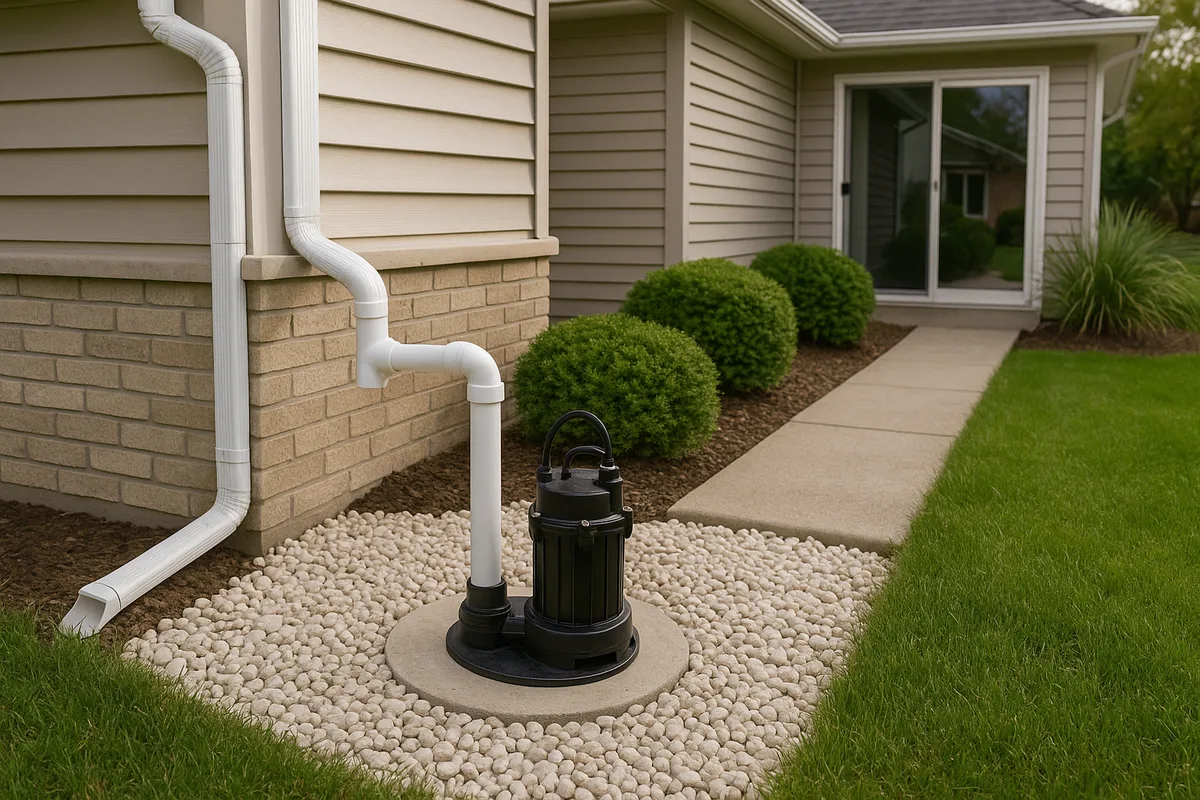
What it is: An electric pump installed in a pit (sump) at the lowest point of a basement or crawl space, designed to pump out water that accumulates below the floor level.
Why it works in Charlotte: Many Charlotte homes with basements — particularly in neighborhoods like Dilworth, Plaza Midwood, NoDa, and parts of South Charlotte — experience hydrostatic pressure from saturated clay soils pushing water through the foundation. A sump pump provides active removal of this water.
Key considerations:
- Install a battery backup system — Charlotte's thunderstorms frequently cause power outages, which is exactly when the sump pump is needed most
- Discharge the pump output at least 10 feet from the foundation via a dedicated pipe — do not discharge into the sanitary sewer (this is illegal in Charlotte)
- Consider a water-powered backup pump as a secondary system
- Sump pumps treat the symptom, not the cause — they should be combined with exterior drainage improvements where possible
- Monitor pump run frequency as a diagnostic tool — a pump running constantly indicates a serious water management problem that should be addressed at the source
Typical Charlotte cost: $1,200–$3,500 for a primary sump pump with battery backup, installed; $3,000–$8,000 for a full interior perimeter drain system with sump pump.
Rain Gardens and Bioretention
What it is: Shallow, planted depressions designed to capture and filter stormwater, allowing it to infiltrate slowly or overflow to a secondary outlet.
Why it works in Charlotte: Rain gardens are a cornerstone of Charlotte's green infrastructure strategy. Mecklenburg County actively encourages them and may offer stormwater fee credits for properly designed installations. The Low Impact Development Center provides design guidance for rain gardens in clay soil environments.
Key considerations:
- In Charlotte's clay soils, rain gardens must be designed with an engineered soil mix (typically 50-60% sand, 20-30% topsoil, 10-20% compost) to provide adequate infiltration
- Include an underdrain (perforated pipe at the bottom connected to an outlet) for clay soil sites — without it, the rain garden becomes a permanent pond
- Size the rain garden to handle runoff from the contributing area — a general rule is 20-30% of the contributing impervious area
- Plant with native species adapted to alternating wet and dry conditions — switchgrass, black-eyed Susan, cardinal flower, and blue flag iris all perform well in Charlotte
- Locate rain gardens at least 10 feet from foundations
Typical Charlotte cost: $3,000–$8,000 for a professionally installed rain garden with engineered soil and underdrain; $500–$1,500 for a DIY installation.
Retaining Walls and Terracing
What it is: Structural walls that hold back soil on sloped lots, creating level areas and controlling the direction of surface water flow.
Why it works in Charlotte: Charlotte's rolling topography means many lots have significant slope. Retaining walls can redirect surface flow, reduce erosion, and create usable yard space. However, they must be designed with drainage in mind.
Key considerations:
- Every retaining wall in Charlotte's clay soils MUST have drainage behind it — a gravel backfill zone with a perforated drain pipe at the base is non-negotiable. Without drainage, hydrostatic pressure from saturated clay will eventually push the wall over.
- Walls over 4 feet tall in Mecklenburg County typically require a building permit and engineered design
- Segmental retaining wall blocks are the most common material in Charlotte; poured concrete and timber walls are also used
- The American Society of Landscape Architects provides resources on integrating retaining walls with comprehensive landscape drainage design
Typical Charlotte cost: $25–$50 per square face foot for segmental block walls under 4 feet; $40–$75+ per square face foot for engineered walls over 4 feet.
Charlotte-Specific Cost Factors
Drainage project costs in Charlotte are influenced by several local factors:
- Clay excavation: Digging in Charlotte's red clay is significantly more difficult than in sandy or loamy soils. Wet clay is heavy and sticky; dry clay is hard as concrete. Expect excavation costs to be 20-40% higher than national averages.
- Disposal: Charlotte's clay soil is heavy (approximately 100-120 pounds per cubic foot when wet), which increases hauling costs. Some contractors charge by the ton for soil removal.
- Rock: Parts of Charlotte, particularly in the northern and western areas (Huntersville, Mountain Island, portions of west Charlotte), have shallow bedrock that can make trenching and grading extremely expensive. A site with rock at 18 inches may cost two to three times more to drain than a site with deep clay.
- Access: Charlotte's older neighborhoods often have narrow lots, mature trees, fences, and limited equipment access. Hand-digging is sometimes necessary, which increases labor costs significantly.
- Seasonal demand: Charlotte's drainage contractors are busiest from March through June, when spring rains expose winter's accumulated problems. Scheduling work in late summer or fall may yield better pricing and faster turnaround.
- Permitting: Factor in permit costs and timeline if your project triggers Mecklenburg County requirements. Permit fees for grading and stormwater projects typically range from $200 to $1,000+ depending on scope.
For homeowners dealing with flood damage or drainage-related property damage, the Small Business Administration offers disaster loans that can cover repair and mitigation costs, and FEMA's preparedness resources can help you develop a plan before the next major storm.
Neighborhood-Specific Drainage Challenges
Dilworth, Myers Park, and Eastover
These historic neighborhoods feature some of Charlotte's most beautiful homes — and some of its most persistent drainage problems. Many homes were built in the 1920s through 1950s with minimal foundation drainage. Mature tree roots can clog aging clay tile drain lines. Rolling terrain and proximity to Briar Creek and Little Sugar Creek put many properties at risk. Common issues include basement water intrusion, retaining wall failure, and erosion along steep backyard slopes.
South Charlotte (Ballantyne, Providence, Rea Farms)
Rapid development from the 1990s through 2010s created vast subdivisions on former farmland. Many of these neighborhoods were graded aggressively, with thin topsoil over heavily compacted clay. Common issues include standing water in flat backyards, failed builder-grade French drains (often installed with corrugated pipe that has since crushed or clogged), and erosion along common-area drainage channels. Properties backing to McAlpine Creek or its tributaries face floodplain concerns.
University City and Mallard Creek Area
This rapidly developing area in northeast Charlotte sits on some of the county's heaviest clay soils. Newer construction has generally better grading than older neighborhoods, but the sheer volume of development has increased runoff volumes dramatically. Properties near Mallard Creek frequently experience backyard flooding during heavy storms. The area's relatively flat terrain means water moves slowly and pools easily.
Steele Creek and Berewick
West Charlotte's Steele Creek area has seen explosive growth, with development pushing into areas that were historically rural. The terrain here is more rolling, and several tributaries of Steele Creek create flood-prone corridors. Newer subdivisions generally comply with current stormwater standards, but older properties and those near creek corridors face significant drainage challenges.
NoDa, Plaza Midwood, and Commonwealth
These trendy urban neighborhoods are experiencing intense infill development. New construction on small lots often maximizes building footprint, leaving minimal pervious area for stormwater management. The heavy clay soils in these areas compound the problem. Neighbors frequently dispute drainage when a new home is built uphill, and the additional impervious surface sends water cascading downslope.
Northlake and Mountain Island Area
Properties in this area often encounter shallow bedrock in addition to clay soils, making drainage solutions more expensive. Proximity to Mountain Island Lake and the Catawba River creates high water table conditions in some locations. The area's rolling terrain can create dramatic runoff patterns during storms.
Legal and Disclosure Requirements for Charlotte Property Owners
Real Estate Disclosure
North Carolina's Residential Property Disclosure Act requires sellers to disclose known material facts about a property's condition, including drainage problems, flooding history, and water intrusion. The standard disclosure form includes specific questions about water problems. Failure to disclose known drainage issues can result in legal liability after the sale.
For buyers, this means the disclosure form is a starting point, not the final word. Many drainage problems are intermittent or seasonal, and a seller may genuinely not be aware of conditions that only manifest during heavy rain events. The Department of Housing and Urban Development provides general guidance on housing standards and buyer protections.
Flood Insurance Requirements
If your Charlotte property is in a FEMA-designated Special Flood Hazard Area and you have a federally backed mortgage, you are required to carry flood insurance. Even if you're not in a mapped flood zone, flood insurance is available and often advisable — in Charlotte, a significant percentage of flood damage claims come from properties outside mapped flood zones. Standard homeowner's insurance does not cover flood damage.
Stormwater Easements
Many Charlotte properties are subject to stormwater drainage easements — strips of land where the city or county has the right to maintain drainage infrastructure. You cannot build structures, plant large trees, or significantly alter grade within these easements. Check your property's recorded plat for easement locations before planning any drainage work.
When to Call a Professional
Some drainage problems in Charlotte can be addressed by a capable homeowner with basic tools and a weekend of work. Others require professional expertise. Here's how to know the difference:
DIY-appropriate:
- Extending downspouts with above-ground extensions
- Minor grading corrections (adding soil to build up grade against the foundation)
- Cleaning and maintaining existing drainage systems
- Installing a simple rain garden in a suitable location
- Adding splash blocks or gravel pads at downspout discharge points
Professional recommended:
- Any project involving excavation deeper than 18 inches
- French drain installation (proper design and installation are critical in clay soils)
- Foundation waterproofing or interior perimeter drain systems
- Retaining wall construction over 2 feet tall
- Projects requiring permits or located near floodplains or creeks
- Any situation involving water intrusion into living spaces
- Disputes with neighbors over drainage
Choosing a Charlotte Drainage Contractor
The Charlotte market has a wide range of contractors offering drainage services, from landscape companies that occasionally do drainage work to specialized drainage and waterproofing firms. Here's what to look for:
- Specialization: Choose a contractor whose primary business is drainage, grading, or waterproofing — not a general landscaper who "also does drainage"
- Licensing: North Carolina requires a general contractor's license for projects over $30,000. For smaller drainage projects, there is no specific drainage contractor license, but look for contractors with relevant certifications.
- Insurance: Verify general liability and workers' compensation insurance. Drainage work involves excavation near foundations and utilities — the liability exposure is significant.
- References: Ask for references from completed drainage projects in Charlotte, ideally in your neighborhood or on similar soil conditions. The American Society of Civil Engineers and the Water Environment Federation maintain resources on stormwater management best practices that can help you evaluate a contractor's proposed approach.
- Written proposals: Get detailed written proposals that specify materials, dimensions, slopes, discharge points, and warranty terms. Beware of vague proposals that promise to "fix the drainage" without explaining how.
- Warranty: Look for a minimum 1-year warranty on workmanship; 2-5 years is better. Understand what the warranty covers — does it cover system performance (the yard stays dry) or just materials and installation?
The Role of Trees and Vegetation in Charlotte Drainage
Charlotte's urban canopy is one of the city's defining features, and trees play a significant role in drainage. A mature hardwood tree can transpire 100+ gallons of water per day during the growing season, effectively acting as a biological pump that removes water from the soil. Charlotte's large oaks, maples, and tulip poplars provide meaningful stormwater benefits.
However, trees also create drainage challenges:
- Root intrusion: Tree roots can penetrate and clog perforated drain pipes, especially older clay tile systems common in Charlotte's historic neighborhoods
- Surface root competition: Large surface roots can disrupt grading and create channels that direct water toward foundations
- Leaf litter: Charlotte's deciduous canopy drops enormous volumes of leaves in fall, clogging gutters, downspouts, and surface drainage inlets
- Canopy interception: While trees intercept rainfall (reducing the volume reaching the ground), they also create drip lines where concentrated water falls — if your gutter system is inadequate, the drip line effectively becomes a linear water source around the perimeter of the house
Charlotte's tree protection ordinance limits the removal of significant trees, so drainage solutions often need to work around existing trees rather than removing them. The Cooperative Extension System provides research-based guidance on managing trees and vegetation in the context of residential drainage.
Emerging Trends in Charlotte Drainage Management
Green Infrastructure
Charlotte-Mecklenburg Storm Water Services has been a regional leader in promoting green infrastructure — rain gardens, bioswales, permeable pavement, and green roofs — as alternatives to traditional pipe-and-pond stormwater management. The city's stormwater fee credit program incentivizes property owners to install these features. American Rivers advocates for green infrastructure approaches in urban watersheds like Charlotte's and provides case studies from similar cities.
Flood Mapping Updates
Mecklenburg County is continuously updating its flood maps using advanced modeling techniques, including detailed LiDAR topographic data. These updated maps often show larger flood zones than older FEMA maps, which can affect property values, insurance requirements, and development options. Homeowners near creek corridors should monitor map revision announcements from both Mecklenburg County and FEMA.
Climate Adaptation
Charlotte's stormwater infrastructure was largely designed based on historical rainfall data. As precipitation intensity increases, the city is reevaluating design standards for new development. For existing homeowners, this means that drainage systems installed 20 or 30 years ago may be undersized for current rainfall patterns. If your property has a drainage system that "used to work fine but doesn't anymore," increased rainfall intensity may be part of the explanation.
Infill Development Impacts
Charlotte's urban core is experiencing intense infill development, with teardowns and new construction replacing older, smaller homes with larger structures on the same lots. Each infill project typically increases impervious surface coverage and can alter drainage patterns for neighboring properties. The National Association of Flood and Stormwater Management Agencies provides policy resources on managing stormwater impacts from urban infill.
Seasonal Maintenance Checklist for Charlotte Properties
Keeping your drainage system functional requires regular maintenance. Here's a Charlotte-specific seasonal schedule:
Spring (March–April)
- Inspect all gutters and downspouts; clean and repair as needed
- Walk the property during rain and note any new pooling or flow patterns
- Check sump pump operation and battery backup
- Inspect French drains and surface drains for clogging or settlement
- Verify that grading around the foundation hasn't settled over winter
- Clear debris from yard drains, catch basins, and swale inlets
Summer (June–July)
- Monitor for erosion after intense thunderstorms
- Maintain vegetation in rain gardens and bioswales
- Check for foundation cracks that may have developed from clay shrink-swell during dry periods
- Ensure irrigation systems aren't saturating soil near the foundation
Fall (October–November)
- Clean gutters after leaf drop — this is critical in Charlotte's heavily treed neighborhoods
- Install gutter guards if leaf clogging is chronic
- Inspect and clean underground downspout drains before winter
- Verify sump pump and backup are operational before winter rains
- Grade any low spots that developed during the year
Winter (December–February)
- Monitor crawl space humidity levels
- Check for ice damming in gutters during rare freezing events
- Plan and budget for spring drainage projects — contractors book up fast once the rain starts
What a Drainage Intelligence Report™ Reveals About Your Charlotte Property
Charlotte's combination of impermeable clay soils, rolling topography, intense rainfall, and rapid development creates a drainage environment where surface-level observation only tells part of the story. A Low Point Labs Drainage Intelligence Report™ provides a comprehensive, data-driven analysis of your property's drainage conditions — the kind of analysis that goes far beyond what a standard home inspection or a contractor's free estimate can deliver.
Our reports analyze your property's specific soil conditions, topographic position, grading adequacy, roof drainage effectiveness, proximity to flood zones and creek corridors, and compliance with Mecklenburg County stormwater requirements. We identify not just where water is going today, but where it's likely to go as conditions change — whether from neighboring development, climate shifts, or the natural settling and compaction that affects every Charlotte property over time.
Whether you're buying a home in Myers Park, evaluating a drainage complaint in Ballantyne, or planning improvements to a property in University City, a Drainage Intelligence Report™ gives you the objective, expert analysis you need to make informed decisions. Don't guess about drainage — know.
Get your Charlotte Drainage Intelligence Report™ today and take control of the water on your property.
Read more in our statewide drainage guide or explore the US Drainage Guide.
Frequently Asked Questions
The Low Point Labs Drainage Intelligence™ platform is accessible via invitation-led onboarding.