Interior vs. Exterior French Drains: Which One Solves Your Problem?
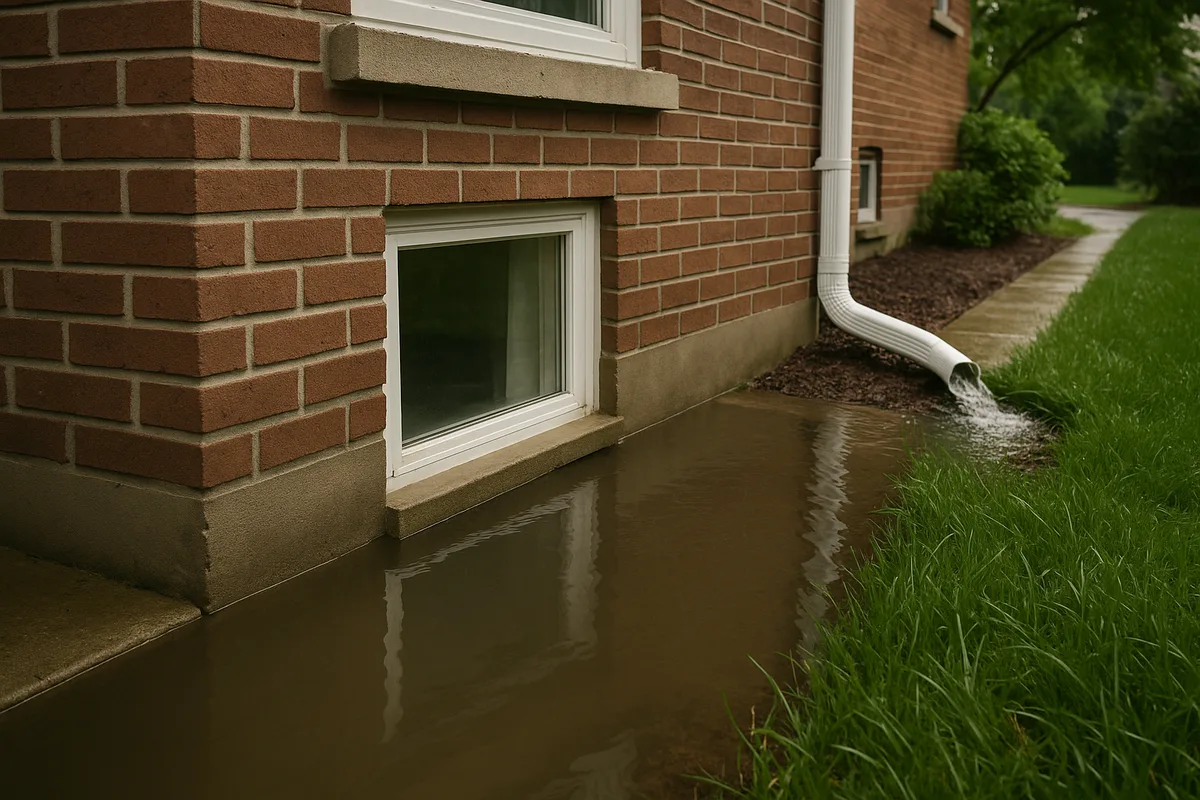
When water shows up where it shouldn't — pooling against your foundation, seeping through basement walls, or saturating your yard — a French drain is often the go-to solution. But the term "French drain" actually describes two fundamentally different systems: an interior French drain installed inside your basement or crawl space, and an exterior French drain buried around the outside perimeter of your foundation. Choosing the wrong one can mean spending thousands of dollars on a system that doesn't address the root cause of your water problem.
This guide breaks down the differences between interior and exterior French drains in detail — how each works, what problems each one solves, the installation process, realistic costs, and the long-term maintenance each system demands. By the end, you'll understand exactly which system matches your situation, or whether you need both.
How French Drains Work: The Core Principle
Before comparing interior and exterior systems, it helps to understand the shared engineering principle behind every French drain. At its core, a French drain is a gravity-driven water management system. It consists of a perforated pipe surrounded by gravel, installed in a trench that slopes toward a discharge point. Water follows the path of least resistance: instead of pushing against your foundation or saturating your soil, it enters the perforations in the pipe and flows downhill to a sump pump, storm drain, dry well, or daylight outlet.
The concept dates back to Henry Flagg French, a Massachusetts farmer and judge who described the technique in his 1859 book Farm Drainage. While the materials have evolved dramatically — from clay tiles to modern corrugated HDPE pipe and rigid PVC — the physics remain identical. Water under hydrostatic pressure seeks relief, and a properly installed French drain provides that relief in a controlled, predictable path.
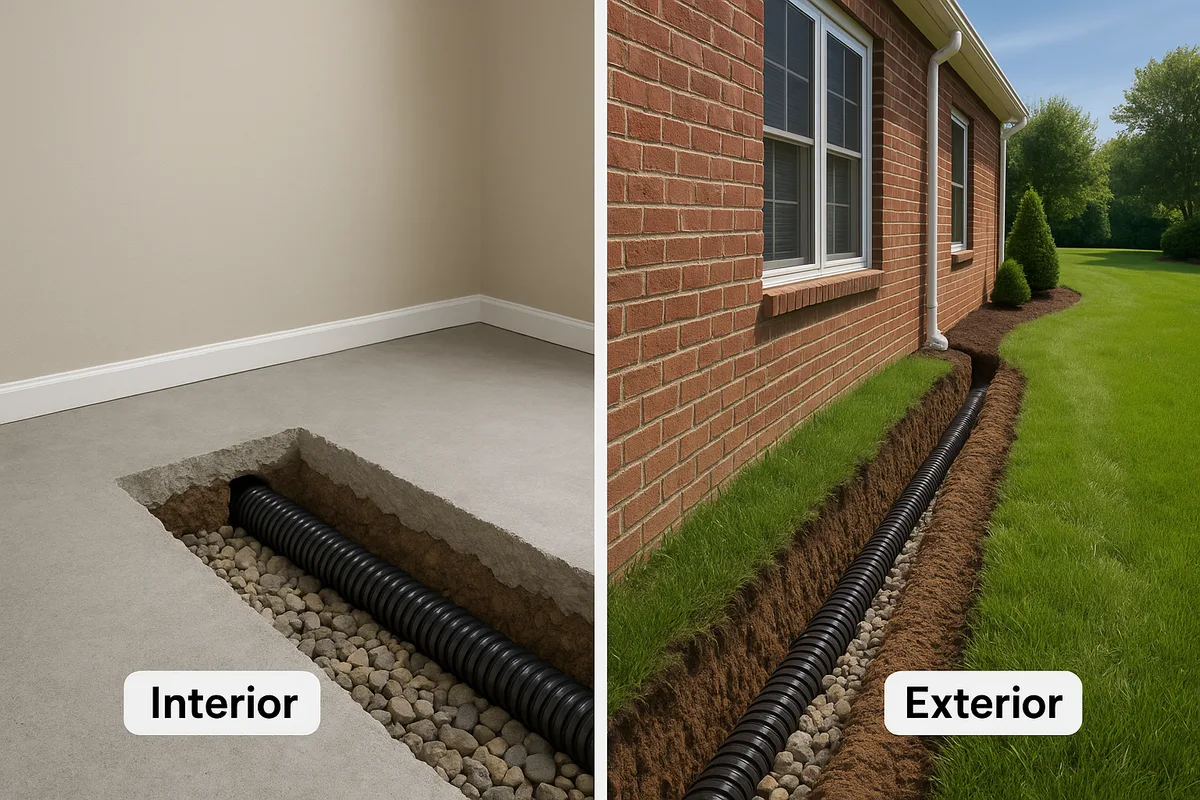
What separates an interior French drain from an exterior French drain isn't the mechanism — it's the location, the installation method, and critically, the type of water problem each one intercepts. An exterior system stops water before it reaches your foundation. An interior system manages water that has already made it past your foundation walls. This distinction is everything when it comes to choosing the right solution.
Exterior French Drains: Stopping Water at the Source
What an Exterior French Drain Does
An exterior French drain — sometimes called a footing drain, perimeter drain, or curtain drain depending on its exact placement — is installed in the soil outside your foundation. Its primary job is to intercept groundwater and surface water before it can build up hydrostatic pressure against your foundation walls and floor slab. Think of it as a defensive perimeter: water moving through the soil toward your house hits the gravel-filled trench first, drops into the perforated pipe, and gets routed away from the structure entirely.
Most exterior French drains are installed at or slightly below the level of the foundation footing. This positioning is critical because hydrostatic pressure increases with depth. By intercepting water at the lowest point of the foundation, the drain relieves pressure where it's greatest. The trench is typically 12 to 24 inches wide and extends down to the footing level, which can be 6 to 8 feet deep for a full basement. The pipe is laid on a bed of washed gravel, surrounded by more gravel, wrapped in filter fabric to prevent soil infiltration, and then backfilled.
When an Exterior French Drain Is the Right Choice
An exterior French drain is the ideal solution when your water problem originates from outside the home. Common scenarios include:
- High water table: If the seasonal water table rises to or above your foundation footing level, an exterior drain can lower the effective water table around your home by continuously intercepting and redirecting groundwater. You can research your local soil and water table conditions using the NRCS Web Soil Survey, which provides detailed hydrologic soil group data for any address in the United States.
- Surface water flowing toward the foundation: Yards that slope toward the house, or properties where neighboring lots drain onto yours, generate surface runoff that saturates the soil adjacent to the foundation. An exterior drain intercepts this water before it reaches the walls.
- Chronic lateral water pressure: If you see horizontal cracks in your basement walls, efflorescence (white mineral deposits), or damp patches that worsen after rain, the problem is almost certainly hydrostatic pressure from outside. An exterior drain addresses this directly.
- New construction or major renovation: If you're building a new home or already excavating around the foundation for other work, installing an exterior French drain is dramatically cheaper and easier because the trench work is already part of the project.
Installation Process
Installing an exterior French drain is a major excavation project. The process typically involves:
- Excavation: Digging a trench around all or part of the foundation perimeter, down to the footing level. For a standard basement, this means removing soil to a depth of 6 to 8 feet. Heavy equipment — typically a mini excavator — is required.
- Foundation inspection and waterproofing: With the foundation exposed, this is the ideal time to inspect for cracks, apply waterproof membrane coatings (such as rubberized asphalt or dimple board), and make structural repairs.
- Pipe installation: A 4-inch perforated pipe (rigid PVC Schedule 40 or corrugated HDPE) is laid on a 4-inch gravel bed at the base of the trench, sloped at a minimum of 1% grade (1/8 inch per foot) toward the discharge point.
- Gravel fill: The pipe is covered with 12 or more inches of washed, angular gravel (typically #57 stone). Round river rock is avoided because it shifts and compacts less effectively.
- Filter fabric: Geotextile filter fabric wraps the gravel to prevent fine soil particles from migrating into the drain and causing clogs over time.
- Backfill and restoration: The trench is backfilled with soil, and the surface — including landscaping, walkways, patios, or driveways that were removed — is restored.
The entire process for a typical single-family home takes 3 to 7 days and requires careful planning around utilities, landscaping, and access points for equipment.
Advantages of Exterior French Drains
- Addresses the root cause: An exterior drain stops water before it contacts the foundation, preventing both structural damage and interior moisture.
- Protects the entire foundation envelope: By keeping the soil around the foundation drier, an exterior drain reduces hydrostatic pressure, freeze-thaw damage, and soil expansion/contraction cycles that crack foundations over time.
- Enables simultaneous waterproofing: Excavation provides the opportunity to apply exterior waterproof membranes, which is the gold standard in foundation waterproofing.
- Longer lifespan when properly installed: Exterior drains with quality materials and filter fabric can function effectively for 25 to 40 years or more.
Disadvantages of Exterior French Drains
- High cost: Full-perimeter exterior French drain installation typically costs $8,000 to $25,000 or more, depending on depth, soil conditions, access, and regional labor rates. Homes with deep basements, rocky soil, or limited equipment access will be at the higher end.
- Major disruption: Excavation destroys landscaping, can damage driveways and walkways, and requires significant restoration work.
- Access limitations: Homes with additions built close to property lines, attached garages, porches, or decks may have sections of foundation that are physically inaccessible for exterior excavation.
- Not always practical for existing homes: If your home is 30 years old with mature landscaping and a finished yard, the disruption and cost of exterior excavation may be prohibitive.
Interior French Drains: Managing Water That's Already Inside
What an Interior French Drain Does
An interior French drain — also known as a perimeter drain system, sub-slab drain, or drain tile system — is installed inside the basement or crawl space, typically beneath or along the edge of the concrete floor slab. Unlike an exterior drain that prevents water from reaching the foundation, an interior French drain accepts that water will penetrate the foundation and provides a managed path for it to reach a sump pump, which then ejects the water away from the home.
The system works by collecting water that seeps through the foundation walls, rises through the floor slab via hydrostatic pressure, or enters through the wall-floor joint (called the cove joint). A channel is cut into the concrete floor along the perimeter of the basement, a trench is dug below the slab, perforated pipe is installed in gravel, and the concrete is patched over the top. Water enters the pipe and flows by gravity to a sump pit, where a sump pump activates automatically and discharges the water to the exterior.
When an Interior French Drain Is the Right Choice
An interior French drain is often the more practical solution for existing homes with water intrusion problems. It's the right choice when:
- Water is entering through the cove joint: The joint where the basement wall meets the floor slab is the single most common entry point for water in basements. An interior perimeter drain captures this water immediately.
- Exterior excavation is impractical or impossible: If your home has a sunroom addition, attached garage, close neighboring structures, or extensive hardscaping that makes exterior excavation cost-prohibitive, an interior system achieves water management without any exterior disruption.
- You need a faster, less disruptive solution: Interior French drain installation typically takes 2 to 4 days and doesn't affect your yard, landscaping, or exterior structures.
- Hydrostatic pressure is pushing water up through the slab: When the water table rises above the slab level, water can literally push up through cracks in the concrete floor. An interior drain with a sump pump relieves this upward pressure.
- Budget constraints: Interior systems are generally less expensive than full exterior excavation, making them accessible for more homeowners.
Installation Process
Interior French drain installation is less physically disruptive than exterior work, but it's still a significant construction project that involves:
- Concrete removal: A concrete saw cuts a channel 12 to 18 inches wide along the interior perimeter of the basement, approximately 6 inches from the foundation wall. The concrete is removed with a jackhammer.
- Trenching: A trench is dug 8 to 12 inches deep beneath the slab level. In some systems, the trench extends to the bottom of the footing.
- Pipe installation: Perforated drainage pipe (3-inch or 4-inch) is placed in the trench on a gravel bed, sloped toward the sump pit location.
- Gravel fill: The pipe is covered with washed gravel to allow water to flow freely into the perforations.
- Sump pit and pump installation: A sump pit (typically an 18- to 24-inch diameter basin) is set into the floor at the lowest point of the drain system. A submersible sump pump with a float switch is installed in the pit, with a discharge line routed to the exterior of the home.
- Concrete patching: The channel is filled with new concrete, leaving a finished surface that's flush with the existing floor.
- Optional wall vapor barrier: Many interior drain systems include a dimple membrane or vapor barrier installed on the interior face of the foundation walls. This membrane directs any wall seepage down into the perimeter drain channel rather than allowing it to evaporate into the basement air (which causes humidity and mold issues).
Advantages of Interior French Drains
- Lower cost: Interior systems typically cost $4,000 to $12,000 for a full perimeter installation, roughly 40% to 60% less than exterior systems.
- Minimal exterior disruption: Your yard, landscaping, driveway, and walkways remain untouched.
- Effective for cove joint and sub-slab water: Interior drains excel at managing the most common types of basement water intrusion.
- Year-round installation: Because the work is done indoors, interior French drains can be installed in any weather, any season.
- Accessible for maintenance: The sump pump is easily accessible for inspection, testing, and replacement.
Disadvantages of Interior French Drains
- Does not address the root cause: An interior drain manages water that has already entered the foundation envelope. It does not reduce hydrostatic pressure on the exterior walls or prevent moisture from contacting the concrete.
- Requires a sump pump: The system is dependent on a mechanical device. If the pump fails during a storm or power outage, the basement can flood. Battery backup and water-powered backup pumps mitigate this risk but add cost.
- Does not protect the foundation structure: Water still contacts the exterior of the foundation, which means ongoing exposure to freeze-thaw cycles, mineral dissolution, and potential structural degradation over time.
- Concrete dust and debris during installation: Cutting and removing concrete generates significant dust and noise. Professional installers use dust containment systems, but the process is still disruptive to the interior living space.
- Reduces usable basement space marginally: The sump pit occupies a small area of floor space, and the perimeter channel may slightly affect how you finish or furnish the basement.
Head-to-Head Comparison: Key Decision Factors
Cost
For most homeowners, cost is a primary consideration. Here's a realistic cost comparison for a typical 1,200-square-foot basement footprint (approximately 140 linear feet of perimeter):
| Factor | Interior French Drain | Exterior French Drain |
|---|---|---|
| Average total cost | $4,000 – $12,000 | $8,000 – $25,000+ |
| Cost per linear foot | $30 – $85 | $60 – $180 |
| Sump pump (included) | Yes | Sometimes |
| Exterior waterproofing | No | Often included |
| Landscaping restoration | None needed | $1,000 – $5,000+ |
| Typical project duration | 2 – 4 days | 3 – 7 days |
These ranges vary significantly based on geographic location, soil conditions, depth of excavation, and the contractor's pricing model. Rocky soil, high water tables, and limited access all push exterior costs higher. Interior costs increase if the basement has extensive finished walls or flooring that must be removed and replaced.
Effectiveness by Water Source
The most important factor in choosing between an interior and exterior French drain is identifying where your water is coming from:
- Surface runoff and poor grading: Exterior French drain (combined with regrading)
- High water table: Either system works, but exterior is more comprehensive; interior is more practical for existing homes
- Cove joint seepage: Interior French drain
- Wall cracks above grade: Neither — this is a wall repair and exterior waterproofing issue
- Floor slab cracks with upward seepage: Interior French drain
- Lateral hydrostatic pressure causing wall bowing: Exterior French drain (structural repair also needed)
- Downspout discharge too close to foundation: Downspout extensions first, then exterior drain if needed
Longevity and Maintenance
Exterior French drains, when installed with proper filter fabric and quality materials, can last 25 to 40 years with minimal maintenance. The primary risk is clogging from fine sediment that migrates through the filter fabric over decades, or root intrusion from nearby trees. Unfortunately, inspecting or repairing an exterior drain requires re-excavation, which is expensive.
Interior French drains have a similar pipe lifespan, but the sump pump is a mechanical component with a typical life of 7 to 10 years. Pumps should be tested quarterly and replaced proactively before failure. The drain channel itself can be affected by iron ochre (a bacterial sludge common in areas with iron-rich groundwater), which requires periodic flushing. The advantage is that the sump pump and pit are easily accessible for maintenance and replacement.
Impact on Home Value
Both systems can positively impact home value by resolving water intrusion issues, which are among the most common deal-breakers in home inspections. An exterior French drain combined with exterior waterproofing is generally viewed more favorably by inspectors and buyers because it addresses the problem at its source. An interior system with a sump pump is effective but may raise questions from buyers about ongoing maintenance and pump reliability.
Regardless of which system you install, documentation matters. Keep records of the installation, including the contractor's name, warranty, system specifications, and any engineering assessments. These documents provide confidence to future buyers and their inspectors.
When You Need Both Systems
In some situations, the correct answer isn't interior or exterior — it's both. Homes with severe water problems often benefit from a layered approach:
- Exterior drain + exterior waterproofing membrane: Intercepts the majority of groundwater and surface water, reduces hydrostatic pressure, and protects the foundation structure.
- Interior drain + sump pump: Serves as a secondary safety net, capturing any water that still makes it through the foundation during extreme events or as the exterior system ages.
This dual approach is common in regions with consistently high water tables, heavy clay soils (Hydrologic Soil Group D), or homes in flood-prone areas. It's also recommended for high-value finished basements where even minor water intrusion would cause significant damage to finishes, furniture, and equipment.
If budget forces you to choose one, consider this rule of thumb: if you can practically and affordably install an exterior drain, do so — it's the more comprehensive solution. If exterior excavation is impractical, an interior French drain with a reliable sump pump system (including battery backup) is a proven, effective alternative that has kept millions of basements dry.
Common Mistakes That Cause French Drain Failures
Regardless of whether you choose an interior or exterior French drain, certain installation errors can cause premature failure:
Using the Wrong Gravel
The gravel surrounding the drain pipe must be washed, angular, and uniformly sized — typically #57 stone (3/4-inch to 1-inch). Using unwashed gravel introduces fine particles that clog the pipe perforations. Using round river rock allows too much soil migration. Using pea gravel (too small) reduces flow capacity. The gravel is not decorative filler — it's a critical filtration and flow component.
Insufficient Slope
French drains rely on gravity. The pipe must maintain a consistent downhill slope toward the discharge point — a minimum of 1% grade (approximately 1/8 inch per linear foot). Flat sections or belly dips in the pipe create standing water that leads to sediment accumulation, bacterial growth (especially iron ochre), and eventual blockage. Laser levels should be used during installation to verify consistent grade.
Omitting Filter Fabric
Filter fabric (geotextile) prevents surrounding soil from migrating into the gravel bed and clogging the system. Skipping this step — or using landscape fabric instead of proper non-woven geotextile — is one of the most common causes of French drain failure within 5 to 10 years. The fabric should wrap the entire gravel envelope, not just the pipe.
Discharging Water Too Close to the Home
The discharge point of any French drain system must move water far enough from the foundation that it doesn't simply re-enter the soil and cycle back. Sump pump discharge lines should extend at least 10 feet from the foundation, and ideally to a location that slopes away from the house. Discharging into a splash block 2 feet from the foundation wall defeats the entire purpose of the system.
Ignoring the Bigger Drainage Picture
A French drain is one component of a complete drainage strategy. If your gutters are clogged, your downspouts dump water at the foundation, and your yard slopes toward the house, a French drain is fighting an uphill battle (literally). Effective drainage starts with proper roof water management, correct surface grading (minimum 5% slope — 6 inches of fall over the first 10 feet from the foundation), and appropriate soil conditions around the home.
How to Diagnose Your Water Problem Before Choosing a System
Before investing in any French drain system, you need to accurately diagnose the source and path of your water problem. Here's a systematic approach:
Document the Timing
When does water appear? If it shows up within hours of a rainstorm, the source is likely surface runoff or rapid infiltration — suggesting an exterior drain and grading correction. If water appears days after rain or during spring snowmelt regardless of recent precipitation, the source is likely a rising water table — which either system can address, but an interior drain may be more practical.
Identify the Entry Points
Examine your basement carefully during or immediately after a water event. Is water coming through:
- The cove joint (wall-floor seam): Interior French drain territory
- Horizontal wall cracks: Structural concern + exterior waterproofing
- Window wells: Window well drains and covers
- Floor cracks: Interior French drain + possible sub-slab pressure relief
- Through the wall surface (efflorescence, damp patches): Exterior hydrostatic pressure — exterior drain preferred
Assess Your Soil
Soil type dramatically affects drainage behavior. Clay soils (Hydrologic Soil Groups C and D) hold water and create sustained hydrostatic pressure against foundations. Sandy soils (Groups A and B) drain quickly and rarely cause chronic foundation water problems. Understanding your soil type helps predict whether a drainage solution needs to handle sustained pressure or periodic surges.
Evaluate Your Topography
The land surrounding your home tells a story. If your property sits at a topographic low point relative to neighboring lots, you're collecting water from a larger area than just your own yard. If your lot has been regraded over the years — common with additions, patios, and landscaping projects — the original drainage design may have been compromised. A professional topographic drainage assessment can reveal these patterns and quantify the water volume your drainage system needs to handle.
Making the Final Decision
Choosing between an interior and exterior French drain comes down to three fundamental questions:
Where is the water coming from? If it's groundwater and surface runoff hitting your foundation from outside, an exterior French drain addresses the cause. If it's seepage through the cove joint or up through the slab, an interior French drain manages the symptom effectively.
Is exterior excavation practical? Consider access, landscaping, hardscaping, adjacent structures, and budget. If you can excavate, an exterior drain provides more comprehensive, longer-lasting protection. If you can't, an interior system is a proven alternative.
What's your risk tolerance? An interior system depends on a sump pump. If you're in an area with frequent power outages, or if your basement contains high-value finishes and equipment, you need to budget for battery backup, a water-powered backup pump, or a generator — or invest in the exterior system that doesn't rely on electricity to function.
Neither system is universally "better." The right French drain is the one that matches your specific water problem, your property's physical constraints, and your budget. The wrong choice isn't just a waste of money — it leaves the underlying problem unsolved while giving you a false sense of security.
At Low Point Labs, we specialize in topographic drainage intelligence that helps homeowners understand exactly how water moves across and around their property. Before you commit to any drainage solution, understanding your property's unique topographic profile — its slopes, low points, flow paths, and soil conditions — ensures you invest in the system that actually solves your problem. Explore our drainage assessment services to get the data-driven insight you need to make the right decision.
See Drainage Intelligence in Practice
Talk with our team or request an invitation to the platform.
Frequently Asked Questions
It depends on the water source. An exterior French drain is better for intercepting groundwater before it reaches your foundation, while an interior French drain is more practical for managing water that seeps through the cove joint or up through the floor slab. For existing homes where exterior excavation is impractical, an interior system with a sump pump is the most common and effective solution.
An interior French drain typically costs $4,000 to $12,000 for a full perimeter installation, while an exterior French drain costs $8,000 to $25,000 or more. Costs vary based on foundation depth, soil conditions, linear footage, and regional labor rates. Exterior systems cost more due to the heavy excavation and landscape restoration required.
A properly installed French drain with quality materials and filter fabric can last 25 to 40 years. However, interior systems include a sump pump that typically needs replacement every 7 to 10 years. The most common cause of premature failure is clogging from improper gravel, missing filter fabric, or root intrusion.
An exterior French drain around a foundation requires heavy excavation equipment and is not a practical DIY project. A shallow exterior French drain in a yard (not at footing depth) is possible for experienced DIYers. Interior French drains involve cutting concrete, working below the slab, and installing a sump pump — this is best left to professionals to ensure proper slope, waterproofing, and code compliance.
Interior French drains always require a sump pump because the water has no gravity outlet — it must be pumped up and out of the basement. Exterior French drains may not need a sump pump if the pipe can daylight (exit at ground level) on a downhill slope away from the home. If the exterior drain cannot achieve daylight, it also requires a sump pump.
A curtain drain is a type of French drain installed in the yard uphill from the home to intercept surface water and shallow groundwater before it flows toward the foundation. A French drain installed at the foundation footing level is typically called a footing drain or perimeter drain. Both use the same perforated pipe and gravel system, but they serve different purposes and are installed at different locations and depths.
Related Articles
Designing a Swale vs French Drain: How to Choose the Right System
Window Well Drainage: How to Stop Basement Window Leaks for Good