French Drain vs. Dry Well vs. Sump Pump: Picking the Right Fix
When water pools against your foundation, turns your backyard into a seasonal pond, or seeps into your basement after every rainstorm, you need a drainage solution — but choosing between a french drain vs. dry well vs. sump pump isn't always straightforward. Each system addresses water problems differently, and selecting the wrong one can mean wasted money, ongoing flooding, or even structural damage to your home.
The truth is that most homeowners don't have a single, universal water problem. They have a specific combination of topography, soil type, water table depth, and grading conditions that makes one solution far more effective than the others — or demands a combination of systems working together. In this guide, we'll break down exactly how each system works, the conditions where each one excels, the situations where each one fails, and a decision framework you can use to pick the right fix for your property.
How Each System Works: The Fundamentals
Before comparing these three drainage solutions head-to-head, it's essential to understand the basic mechanics of each. They all manage water, but they do so through fundamentally different principles: interception and redirection, infiltration and storage, and active mechanical removal.
French Drains: Intercepting and Redirecting Water
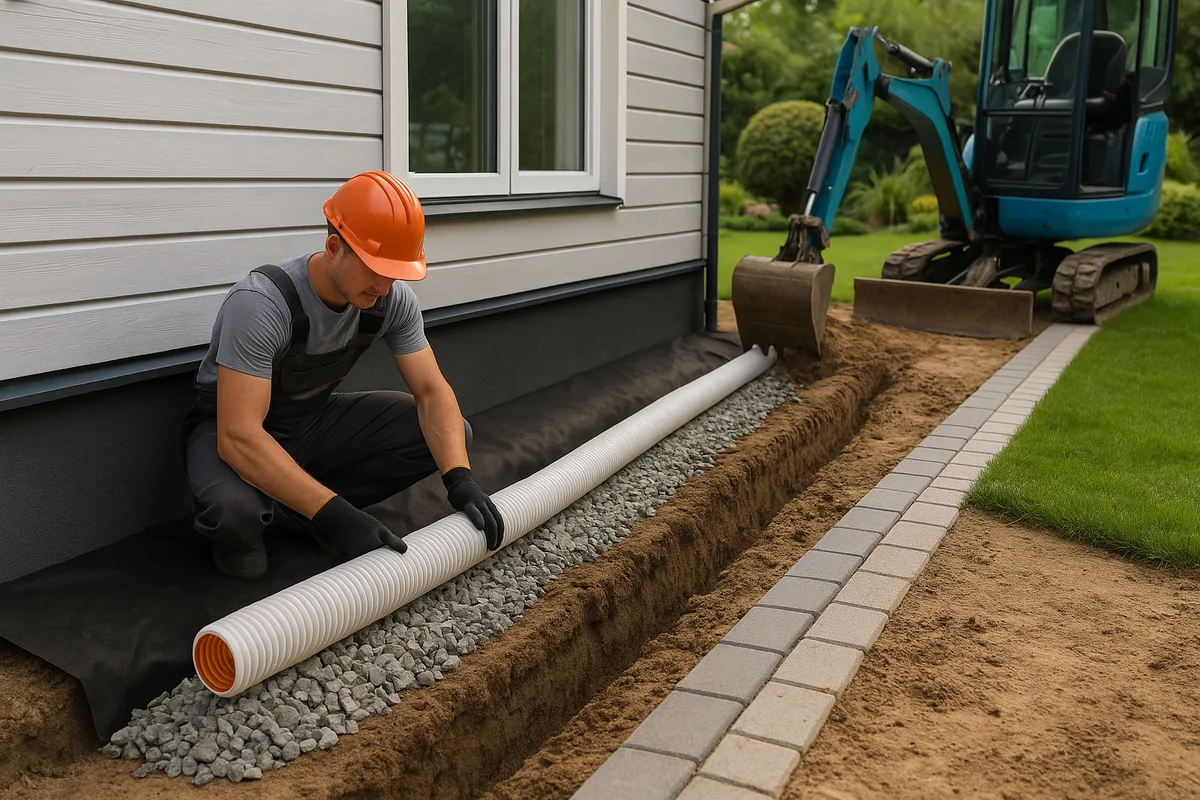
A french drain is a passive, gravity-driven system designed to intercept subsurface water and redirect it to a discharge point. The basic anatomy is simple: a trench (typically 12–24 inches wide and 18–36 inches deep) lined with landscape fabric, filled with washed gravel or crushed stone, and containing a perforated pipe (usually 4-inch rigid PVC or flexible corrugated pipe) at the bottom. Water enters through the gravel, flows into the perforations in the pipe, and gravity carries it along the pipe's slope to a designated outlet — a storm drain, a swale, a dry well, or daylight at a lower elevation on the property.
The critical engineering detail is slope. A french drain requires a minimum fall of approximately 1% (about 1 inch per 8 feet of run), though 1–2% is the recommended range for reliable flow. Without adequate slope, water stagnates in the pipe, sediment accumulates, and the system fails. This means french drains are inherently dependent on topography — you need a lower point to discharge to, or you need to create one.
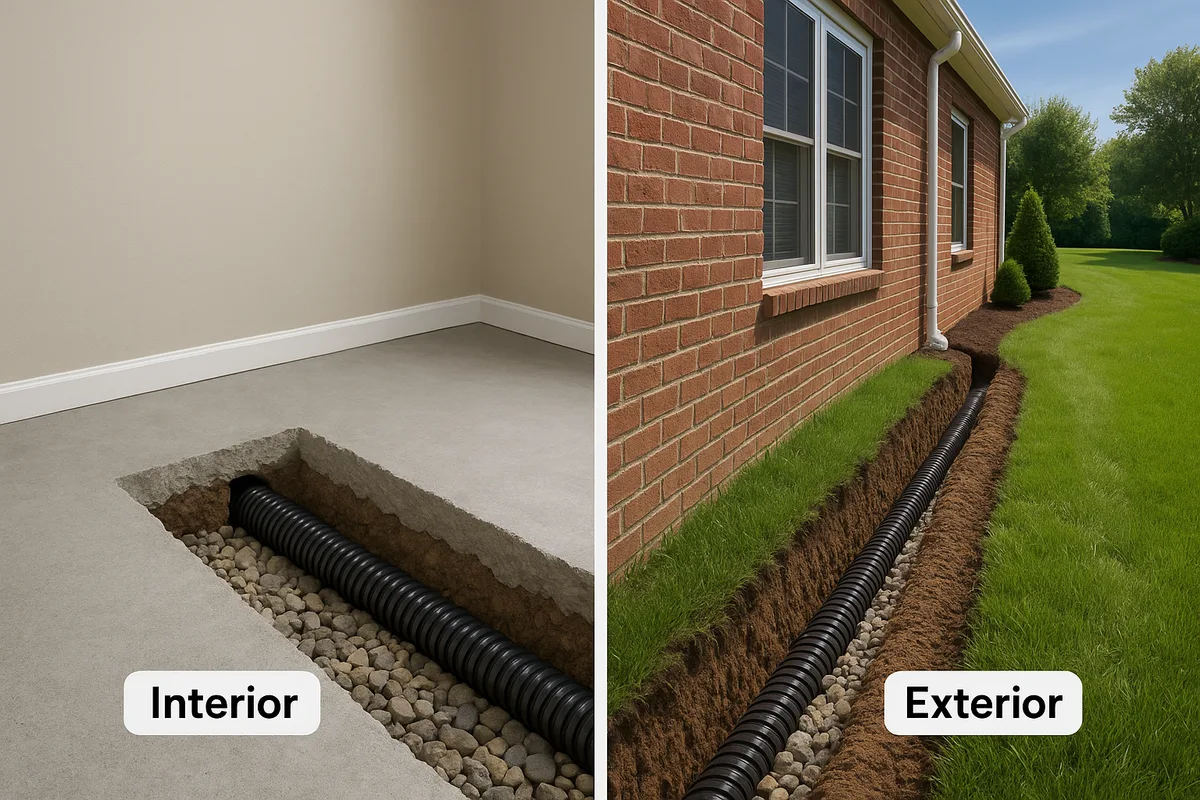
French drains can be installed along the exterior perimeter of a foundation (often called a footing drain or perimeter drain), across a yard to intercept sheet flow, or along the base of a hillside to capture seepage. Interior french drains — installed beneath a basement slab along the interior footing — are also common in basement waterproofing systems, where they typically discharge into a sump pit.
Dry Wells: Storing and Infiltrating Water
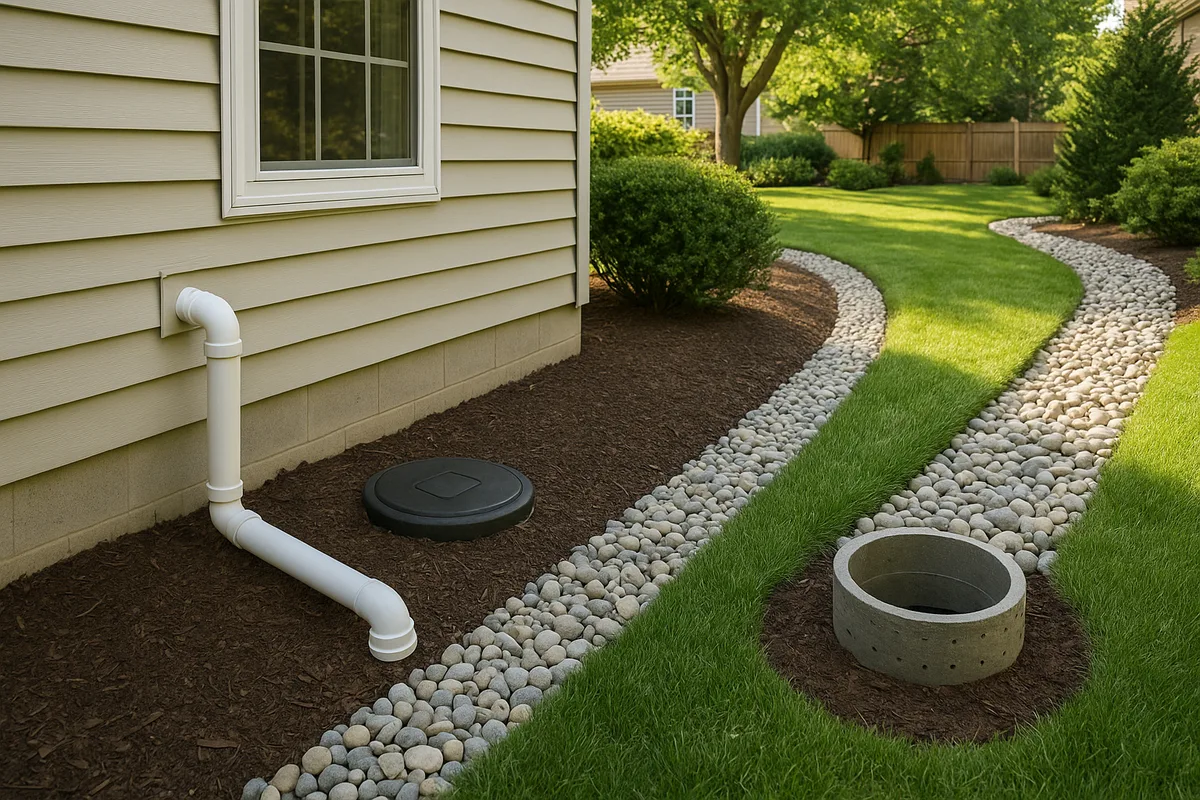
A dry well is an underground storage structure designed to collect stormwater runoff and allow it to slowly percolate into the surrounding soil. Think of it as an underground holding tank with holes. Modern dry wells are typically constructed from perforated plastic chambers, stacked concrete rings, or large gravel-filled pits wrapped in filter fabric. Sizes range from small 50-gallon units suitable for a single downspout to large multi-chamber systems handling several hundred gallons.
The key principle is infiltration. A dry well doesn't move water somewhere else — it gives water a place to soak into the ground at a controlled rate. This means the system's effectiveness is almost entirely dependent on the infiltration capacity of the surrounding soil. Sandy and gravelly soils with infiltration rates of 1 inch per hour or more are ideal. Clay soils with rates below 0.2 inches per hour can render a dry well essentially useless, as the well fills faster than it can drain and eventually overflows.
Dry wells are typically positioned at least 10 feet from the foundation (many codes require 12 feet or more) and connected to the water source — usually gutter downspouts or a french drain outlet — via solid (non-perforated) pipe. They're buried 2–4 feet below grade, and the bottom of the well should sit at least 2–4 feet above the seasonal high water table to allow adequate infiltration.
Sump Pumps: Mechanically Removing Water
A sump pump is an active, electrically powered system that mechanically lifts and discharges water from a collection pit (the sump basin or sump pit). The pump sits inside a basin — typically 18–24 inches in diameter and 22–36 inches deep — installed at the lowest point of a basement floor, crawl space, or even an exterior collection point. When water rises to a trigger level, a float switch activates the pump, which pushes water through a discharge pipe to an outlet away from the foundation.
Sump pumps come in two primary types: submersible pumps, which sit entirely inside the sump basin below the water line, and pedestal pumps, which mount above the basin with only the impeller submerged. Submersible models are quieter, more powerful, and generally preferred for residential applications. Standard residential sump pumps range from 1/3 to 1/2 horsepower and can move 2,000–3,500 gallons per hour at moderate lift heights.
The fundamental advantage of a sump pump is that it doesn't depend on gravity or soil conditions — it uses mechanical force to move water uphill and out. The fundamental disadvantage is that it requires electricity. When the power goes out during a storm — exactly when you need it most — a standard sump pump becomes a plastic bucket. Battery backup systems, water-powered backup pumps, and generator connections mitigate this risk but add cost and complexity.
French Drain vs. Dry Well: When to Choose Each
The comparison of french drain vs. dry well comes down to a fundamental question: does your property need to move water or absorb water? These are complementary functions, not competing ones, but most properties have a primary need.
Choose a French Drain When:
A french drain is the right choice when you have subsurface water moving laterally through the soil — hydrostatic pressure against a foundation wall, a high water table that rises seasonally, or groundwater seeping down a slope toward your home. French drains excel at interception: catching water that's already underground and rerouting it before it reaches a structure.
French drains are also the preferred solution when you have a viable discharge point at a lower elevation. If your property slopes toward a municipal storm drain, a roadside ditch, a natural swale, or simply a lower area of the yard where water can daylight safely, a french drain can deliver water there passively and indefinitely without any power source, moving parts, or ongoing maintenance beyond occasional inspection.
Yard grading problems — where surface water sheet-flows across a lawn toward the house because of improper slope — are another classic french drain scenario. A shallow french drain (sometimes called a curtain drain) installed perpendicular to the flow path intercepts the water before it reaches the foundation and diverts it to the side of the property.
Choose a Dry Well When:
A dry well is the right choice when you have concentrated surface runoff — typically from roof downspouts — and no convenient discharge point. Many suburban and urban properties don't have access to a storm drain, can't discharge onto neighboring properties, and don't have adequate slope to daylight a pipe. In these situations, a dry well provides on-site infiltration: the water stays on your property but goes into the ground rather than across it.
Dry wells are also increasingly required by local stormwater regulations. Many municipalities now mandate on-site stormwater retention for new construction and major renovations, requiring that a certain volume of runoff from impervious surfaces (roofs, driveways, patios) be infiltrated on-site rather than discharged to the municipal system. A dry well is one of the simplest ways to meet these requirements.
The critical prerequisite is soil permeability. Before installing a dry well, you should perform a percolation test (or review your property's soil data through the NRCS Web Soil Survey) to confirm that the soil can absorb water at a sufficient rate. Hydrologic Soil Group A (sands, gravels) and Group B (sandy loams, silt loams) soils are generally suitable. Group C and D soils (clay loams, heavy clays) are poor candidates, and a dry well installed in these soils will chronically overflow.
The Combination Approach
In many real-world scenarios, a french drain and dry well work together as a system. The french drain intercepts and collects water; the dry well receives and infiltrates it. This is especially common when a french drain has no gravity outlet — instead of trying to find a discharge point that doesn't exist, the drain terminates at a dry well that absorbs the collected water underground. This combined approach is one of the most effective residential drainage solutions available, provided soil conditions support infiltration.
French Drain vs. Sump Pump: When to Choose Each
The debate of french drain vs. sump pump often arises in the context of basement waterproofing, but the comparison extends to any situation where subsurface water threatens a structure. The core distinction is passive versus active: a french drain uses gravity; a sump pump uses electricity.
Choose a French Drain When:
If your property has adequate slope to create a gravity-fed discharge path, a french drain is almost always preferable to a sump pump for exterior applications. It has no operating cost, no mechanical failure risk, no dependency on the power grid, and a lifespan measured in decades when properly installed with quality materials. An exterior perimeter french drain installed at the footing level, with proper waterproofing membrane on the foundation wall and a gravity outlet to daylight, is the gold standard for foundation drainage.
French drains are also the better choice for managing diffuse subsurface water across a yard. A sump pump requires water to collect in a single point (the basin), which means you still need a collection system — often a french drain — to gather the water. In many cases, if you're already installing the collection infrastructure, you might as well route it to a gravity outlet and skip the pump entirely.
Choose a Sump Pump When:
A sump pump becomes necessary when gravity isn't an option. The most common scenario is a basement or crawl space where the floor is below the discharge elevation — water can't flow uphill on its own, so a pump must lift it. Interior basement waterproofing systems almost universally rely on a sump pump: an interior french drain (sub-slab drainage channel) collects water that enters through the footing joint or floor cracks and routes it to a sump pit, where the pump ejects it to the surface and away from the house.
Sump pumps are also the right choice when the volume and speed of water intrusion overwhelm what a passive system can handle. In areas with high water tables that rise rapidly during storms, a french drain alone may not have the capacity to keep up. A sump pump can move thousands of gallons per hour — far more than gravity flow through a 4-inch perforated pipe can typically deliver.
Properties in flood-prone areas or with chronic hydrostatic pressure issues often need a sump pump as the last line of defense, even if french drains handle the primary drainage load. Think of the sump pump as the emergency response system: it handles the water that gets past everything else.
The Interior Waterproofing System: French Drain + Sump Pump
The most common residential application where these two systems work together is interior basement waterproofing. Here's the typical configuration: a channel is cut into the basement slab along the interior perimeter of the foundation, a perforated drain pipe is installed in the channel surrounded by gravel, the channel is covered with new concrete, and the drain pipe slopes toward a sump pit in a corner of the basement. When water enters through the wall-floor joint (the most common entry point), it drops into the channel, flows through the pipe to the pit, and the sump pump ejects it outside.
This system is so effective and so widely used that many homeowners think of "french drain" and "sump pump" as parts of the same system rather than separate solutions. They can be — but they don't have to be. Understanding them as independent tools with distinct capabilities gives you more flexibility in designing the right solution for your specific problem.
Comparing Costs, Lifespans, and Maintenance
Practical considerations — budget, longevity, and ongoing effort — often drive the final decision as much as technical suitability. Here's how the three systems compare on these dimensions.
Installation Costs
Costs vary significantly by region, soil conditions, system size, and whether you hire a contractor or DIY, but these ranges provide a useful baseline for planning:
- French Drain (exterior): $25–$60 per linear foot installed, with most residential projects running 50–150 linear feet. Total project cost typically falls between $2,000 and $8,000. Interior french drains (sub-slab) tend to run higher — $40–$80 per linear foot — due to the concrete cutting and removal involved.
- Dry Well: $1,000–$5,000 per unit installed, depending on size and soil conditions. A single dry well handling 2–3 downspouts is a common residential configuration. Larger systems or those requiring extensive excavation in difficult soil can push higher.
- Sump Pump: $800–$2,500 for a basic submersible pump with basin installation. Add $500–$1,500 for a battery backup system (strongly recommended). Interior waterproofing systems combining a sub-slab french drain and sump pump typically run $5,000–$15,000 for a full perimeter installation.
Lifespan and Durability
- French Drain: 20–40+ years when installed with rigid PVC pipe, washed stone (not pea gravel or recycled concrete), and proper filter fabric. The most common failure mode is clogging from fine sediment, root intrusion, or fabric degradation. Corrugated flexible pipe has a shorter effective lifespan (10–20 years) due to its tendency to crush, sag, and accumulate sediment in its corrugations.
- Dry Well: 20–30+ years for the structure itself. However, the surrounding soil's infiltration capacity can decline over time as fine particles migrate into the gravel envelope. Periodic inspection and occasional cleanout extend the functional life.
- Sump Pump: 7–12 years for the pump itself (submersible models), with float switches often failing sooner. The sump basin lasts indefinitely. Budget for pump replacement every decade, and test the system (including backup) at least twice per year.
Ongoing Maintenance
- French Drain: Low maintenance. Inspect discharge points annually to ensure they're clear. Flush the system with a garden hose every 2–3 years. Watch for signs of clogging (slow drainage, surface ponding over the drain line).
- Dry Well: Low to moderate maintenance. Inspect the inlet for debris accumulation. Some municipalities require periodic inspection and certification. If the well drains noticeably slower over time, the surrounding soil may need rehabilitation or the well may need to be rebuilt.
- Sump Pump: Moderate to high maintenance. Test the pump quarterly by pouring water into the basin. Verify the float switch operates freely. Clean the inlet screen. Check the discharge pipe for obstructions or freezing in winter. Test the backup system. Replace the battery backup every 3–5 years.
Soil, Slope, and Water Table: The Three Deciding Factors
If you strip away the marketing language and contractor preferences, the right drainage solution for your property comes down to three physical characteristics of your site: soil type, slope, and water table depth. These aren't opinions — they're measurable conditions that dictate what will and won't work.
Soil Type
Soil permeability determines whether infiltration-based solutions (dry wells) are viable. Sandy soils drain quickly and support dry wells beautifully. Clay soils hold water and resist infiltration, making dry wells ineffective and making french drains more critical for intercepting water that can't percolate naturally.
Soil type also affects french drain performance. In clay soils, the gravel trench itself becomes the primary conduit for water — the surrounding soil contributes very little drainage — so the trench dimensions and pipe sizing become more critical. In sandy soils, the surrounding ground already drains well, and the french drain serves more as a targeted interceptor than a broad drainage system.
You can check your property's soil classification using the NRCS Web Soil Survey, which provides detailed soil maps, hydrologic soil group classifications, and estimated infiltration rates for any address in the United States.
Slope and Topography
Slope determines whether gravity-based solutions (french drains) can function. A property with consistent fall away from the house in at least one direction has a natural advantage: water can be collected and routed downhill passively. A property that sits in a topographic low point — surrounded by higher ground on all sides — has a much harder problem. Water flows toward the house from every direction, and there's no lower elevation to discharge to without mechanical assistance.
This is where topographic analysis becomes invaluable. Understanding the micro-topography of your lot — where the high points and low points are, where water naturally converges, where flow paths cross — is the foundation of any effective drainage design. Without this information, you're guessing.
Water Table Depth
The depth to the seasonal high water table determines whether subsurface solutions are feasible and whether a sump pump is necessary. If the water table rises to within 12–18 inches of your basement slab during wet seasons, no amount of exterior grading or french drain work will keep your basement dry without a sump pump to actively manage hydrostatic pressure from below.
Conversely, if the water table is consistently 6+ feet below your foundation, your water problems are almost certainly surface-related (poor grading, gutter discharge, surface runoff) and can usually be solved with exterior french drains, regrading, and/or dry wells without any mechanical pumping.
Decision Framework: Matching the Fix to the Problem
Here's a practical decision framework you can use to narrow down the right solution — or combination of solutions — for your property.
Problem: Water pooling against the foundation from surface runoff
First fix: Regrade the soil around the foundation to achieve a minimum 5% slope (6 inches of fall over 10 feet) away from the house for the first 10 feet. Extend gutter downspouts at least 6–10 feet from the foundation. These two steps solve the majority of residential surface drainage problems and cost very little.
If that's not enough: Install a shallow french drain (curtain drain) 3–6 feet from the foundation to intercept remaining surface flow and redirect it to a discharge point or dry well.
Problem: Water entering the basement through walls or floor
If exterior access is feasible: Excavate to the footing, install or repair the exterior perimeter drain (french drain at footing level), apply waterproofing membrane to the foundation wall, and route the drain to a gravity outlet.
If exterior excavation isn't practical (finished landscaping, attached structures, limited access): Install an interior sub-slab french drain system with a sump pump. This doesn't stop water from reaching the foundation — it manages it after it arrives.
Problem: Gutter downspouts creating erosion or pooling
If soil drains well and you have no convenient surface outlet: Install a dry well 10–15 feet from the foundation, connected to the downspout via solid pipe.
If soil is clay or the water table is high: Extend the downspout discharge via solid pipe to a surface outlet (swale, storm drain, or lower area of the yard). A dry well in poor-draining soil will simply overflow.
Problem: Yard flooding in low-lying areas
If there's a lower discharge point available: Install a french drain or channel drain across the affected area, sloped to discharge at the low point.
If the yard is the low point with nowhere to discharge: Consider a dry well (if soil permits), a rain garden designed to handle the volume, or regrading to create a new flow path. In severe cases, a pump-based system with a collection basin may be the only option.
Problem: High water table causing chronic basement dampness
Primary solution: Interior sump pump with battery backup, fed by an interior perimeter drain. This is a mechanical problem that requires a mechanical solution — gravity and infiltration can't overcome a water table that rises above your floor level.
Supplementary: Exterior perimeter drain to reduce the volume of water reaching the foundation, reducing the load on the sump pump.
Common Mistakes and How to Avoid Them
Even the right system can fail if it's designed or installed incorrectly. Here are the most frequent mistakes we see in residential drainage projects.
Mistake 1: Installing a Dry Well in Clay Soil
This is perhaps the most common drainage mistake in residential construction. A contractor installs a dry well without testing the soil's infiltration rate, and the homeowner discovers during the first heavy rain that the well fills up and overflows because the surrounding clay can't absorb water fast enough. Always perform a percolation test or consult soil survey data before committing to a dry well.
Mistake 2: Using Corrugated Pipe for French Drains
Corrugated flexible pipe is cheaper and easier to install than rigid PVC, which is why many contractors default to it. But its ridged interior traps sediment, its thin walls are susceptible to crushing under soil weight, and its flexibility allows it to sag and create low spots where water pools. Rigid Schedule 40 PVC with drilled perforations is the superior choice for any french drain intended to last more than a decade.
Mistake 3: Skipping the Battery Backup on a Sump Pump
A sump pump without a battery backup is a fair-weather friend. Power outages correlate strongly with severe storms — the exact moments when the pump is needed most. A quality battery backup system adds $500–$1,500 to the installation cost but provides 8–24 hours of emergency pumping capacity. For homes that depend on a sump pump to keep the basement dry, this is not optional — it's essential.
Mistake 4: Discharging Water Too Close to the Foundation
Whether it's a sump pump discharge, a french drain outlet, or a downspout extension, the water must be deposited far enough from the foundation that it doesn't simply recirculate back. A minimum of 10 feet from the foundation is a common guideline, but more is better. We've seen systems where the sump pump discharge was only 4 feet from the house, and the ejected water flowed right back toward the foundation, creating an endless pumping cycle.
Mistake 5: Ignoring the Root Cause
Drainage systems manage symptoms. The root cause is usually poor grading, inadequate gutter systems, or unfavorable topography. Before investing thousands of dollars in subsurface drainage infrastructure, make sure you've addressed the basics: gutters that are clean and properly sized, downspouts that discharge well away from the house, and soil graded to slope away from the foundation on all sides. These simple, inexpensive fixes eliminate the majority of residential water problems.
When You Need More Than One System
The reality of residential drainage is that many properties need a layered approach — multiple systems working together, each addressing a different aspect of the water problem. Here are the most common and effective combinations:
- French drain + dry well: The french drain collects subsurface water; the dry well infiltrates it. Ideal for properties with no gravity discharge point but good soil permeability.
- French drain + sump pump: The french drain collects water; the sump pump ejects it. The standard interior basement waterproofing configuration, and also used for exterior systems where the drain can't achieve gravity flow.
- Regrading + french drain + dry well: Surface regrading handles the bulk of surface water, the french drain catches what gets past the grading, and the dry well handles concentrated downspout flow. This three-layer approach is comprehensive and addresses both surface and subsurface water.
- All three systems: Properties with severe drainage challenges — high water tables, clay soil, flat topography, and large impervious surfaces — sometimes need all three: french drains for interception, dry wells for infiltration where soil permits, and a sump pump as the mechanical backstop for what the passive systems can't handle.
The key is understanding your property's specific conditions and designing a system that addresses the actual water dynamics at work — not just installing whatever the first contractor suggests. This is where topographic drainage analysis provides its greatest value: by mapping the precise flow paths, low points, and drainage patterns on your lot, you can design a system that works with your property's natural topography rather than fighting against it.
Making the Right Choice for Your Property
Choosing between a french drain, dry well, and sump pump isn't about picking the "best" system in the abstract — it's about matching the right tool to your property's specific drainage challenge. A french drain excels at intercepting and redirecting subsurface water using gravity. A dry well excels at storing and infiltrating concentrated runoff on-site. A sump pump excels at mechanically removing water when gravity and infiltration aren't enough.
The decision starts with understanding your property: its soil, its slope, its water table, and its specific water problems. Without that foundational knowledge, you're making an expensive guess.
At Low Point Labs, we specialize in topographic drainage intelligence — detailed analysis of your property's elevation data, flow paths, and low points that reveals exactly where water goes and why. Whether you're troubleshooting an existing problem or planning a drainage system for a new project, understanding your property's drainage patterns is the essential first step. Explore our drainage assessment services to get the data-driven insights you need to choose — and install — the right fix the first time.
See Drainage Intelligence in Practice
Talk with our team or request an invitation to the platform.
Frequently Asked Questions
Yes, combining a french drain with a dry well is one of the most effective residential drainage configurations. The french drain intercepts and collects subsurface water, then routes it via pipe to the dry well, where it slowly infiltrates into the surrounding soil. This combination is especially useful on properties that lack a gravity discharge point but have well-draining soil.
It depends on whether your french drain can discharge by gravity. If the drain has a viable downhill outlet, a sump pump is usually unnecessary. However, if your basement floor is below the discharge elevation or the water table rises above your slab level, a sump pump is needed to mechanically lift water out of the sump pit where the french drain terminates.
Perform a percolation test by digging a hole to the planned dry well depth, filling it with water, and measuring how quickly the water level drops. Infiltration rates of 1 inch per hour or faster are ideal. You can also check your soil type using the NRCS Web Soil Survey — Hydrologic Soil Groups A and B are generally suitable, while Groups C and D (clay-heavy soils) are poor candidates.
A properly installed french drain using rigid PVC pipe, washed gravel, and quality filter fabric can last 20–40 years or more. French drains built with corrugated flexible pipe tend to have shorter lifespans of 10–20 years due to sediment accumulation and pipe degradation. Regular inspection and occasional flushing extend the system's functional life.
A standard sump pump stops working during a power outage, which often coincides with heavy storms when the pump is needed most. A battery backup sump pump system provides 8–24 hours of emergency pumping capacity and is strongly recommended for any home that relies on a sump pump for basement waterproofing. Water-powered backup pumps and standby generators are additional options.
A sump pump installation typically costs $800–$2,500, making it less expensive upfront than most french drain projects, which run $2,000–$8,000 depending on length. However, sump pumps have ongoing electricity costs, require pump replacement every 7–12 years, and need battery backup systems. French drains have minimal ongoing costs after installation, making them more economical over a 20-year period in many cases.
Related Articles
Interior vs. Exterior French Drains: Which One Solves Your Problem?
How to Turn a Basic Yard Maintenance Customer into a High-Ticket Drainage Client