The City Built on Basalt and Rain
Portland sits on one of the most geologically complex urban foundations in the United States. Beneath the city's neighborhoods lie layers of Columbia River Basalt flows, Missoula Flood sediments, Boring Lava volcanic deposits, and loess-derived clay loams — all interacting with 43 inches of annual rainfall that arrives almost entirely between October and May. The result is a city where a homeowner in the West Hills might be dealing with hillside seepage through fractured basalt while someone three miles east in the Jade District fights standing water on nearly impermeable silty clay. No single drainage strategy works across Portland because no single soil profile defines it.
What makes Portland's drainage situation particularly acute right now is the convergence of three forces: aging stormwater infrastructure that was designed for a smaller, less-paved city; increasingly intense rainfall events driven by shifting Pacific weather patterns; and the city's progressive stormwater regulations that place significant responsibility — and cost — on individual property owners. Portland's Bureau of Environmental Services (BES) operates one of the most aggressive stormwater management programs in the country, and understanding how it affects your property isn't optional. It's essential.
This guide covers what Portland property owners, buyers, and real estate professionals need to know about drainage in 2026 — from the soil under your foundation to the permits you need before you dig.
Portland's Drainage Landscape: Why Water Behaves the Way It Does Here
The Soil Story
Portland's soils are the product of volcanic eruptions, catastrophic floods, and millennia of weathering, and they vary dramatically across the city. The USDA Web Soil Survey classifies Portland's dominant soil series into several distinct groups, each with profoundly different drainage characteristics.
West Hills and Southwest Portland — The hills west of downtown are underlain by Columbia River Basalt with a veneer of silt loam topsoil. The Cascade and Goble soil series dominate here. These soils are moderately deep, silty, and sit on fractured or solid basalt. When saturated, they become prone to shallow landslides — a well-documented hazard in neighborhoods like Council Crest, Hillsdale, and the winding streets above Barbur Boulevard. Water percolates through the upper soil layers until it hits basalt, then moves laterally along the rock surface, emerging as springs and seeps on hillsides. If your home is cut into a slope in SW Portland, this subsurface lateral flow is almost certainly affecting your foundation.
East Portland and the Flats — East of the Willamette River, the terrain flattens considerably, and soils shift to the Willamette, Woodburn, and Aloha series — deep silt loams and silty clay loams deposited by the Missoula Floods roughly 15,000 years ago. These soils have a characteristic fragipan or clay-enriched B horizon that sits 18 to 36 inches below the surface. Water infiltrates the topsoil readily but then stalls on this dense subsurface layer, creating perched water tables that saturate yards, crawl spaces, and basements from November through March. Neighborhoods like Lents, Foster-Powell, Brentwood-Darlington, and much of outer East Portland experience this pattern acutely.
North Portland and the Columbia Corridor — The low-lying areas along the Columbia River, including St. Johns, Kenton, Portsmouth, and the Columbia Corridor industrial zone, sit on alluvial deposits and are protected by a system of levees and pump stations. Soils here are deep, poorly drained silty clays and muck soils. The water table can be within a few feet of the surface year-round. These areas face a fundamentally different drainage challenge: it's not about moving water away from the surface so much as managing groundwater that's perpetually close to your slab or crawl space.
The Boring Lava Field — A unique geological feature that most Portland homeowners don't know about: the city sits atop the Boring Lava Field, a series of small volcanic vents that were active as recently as 50,000 years ago. Mt. Tabor, Rocky Butte, Powell Butte, and Kelly Butte are all part of this field. The soils around these features — the Jory and Nekia series — are well-drained volcanic clay loams that perform reasonably well for drainage, but properties on the flanks of these buttes can experience rapid runoff and erosion during heavy rains.
Understanding which soil series underlies your property is the single most important piece of drainage intelligence you can have. The USDA Natural Resources Conservation Service provides detailed soil maps, but interpreting them in the context of your specific lot requires expertise.
Topography and Water Flow
Portland's topography creates a natural drainage pattern that flows generally from the West Hills and East Buttes toward the Willamette River and Columbia River. The city spans an elevation range from near sea level along the Columbia Corridor to over 1,000 feet in the West Hills. This relief creates three distinct drainage zones:
- Hillside zones (SW Portland, NW Portland, parts of SE near buttes) — Steep grades, rapid surface runoff, erosion risk, landslide hazard, and subsurface seepage along bedrock interfaces.
- Transitional slopes (inner East Portland, parts of North Portland) — Moderate grades where water transitions from surface flow to subsurface saturation. These areas often have the most complex drainage problems because they receive runoff from uphill while also dealing with rising water tables from below.
- Floodplain and lowland zones (Columbia Corridor, parts of St. Johns, Johnson Creek corridor) — Flat terrain where water has nowhere to go. Drainage here depends almost entirely on engineered systems: storm sewers, pump stations, and levees.
The US Geological Survey maintains topographic data and streamflow gauges throughout the Portland metro area that can help property owners understand how regional water flow patterns affect their specific location.
Climate Patterns and Rainfall
Portland's marine climate delivers roughly 43 inches of rain per year, but the distribution is what matters most for drainage. November through January typically brings 5 to 6 inches per month, while July and August see less than an inch combined. This extreme seasonality means Portland's soils undergo a dramatic annual cycle: they dry out and shrink during summer (creating cracks in clay-rich soils that can damage foundations), then re-wet and swell during fall, eventually reaching full saturation by December.
The critical drainage period runs from late October through early April. During this window, soils are at or near saturation, and any additional rainfall runs off rather than infiltrating. The National Weather Service issues flood watches and warnings for the Portland metro area multiple times each winter, and the National Oceanic and Atmospheric Administration tracks long-term precipitation trends that show Portland's rainfall events becoming more intense even as total annual precipitation remains relatively stable.
What this means for homeowners: your drainage system needs to handle sustained, multi-day rain events during already-saturated conditions. A system designed for average rainfall intensity will fail during the storms that actually cause damage.
Portland's Stormwater Regulations: What Property Owners Must Know
The Bureau of Environmental Services (BES) Framework
Portland's stormwater program is among the most comprehensive municipal programs in the nation. The Bureau of Environmental Services manages stormwater through a combination of the Stormwater Management Manual (SWMM), the Source Control Manual, and a robust permitting system. Here's what directly affects residential property owners:
Stormwater Management Requirements for Development — Any development or redevelopment project that creates or replaces 500 square feet or more of impervious surface triggers stormwater management requirements. This includes new driveways, patios, additions, and even significant re-roofing projects in some cases. You'll be required to manage stormwater on-site through infiltration, detention, or other approved methods.
The Stormwater Discount Program — Portland offers a stormwater utility fee discount of up to 100% for properties that manage stormwater on-site through approved facilities like rain gardens, eco-roofs, permeable pavement, or other green infrastructure. Given that stormwater fees can run $30 to $50 per month for a typical residential property, this discount is a meaningful financial incentive to invest in drainage improvements.
Combined Sewer Overflow (CSO) Areas — Much of inner Portland (roughly inside the I-205 loop) is served by a combined sewer system that carries both sanitary sewage and stormwater in the same pipes. During heavy rains, this system can overflow into the Willamette River. Portland's Big Pipe project, completed in 2011, dramatically reduced these overflows, but the combined system still means that stormwater management on your property directly affects sewer capacity. BES strongly encourages — and in some cases requires — on-site stormwater management to reduce combined sewer loading.
Erosion Control Requirements — Any ground-disturbing activity on slopes greater than 10% or within 50 feet of a water body requires an erosion control permit. In SW Portland, where steep slopes are common, this means even modest landscaping projects may need a permit.
The Environmental Protection Agency sets the federal framework for stormwater management under the Clean Water Act, and Portland's program exceeds federal minimums significantly. Property owners should be aware that Portland's standards are stricter than most cities.
Flood Zone Designations in Multnomah County
Multnomah County contains significant areas of FEMA-designated floodplain, and understanding your property's flood zone status is critical for both insurance and drainage planning. FEMA maintains the official Flood Insurance Rate Maps (FIRMs) that define flood zones.
The most significant flood-prone areas in Portland include:
- Johnson Creek corridor — Running through Lents, Foster-Powell, and Milwaukie, Johnson Creek is Portland's most flood-prone waterway. The Johnson Creek Willing Seller Program has acquired and removed dozens of homes from the floodplain over the past two decades, but hundreds of properties remain in Zone AE (1% annual chance flood zone). Properties here face mandatory flood insurance requirements if they have a federally backed mortgage.
- Columbia Corridor — The low-lying area between the Columbia River and the bluffs of North Portland is protected by the Multnomah County Drainage District (MCDD) levee system. These levees are accredited by FEMA, which keeps most properties behind them out of the high-risk flood zone. However, the levee system requires ongoing maintenance and periodic recertification. If levee accreditation were ever lost, thousands of properties would be reclassified into Zone A, triggering mandatory flood insurance requirements and potentially devastating property values.
- Willamette River corridor — Properties along the Willamette, particularly in the Sellwood, Brooklyn, and South Waterfront areas, may fall within flood zones during major river flooding events.
- Fanno Creek — In SW Portland, Fanno Creek and its tributaries create localized flood risk in neighborhoods like Garden Home and Raleigh Hills.
Property owners should check their flood zone status through FEMA's flood map service and consider flood insurance even if they're not in a high-risk zone. FloodSmart.gov provides consumer-friendly information about flood insurance options and costs. It's worth noting that roughly 25% of all flood insurance claims nationally come from properties outside high-risk flood zones.
Disclosure Requirements
Oregon law requires sellers to complete a Seller's Property Disclosure Statement that includes questions about known drainage problems, flooding history, and water intrusion. Specifically, sellers must disclose:
- Known water drainage problems on the property
- Whether the property is in a flood zone
- History of flooding or water intrusion in the structure
- Known problems with the sewer or septic system
- Any drainage easements or shared drainage infrastructure
Failure to disclose known drainage issues can result in legal liability. For buyers, this means the disclosure form is a starting point, not a complete picture. Many drainage problems are latent — they exist but haven't been discovered by the current owner, especially if the owner purchased during a dry year or hasn't occupied the property during a particularly wet winter.
Diagnosing Drainage Problems on Your Portland Property
The Winter Walk-Through
The single most effective diagnostic tool for Portland drainage is a thorough property inspection during sustained rain — ideally in December or January when soils are fully saturated. Here's a systematic approach:
Exterior Assessment:
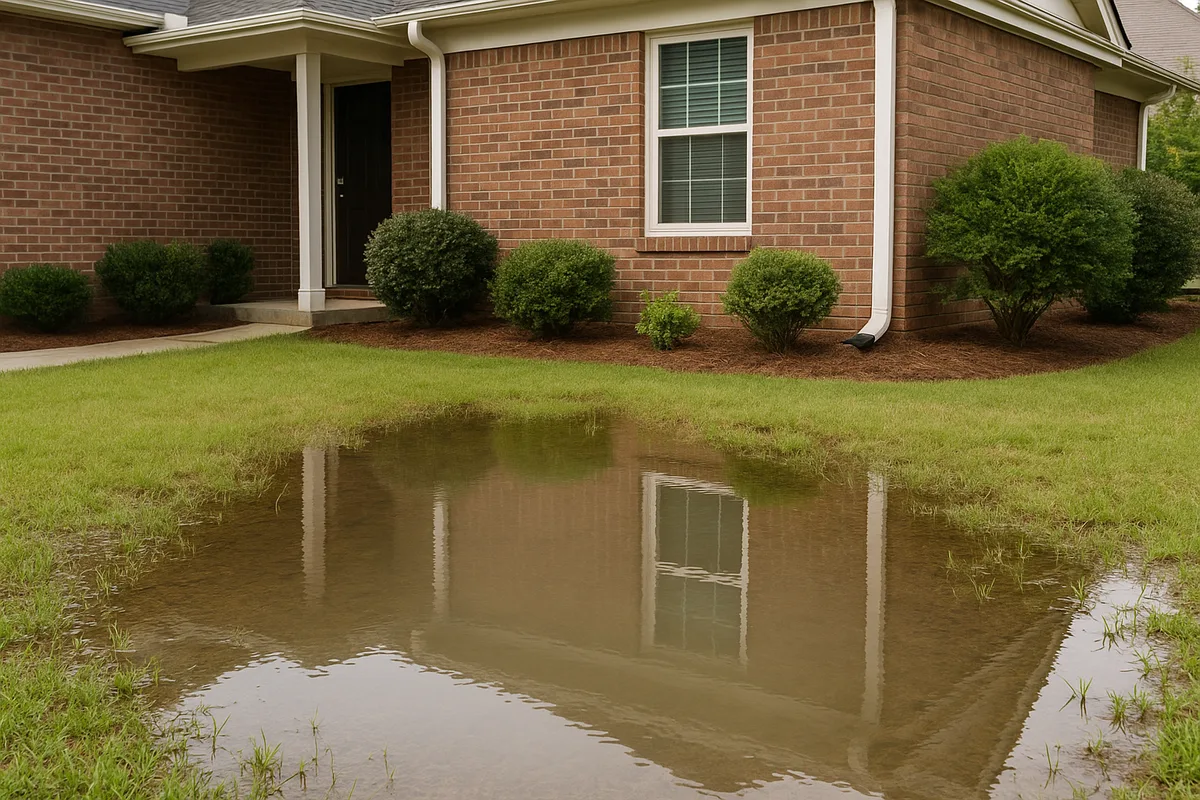
Grade check — Walk the perimeter of your home during rain. Water should flow away from the foundation in all directions. Look for areas where water pools within 5 feet of the foundation. In Portland's clay-rich soils, even a 1-inch depression can hold water for days.
Downspout discharge — Follow every downspout to its terminus. In Portland, downspouts may be connected to the public storm sewer (legal and common in areas with separated systems), connected to the combined sewer (legal but BES encourages disconnection), or discharging to the surface. If discharging to the surface, water should flow at least 5 feet from the foundation and not toward a neighbor's property. Portland's downspout disconnection program has been a major initiative — verify your downspouts are configured correctly.
Surface flow patterns — During moderate rain, observe where water flows across your yard. Look for erosion channels, areas of standing water, and places where water from neighboring properties enters yours. In East Portland's flat terrain, water may simply sit with nowhere to go. In SW Portland, you may see water sheeting across slopes or emerging from the ground as springs.
Retaining wall condition — Portland has thousands of retaining walls, many built decades ago with inadequate drainage. Look for weep holes (they should be present every 4 to 6 feet along the base), bulging or leaning, and saturated soil behind the wall. A retaining wall without proper drainage is a wall that will eventually fail.
Driveway and hardscape drainage — Check where water goes when it runs off your driveway, patio, and walkways. Impervious surfaces accelerate runoff and concentrate it. Look for erosion at the edges of hardscape.
Interior Assessment:
Basement and crawl space — During wet weather, inspect for standing water, damp walls, efflorescence (white mineral deposits on concrete), musty odors, and visible mold. In Portland, crawl space moisture is endemic — the question isn't whether your crawl space gets damp, but whether it's managed properly.
Foundation walls — Look for horizontal cracks (which can indicate hydrostatic pressure from saturated soil), vertical cracks wider than 1/8 inch, and water stains at consistent heights (indicating a perched water table).
Sump pump — If you have one, test it by pouring water into the pit. Note how frequently it cycles during winter storms. A sump pump running constantly suggests significant groundwater intrusion. A sump pump that never runs may indicate it's not connected to anything useful.
Professional Diagnostic Tools
Beyond visual inspection, several professional diagnostic methods are particularly relevant in Portland:
- Percolation testing — Measures how quickly water infiltrates your soil. Critical for designing rain gardens and infiltration systems. Portland's BES may require perc testing before approving stormwater management plans.
- Soil boring and classification — A geotechnical investigation that identifies soil layers, depth to bedrock or restrictive layers, and seasonal high water table. Essential for properties in SW Portland's slide-prone areas.
- Sewer scope with dye testing — A camera inspection of your sewer lateral combined with dye testing can reveal whether stormwater is inadvertently entering the sanitary sewer (an illicit connection that's both illegal and a common source of sewer backups).
- Topographic survey — A professional survey that maps elevations across your property, identifying subtle grade issues invisible to the naked eye. In Portland's flat East side neighborhoods, grade differences of just 2 to 3 inches can determine whether water flows toward or away from your home.
Neighborhood-Specific Drainage Challenges
Southwest Portland: Slides, Seeps, and Slopes
SW Portland is Portland's most geologically hazardous area for drainage. The combination of steep slopes, shallow soils over basalt, and heavy rainfall creates conditions ripe for landslides, retaining wall failures, and chronic foundation seepage.
Key challenges:
- Shallow bedrock forces water to move laterally through soil, emerging as seeps on cut slopes and against foundations
- Many homes are built on cut-and-fill pads where the fill material was never properly compacted or drained
- The road network (narrow, winding, often without curbs or storm drains) concentrates runoff in unpredictable ways
- Mature trees — while beautiful — can both help (root systems stabilize slopes) and hurt (root intrusion into drain lines, wind-throw creating new drainage pathways)
Priority solutions for SW Portland:
- Curtain drains (interceptor drains installed upslope of the home to capture lateral subsurface flow)
- Properly engineered retaining walls with aggregate backfill and weep holes
- Foundation waterproofing with dimple board membrane and footing drains
- Slope stabilization through bioengineering (live staking, brush layering) combined with drainage
The US Army Corps of Engineers has been involved in several Portland slope stabilization projects and maintains resources on erosion control and slope management that are relevant to SW Portland property owners.
East Portland: The Flat, Wet Challenge
East Portland — roughly east of 82nd Avenue — presents the opposite challenge from SW Portland. Here, the terrain is flat to gently rolling, and the soils are deep silt loams with restrictive clay layers. The drainage infrastructure is also generally newer but was often built to minimal standards during rapid development in the 1970s through 1990s.
Key challenges:
- Perched water tables creating saturated yards and crawl space flooding from November through March
- Many properties lack connected storm sewer service and rely on drywells or surface drainage
- Drywells in clay-rich soils often fail within 10 to 15 years as fine sediment clogs the surrounding soil
- Flat grades make it difficult to achieve gravity drainage away from structures
- Many lots were graded with minimal slope — sometimes as little as 1% — which is insufficient for Portland's rainfall intensity
Priority solutions for East Portland:
- French drain systems with perforated pipe connected to storm sewer or functional drywells
- Re-grading to achieve minimum 2% slope away from foundations for at least 10 feet
- Crawl space encapsulation with interior drainage and sump pump
- Rain gardens designed to the BES Stormwater Management Manual specifications (which also qualify for the stormwater fee discount)
North Portland and the Columbia Corridor: Living Behind the Levees
The Multnomah County Drainage District (MCDD) operates and maintains the levee system that protects approximately 12,000 acres of North Portland and the Columbia Corridor from Columbia River flooding. This system includes levees, pump stations, and an internal drainage network.
Key challenges:
- High groundwater tables year-round — basements are generally not advisable and crawl spaces require aggressive moisture management
- The internal drainage system relies on pump stations; if pumps fail during a storm, localized flooding can occur rapidly
- Soil is predominantly poorly drained alluvial silty clay and organic muck
- Properties are dependent on infrastructure they don't control — levee maintenance, pump station operations, and drainage district management
Priority solutions for North Portland lowlands:
- Sump pump systems with battery backup (power outages during storms are common)
- Crawl space vapor barriers and dehumidification
- Raised foundation elements where possible
- Understanding your property's relationship to the MCDD drainage system — know where your nearest pump station is and how water gets from your property to the system
Johnson Creek Corridor: Portland's Most Flood-Prone Watershed
Johnson Creek runs through some of Portland's most affordable neighborhoods — Lents, Foster-Powell, Brentwood-Darlington — and it floods regularly. The creek's watershed is heavily urbanized, which means impervious surfaces generate rapid runoff during storms. Portland has invested significantly in floodplain restoration and stormwater management in this watershed, but flood risk remains.
Key challenges:
- Properties in the FEMA-designated floodplain face mandatory flood insurance, building restrictions, and reduced property values
- Even properties outside the mapped floodplain can experience flooding from Johnson Creek's tributaries and from overwhelmed storm sewers
- The creek's channel has been modified extensively, creating unpredictable flow patterns during high water
- Groundwater in the Johnson Creek corridor is often contaminated from historical industrial and agricultural uses, which complicates drainage solutions that rely on infiltration
For homeowners in flood-prone areas, Ready.gov provides practical flood preparedness guidance, and the Small Business Administration offers disaster loans for flood damage repair that may not be covered by insurance.
Inner Portland Neighborhoods: Combined Sewers and Aging Infrastructure
Neighborhoods like Irvington, Alameda, Laurelhurst, Buckman, Sunnyside, and Richmond sit on Portland's combined sewer system. These areas were developed primarily between 1900 and 1940, and the drainage infrastructure reflects that era.
Key challenges:
- Combined sewer backups during heavy rain events — when the system is overwhelmed, sewage can back up into basements through floor drains
- Aging clay tile sewer laterals that are cracked, root-infiltrated, or offset at joints
- Many homes have unpermitted or forgotten connections between downspouts and the combined sewer
- Mature street trees with root systems that infiltrate and damage both sewer laterals and foundation drains
- Basements in these neighborhoods were often built without modern waterproofing and rely on gravity drainage to the combined sewer — which fails when the sewer is surcharged
Priority solutions for inner Portland:
- Backwater valve installation on the sewer lateral to prevent sewer backups
- Downspout disconnection and redirection to rain gardens or surface drainage
- Sewer lateral replacement with modern materials (HDPE or PVC)
- Interior basement waterproofing with sump pump and battery backup
- Root barriers along sewer lateral routes
Common Drainage Solutions for Portland Properties
French Drains and Curtain Drains
French drains are the workhorse of Portland residential drainage. A properly installed French drain consists of a perforated pipe in a gravel-filled trench, wrapped in filter fabric, that collects and redirects subsurface water.
Portland-specific considerations:
- In clay-rich East Portland soils, filter fabric selection is critical. Use a non-woven geotextile with a flow rate of at least 80 gallons per minute per square foot. Woven fabrics clog quickly in silty clay.
- Pipe diameter matters: 4-inch pipe is standard for residential, but properties with significant water volume should consider 6-inch.
- Outlet is everything. A French drain needs somewhere to send the water — a storm sewer connection, a daylight outlet at a lower elevation, or a drywell. In flat East Portland, finding adequate outlet can be the biggest challenge.
- Depth should be at least 18 inches below the bottom of the footing for foundation drains, or at the depth of the restrictive soil layer for yard drainage.
- In SW Portland, curtain drains (a specific type of French drain installed across a slope to intercept lateral subsurface flow) are often more effective than perimeter drains.
The Irrigation Association and NDS Inc. both provide technical resources on drain system design that can help homeowners evaluate contractor proposals.
Rain Gardens and Bioretention
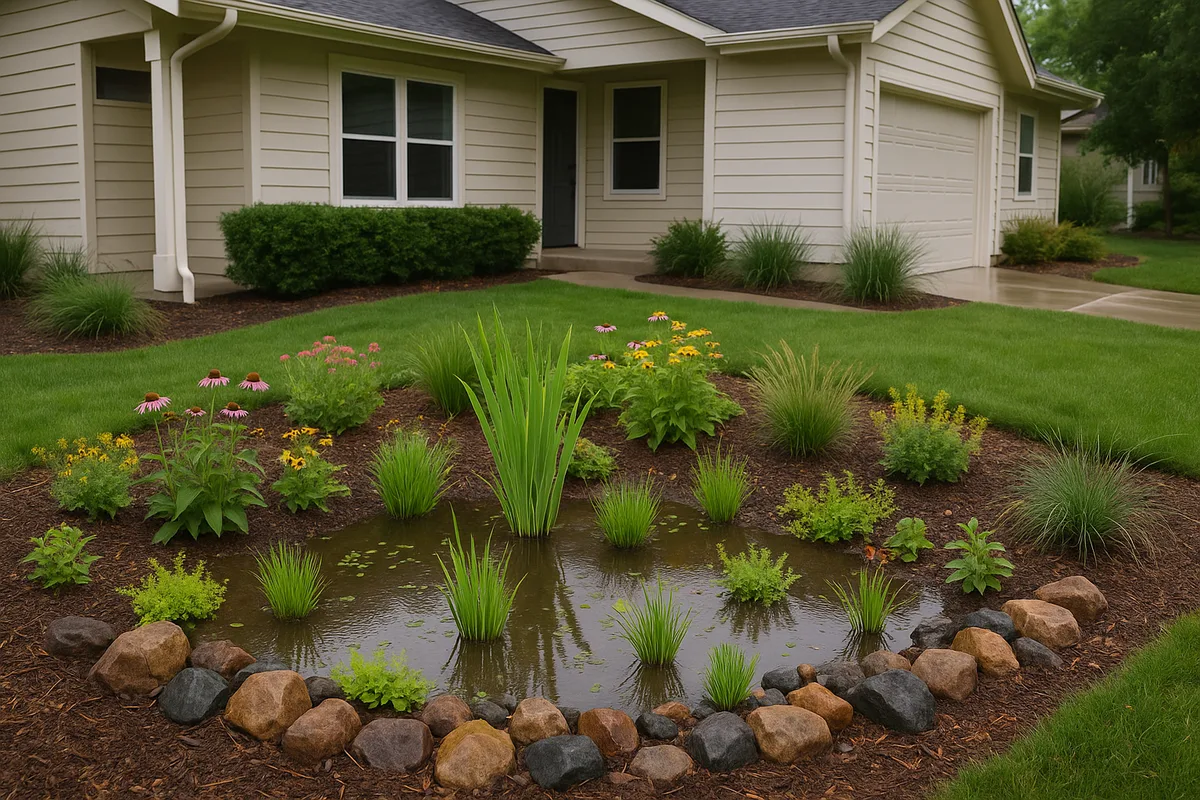
Portland is a national leader in rain garden implementation, and BES provides extensive guidance and incentive programs for residential rain gardens. A rain garden is a shallow, planted depression that receives stormwater runoff, allows it to pond temporarily, and infiltrates it into the soil.
Portland-specific design parameters:
- Size: BES recommends sizing rain gardens to capture the first 1 inch of rainfall from the contributing impervious area. For a typical 1,500-square-foot roof, this means a rain garden of roughly 100 to 150 square feet.
- Soil amendment: Portland's native soils often need amendment for rain garden performance. A typical rain garden soil mix is 60% sand, 20% compost, and 20% topsoil, installed to a depth of 18 inches.
- Plant selection: Use native Pacific Northwest species adapted to seasonal wet/dry cycles. Oregon grape, sword fern, red-twig dogwood, and sedges are proven performers.
- Overflow: Every rain garden needs an overflow mechanism — either a connection to the storm sewer or a surface overflow path that directs excess water away from structures.
- Setback: Maintain at least 10 feet between a rain garden and any foundation. In Portland's clay soils, infiltrated water can migrate laterally and cause foundation problems if the rain garden is too close.
The Low Impact Development Center provides design guidance for rain gardens and other green infrastructure approaches, and the American Society of Landscape Architects maintains a database of green infrastructure projects that includes several Portland examples.
Drywells
Drywells — underground chambers that collect stormwater and allow it to infiltrate into surrounding soil — are common in Portland, particularly in areas without storm sewer service. Portland requires Underground Injection Control (UIC) registration for drywells through the Oregon Department of Environmental Quality.
Portland-specific issues:
- Drywells work well in sandy loam and well-drained volcanic soils (around buttes and in parts of NW Portland) but perform poorly in the silty clay soils of East Portland
- Existing drywells should be tested periodically — pour water in and time how quickly it drains. If a drywell takes more than 24 hours to drain after a typical storm, it's failing.
- Portland requires that drywells be set back at least 5 feet from property lines and 10 feet from buildings
- In areas with contaminated groundwater (parts of the Johnson Creek corridor, the Portland Harbor Superfund area), drywells may not be permitted
Sump Pump Systems
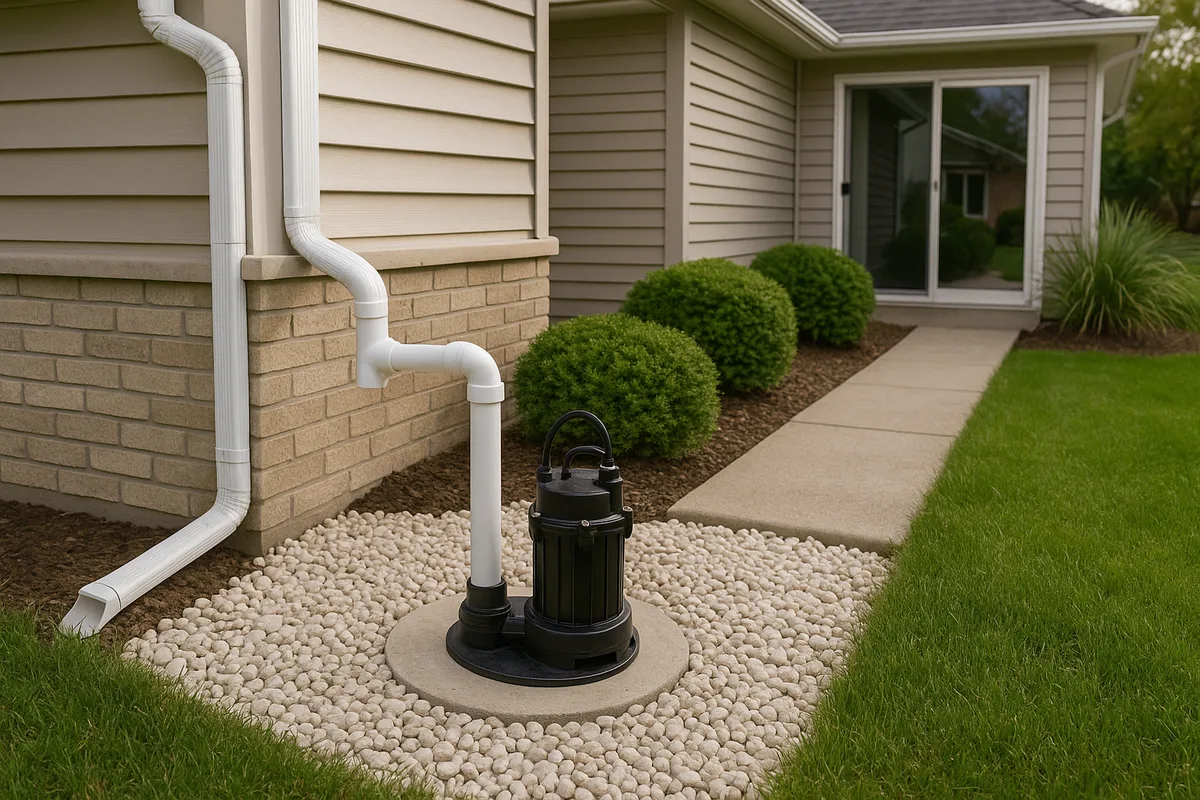
For Portland homes with basements or crawl spaces below the seasonal water table, a sump pump system is often the most reliable solution. The system collects water from footing drains or interior drainage channels and pumps it to a discharge point.
Portland-specific recommendations:
- Install a battery backup sump pump. Portland experiences power outages during winter storms — exactly when your sump pump is working hardest. A battery backup can provide 8 to 12 hours of pumping during an outage.
- Discharge location must comply with BES requirements. Pumping to the combined sewer is generally permitted but discouraged. Pumping to the surface or a rain garden is preferred.
- Size the pump for your actual flow rate. A 1/3 HP pump handles most residential applications, but homes with significant groundwater intrusion may need 1/2 HP or larger.
- Install a high-water alarm that alerts you if the pump fails or can't keep up with inflow.
Grading and Surface Drainage
Re-grading is often the simplest and most cost-effective drainage improvement, yet it's frequently overlooked. The International Residential Code requires a minimum 6 inches of fall in the first 10 feet away from a foundation. Many Portland homes, especially those built before 1980, don't meet this standard — and decades of landscaping, mulch accumulation, and soil settlement have made things worse.
Portland-specific grading considerations:
- In clay-rich soils, positive grading is even more critical because surface drainage is the primary mechanism for moving water away from the foundation — the soil won't absorb it.
- Raised garden beds against foundations (extremely common in Portland) are a major drainage liability. They trap moisture against the foundation wall and prevent proper grading. Move them at least 3 feet from the foundation.
- Swales (shallow, vegetated channels) are an effective and low-cost way to direct surface water across flat properties. A swale with as little as 1% slope can move significant water volume.
Costs for Drainage Work in Portland (2026 Market)
Portland's drainage contractor market is competitive but seasonal. Most contractors are booked solid from October through February (when homeowners discover problems) and have availability from May through September (the ideal time to install drainage systems in dry conditions). Planning ahead saves money and ensures better installation quality.
Typical Cost Ranges
| Project | Typical Cost Range | Notes |
|---|---|---|
| French drain (linear foot) | $35–$75/LF | Varies with depth, access, and outlet |
| Curtain drain (SW Portland slopes) | $50–$100/LF | Steeper terrain increases cost |
| Foundation perimeter drain | $5,000–$15,000 | Full perimeter of typical Portland home |
| Rain garden (complete installation) | $2,000–$6,000 | Includes soil amendment and planting |
| Drywell installation | $1,500–$4,000 | Includes UIC registration |
| Sump pump system with battery backup | $2,000–$5,000 | Interior installation with discharge piping |
| Crawl space encapsulation | $5,000–$15,000 | Vapor barrier, drainage mat, dehumidifier |
| Re-grading (per 100 SF) | $500–$1,500 | Depends on soil volume and access |
| Backwater valve installation | $1,500–$4,000 | On existing sewer lateral |
| Retaining wall with drainage (per LF) | $150–$400/LF | Engineered wall with proper backfill |
| Downspout disconnection and redirect | $200–$800/downspout | Including extension and splash block |
What Drives Costs Up in Portland
- Access limitations — Many Portland lots are narrow with limited equipment access, requiring hand excavation that doubles or triples labor costs
- Depth to storm sewer — Connecting to a deep storm sewer main requires deeper trenching and potentially a pump
- Permitting — BES permits for stormwater work can add $500 to $2,000 to project costs and weeks to timelines
- Slope work — SW Portland hillside projects often require geotechnical engineering, specialized equipment, and erosion control measures
- Root removal — Portland's mature urban canopy means tree roots are everywhere, and working around them (or removing and replacing damaged roots) adds cost and complexity
- Contaminated soil — In areas near the Portland Harbor Superfund site or former industrial zones, soil disposal costs can be significant
Contractor Selection in Portland
Portland has a robust market of drainage contractors ranging from one-person operations to large landscape and civil engineering firms. When selecting a contractor:
- Verify they hold an active Oregon Construction Contractors Board (CCB) license
- Confirm they carry general liability insurance and workers' compensation
- Ask specifically about their experience with Portland's soil conditions and BES permitting requirements
- Request references from projects in your specific neighborhood — a contractor who does excellent work in flat East Portland may not have the expertise for SW Portland slope work
- Get at least three written proposals that specify materials, depths, pipe sizes, outlet locations, and permit responsibility
- Be wary of contractors who propose solutions without first investigating your soil conditions and drainage patterns
Seasonal Considerations for Portland Drainage
Fall (October–November): The Critical Transition
This is when drainage problems first reveal themselves each year. As the rainy season begins, soils that dried and cracked during summer begin to re-wet. The first significant rains often run off the hardened soil surface rather than infiltrating, creating flash flooding conditions even before soils are fully saturated.
Action items:
- Clean gutters and downspouts before the first major rain (Portland's deciduous trees shed heavily in October)
- Test sump pumps and battery backups
- Inspect and clean drywell grates and catch basins
- Walk your property during the first heavy rain to identify new drainage patterns
Winter (December–March): Peak Drainage Season
This is when Portland's drainage systems are tested to their limits. Soils are fully saturated, water tables are at their seasonal high, and storm events can deliver 2 to 3 inches of rain in 24 hours.
Action items:
- Monitor crawl spaces and basements weekly during extended wet periods
- Keep a log of sump pump cycling frequency — increasing frequency may indicate a developing problem
- Watch for new cracks in foundations, retaining walls, or pavement — these can indicate soil movement from hydrostatic pressure
- Report any flooding or drainage infrastructure failures to BES (503-823-7740)
- Document drainage problems with photos and dates — this documentation is valuable for insurance claims, disclosure requirements, and contractor consultations
Spring (April–May): Assessment and Planning
As rains taper off, this is the ideal time to assess how your property performed during the wet season and plan improvements.
Action items:
- Note areas where water was persistently standing or where erosion occurred
- Get contractor estimates — spring is the best time to schedule summer installation
- Apply for BES permits if your project requires them — permit review can take 4 to 8 weeks
- Check for damage to drainage infrastructure (settled trenches, displaced pipe, clogged inlets)
Summer (June–September): Installation Season
Dry conditions make summer the ideal time for drainage installation. Excavation is easier, soils are workable, and there's no active water to manage during construction.
Action items:
- Schedule and complete drainage improvement projects
- Install rain gardens (fall planting of native species gives them a full wet season to establish roots)
- Address grading issues while soil is dry and easy to move
- Repair or replace damaged retaining walls
- Be mindful of Portland's summer watering restrictions — newly installed plantings may need hand-watering
When to Get Professional Help
Some drainage issues are straightforward enough for a capable homeowner to address — cleaning gutters, extending downspouts, re-grading small areas, and installing simple surface drainage. But several situations in Portland demand professional expertise:
- Any work on slopes greater than 15% — Slope stability is a life-safety issue in SW Portland. Improper drainage work on slopes can trigger landslides. Consult a geotechnical engineer before modifying drainage on steep sites.
- Foundation water intrusion — If water is entering your basement or crawl space through the foundation walls or floor, the cause may be hydrostatic pressure, failed waterproofing, or a high water table. Diagnosis requires expertise.
- Sewer backups — If you're experiencing sewer backups during storms, the cause could be a failed lateral, root intrusion, a missing backwater valve, or a systemic capacity issue in the public main. A sewer scope and hydraulic analysis are needed.
- Properties in FEMA flood zones — Any improvements to structures in the floodplain must comply with Portland's floodplain development regulations, which are more restrictive than the minimum federal standards. Work with a professional who understands both FEMA requirements and Portland's local overlay.
- Retaining wall construction or repair — Walls over 4 feet in height require a building permit and engineered design in Portland. Even shorter walls need proper drainage to function.
- Drainage work near streams, wetlands, or environmental overlay zones — Portland's Environmental Conservation and Protection overlay zones restrict development near streams and wetlands. Work in these areas requires environmental review and potentially a land use review.
The American Society of Civil Engineers and the Water Environment Federation maintain directories of professionals with stormwater management expertise, and the National Association of Flood and Stormwater Management Agencies provides resources on best practices for residential stormwater management.
Green Infrastructure and Portland's Drainage Future
Portland has been a national pioneer in green infrastructure — using natural systems to manage stormwater rather than relying solely on pipes and concrete. The city's Green Streets program, eco-roof incentives, and residential rain garden programs have made Portland a model for other cities.
For property owners, this means both opportunity and obligation:
Opportunities:
- Stormwater fee discounts for on-site management (up to 100% reduction)
- BES technical assistance for rain garden design and installation
- Increased property value — homes with well-designed drainage and green infrastructure are increasingly valued in Portland's real estate market
- Community programs like Depave (removing unnecessary pavement) and Friends of Trees that support green infrastructure
Obligations:
- New development and redevelopment must meet increasingly stringent stormwater standards
- Maintenance requirements for approved stormwater facilities — if you install a rain garden for a stormwater discount, you're responsible for maintaining it
- Potential future regulations requiring on-site stormwater management for existing developed properties (currently under discussion at the city level)
The American Rivers organization has highlighted Portland's green infrastructure approach as a model for urban stormwater management, and the principles of green infrastructure align well with Portland's environmental values and regulatory direction.
The Real Estate Dimension: Drainage and Portland Property Values
Drainage affects Portland property values in ways that aren't always obvious:
- Flood zone designation — Properties in FEMA-designated flood zones typically sell for 5% to 15% less than comparable properties outside flood zones, and they carry the additional ongoing cost of flood insurance.
- Basement water history — A disclosed history of basement water intrusion can reduce a home's value by $10,000 to $30,000 or more, depending on severity and whether it's been remediated.
- Crawl space condition — Home inspectors in Portland flag crawl space moisture issues on a large percentage of inspections. Proactive crawl space management (encapsulation, drainage, dehumidification) is increasingly expected by buyers.
- Retaining wall condition — Failed or failing retaining walls are a significant negotiation point in Portland real estate transactions, particularly in SW Portland where replacement costs can run $20,000 to $100,000 or more.
- Landslide hazard — Properties in Portland's mapped landslide hazard areas face scrutiny from lenders and insurers. A documented drainage management plan can help mitigate these concerns.
For buyers, a pre-purchase drainage assessment is one of the highest-value investments you can make. Standard home inspections identify visible moisture issues but rarely diagnose the underlying drainage conditions causing them. For sellers, addressing drainage proactively — or at minimum documenting conditions accurately — reduces legal risk and negotiation friction.
HUD sets standards for property condition in federally backed mortgage transactions, and significant drainage deficiencies can affect loan approval.
Get a Drainage Intelligence Report™ for Your Portland Property
Portland's combination of complex geology, intense seasonal rainfall, aggressive stormwater regulations, and neighborhood-specific challenges makes drainage one of the most consequential — and most overlooked — aspects of property ownership in the city.
A Low Point Labs Drainage Intelligence Report™ provides a comprehensive, data-driven assessment of drainage conditions on your specific Portland property. Unlike a standard home inspection's cursory moisture check, our reports analyze:
- Soil classification and drainage characteristics specific to your lot
- Topographic analysis showing how water moves across and around your property
- Flood zone and environmental overlay status with implications for insurance and development
- Infrastructure assessment including storm sewer connectivity, drywell condition, and sewer lateral status
- Risk factors specific to your neighborhood — whether that's landslide hazard in SW Portland, perched water tables in East Portland, or levee dependence in North Portland
- Prioritized recommendations with estimated costs and ROI for drainage improvements
Whether you're buying a home in Laurelhurst, selling a property in Lents, maintaining a hillside home in the West Hills, or investing in a rental in St. Johns, a Drainage Intelligence Report™ gives you the information you need to make confident decisions about one of Portland's most persistent property challenges.
Don't wait for the next atmospheric river to discover your drainage problem. Get ahead of the water.
Explore our US Drainage Guide for a national perspective.
Frequently Asked Questions
The Low Point Labs Drainage Intelligence™ platform is accessible via invitation-led onboarding.