Birmingham's Drainage Challenge: Where Red Clay Meets Red Mountain
Birmingham sits in a geological bowl. The city was built in Jones Valley, flanked by Red Mountain to the south and the Appalachian foothills rolling north toward Blount County. That dramatic topography — combined with 56 inches of annual rainfall and some of the most stubborn red clay soil in the Southeast — creates a drainage environment that punishes poorly graded properties and rewards homeowners who understand how water actually moves through this landscape.
What makes Birmingham's drainage situation genuinely distinct is the convergence of three factors you rarely see together at this intensity: steep residential lots carved into ridgelines (Over the Mountain communities like Vestavia Hills, Mountain Brook, and Homewood), a clay-dominant soil profile that can shed water almost as effectively as concrete, and a subtropical rainfall pattern that routinely delivers 2-3 inches in a single afternoon thunderstorm between April and October. The result is that properties across Jefferson County — from Avondale to Trussville, from Ensley to Irondale — face drainage problems that range from chronic yard saturation to catastrophic foundation damage.
This guide is built for Birmingham homeowners, buyers evaluating properties, real estate professionals navigating disclosure requirements, and contractors looking for location-specific best practices. Everything here is focused on what you can do today to identify, understand, and solve drainage problems on Birmingham properties.
Understanding Birmingham's Soil: The Red Clay Factor
If you've ever tried to dig a post hole in a Birmingham yard after a dry spell, you know the soil here isn't cooperative. The dominant soil series across Jefferson County include the Nauvoo, Townley, and Montevallo series on the ridges, and the Decatur and Dewey series in the valley floors. What these all share is a high clay content — often exceeding 40% in the B-horizon (the layer just below topsoil) — and a characteristic iron-oxide red color that stains everything it touches.
You can explore the specific soil composition of any Birmingham address using the USDA Web Soil Survey, which provides detailed drainage class ratings, permeability data, and depth-to-bedrock measurements for individual parcels. This is one of the most underused free tools available to homeowners.
Why Red Clay Creates Drainage Problems
Clay particles are flat and plate-like, stacking tightly together when wet. This gives Birmingham's red clay an extremely low permeability rate — often less than 0.2 inches per hour when saturated. For context, a moderate Birmingham thunderstorm can deliver 1-2 inches per hour. The math is simple and unforgiving: water arrives faster than the soil can absorb it, and the excess has to go somewhere.
That "somewhere" is typically across the surface — sheeting over lawns, pooling against foundations, eroding landscaping, and overwhelming any drainage infrastructure that wasn't sized for the actual conditions. The USDA Natural Resources Conservation Service classifies most Birmingham-area clay soils in Hydrologic Soil Group C or D, meaning they have the highest runoff potential of any soil types.
Sandy Loam Pockets: Not Always Better
Some Birmingham neighborhoods — particularly in eastern Jefferson County near Leeds and portions of the Cahaba River watershed — sit on sandy loam soils that drain more readily. However, these areas present their own challenges. Sandy loam can erode quickly on slopes, creating gullies and undermining structures. Properties near the Cahaba River and its tributaries may also deal with a high water table that limits how deep drainage systems can be installed.
The critical takeaway: drainage solutions in Birmingham must be designed for the specific soil on your specific lot. A French drain system that works perfectly in the sandy loam of a Cahaba Heights property may be completely wrong for a red clay lot in Crestwood.
The Compaction Problem in New Construction
Birmingham's construction boom — particularly in the 280 corridor, Ross Bridge, and the Liberty Park area — has introduced a widespread compaction issue. Heavy equipment used during construction compresses clay soil to near-impervious density. New homeowners often discover within the first year that their yard holds standing water for days after rain, even on lots that appear to have adequate slope. This isn't a defect in the land itself; it's a consequence of construction practices that can be remediated with proper aeration, amendment, and sometimes re-grading.
Birmingham's Topography: Slopes, Valleys, and Water's Path
Birmingham's topography is defined by the parallel ridges and valleys of the southern Appalachian system. This creates a landscape where residential lots routinely have 10-20% slopes, and some Over the Mountain properties exceed 30%. The U.S. Geological Survey provides detailed topographic data that reveals how Birmingham's ridge-and-valley structure channels water into predictable corridors.
Over the Mountain Communities
Mountain Brook, Vestavia Hills, Homewood, and Hoover occupy some of the most topographically challenging residential terrain in the Southeast. Properties here were often cut into hillsides, creating artificial slopes and retaining wall situations that concentrate runoff. Common problems include:
- Uphill neighbor runoff: Water from properties above sheets across lower lots, often carrying sediment and debris
- Retaining wall saturation: Walls without adequate drainage behind them develop hydrostatic pressure that causes leaning, cracking, and eventual failure
- Driveway channeling: Steep driveways act as concentrated flow paths, directing thousands of gallons toward garages and foundations during storms
- Erosion on cut slopes: Exposed clay on graded hillsides erodes rapidly, undermining landscaping, walkways, and structures
Valley Floor Neighborhoods
Neighborhoods in Jones Valley — including downtown, Avondale, Woodlawn, East Lake, Ensley, and much of the western Birmingham corridor — face a different set of challenges. These areas are relatively flat, which sounds like it should help drainage but often makes it worse. Without adequate slope to move water away from structures, flat lots in clay soil become retention basins. Older neighborhoods in these areas frequently have:
- Inadequate or deteriorated storm sewer infrastructure
- Combined sewer systems that overflow during heavy rain
- Lots that have settled over decades, creating negative grade toward foundations
- Mature tree root systems that have disrupted underground drainage lines
The Cahaba and Village Creek Watersheds
Two major watersheds dominate Birmingham's drainage landscape. The Cahaba River watershed drains the southern and eastern portions of the metro area, while Village Creek and its tributaries drain much of the western and northern sections. Both systems are monitored by the National Weather Service for flood stage levels, and both have historically been prone to flooding that affects residential properties.
Village Creek, in particular, has a long history of flooding in neighborhoods like Pratt City, Ensley, and portions of western Birmingham. The U.S. Army Corps of Engineers has been involved in flood risk management projects along Village Creek for decades, and properties in these areas should be carefully evaluated for flood zone designation before purchase.
Climate Patterns and Seasonal Drainage Stress
Birmingham's humid subtropical climate delivers rainfall year-round, but the pattern and intensity vary significantly by season — and each season creates distinct drainage challenges.
Spring (March–May): The Peak Risk Window
Spring is Birmingham's wettest and most dangerous season for drainage. Average monthly rainfall exceeds 5 inches in March, April, and May, and this period frequently produces severe thunderstorms and occasionally tornadic systems that can deliver 3-5 inches in a few hours. The soil is often already saturated from winter rains, leaving zero absorption capacity when spring storms arrive.
The National Oceanic and Atmospheric Administration tracks precipitation patterns that confirm Birmingham's spring rainfall intensity has increased measurably in recent decades. More rain is falling in fewer, more intense events — exactly the pattern that overwhelms residential drainage systems designed for gentler, more distributed rainfall.
Summer (June–August): Afternoon Convective Storms
Birmingham's summer pattern features intense afternoon thunderstorms driven by convective heating. These storms are often highly localized — one neighborhood may receive 2 inches while another a mile away stays dry. The challenge for drainage systems is the sudden onset: a property can go from dry to overwhelmed in 20 minutes. Clay soil that has dried and cracked during a hot spell actually repels water initially (a phenomenon called hydrophobicity), creating even more surface runoff during the first minutes of a storm.
Fall (September–November): Tropical Moisture and Recovery
Alabama's position in the Gulf of Mexico's moisture corridor means Birmingham occasionally receives remnant tropical systems that deliver sustained, heavy rainfall over 24-48 hours. These events — which can drop 6-10 inches — are the most likely to cause widespread flooding and overwhelm even well-designed drainage systems. Fall is also the best season for drainage remediation work, as soil moisture levels are typically lower and contractors' schedules begin to open up.
Winter (December–February): Saturated Ground and Freeze-Thaw
Winter brings steady, moderate rainfall that keeps clay soils saturated for weeks at a time. While individual storms are rarely as intense as spring or summer events, the cumulative saturation creates persistent problems: basement seepage, crawlspace moisture, and standing water in low-lying areas. Birmingham's occasional freeze-thaw cycles can also damage exposed drainage infrastructure and cause clay soil to heave, disrupting grading around foundations.
Regulatory Landscape: Stormwater Rules in Jefferson County
Birmingham and Jefferson County operate under a complex regulatory framework for stormwater management that directly affects homeowners, developers, and contractors.
Birmingham's MS4 Permit and Stormwater Program
The City of Birmingham operates under a Municipal Separate Storm Sewer System (MS4) permit issued under the Clean Water Act, administered by the Environmental Protection Agency and the Alabama Department of Environmental Management (ADEM). This permit requires the city to manage stormwater quality and quantity, which translates into regulations that affect everything from new construction grading to how and where you can discharge water from your property.
Birmingham's stormwater management ordinance requires that new development and significant redevelopment projects manage stormwater runoff so that post-development discharge does not exceed pre-development levels. For homeowners, this means that projects like large patio installations, driveway expansions, or significant re-grading may require a stormwater management plan and possibly a permit.
Grading and Land Disturbance Permits
Jefferson County requires a land disturbance permit for any project that disturbs more than one acre of land. However, even smaller residential projects within Birmingham city limits may require a grading permit if they alter drainage patterns, especially in mapped floodplains or near waterways. Before beginning any drainage project that involves significant earthwork, contact the City of Birmingham's Department of Planning, Engineering, and Permits.
Flood Zone Designations and Insurance
Jefferson County has extensive FEMA-mapped flood zones, particularly along Village Creek, Valley Creek, Five Mile Creek, and the Cahaba River and its tributaries. You can check any Birmingham address against current Flood Insurance Rate Maps (FIRMs) through FEMA. Properties in designated Special Flood Hazard Areas (Zone A, AE, or AH) are required to carry flood insurance if they have a federally backed mortgage.
What many Birmingham homeowners don't realize is that flood insurance through the National Flood Insurance Program is available to any property owner in a participating community — not just those in mapped flood zones. Given Birmingham's intense rainfall patterns and clay soil, even properties outside designated flood zones can experience significant water damage. The standard homeowner's insurance policy does not cover flood damage, a distinction that catches many Birmingham homeowners off guard.
Disclosure Requirements for Real Estate Transactions
Alabama's real estate disclosure law requires sellers to disclose known material defects, which includes known drainage problems, flooding history, and water intrusion issues. The Alabama Real Estate Commission's property disclosure form specifically asks about water-related issues. However, Alabama follows a "caveat emptor" (buyer beware) standard more than many states, making independent drainage assessment before purchase critically important. The Department of Housing and Urban Development provides guidance on federal disclosure requirements that may apply in addition to state law.
Diagnosing Drainage Problems on Your Birmingham Property
Before spending money on solutions, you need an accurate diagnosis. Here's a systematic approach to evaluating drainage on a Birmingham property.
The Rainstorm Walk-Through
The single most valuable diagnostic step costs nothing: walk your property during an active rainstorm. Not a drizzle — wait for a genuine Birmingham thunderstorm (you won't have to wait long between April and September). Put on rain gear and observe:
- Where is water flowing? Follow the surface flow paths from the highest point of your lot to the lowest. Note where water concentrates into channels versus where it sheets broadly.
- Where is water pooling? Identify any areas where water collects and stands. Measure approximate depth and note how long it takes to drain after the rain stops (check at 1 hour, 4 hours, 12 hours, and 24 hours).
- What's happening at the foundation? Look at the base of your house on all four sides. Is water flowing toward the foundation, away from it, or parallel to it? Is water entering any basement windows, crawlspace vents, or garage doors?
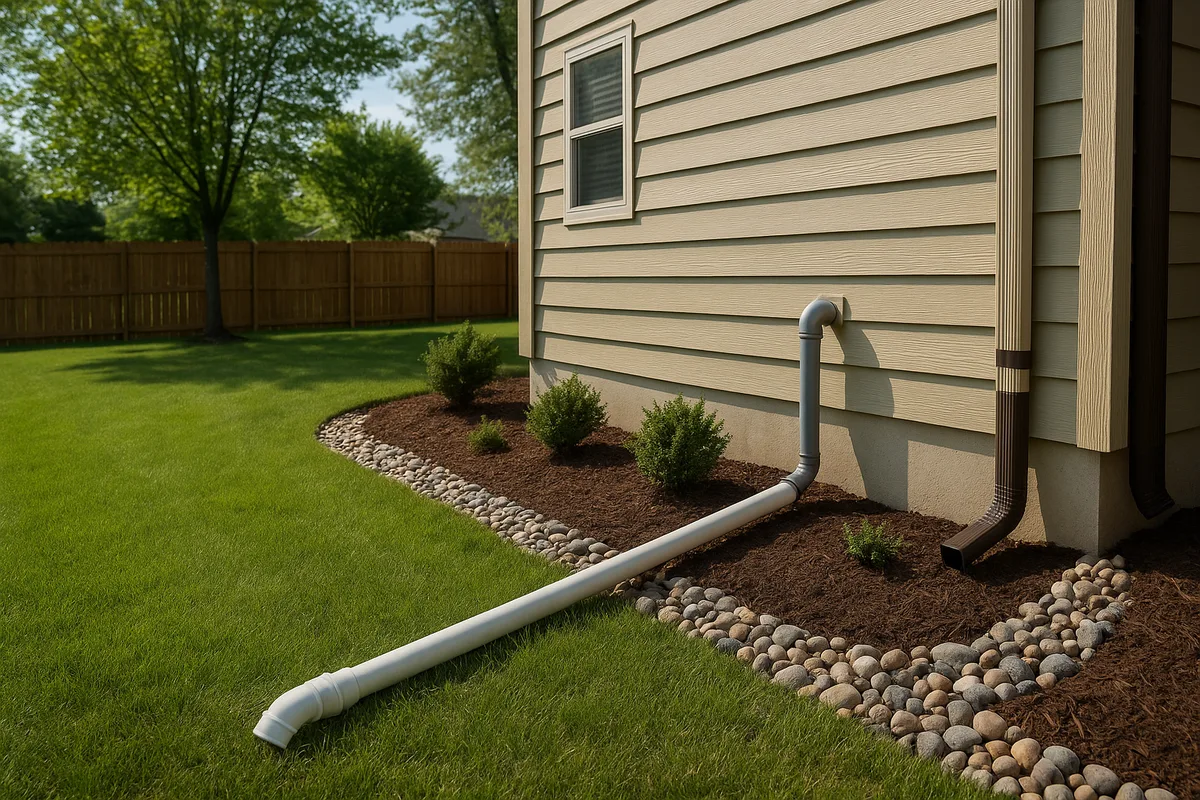
- Where are the downspouts discharging? Follow each downspout to its discharge point. Is the water being carried at least 6-10 feet from the foundation, or is it dumping right at the base of the wall?
- What's happening at property boundaries? Is water from your neighbor's property flowing onto yours? Is your runoff flowing onto a neighbor's property or into the street?
Document everything with photos and video. This rainstorm reconnaissance is more diagnostic than any dry-weather inspection.
The Soil Percolation Test
You can perform a basic percolation (perc) test in your own yard:
- Dig a hole 12 inches deep and 6 inches in diameter
- Fill it with water and let it drain completely (this pre-saturates the soil)
- Fill it again and time how long it takes to drain
- If it takes more than 4 hours to drain 12 inches of water, you have a significant permeability problem
In Birmingham's red clay, it's common to see perc test times of 8-24+ hours. This doesn't mean drainage solutions are impossible — it means they need to account for the soil's limitations rather than pretending they don't exist.
Foundation and Structure Indicators
Inside your home, look for these signs of drainage-related problems:
- Stair-step cracks in brick veneer — especially common in Birmingham homes built on clay, where soil expansion and contraction cycles stress masonry
- Sticking doors and windows — can indicate foundation movement caused by uneven soil moisture
- Musty odors in basements or crawlspaces — indicates chronic moisture intrusion
- Efflorescence (white mineral deposits) on basement walls — water is migrating through the concrete or block
- Damp or buckled hardwood floors on the ground level — moisture migrating up through the slab or from the crawlspace
Grading Assessment
Using a 4-foot level and a tape measure, check the grade around your foundation:
- You should have a minimum 6-inch drop in the first 10 feet away from the foundation on all sides
- The ideal slope is 5% (about ¾ inch per foot) for the first 10 feet
- In Birmingham's clay soil, aim for the higher end of this range because surface runoff is the primary drainage mechanism
Many Birmingham homes — especially those built before the 1990s — have lost their original positive grade due to soil settlement, landscaping changes, and mulch/soil buildup against the foundation. This is one of the most common and most fixable drainage problems in the Birmingham market.
Gutter and Downspout Evaluation
Birmingham's tree canopy — particularly the mature oaks, pines, and sweetgums common across the metro — creates enormous gutter maintenance demands. Evaluate your gutter system for:
- Capacity: Standard 5-inch K-style gutters are marginal for Birmingham's rainfall intensity. Many homes benefit from upgrading to 6-inch gutters with 3x4-inch downspouts.
- Condition: Look for sagging sections, separated joints, and overflow points. Even small gaps become major problems at Birmingham rainfall rates.
- Downspout extensions: Every downspout should discharge at least 6 feet from the foundation, ideally 10 feet. Underground downspout extensions connected to a pop-up emitter or daylighted to a drainage swale are the gold standard.
Common Drainage Solutions for Birmingham Properties
Every drainage solution discussed here is evaluated specifically for Birmingham's soil, climate, and topography.
Re-Grading: The Foundation of Every Drainage Plan
Before installing any drainage infrastructure, the grade around your home must be correct. In Birmingham's clay soil, positive grading is the single most impactful drainage improvement you can make. Re-grading involves adding compacted fill soil (typically a clay-loam blend appropriate for the area) to build up the grade adjacent to the foundation and create a consistent slope away from the structure.
For Birmingham properties, key grading considerations include:
- Soil selection: Don't use pure topsoil against the foundation — it's too permeable and will settle. Use a compacted clay-loam fill, then top with 2-3 inches of topsoil for grass establishment.
- Compaction: Fill must be compacted in lifts (layers) of no more than 4-6 inches to prevent future settlement. This is where many DIY grading projects fail.
- Siding clearance: Maintain at least 6 inches between the top of the soil and any wood siding or trim. Birmingham's humidity and termite pressure make this non-negotiable.
- Swale creation: On lots where re-grading alone can't move water far enough, a shallow swale (a gentle, grassed depression) can be graded to channel water around the house to a safe discharge point.
French Drains: Birmingham's Most Misunderstood Solution
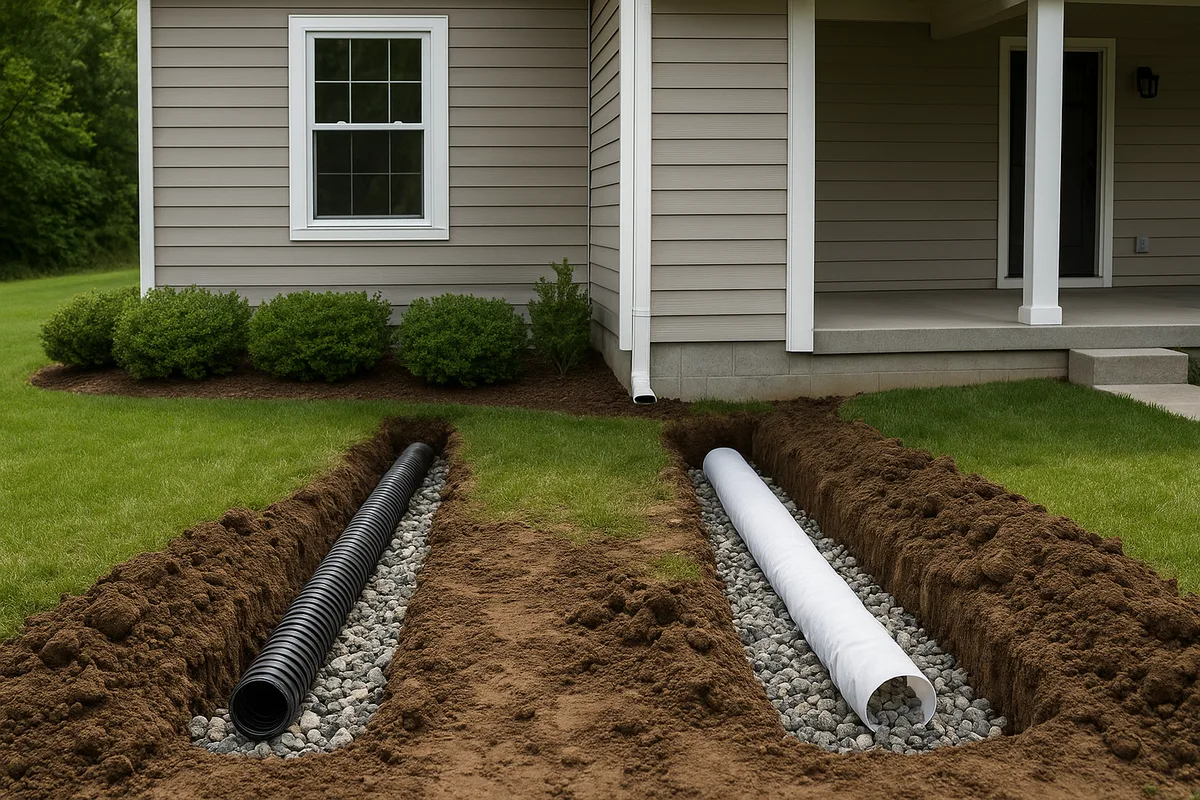
French drains are the most commonly installed — and most commonly botched — drainage solution in the Birmingham market. A proper French drain is a gravel-filled trench containing a perforated pipe that collects subsurface water and carries it by gravity to a discharge point. Here's what makes them work (or fail) in Birmingham's red clay:
Why they often fail here:
- Birmingham's red clay migrates into the gravel over time, clogging the system. Without a proper filter fabric sock on the pipe AND filter fabric lining the trench, a French drain in Birmingham clay may have a functional lifespan of only 5-7 years.
- Many installers use inadequate pipe diameter. In Birmingham's rainfall environment, 4-inch corrugated pipe is the minimum; 6-inch is preferred for primary collection lines.
- Insufficient slope. French drains need a minimum 1% slope (1/8 inch per foot) to function. On flat Birmingham lots, achieving adequate slope while maintaining sufficient depth can be challenging.
How to do them right:
- Use a non-woven geotextile fabric to line the entire trench before adding gravel
- Use rigid PVC or HDPE pipe (not flexible corrugated pipe, which sags and collects sediment) with a filter fabric sock
- Size the system for Birmingham's rainfall intensity, not national averages
- Ensure a positive discharge point — either to daylight on a lower portion of the lot, to the street gutter, or to a storm drain (check local regulations)
- Install cleanout access points every 50-75 feet for maintenance
The National Drainage Products (NDS) website provides detailed design guides for residential French drain systems that can be adapted to Birmingham conditions.
Channel Drains and Catch Basins
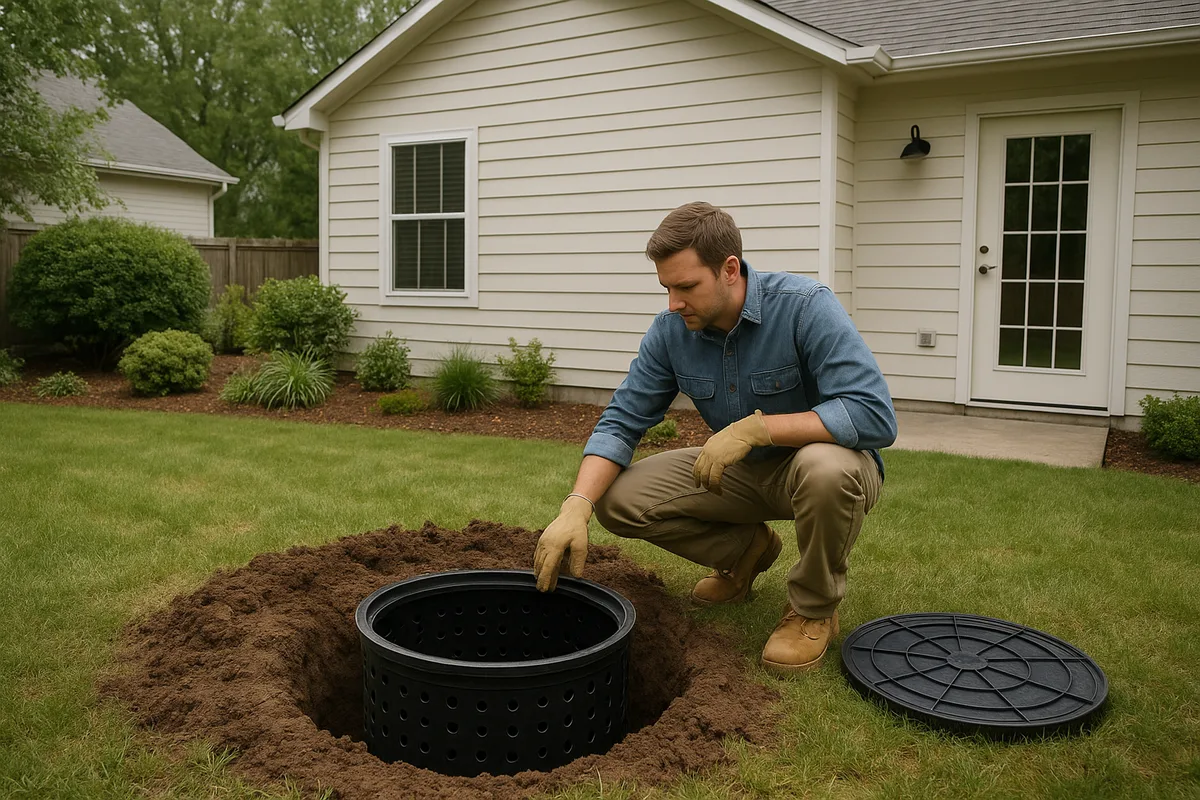
For Birmingham driveways, patios, and other hardscaped areas where water concentrates, channel drains (linear drains set into the pavement surface) and catch basins (box drains at low points) are essential tools. These are particularly important in Over the Mountain communities where steep driveways channel enormous volumes of water toward garages.
A typical driveway channel drain installation in Birmingham involves:
- A linear drain at the base of the driveway, spanning the full width
- Connection to a solid (non-perforated) pipe that carries water to an appropriate discharge point
- Sizing the drain for the contributing area — a 50-foot steep driveway in Vestavia Hills may need to handle 50+ gallons per minute during peak storms
Dry Creek Beds and Bioswales
Dry creek beds — engineered channels lined with graded stone that mimic natural stream courses — are both functional and aesthetically appealing solutions for Birmingham properties with significant slope. They provide a defined path for surface runoff while slowing water velocity and reducing erosion.
Bioswales take this concept further by incorporating plants and engineered soil media that filter and absorb stormwater. The American Society of Landscape Architects promotes bioswales as a key green infrastructure strategy, and they're particularly effective in Birmingham because they work with the clay soil's limitations rather than against them. The bioswale's engineered soil mix provides the infiltration capacity that the native clay lacks, while the clay beneath acts as a natural liner that prevents uncontrolled subsurface water movement.
For Birmingham installations, native plants like switchgrass, river oats, blue flag iris, and various sedges perform well in bioswale environments and tolerate the wet-dry cycles typical of our climate.
Sump Pump Systems
Many Birmingham homes with basements — particularly in Crestline, Forest Park, Highland Park, and older Mountain Brook neighborhoods — rely on sump pump systems to manage subsurface water intrusion. A sump pump collects water from a perimeter drain system (interior or exterior) and pumps it to a discharge point away from the foundation.
Critical considerations for Birmingham sump pump installations:
- Battery backup is essential. Birmingham's severe thunderstorms frequently cause power outages precisely when the sump pump is needed most. A battery backup system or water-powered backup pump is not optional here — it's a necessity.
- Discharge location matters. Sump pump discharge must be directed away from the foundation and must not create problems for neighboring properties. Some Birmingham neighborhoods have specific restrictions on sump pump discharge.
- Capacity sizing. Birmingham's high water table in valley-floor neighborhoods can require a sump pump to run almost continuously during wet periods. Undersized pumps burn out quickly.
Permeable Paving and Hardscape Solutions
For Birmingham properties where impervious surface coverage is contributing to runoff problems, permeable pavers, pervious concrete, or gravel systems can reduce the volume of water that needs to be managed. The Low Impact Development Center provides extensive guidance on permeable paving systems and their application in clay-soil environments.
In Birmingham's clay, permeable paving systems typically need an enhanced aggregate base (12-18 inches of open-graded stone) that serves as a temporary storage reservoir, since the underlying clay won't absorb the water quickly. The stored water is then slowly released through underdrain pipes to an appropriate discharge point. This is more complex and expensive than permeable paving in sandy soil, but it's effective when properly designed.
Rain Gardens
Rain gardens are shallow, planted depressions designed to capture and infiltrate stormwater runoff from roofs, driveways, and lawns. In Birmingham, rain gardens need to be designed with an amended soil mix (typically 60% sand, 20% compost, 20% topsoil) because the native clay won't provide adequate infiltration. An underdrain pipe at the bottom of the rain garden provides overflow capacity for Birmingham's intense storms.
The Cooperative Extension System through Alabama Extension provides region-specific guidance on rain garden design, plant selection, and maintenance for Alabama's climate and soil conditions.
Cost Expectations for Birmingham Drainage Projects
Drainage project costs in Birmingham vary significantly based on site conditions, access, and the specific solution required. Here are realistic cost ranges for the Birmingham market as of 2026:
Basic Projects
| Project | Typical Cost Range |
|---|---|
| Downspout extensions (per downspout, underground with pop-up) | $250–$500 |
| Foundation re-grading (per linear foot of foundation) | $15–$35 |
| Gutter replacement (5-inch to 6-inch upgrade, per linear foot) | $12–$22 |
| Surface swale grading (simple, per linear foot) | $10–$25 |
Moderate Projects
| Project | Typical Cost Range |
|---|---|
| French drain system (per linear foot, properly installed) | $30–$75 |
| Channel drain at driveway base (installed) | $1,200–$3,500 |
| Dry creek bed (per linear foot) | $35–$65 |
| Sump pump installation (including basin and discharge line) | $2,500–$5,500 |
| Rain garden (typical residential, 150-200 sq ft) | $2,000–$5,000 |
Major Projects
| Project | Typical Cost Range |
|---|---|
| Comprehensive yard drainage system (French drains, catch basins, re-grading) | $5,000–$15,000 |
| Exterior foundation waterproofing with drainage board | $8,000–$20,000+ |
| Retaining wall with integrated drainage (per linear foot, 4-ft height) | $75–$200 |
| Complete lot re-grading with erosion control | $5,000–$25,000+ |
These costs reflect Birmingham's labor market and material costs. Over the Mountain communities may see higher costs due to access challenges on steep lots and the complexity of working in established, densely landscaped properties.
Getting Accurate Bids
For any drainage project in Birmingham, get a minimum of three bids from contractors who specialize in drainage — not general landscapers who "also do drainage." Ask each contractor:
- What is the specific soil type on my lot, and how does your design account for it?
- Where will the water discharge, and do we need any permits?
- What is the expected lifespan of this system, and what maintenance does it require?
- Do you carry liability insurance and workers' compensation coverage?
- Can you provide references from Birmingham-area projects in similar soil conditions?
A contractor who can't answer these questions confidently should not be installing your drainage system.
Seasonal Timing for Drainage Work in Birmingham
Timing your drainage project correctly can significantly affect both cost and quality.
Best Season: Fall (Late September–November)
Fall is the optimal window for drainage work in Birmingham. Soil moisture levels are typically lower, making excavation easier and less likely to damage your yard. Contractor availability improves as the peak landscaping season winds down. Newly graded areas have time to establish grass before winter rains.
Acceptable Season: Winter (December–February)
Winter work is feasible but riskier. Rain delays are common, and saturated clay is extremely difficult to work with — heavy equipment can create deep ruts and further compact soil. However, contractor pricing may be more competitive during the slower season.
Challenging Season: Spring (March–May)
Spring is the worst time for drainage construction in Birmingham. The combination of frequent rain, saturated soil, and peak contractor demand means higher costs, more delays, and greater risk of poor-quality installation. However, spring is when most homeowners discover they have a drainage problem, creating urgency that's hard to delay.
Summer: Mixed Conditions
Summer work is feasible during dry spells but can be complicated by afternoon thunderstorms. The extreme heat also affects worker productivity and can cause freshly graded soil to dry and crack before grass can establish.
The preparedness guidance from Ready.gov emphasizes that addressing water management proactively — before the next major storm — is always more effective and less costly than responding to damage after the fact.
When to Call a Professional
Some drainage problems in Birmingham can be addressed by a capable DIY homeowner. Others require professional expertise. Here's how to know the difference.
DIY-Appropriate Projects
- Extending downspouts with above-ground extensions
- Adding splash blocks at downspout discharge points
- Minor grading adjustments using hand tools (adding soil to build up grade near the foundation)
- Cleaning and maintaining existing drainage systems
- Installing small rain gardens in low areas
Projects Requiring Professional Help
- Any project involving excavation deeper than 18 inches — Birmingham's red clay is deceptively stable when dry but can collapse when wet, creating a trench safety hazard
- French drain installation — the margin for error in pipe slope, filter fabric installation, and discharge design is too small for most DIY installations in clay soil
- Foundation waterproofing — this involves excavation to the footing, application of waterproofing membrane, installation of drainage board and perimeter drain, and proper backfill. Mistakes are extremely costly to fix.
- Retaining wall drainage — walls over 4 feet tall typically require engineering, and even shorter walls need proper drainage design to avoid hydrostatic failure
- Any work in or near a mapped floodplain — permits and engineering requirements apply
The American Society of Civil Engineers maintains professional standards for drainage engineering that licensed professionals in Birmingham follow. For complex projects, consider hiring a licensed civil engineer or a geotechnical engineer to design the system, then a qualified contractor to install it.
Choosing Between Drainage Contractors, Landscapers, and Engineers
- Drainage-specific contractors: Best for most residential drainage projects. Look for companies that focus primarily on drainage and waterproofing, not companies that do drainage as a sideline.
- Landscape architects: Ideal when drainage solutions need to integrate with significant landscape design, especially on high-value Over the Mountain properties. The ASLA can help you find licensed professionals in the Birmingham area.
- Civil engineers: Necessary for complex projects involving significant earthwork, retaining walls over 4 feet, work in floodplains, or situations where a neighbor dispute requires a professional opinion.
- Geotechnical engineers: Essential when foundation movement is suspected or when subsurface conditions are uncertain. Birmingham has several geotechnical firms experienced with the area's clay and rock formations.
Neighborhood-Specific Drainage Considerations
Birmingham's diverse neighborhoods each present distinct drainage profiles. Here's what to watch for in specific areas.
Homewood and Mountain Brook
These established communities feature mature landscapes on moderate to steep slopes. Common issues include aging terracotta and cast-iron drain lines that have cracked or been infiltrated by tree roots, retaining walls with failed drainage systems, and properties where decades of landscaping have altered original grading. The dense tree canopy means gutters require frequent cleaning — quarterly at minimum, monthly during fall.
Vestavia Hills and Hoover
Mixed terrain ranging from ridgetop lots to valley-floor properties. The Highway 280 corridor in particular has seen intense commercial and residential development that has increased impervious surface coverage dramatically, concentrating runoff into residential areas downstream. Properties in the Cahaba River watershed should be particularly attentive to erosion control, as the Cahaba is one of the most biodiverse rivers in North America and is closely monitored by organizations like American Rivers.
Trussville and Clay
Eastern Jefferson County communities with a mix of established neighborhoods and newer subdivisions. Newer developments sometimes have stormwater detention facilities that require homeowner association maintenance — verify that these are being properly maintained, as failed detention ponds can create downstream flooding. The Cahaba River tributaries in this area are prone to flash flooding.
Western Birmingham (Ensley, Pratt City, Fairfield)
These communities along the Village Creek corridor face the most significant flood risk in the Birmingham metro area. Many properties are in FEMA-designated Special Flood Hazard Areas. If you own or are considering purchasing property in these areas, obtaining a Flood Insurance Rate Map review is essential. The Small Business Administration provides disaster loans for flood-damaged properties, but prevention through proper drainage and flood insurance is far more effective than post-disaster recovery.
Avondale, Crestwood, and East Birmingham
These transitional neighborhoods feature a mix of early-20th-century housing stock and new construction. Older homes often have inadequate or non-existent foundation drainage, and many sit on lots where the original grade has reversed over time. New infill construction sometimes creates drainage conflicts with adjacent older properties by increasing impervious coverage and redirecting runoff.
Highland Park, Forest Park, and Redmont
Some of Birmingham's most beautiful — and most drainage-challenged — neighborhoods. Steep lots, mature trees, stone retaining walls, and aging infrastructure combine to create complex drainage situations. Many homes in these areas have basements that experience chronic water intrusion. Comprehensive exterior waterproofing with proper drainage is often the only lasting solution.
Environmental and Stormwater Quality Considerations
Birmingham homeowners should be aware that drainage solutions affect not just their property but the broader watershed. The Water Environment Federation and the EPA both emphasize that residential stormwater management is a critical component of overall water quality.
In practical terms, this means:
- Don't just move the problem: A drainage solution that dumps concentrated runoff onto a neighbor's property or directly into a stream isn't a solution — it's a liability. Birmingham's stormwater ordinance prohibits creating drainage problems for adjacent properties.
- Reduce runoff volume when possible: Rain gardens, permeable paving, and bioswales reduce the total volume of runoff leaving your property, which benefits both your property and the downstream watershed.
- Control sediment: Any drainage project that exposes bare soil must include erosion and sediment control measures. In Birmingham's clay, sediment-laden runoff is a significant water quality concern, especially in the Cahaba River watershed.
- Maintain your systems: A clogged French drain, an overflowing gutter, or a failed sump pump doesn't just affect your property — it contributes to the cumulative stormwater burden on Birmingham's infrastructure.
The Hidden Cost of Ignoring Drainage
Birmingham homeowners who defer drainage problems face escalating costs:
- Foundation repair: The average foundation repair in Birmingham runs $5,000–$15,000, and severe cases can exceed $30,000. Most foundation problems in clay soil are caused or worsened by poor drainage.
- Mold remediation: Chronic moisture intrusion leads to mold growth, with remediation costs typically ranging from $2,000–$10,000+.
- Property value reduction: A drainage problem that's visible during a home inspection or that shows up in disclosure documents can reduce a property's value by 10-15% or kill a sale entirely.
- Landscape destruction: Erosion from uncontrolled runoff destroys landscaping investments that may have cost thousands of dollars.
- Structural damage to retaining walls: Retaining wall replacement on Birmingham's hillside lots routinely costs $15,000–$50,000+.
The economics are clear: proactive drainage management costs a fraction of reactive repair.
Getting a Professional Drainage Assessment
If you've read this guide and recognize drainage concerns on your Birmingham property — or if you're evaluating a property for purchase — a professional drainage assessment is the logical next step.
A thorough drainage assessment for a Birmingham property should include:
- Topographic analysis of the lot and surrounding properties
- Soil identification and permeability assessment
- Foundation grade measurement on all sides of the structure
- Gutter and downspout system evaluation
- Existing drainage infrastructure assessment (condition, capacity, discharge points)
- Identification of off-site water sources (neighbor runoff, street drainage, springs)
- Flood zone verification against current FEMA maps
- Prioritized recommendations with cost estimates
Get Your Birmingham Drainage Intelligence Report™
Low Point Labs provides comprehensive Drainage Intelligence Reports™ for Birmingham properties. Our reports go beyond a visual inspection — we analyze topography, soil conditions, existing infrastructure, and site-specific risk factors to give you a complete picture of how water interacts with your property.
Whether you're a homeowner dealing with a wet basement in Highland Park, a buyer evaluating a property in Ross Bridge, a real estate agent who needs to understand a drainage concern before listing, or a contractor looking for a professional assessment to guide your scope of work — a Drainage Intelligence Report™ gives you the data you need to make informed decisions.
Birmingham's combination of red clay soil, intense rainfall, and challenging topography means that drainage is not optional — it's fundamental to protecting your property. Don't wait for the next spring thunderstorm to find out where the water goes. Find out now.
Order your Drainage Intelligence Report™ from Low Point Labs today and take control of the water on your Birmingham property.
Read more in our statewide drainage guide or explore the US Drainage Guide.
Frequently Asked Questions
The Low Point Labs Drainage Intelligence™ platform is accessible via invitation-led onboarding.